

Daniel 7:1-10, Part 1


Daniel’s Vision: Four Beasts Part 1
Guest (Female): Shalom. Holy Scriptures and Israel is a ministry designed to share with the Jewish people the good news of the Lord Jesus, Yeshua the Messiah, and to instruct Christians on the Jewish roots of their faith. And now, teaching God's word from a Hebrew Messianic perspective, here is Gideon Levytam.
Gideon Levytam: Well, please turn with me to Daniel chapter seven. Today, we are going to start to deal with the seventh chapter of the book of Daniel. We are going to talk about the times of the Gentiles that is found in chapter seven just the same like it had been found in chapter two. And so please turn to chapter seven. I would like to read first of all this chapter. As we read this chapter, we'll see how it is connected so much with the second chapter of Daniel which we have already studied.
Chapter seven actually begins the prophetic portion of the book of Daniel, even though chapter one through chapter six have historical history, but with some prophecy. Chapter seven to the end of Daniel, to chapter 12, have prophecy with some history. And so it is very interesting. Let me read chapter seven first of all, starting in verse one.
Guest (Male): In the first year of Belshazzar king of Babylon Daniel had a dream and visions of his head upon his bed: then he wrote the dream, and told the sum of the matters. Daniel spake and said, "I saw in my vision by night, and, behold, the four winds of the heaven strove upon the great sea. And four great beasts came up from the sea, diverse one from another.
"The first was like a lion, and had eagle's wings: I beheld till the wings thereof were plucked, and it was lifted up from the earth, and made stand upon the feet as a man, and a man's heart was given unto it. And behold another beast, a second, like to a bear, and it raised up itself on one side, and it had three ribs in the mouth of it between the teeth of it: and they said thus unto it, 'Arise, devour much flesh.'
"After this I beheld, and lo another, like a leopard, which had upon the back of it four wings of a fowl; the beast had also four heads; and dominion was given to it. After this I saw in the night visions, and behold a fourth beast, dreadful and terrible, and strong exceedingly; and it had great iron teeth: it devoured and brake in pieces, and stamped the residue with the feet of it: and it was diverse from all the beasts that were before it; and it had ten horns.
"I considered the horns, and, behold, there came up among them another little horn, before whom there were three of the first horns plucked up by the roots: and, behold, in this horn were eyes like the eyes of man, and a mouth speaking great things. I beheld till the thrones were cast down, and the Ancient of days did sit, whose garment was white as snow, and the hair of his head like the pure wool: his throne was like the fiery flame, and his wheels as burning fire.
"A fiery stream issued and came forth from before him: thousand thousands ministered unto him, and ten thousand times ten thousand stood before him: the judgment was set, and the books were opened. I beheld then because of the voice of the great words which the horn spake: I beheld even till the beast was slain, and his body destroyed, and given to the burning flame.
"As concerning the rest of the beasts, they had their dominion taken away: yet their lives were prolonged for a season and time. I saw in the night visions, and, behold, one like the Son of man came with the clouds of heaven, and came to the Ancient of days, and they brought him near before him. And there was given him dominion, and glory, and a kingdom, that all people, nations, and languages, should serve him: his dominion is an everlasting dominion, which shall not pass away, and his kingdom that which shall not be destroyed."
Gideon Levytam: Now you know what I'm going to do. I'm going to stop with this verse because this is really where we get to the first half of this particular chapter. I would like to stop here because we're going to do the reading again next time. But today, I would like really to begin with Daniel chapter seven, verse one to 14.
Let me just first of all say this, that Daniel chapter seven, if you want to give to this chapter a title, we can give it really two titles. The first title that we can give to this chapter is simply the visions of Daniel seeing the four beasts. That can be one of the titles that we can give to this chapter. The second title that we can give to this chapter is the sovereign rule of God over Gentile empires demonstrated again.
It was demonstrated before already in chapter two that God is sovereign and he is ruling over the affairs of the Gentile empires. The first time we saw it was in chapter two, and the second time we see it is in chapter seven. In other words, we can see a demonstration of the sovereignty of God over Gentile empires demonstrated a second time in chapter seven.
Now, if you remember, and I'm going to do this a little bit this evening so we can see something that will be good for visual for all of us, if we want to understand certain things, it's good for us to see them in a picture form. For me, it's very helpful in order to be able to clearly understand certain things. I want you basically to look at this this evening.
You notice that in our study of the book of Daniel, we have been introduced first of all to chapter one, which was introductory. It was the opening of the book of Daniel and it shows us the condition that existed among the people of Judah, how Nebuchadnezzar came and took the Jewish people down to Babylon. He came three times, and the last time he destroyed and burned the temple and destroyed the city of Jerusalem completely.
Now we also studied in chapter two, which is very important here. In chapter two, we have seen the great image. You remember the great image. It was an interesting thing because that particular dream was not given to Daniel. To Daniel was given the interpretation, but the dream was given to Nebuchadnezzar. Really chapter two tells us the times of the Gentiles.
Chapter two took us over the whole period of the times of the Gentiles, beginning from taking away the scepter from the Jewish people. The Jewish people have gone to Babylon and it ends up at the second coming of the Messiah himself. When the Messiah, the stone that fell upon the toes if you remember, it is the second coming of the Messiah. So it has given us an overview over the whole times of the Gentiles.
But if you notice, it was looked at from a human perspective. Because when Nebuchadnezzar had seen the vision, what does he see? He sees a vision of the greatness of the times of the Gentiles. He looks at a great image: gold, silver, and bronze, and eventually iron and clay. He looks at this and sees an image. If you remember in chapter three, what did he do? He built a great image, a greatness of this empire, making it really the greatness of himself.
By the time we have studied these times of the Gentiles in chapter two, we looked at this from a human perspective. In other words, men look at the times of the Gentiles and see the greatness of the times of the Gentiles, all these empires: the Babylonian empire, the Medo-Persian empire, the Grecian empire, and ultimately the Roman empire.
Then we studied chapter four, and we saw the testimony of Nebuchadnezzar. He became like an animal, and finally he had been restored and received the kingdom again. Then of course we studied chapter five with Belshazzar and how Belshazzar ended up in his death and the taking over of the Babylonian kingdom by the Medo-Persians, and the Medo-Persians became the next kingdom.
But it is interesting by the time we get to chapter seven. Chapter seven ought to be inserted not after chapter six in a chronological way, but it should really fit between chapter four and chapter five. In fact, what we find out is that in chapter four, after Nebuchadnezzar had ended, you notice that you have already the Medo-Persian in chapter five.
But really, in between chapter four and chapter five, there we should really begin in chapter seven. That's where it fits in a chronological way. Notice chapter seven where we read this evening in verse one, "In the first year of Belshazzar, king of Babylon." In the first year, when he began to reign as the king of Babylon. So really, chapter seven fits in between chapter four and chapter five of the book of Daniel chronologically.
In chapter seven, it really deals with the same point of the time of the Gentiles. But instead of looking at this from a human perspective, from men's side upward, we're looking at this from God's side downwards. While men look at the great image, God sees four beasts. While men look at the greatness of his accomplishment, God looks from heaven. What does he see? He sees four beasts.
The kingdom again, the times of the Gentiles in this chapter seven really goes parallel with chapter two. Chapter seven goes parallel with chapter two. Every beast that we see here in this particular chapter represents in a same parallel what chapter two represented: the Babylonian, the Medo-Persian, the Grecians, the Romans, the revived Roman Empire, and finally the coming of the Messiah himself to receive a kingdom for himself.
Here it is, the image. That is what we have seen in chapter two: the image, Babylon, Medo-Persia, Greece, Rome, the second coming of the Messiah in power to take control over the affairs of this world. Today, of course, we begin the study of chapter seven, which presents before us the four kingdoms looked at from a divine side. From God looking down, and what does he see? He sees the four kingdoms and its beastly description, in the reality of how God describes those four kingdoms in the time of the Gentiles.
There is a little parallel between those two chapters that we have been speaking about, chapter two and chapter seven. What is the similarity? In chapter two, the dream had been received by Nebuchadnezzar himself. In chapter seven, the dream had been received from God by Daniel, not Nebuchadnezzar. In chapter two, the interpreter of the dream was Daniel. In chapter seven, we're going to see the interpreter would be an angel.
In chapter two, we are looking at things at the time of the Gentiles from a human perspective. In chapter seven, we are looking at the same times of the Gentiles from a divine point of view. So you can see the parallel between those two chapters. Now, let's continue. I want to suggest that chapter seven divides itself into two sections. Verses one to 14 is the dream and the visions. Notice it's a dream, singular, and visions, plural. Chapter seven verses 15 to the end is basically the interpretation of this particular dream and vision.
Today, we are going to deal with the first half of this chapter. If we succeed to finish it, if not, we'll carry on in our next meeting together. Verses one to 14 is the dream and the visions. First of all, we find out the introduction to the visions in verse one. In verse one, we read, "In the first year of Belshazzar, king of Babylon, Daniel had a dream," singular, "and visions," plural, "of his head upon his bed, and he wrote the dream and told the sum of the matters."
Just imagine Daniel. God now was going to give him to see things from God's perspective about the future events. Daniel, a Hebrew coming down from Judea, living in Babylon. By that time, he must have been over 60 years old. And now God is giving him to see a dream and visions. Daniel, as it says here, was laying upon his bed, and then he received the dream and the visions.
And then what did he do? It says here in verse one, he wrote the dream and he told the sum of the matters. Notice it says "the sum of the matters." Perhaps there were a lot more details that he could have written down, but what he told and what he said was the sum of this particular matter and this dream and vision that had been given unto him by God.
Now, what does he see? In verses two to verse six, he has the first vision. Notice how interesting. First of all, in verses two and three, what does he see? He sees the great sea. Apparently, the sea was agitated. Notice it says here in verse two, "And Daniel spake and he said, I saw in my vision by night and behold the four winds of the heaven strove upon the great sea. And four great beasts came up from the sea, diverse one from another."
Just think for a second how interesting it is. He's laying down, he's receiving this dream and visions. What does he see? He received from God, he saw the four winds of heaven striving together. He sees like an agitation. He sees all kind of turmoil and problems. And what do the winds do? They are striving upon the great sea.
This expression "the great sea" in the Bible in a literal way has a reference to the Mediterranean Sea. When you think about the great sea in the scriptures, it has a reference to the Mediterranean Sea. If you know Israel, in the north we have Syria, in the south we have Egypt, in the east you have Jordan, and in the west you have the Mediterranean Sea. It's called in the scripture the great sea.
I want to give you some verses to prove that. If you just leave your finger here and go to the book of Numbers. Numbers chapter 34. Numbers 34 gives us the borders of Canaan. God had given to the people of Israel a promise of a land, a land that he was going to provide for the nation of Israel. Israel was going to enter into this land. It is a land flowing with milk and honey.
Of course, the reason that they haven't enjoyed that land fully is because of disobedience, and God eventually caused the diaspora and the Jewish people are dispersed, waiting for the day when they are going to be restored in the second coming of the Messiah. But notice what it says here. Numbers chapter 34 and verse six and seven. "And for the western border, ye shall have the great sea for a border. This shall be your border. And this shall be your north border: from the great sea ye shall point out for you Mount Hor."
This expression "the great sea" has to do with the Mediterranean Sea. If you think about the land that God had given to Israel, the great sea has a reference to the Mediterranean Sea. Turn to the book of Joshua now, chapter one. Joshua chapter one.
Featured Offer
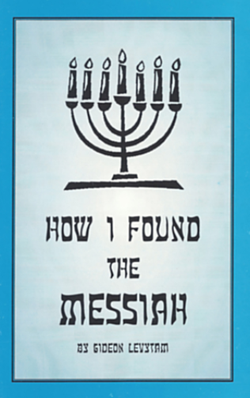
Follow Gideon Levytam's journey and discover how he was led by God, through a series of exciting circumstances, to find the One his people are still waiting for.
Past Episodes

Featured Offer
Follow Gideon Levytam's journey and discover how he was led by God, through a series of exciting circumstances, to find the One his people are still waiting for.
About Holy Scriptures and Israel
As time passed by, the Lord Yeshua took dear brother John Van Stormbroek to himself. The ministry of Holy Scriptures and Israel continued with additional development. In the early 1990’s, a weekly morning Bible class began which brother Gideon Levytam led regularly in the City of Toronto. This weekly open Bible class was held in the Willowdale assembly meeting hall. Eventually, a second mid-week evening Bible class was added. In April 2002, the need for an additional outreach Bible teaching meeting arose. We begun a Saturday (Shabbat) ministry meeting in which a systematic teaching of God’s word is presented to all who attend. Together we learn God’s Word, pray for each need and the salvation of Israel, and sing songs of worship unto our God, praising Him and our Lord Yeshua the Messiah.
In Mid 2004 we started to air on Joy 1250 Radio station a 15 minute Bible teaching program called "The Holy Scriptures and Israel" with Gideon Levytam. The broadcast teaches God’s word from a Hebrew Messianic perspective and has proved to be a blessing to many. It's now aired seven days a week. Our prayer is that many more of our Israeli people will have a clear understanding of who Yeshua is, why we all need him, and come to know him as their Lord and Messiah.
About Gideon Levytam
Contact Holy Scriptures and Israel with Gideon Levytam
426 Simcoe Street
Niagara-on-The-Lake
Ontario L0S 1J0
Canada
(905) 325-1234