
Daniel 5:1-16, Part 2


Belshazzar’s Great Feast and Handwriting On The Wall Part 2
Guest (Male): Shalom! Holy Scriptures and Israel is a ministry designed to share with the Jewish people the good news of the Lord Jesus, Yeshua the Messiah, and to instruct Christians on the Jewish roots of their faith. And now, teaching God's word from a Hebrew Messianic perspective, here is Gideon Levytam.
Gideon Levytam: The study of Daniel chapter 5. I went to the place where Ground Zero is right now. The two big towers used to stand there. I tell you, I remember about 15 years ago I used to be underneath those two towers handing out tracts and telling people about Jesus, the Messiah. Just two months ago I went with my son Yoav in the same location. And what I see? No towers. Nothing but a hole in the ground and a big plaque that gives us the names of the people who died there on September 11th.
You realize, beloved, that the best of what men can produce, one time it's going to come to an end. The best that men can produce will come to an end. These towers represented a powerful place of this nation of United States of America. This city of Babylon represented the power that existed in the time of the Babylonians, the greatness of the Babylonians. It represented power and strength and ability to sustain for years. There is a lesson that we can learn from these chapters: that God is the one that is in full control over everything, over the affairs of this world. When God decided to make an end to something, to allow this to fall, God is going to make sure that He's going to bring it to pass.
Pride comes before a fall, as the Bible teaches us. King Nebuchadnezzar, if you remember, learned that lesson. He ended up becoming like an animal. For seven years, King Nebuchadnezzar lived outdoors on the grass, away from his kingdom, eating grass outside. He lost everything that God had given him until seven years had gone over him. Once the seven years had passed away, God restored him into his high position. Notice what it says at the end of chapter 4 of Daniel. In the last verse, it says this: "Now I Nebuchadnezzar praise and extol and honor the King of heaven, all his works are truth, and his ways judgment: and those that walk in pride he is able to abase."
King Nebuchadnezzar, at the end of this seven-year experience, is now saying, "Now I am exalting not myself, but the King of heaven." He is no longer exalting himself; he is exalting God. God restored him to his favored place, and then he continued to be that King of Babylon. Now, once we finish with chapter 4, let me just remind you that the book of Daniel was not written in the order of the chapters that we have before us. In fact, by the time we get to chapter 5, chapter 7 and chapter 8 have already been enacted.
How do we know that? Let me show you. For example, chapter 5, verse 1 says, "Belshazzar the king made a great feast." The end of chapter 5, we read in verse 30, "In that night was Belshazzar the king of the Chaldeans slain." Then we go into chapter 7 and verse 1, and we read, "In the first year of Belshazzar king of Babylon." Then we go to chapter 8 and verse 1, and we read, "In the third year of the reign of Belshazzar the king of Babylon." But by the time we end chapter 5, he already died. So chapter 7 and chapter 8 came before chapter 5.
That is important to understand. Otherwise, we get very much mixed up in the order. The chronological order is a little bit different than the chapters themselves. What happened is that by the time King Belshazzar was making that feast of chapter 5, Daniel already received information from God that it was the end of the Babylonian kingdom. The Babylonian kingdom was going to come to an end. Daniel had already received it in the other chapters later on, which were actually before this particular chapter. Daniel himself knows what is going to be the end of this particular king.
Another point to mention. We read here in verse 1, "Belshazzar the king made a great feast." I want again to emphasize one more thing. King Nebuchadnezzar died in the year 561 BC. When King Nebuchadnezzar died, the one who succeeded him was his son by the name of Evil-Merodach. Evil-Merodach succeeded him, but notice he was murdered by his brother-in-law by the name of Nergal-Sharezer. So after King Nebuchadnezzar and Evil-Merodach, we have Nergal-Sharezer. He reigned from 559 to 556.
This particular king died, leaving the kingdom to his son, and his son's name was Labashi-Marduk. Labashi-Marduk reigned for about two months, and he was assassinated. After he had been assassinated, the son-in-law of Nebuchadnezzar by the name of Nabonidus became the king of Babylon. Nabonidus, who became the king of Babylon, had some problems in the capital city of Babylon with the leaders or the magicians of the Babylonians. He decided to move to another city. He moved from Babylon to a place called Tema in Arabia. He built himself a palace there and really reigned from there.
He situated his son by the name of Belshazzar to become the king of Babylon. So what we really see is that by that time when Belshazzar was reigning, he was co-reigning together with his father. Belshazzar's father was Nabonidus, and his grandfather was Nebuchadnezzar. You get the whole story. Nabonidus was really the king, but also Belshazzar became the king as well, co-king with his father. Critics of the book of Daniel tried to find a problem because they couldn't see the name Belshazzar found in many writings historically. They asked how the book of Daniel could be correct because they never read in history about this man.
Well, about the earlier 1900s, they found a lot of information about Babylon and certain architecture. They found various things like stones or writings, and on those writings, they found the name of Belshazzar mentioned there, stating that he did reign at a time when his father Nabonidus did reign. So the critics tried to find some problem with it, but we take the Word of God for what it says. According to the Bible, King Belshazzar did reign over the city of Babylon, and he was co-reigning with his father Nabonidus.
One more thing that is important: by the time that King Belshazzar was making that feast here, already the city of Babylon was surrounded by the Medo-Persians. They were putting a siege upon that city, ready to take the city of Babylon. But to take the city of Babylon was not an easy task. The walls of Babylon were about 350 feet high. The width of the walls of the city of Babylon was about 87 feet wide. All around the city, there were 150 towers, which were about 100 feet above the walls, watchtowers to see who was coming from around.
The city was surrounded by many gates which were made out of brass, very strong gates. It was a city that could never, humanly speaking, be taken by any other army. This man by the name of Belshazzar, situated inside, felt very safe and very secure. Another thing that was going for him was that inside the city there was enough food for 20 years to feed the whole city. You didn't need to go out; you didn't need to come in. The city was filled with enough food to feed the people for 20 years.
You are concerned about water, right? The water of the Euphrates was going right through the city, so there was enough fresh water to drink all the time, 24 hours a day. The city seemed to be without any potential to fall. At that particular time, we find out that Belshazzar the king made that great feast. The first few verses that we read, verses 1 to 4, the topic here is really the feast itself. Notice first of all, verse 1, "Belshazzar the king made a great feast to a thousand of his lords, and he drank wine before the thousand."
Notice this expression of drinking wine "before the thousand" is a very interesting statement. It's not only drinking wine with the thousand, but drinking wine before the thousand. In other words, it had been said that when these kings used to have these feasts, they were standing on a higher plateau, showing to everyone that they were in full control, they were able to feast, and to drink wine. They were getting into a celebration of getting drunk and doing as they pleased, leaving all the concerns away, just getting drunk and having a great feast.
In verse 2, what does he do? He orders to bring the golden vessels that were found in the temple in Babylon, the golden vessels that belonged to the house of the Lord, the God of Israel, that came from Jerusalem. It says in verse 2, "And Belshazzar, while he tasted the wine, he commanded to bring the golden and silver vessels which his father Nebuchadnezzar had taken out of the temple which was in Jerusalem; that the king, and his princes, his wives, and his concubines, might drink therein."
I find it very interesting. Remember what I said: when a king at that time won a battle against any other kingdom or nation, it was very natural to take all the gods from the temple and bring them into their own temple. By doing that, they were saying, "Our god is greater than your god, our god is stronger than your god." They would take all these vessels and all the gods to put them into their own temple. When Nebuchadnezzar went to Jerusalem, he could not find any idols, so what did he find? He found vessels that had been used for the temple worship in Jerusalem, the worship of the true and living God.
He took them down to Babylon, he placed them in his own temple, and now Belshazzar is asking to bring those vessels so that he might associate those vessels with this time of drunkenness, with the feast that he had made to a thousand of his lords. I want you for a minute to put your finger here and go to the prophet Jeremiah for a second. Go to Jeremiah chapter 27. Notice in verse 19 to verse 22 what we read there about the vessels that Nebuchadnezzar had taken from Jerusalem.
It says in Jeremiah 27:19, "For thus saith the Lord of hosts concerning the pillars, and concerning the sea, and concerning the bases, and concerning the residue of the vessels that remain in this city, which Nebuchadnezzar king of Babylon took not, when he carried away captive Jeconiah the son of Jehoiakim king of Judah from Jerusalem to Babylon, and all the nobles of Judah and Jerusalem; Yea, thus saith the Lord of hosts, the God of Israel, concerning the vessels that remain in the house of the Lord, and in the house of the king of Judah and in Jerusalem; they shall be carried to Babylon, and there shall they be until the day that I visit them, saith the Lord."
In other words, when King Nebuchadnezzar came more than once to Jerusalem, and when he finally came the third time when he destroyed the temple and they burned the temple and the city of Jerusalem, everything was carried into Babylon. Now all the vessels found themselves in Babylon. The very same vessels that our Jewish people used for the worship of Jehovah, the worship of God, they found themselves down in the city of Babylon. God said they would be there until the day that He visited them. Surely they had been there. So what did Belshazzar do? He ordered those vessels to be brought to this party.
"Then they brought the golden vessels that were taken out of the temple of the house of God which was in Jerusalem; and the king, and his princes, his wives, and his concubines, drank in them. They drank wine, and praised the gods of gold, and of silver, of brass, of iron, of wood, and of stone." It seems, beloved brothers and sisters, that he was intentionally doing this in order to be an affront to the God of Abraham, Isaac, and Jacob. He could have chosen any other vessels. He could have chosen a lot of vessels of other nations to celebrate his feast, but he chose specifically to bring these particular vessels that had to do with the house of the true and living God, the God of Israel.
Instead of praising the true and living God, whom they couldn't because they didn't believe in Him, they praised the gods of gold, of silver, brass, iron, wood, and stone. What a desecration he had done. What an abomination this man had done. In a sense, it seemed he knew already that the armies of the Medo-Persians were outside. He knew that his time was getting to the end, but instead of repenting and confessing and dealing with the problem that he had, he was making it even worse. He was calling for those vessels and ultimately seeking to worship false gods using the vessels from the temple found in Jerusalem.
Immediately following what we have just been reading, verses 5 and 6 describe the writing on the wall. "In the same hour came forth fingers of a man's hand, and wrote over against the lampstand upon the plaster of the wall of the king's palace: and the king saw the part of the hand that wrote. Then the king's countenance was changed, and his thoughts troubled him, so that the joints of his loins were loosed, and his knees smote one against the other." Let's just pause here with this thought for a minute. In fact, I would like you to turn to the book of Proverbs, chapter 29. King Solomon wrote something very interesting there.
Chapter 29 and verse 1: "He, that being often reproved and hardeneth his neck, shall suddenly be destroyed, and that without remedy." Solomon, the king of Israel, wrote that many years ago, and he wrote such a true principle to get a hold of. God is reproving men. God is appealing to men to repent and to turn to Him. In fact, today, when the gospel is being preached, the same message of the gospel is being proclaimed where God is saying to people to repent and accept the Savior, the Messiah, the Lord Jesus. But there is coming a time when the door of God's grace is going to be shut. Then God is going to have to deal with the individuals who rejected Him in a sudden way.
The same thing happened here in Daniel chapter 5. This man by the name of Belshazzar should have known the history of his father and how his father came to faith in the God of Israel, but he did not seem to think about it at all. He took the vessels, making this celebration with thousands of his lords, with his wives, his princes, and his concubines. He took the vessels of God's house and he began to worship the false gods. Then immediately, the handwriting appeared on the wall. It says here that in the same hour came forth fingers of a man's hand, and he wrote over against the lampstand upon the plaster of the wall of the king's palace, and the king saw the part of the hand that wrote.
Can you imagine, the lampstand is sitting by the wall to give the light? All of a sudden, out of the wall comes a hand, and that hand is writing on the plaster in a place right next to the lampstand where everyone could see it. It was a supernatural action that God provided at that particular moment. The hand is coming and there is a writing on the wall. I'm reminded of a verse in the Bible. You remember in the Gospel of John, chapter 8, where the Lord Jesus—we read that story of the woman that was found caught in an action that was not pleasing to the Lord?
They accused her and wanted to throw stones at her. Remember how the Lord told them, "Who is the one that is without sin cast the first stone"? One by one they went out. He was leaning down and he was writing with his fingers on the sand. Perhaps as he was writing with his finger on the sand, he was writing the names of every individual there that perhaps was involved with that particular woman. We do not know what he wrote, but he wrote with his finger on the ground, and one by one they went out. They went away, beginning from the older all the way to the younger, because all have sinned.
Perhaps some of the people that were there accusing the woman were the very same individuals that were involved in that particular action. So the writing was there. You remember this woman came to him and he told her, your sins are forgiven. He realize that he is the Lord. It's an interesting chapter, John chapter 8, to read. But my thought came when I was reading this: the fingers of a hand of a man writing something on that plaster wall.
Notice what happened to Belshazzar. Four things we find happened to Belshazzar in this particular occasion in verse 6. We read the effect on Belshazzar. Something happened to him when he saw that. Number one: "The king's countenance were changed." All of a sudden, when God began to deal with Belshazzar, his face changed. He no longer had the countenance of fun and good time. All of a sudden, his face changed.
Secondly, it says that "his thoughts troubled him." You would think he would take wine and drink as much as he wanted and forget about everything. You discover very quickly when God has to deal with men that all of a sudden your thoughts trouble you. This is so true and so real when God is going to deal with individuals who refused Him, rejected Him, despised Him, mocked Him, laughed at Him, and desecrated the vessels of the temple. God is going to deal with him sooner or later. His thoughts, it says here, troubled him.
The third thing that we find happened to him in verse 6: "so that the joints of his loins were loosed." Sometime when there is fear coming our way, we find that we cannot even carry ourselves anymore. When we walk in pride, everything seems to be fine. When fear comes our way all of a sudden, we find that we don't have the strength even to carry ourselves, and we need to be dependent upon God. Fourthly, we find out that his knees smote one against the other. All of a sudden he was shaking in fear, his knees knocking against each other.
Featured Offer
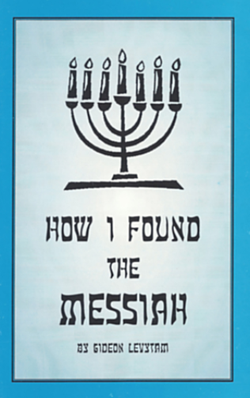
Follow Gideon Levytam's journey and discover how he was led by God, through a series of exciting circumstances, to find the One his people are still waiting for.
Past Episodes

Featured Offer
Follow Gideon Levytam's journey and discover how he was led by God, through a series of exciting circumstances, to find the One his people are still waiting for.
About Holy Scriptures and Israel
As time passed by, the Lord Yeshua took dear brother John Van Stormbroek to himself. The ministry of Holy Scriptures and Israel continued with additional development. In the early 1990’s, a weekly morning Bible class began which brother Gideon Levytam led regularly in the City of Toronto. This weekly open Bible class was held in the Willowdale assembly meeting hall. Eventually, a second mid-week evening Bible class was added. In April 2002, the need for an additional outreach Bible teaching meeting arose. We begun a Saturday (Shabbat) ministry meeting in which a systematic teaching of God’s word is presented to all who attend. Together we learn God’s Word, pray for each need and the salvation of Israel, and sing songs of worship unto our God, praising Him and our Lord Yeshua the Messiah.
In Mid 2004 we started to air on Joy 1250 Radio station a 15 minute Bible teaching program called "The Holy Scriptures and Israel" with Gideon Levytam. The broadcast teaches God’s word from a Hebrew Messianic perspective and has proved to be a blessing to many. It's now aired seven days a week. Our prayer is that many more of our Israeli people will have a clear understanding of who Yeshua is, why we all need him, and come to know him as their Lord and Messiah.
About Gideon Levytam
Contact Holy Scriptures and Israel with Gideon Levytam
426 Simcoe Street
Niagara-on-The-Lake
Ontario L0S 1J0
Canada
(905) 325-1234