

Daniel 4:1-18, Part 2


Nebuchadnezzar’s Second Dream Part 2
Narrator: Shalom. Holy Scriptures and Israel is a ministry designed to share with the Jewish people the good news of the Lord Jesus, Yeshua the Messiah, and to instruct Christians on the Jewish roots of their faith. And now, teaching God's word from a Hebrew Messianic perspective, here is Gideon Levytam.
Gideon Levytam: The study of Daniel chapter four. In verses 4 to 9, it is the beginning of the story. He was dreaming a dream. He called the magicians to come to help him to give him the interpretation. They could not help him. Finally, Daniel comes, and then he asked Daniel, "Daniel, please, you are the one that is a master of all the magicians. I know nothing is troubling you. Tell me the visions of my dream. I want to know the interpretation of the dream." That is verses 4 to 9.
In verses 10 to 18, here is the dream itself. When he is telling Daniel the dream, he breaks it into four sections. The first section is verses 10, 11, and 12. He tells him the dream of a tree. Notice it says in verses 10, 11, and 12: "Thus were the visions of mine head in my bed; I saw, and behold a tree in the midst of the earth, and the height thereof was great. The tree grew, and was strong, and the height thereof reached unto heaven, and the sight thereof to the end of all the earth. The leaves thereof were fair, and the fruit thereof was much, and in it was food for all: the beasts of the field had shadow under it, and the fowls of the heaven dwelt in the boughs thereof, and all flesh was fed of it."
It is interesting how God is expressing certain things to us through the Scriptures. Notice that the dream was about a tree, a regular tree. Oftentimes in the Bible, when God is using a tree as an object lesson, a tree will resemble either a man or a nation, or even both. As an example, if you turn to Psalm 1, it is interesting. He sees a tree. Why is it that God spoke to Nebuchadnezzar by that vision, by this dream, by showing him a tree and teaching him a lesson from a tree?
Some suggest that because Nebuchadnezzar had conquered so many countries, when he had gone to Lebanon and seen these great cedars of Lebanon, he had been so impressed that many times he was speaking about those great trees and the humongous trees. God now was speaking to him through that which he was so much impressed by. Notice it says here in Psalm 1, verses 1 to 3: "Blessed is the man that walketh not in the counsel of the ungodly, nor standeth in the way of sinners, nor sitteth in the seat of the scornful. But his delight is in the law of the Lord; and in his law doth he meditate day and night. And he shall be like a tree planted by the rivers of water, that bringeth forth his fruit in his season; his leaf also shall not wither; and whatsoever he doeth shall prosper."
Psalm 1 in a prophetic sense speaks about the Messiah. He was the man of Psalm 1, whose desire and life were constantly devoted to God. But in a type and a picture, it is also speaking about people, about men that sit and stand and walk in a way that is pleasing to God. It says this man that has a delight in the law of the Lord shall be like a tree which is planted by the rivers of water. If a tree is planted by the rivers of water, it is going to bring a lot of fruit—fruit for God and blessings for man. That is what happens when a person has a delight and a desire to spend his time in the presence of the Lord. Spiritually, he or she will be a blessing to people around them.
The scripture is clear that a tree represents an individual. Turn to the prophet Isaiah chapter 56. Let me read the first three verses: "Thus saith the Lord, Keep ye judgment, and do justice: for my salvation is near to come, and my righteousness to be revealed. Blessed is the man that doeth this, and the son of man that layeth hold on it; that keepeth the sabbath from polluting it, and keepeth his hand from doing any evil. Neither let the son of the stranger, that hath joined himself to the Lord, speak, saying, The Lord hath utterly separated me from his people: neither let the eunuch say, Behold, I am a dry tree."
For thus saith the Lord unto the eunuchs that keep my sabbaths, and choose the things that please me, and take hold of my covenant. He is speaking about the eunuch, that the eunuch will not say, "I am a man," or "I am a dry tree," meaning there is no fruit. Again, the tree resembles an individual, a person.
One more verse, in the prophet Jeremiah chapter 17. We read in Psalm 1: "Blessed is the man, he shall be like a tree planted by the rivers of water." Jeremiah 17 tells us in verse 5: "Thus saith the Lord; Cursed be the man that trusteth in man, and maketh flesh his arm, and whose heart departeth from the Lord. For he shall be like the heath in the desert, and shall not see when good cometh; but shall inhabit the parched places in the wilderness, in a salt land and not inhabited."
Verse 7: "Blessed is the man that trusteth in the Lord, and whose hope the Lord is. For he shall be as a tree planted by the waters, and that spreadeth out her roots by the river, and shall not see when heat cometh, but her leaf shall be green; and shall not be careful in the year of drought, neither shall cease from yielding fruit."
We get the picture. When we are speaking about the tree, it often has a reference to a person, either a dry tree away from the Lord or a tree that brings much fruit near to the Lord. It is representing a nation in Ezekiel 31, verses 3 to 14. Hosea chapter 9 and verse 10 has a reference to nations, as does Joel chapter 1 and verse 7. A tree has reference to a nation or to an individual person.
Let's go back to Daniel chapter 4. In verses 10 to 18, he gives us the dream, and he gives us four parts to the dream. Part number one, verses 10 to 12, he gives us the great tree. In verse 10: "I saw, and behold a tree in the midst of the earth, and the height thereof was great." In verse 11, he tells us the development and the growth of that tree: "The tree grew, and was strong, and the height thereof reached unto heaven, and the sight thereof to the end of all the earth." That tree did not stay small. It grew and it reached unto heaven. It was so great, and the sight thereof was to the end of all the earth. Everybody could recognize that tree. Everyone could behold that tree. It was spread in its height and in its breadth. There was a development.
In verse 12, listen to the influence of that tree: "The leaves thereof were fair, and the fruit thereof was much, and in it was food for all: the beasts of the field had shadow under it, the fowls of the heaven dwelt in its boughs, and all flesh was fed of it." He is using the dream to illustrate something he was going to speak to Nebuchadnezzar about. That tree developed and grew, and it was so great, reaching high up to heaven and wide enough that everybody could see it. Not only that, but that particular tree nourished many people.
In verse 12, it says the fruit was so much and it was food for everyone. The beasts of the field had shadow under it, the fowls of the heaven dwelt in its boughs, and all flesh was fed from it. That is the kind of tree that Nebuchadnezzar was dreaming about. It is amazing that every time he is dreaming, he is dreaming about great things. In chapter 2, he dreamt about this great image. In chapter 3, he built that great image. In chapter 4, he is dreaming about this huge tree that God was going to speak to him through. So, part one of the dream is the great tree. It speaks of a man and nations. In this case, it speaks to us about Nebuchadnezzar himself.
The second part of this dream is verses 13, 14, 15, and 16. There was a decree made against that tree. It was so great and huge, enough to feed the whole world, with beasts getting shade and birds in the leaves and branches. Now, there was a decree made against that tree. There was a watcher that made a decree commanding to destroy that tree.
In verse 13 and 14: "I saw in the visions of my head upon my bed, and, behold, a watcher and an holy one came down from heaven." These are angels, angelic beings. Some suggest it is one angel because it says "a watcher and an holy one." It is the same one because in verse 14 it says "he," singular. That watcher, that holy one, that angelic being is doing the service for God. They are acting upon God's command. The angels are the servants and ministers of God. Notice what the command was and look at the decree being made in verse 14: "He cried aloud, and said thus, Hew down the tree, and cut off his branches, shake off his leaves, and scatter his fruit: let the beasts get away from under it, and the fowls from his branches."
When you look at this story and you read that story, it makes you wonder why such a great tree that was so sufficient for everybody to feed from would be cut down. Why would the watcher come down and say, "Cut it down, do away with it"? There is a reason, and he is going to tell us this.
In verse 15a, he still says one thing that is going to happen: even though they are to cut down the whole tree, the stump will be left protected. Verse 15a: "Nevertheless leave the stump of his roots in the earth." Leave it, even with a band of iron and brass in the tender grass of his field. Cut the tree all the way down, but leave the lower part, the stump. Leave it and leave his roots in the earth. Bind it with iron and brass in the tender grass of the field. Leave him outside. Do not destroy it completely. Everything else is destroyed, but leave the stump, bound and outside with the grass for a little while.
Then, in verse 15b and 16, a judgment upon the stump. It has three points about the stump: three judgments upon the stump. Number one: "Let it be wet with the dew of heaven." Leave him outside. Number two: "Let his portion be with the beasts in the grass of the earth." Not only should he be kept outside with the dew, but also keep him with the beasts and by the grass. And number three in verse 16: "Let his heart be changed from man's, and let a beast's heart be given unto him; and let seven times pass over him."
Again, God is depicting a man, a man like a tree that was great, whose height was all the way to heaven and his breadth was all over the world. The nourishment of the fruit that he had upon this tree was sufficient enough to feed everyone—the animals and the human beings. It even gave shade to the birds. At this climax time of the greatness of this tree, cut it down. Leave the stump tied with bands, leave it outside with the beasts in the dew by the grass.
In verse 16, it says, "Let his heart be changed from man's heart." This is very interesting. There is a lesson here. Let his heart change from a man's to a beast's heart until seven years or seven times will pass over him. In the book of Daniel, when it talks about times, most likely it has to do with years, because elsewhere when we find the word for times, we often take it as a reference to years. Can you imagine the description of greatness of a man and then being literally humbled all the way? Even his heart will become the heart of a beast given unto him. He is outside with the dew of heavens, on the grass with the beasts, not recognized for seven years.
The third part of the dream is in verse 17. Verse 10, 11, and 12 were the great tree. Verses 13, 14, 15, and 16 were the decree against the tree. Verse 17 is the purpose. Why is it that this is going to happen? Verse 17 says this: "This matter is by the decree of the watchers, and the demand by the word of the holy ones: to the intent that the living may know that the most High ruleth in the kingdom of men."
In the beginning of our study of the book of Daniel, we said that the title we can give over the book of Daniel is that "the Most High God" rules in the kingdom of men. That is the acknowledgment or the realization that the Most High God ruleth in the kingdom of men. The decree was by the watchers so that the living may know that the Most High God ruleth in the kingdom of men and he giveth it to whomsoever he will, and setteth up over it the basest of men.
There was a reason why God showed Nebuchadnezzar that dream with the great tree—to teach a lesson. The decree was to cut off this tree because God rules. God gives the kingdom to whomsoever he will. God sets up even the lowest of men. He sets him up and he puts down the greatest of men. God is in full control in the events of this world. Sometimes we wonder when we look at the events that happen in this world. There was a great man in Iraq by the name of Saddam Hussein. Where is Saddam Hussein today? Saddam Hussein was priding himself to be the next Nebuchadnezzar. Where is he today?
You might say it was the great America that went with the mighty power, but you have to realize that it is God who changes events in this world. Even though men might be used by God, ultimately God is the one who controls the events in this world. So, we learn this lesson in the third part of the dream. The purpose is to understand that God is ruling, to understand that he gives kingdoms to whomsoever he will, and to realize that he is the one who sets up the humblest or the lowest of all men. That's why the tree had to be cut down, to teach us that lesson.
The fourth part of this dream is in verse 18: "This dream I king Nebuchadnezzar have seen. Now thou, O Belteshazzar, declare the interpretation thereof, forasmuch as all the wise men of my kingdom are not able to make known unto me the interpretation: but thou art able; for the spirit of the holy gods is in thee."
We have the four parts: number one, the great tree; number two, the decree against the tree; number three, the purpose of why the tree had to be cut down; and number four, the plea for interpretation. We will stop with this part. We have been sitting here for a while, and we can cover the second part of chapter 4 in our next meeting in two weeks from now.
But just to sum up this thought: Nebuchadnezzar was a great king. He was a monarch. God is the one that placed him in that high and lofty position. He was the head of gold in the dream of chapter 2. He was placed there by God. But apparently, just like all men are, there is the pride that comes into one's heart. Pride comes before a fall. The Bible teaches us this. Sometimes God allows us to receive many blessings and many mercies, and instead of granting the glory to Him, we take pride in it. God had to teach Nebuchadnezzar a very important lesson. God had to teach him so he will declare this: "How great are his signs! and how mighty are his wonders! his kingdom is an everlasting kingdom, and his dominion is from generation to generation." Can we say amen to that? Amen.
Narrator: You've been listening to Holy Scriptures and Israel with Gideon Levytam. Gideon teaches God's word from a Hebrew Messianic perspective. For more information about this ministry, write to Holy Scriptures and Israel, Box 1411, Niagara-on-the-Lake, Ontario, L0S 1J0. Or visit our website at holyscripturesandisrael.com. You are also invited to Gideon's weekly Bible teaching on Fridays at 11:00 AM and 7:00 PM and Saturdays at 1:00 PM at Willowdale Christian Assembly Hall, 28 Martin Ross Avenue in Toronto. Holy Scriptures and Israel is made possible by your prayers and financial support. If you would like to support the program, visit holyscripturesandisrael.com. God bless you. Shalom, shalom.
Featured Offer
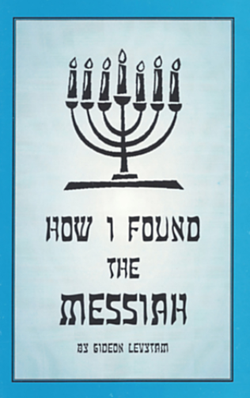
Follow Gideon Levytam's journey and discover how he was led by God, through a series of exciting circumstances, to find the One his people are still waiting for.
Past Episodes

Featured Offer
Follow Gideon Levytam's journey and discover how he was led by God, through a series of exciting circumstances, to find the One his people are still waiting for.
About Holy Scriptures and Israel
As time passed by, the Lord Yeshua took dear brother John Van Stormbroek to himself. The ministry of Holy Scriptures and Israel continued with additional development. In the early 1990’s, a weekly morning Bible class began which brother Gideon Levytam led regularly in the City of Toronto. This weekly open Bible class was held in the Willowdale assembly meeting hall. Eventually, a second mid-week evening Bible class was added. In April 2002, the need for an additional outreach Bible teaching meeting arose. We begun a Saturday (Shabbat) ministry meeting in which a systematic teaching of God’s word is presented to all who attend. Together we learn God’s Word, pray for each need and the salvation of Israel, and sing songs of worship unto our God, praising Him and our Lord Yeshua the Messiah.
In Mid 2004 we started to air on Joy 1250 Radio station a 15 minute Bible teaching program called "The Holy Scriptures and Israel" with Gideon Levytam. The broadcast teaches God’s word from a Hebrew Messianic perspective and has proved to be a blessing to many. It's now aired seven days a week. Our prayer is that many more of our Israeli people will have a clear understanding of who Yeshua is, why we all need him, and come to know him as their Lord and Messiah.
About Gideon Levytam
Contact Holy Scriptures and Israel with Gideon Levytam
426 Simcoe Street
Niagara-on-The-Lake
Ontario L0S 1J0
Canada
(905) 325-1234