

Daniel 11:2-35, Part 2


Warring Kings of North and South Part 2
Guest (Male): Shalom. Holy Scriptures and Israel is a ministry designed to share with the Jewish people the good news of the Lord Jesus Yeshua the Messiah and to instruct Christians on the Jewish roots of their faith. And now teaching God's word from a Hebrew Messianic perspective here is Gideon Levitan.
Gideon Levytam: The study of Daniel chapter 11. So apparently in verse two of Daniel chapter 11, there shall stand up yet looking yet to the future, there shall stand up yet three kings in Persia. Now there is those who knows all the details. Now I just mark marked the names, some of the names Cambyses Cyrus son reign from 529 to 521. Then PSEUDO reign in 521. And thirdly Darius the first reign from 521 to 487. He's mentioned in Ezra chapter four. So those three kings that he's mentioning here in verse in verse two, yet three kings in Persia will stand.
So he's giving to Daniel the information that there would be still three kings are coming in Persia after Cyrus. Cyrus son. Then we have the the one that are reign in 521 BC and then Darius the first 521 to 487. Now Daniel did not know. What does he know? He was just receiving information about future events that are going to happen. Now if you and I going to read about historic, you going to read about it, we'll find a lot of information about those kings. Now I don't know a person must be historian to go through these information to find out all these details.
But now notice that in verse two, he still continues and tells us there's an additional king. It says here and the fourth shall be far richer than they all. And by his strength, through his riches, he shall stir up all against the realm of Gracia. In other words, there will be a fourth kings and by the way there are other kings after him that yet would come before the Greeks will take the the become the the the the next kingdom. But the fourth king is Artaxerxes. This is what we call in Hebrew you would say in English.
He is the one that ruled in the time in the book of Esther. When we read about him in the book of Esther, he ruled from 485 to 464 BC. And you know you notice that it says that he we're going to be far richer than they all. You know it is interesting that he was so rich. If you read the book of Esther, you remember in chapter one of the book of Esther, he made a great feast. And you remember how many how many princess came to this feast. If I'm correct, what was it?
127 127 came from all over to to celebrate it. And if you remember, he is the one that eventually Esther, the Jewish girl, end up to be his wife. And the the the next queen of of of of Persia. And so what we find out that he gives him, you know, details. I I'm I'm not an an historian. But imagine for a person who likes details to look into history and to begin to find out about those three kings and then the fourth king that came after, the wealthy, the rich king. And ultimately there were other kings that came after until the kingdom of Persia have ended.
And if you remember when we studied Daniel chapter chapter two and chapter seven, we saw that there were four kingdoms, the Babylonian, the Medo-Persian, the Grecian and and eventually the Romans. And then we had the revived Roman Empire in the future day which finally the Messiah will come and will totally destroy with the power of his coming. and he is going to be the one that is going to establish a kingdom which have will have never end, which have which will have no end. So in verse two, we see a summary of the rulers of Persia.
Basically we see three, the one that have been first of all plus three plus the fourth one. And we don't have any more details but there were an additional a few kings before the next kingdom enter in. Now here is the next kingdom. The next kingdom is verses three and four. In verse three and four, and let me read those two verses, and a mighty king shall stand up. That shall rule with great dominion and do according to his will. And when he shall stand up, his kingdom shall be broken and shall be divided toward the four winds of heaven and not to his posterity or family or children or his family nor according to his dominion which he ruled for his kingdom shall be plucked up even for others beside those.
Now verse two, I should say verse three and four gives us a summary of the kingdom of Greece. What we have here really in verse two, first of all, in verse two we have Alexander the Great. Alexander the Great. It says here in verse three, a mighty king shall stand up. You know very well the story of Alexander the Great. He was a young man when he conquered, when he became a king and in a 336 to 323 he BC he was a king who ruled Greece. And it says here about Alexander that he would be a mighty king.
We read of him in chapter seven. We read of him in chapter seven when he's come to the image. We read of him in chapter seven when he's come to the four beasts, the third beast there. And we read of him here again. He would be that mighty king that shall stand up. And then it said and that and that shall rule with great dominion and do according to his will. And that is exactly what he did. He was a young man and by the way in 323 BC Alexander died. And what happened is it says here in the next verses, in actually verse four, there was a division of his kingdom.
Instead of his family to inherit the kingdom, no, eventually actually his four generals that that have led his army were the ones that the kingdom have been divided too. It says here in verse four, he shall stand up. And his kingdom shall be broken and shall be divided towards the four winds of heaven. And it is interesting that those four generals, and I make I have their name here, Ptolemy Seleucus and Lysimachus and and Cassander. Those four generals have taken over the kingdom. But you know what? As we go on, as time went on, the two major generals and the two major kingdoms have taken over the north and the south.
And the northern kingdom was really has been placed in Syria, north of Israel, straight north of Israel. And the southern kingdom was in Egypt. And so from from these verses we discovered that his kingdom have been divided into four. It had been broken, divided towards the four winds of heaven. And not notice it says and not to his posterity, his family or his children nor according to his dominion which he ruled for his kingdom shall be plucked up even for others beside those. And so really what we have here in verse two, we have a summary of the kingdom of Persia.
In verse three and four, we have a summary of the kingdom of Persia. And actually from verse five on, all the way to verse 35. And that is where I do not I'm not going to go into details because not only that I cannot go into a lot of details here because there's so much historical details here that one need to really sit down and begin to write name after name after name after name of kings and rulers that rule be rule in Syria. This is the northern Grecian kingdom and Egypt. This is the southern Grecian kingdom.
And so what we have here now in the next verses for verse five to verse 35, we really have a summary or if you will a detailed information which summed up in those verses between the warfare that existed between the king of the north and the king of the south. Now when we say in Daniel chapter 11 verse five to 35, when we say the king of the north and the king of the south, we don't mean the far north. We mean north with has to do with Syria, the Grecian Syrian king on or kings I should say and the southern kings which are the Egyptians, Grecian Egyptian kings.
Now let me just break this a little bit into two sections here. I'll read that. Verse five to 20. Let me read those verses so we just get an idea. Verse five to 20. And the king of the south shall be strong. And one of his princess. And he shall be strong above him and have dominion. His dominion shall be a great dominion. And in the end of years they shall join themselves together for the king's daughter of the south shall come to the king of the north to make an agreement. But she shall not retain the power of the arm, neither shall he stand nor his arm.
But she shall be given up and they that brought her and he that beget her and he that strengthened her in these times. But out of a branch of her roots shall one stand up in his estate which shall come with an army and shall enter into the fortress of the king of the north and shall deal against them and shall prevail. And shall also carry captives into Egypt, their gods, with their princess and with their precious vessels of silver and of gold. And he shall continue more years than the king of the north. So the king of the south shall come into his kingdom and shall return into his own land.
But his sons shall be stirred up and shall assemble a multitude of great forces. And one shall certainly come and overflow and pass through. Then shall he return and be stirred up even to his fortress. And the king of the south shall be moved with with with rage and shall come forth and fight with him even with the king of the north. And he shall set forth a great multitude. But the multitude shall be given into his hand. And when the hand and when I'm sorry, and when he had taken away the multitude, his heart shall be lifted up and he shall cast down many 10,000s.
But he shall not be strengthened by it. But the king of the north shall return and shall set forth a multitude greater than the former and shall certainly come after certain years with a great army and with much riches. And in those times there shall many stand up against the king of the south. Also the robbers of the people shall exalt themselves to establish the vision. But they shall fall. So the king of the south shall come and cast up a mount and take the most fenced cities. And the arms of the south shall not withstand neither his chosen people, neither shall there be any strength to withstand.
But he that cometh against him shall do according to his own will and none shall stand before him and he shall stand in the glorious land which by his hand shall be consumed. He shall also set his face to enter with the strength of his whole kingdom and upright once with him. Thus shall he do and he shall give him the daughter of women corrupting her. But she shall not stand on his side neither be for him. After this shall he turn his face into the aisles and shall take many but prince but a prince for his own behalf shall cause the reproach offered by him to seize.
Without his own reproach he shall cause it to turn upon him. Then he shall turn his face towards the fort of his own land and he shall stumble and fall and not be found. Then shall stand up in his estate a raiser of taxes in the glory of the kingdom. But within few days he shall be destroyed neither in anger nor in battle. Now as we are reading these verses, obviously you can see from verses five to 20. I don't know if you notice a few times the word mentioned the king of the south and the king of the north.
You notice by the way verse five, the king of the south, Egypt. Verse six, the king of the north, Syria. Then if you just go ahead and you notice verse seven, the king of the north. Verse eight, king of the north. Verse nine, king of the south. Verse 11, king of the south. Verse 11 again, king of the north. Verse 13, king of the north. Verse 14, king of the south. Verse 15, king of the north. And if you just read those verses, there is so much details here in verses five to 20. Really what we have in verses five to 20, we have the conflict which existed between Ptolemies or the Ptolemaic kings of Egypt and the Seleucus kings of Syria.
That's what we have here. We have here and we have here a detailed information about the warfare that existed between the kings, if you will, the the descendants of those two kings, the kings of the north and the kings of the south. So verses five to 20 take us through the conflict which existed between the kings and their successors. The king of the north, Syria and the king of the south. And guess what? In between, in the middle of these two north Syria, south Egypt, the land of Israel is there. And every time every time there was a warfare between the two, somehow it affected the land of Israel and the Jewish people.
In fact, you notice by the way it says in verse 16. Notice verse 16. But he that cometh against him shall do according to his own will and none shall stand before him and he shall stand in the glorious land which by his hand shall be consumed. Somehow in between the two north and south, the the successors of those two kings, the Grecians, Syrian and Egyptians kings, the north and the south, the people of Israel, the glorious land is right in the middle. And so really what we have in verses five to 20, we have the conflict that existed between those two kingdoms while the Jewish people is right in the middle.
And the people of Israel has suffered tremendously as those warfare were carrying on. I have some names of kings that I'm not going to pass to you because I cannot even pronounce some of these names here. But you'll have to read it for yourself in in in in in in history books and biblical people who have written about that. But let's move on. In verse 21 to 35 we are still under the the God's dealing or God's ruling over Israel during the first 69 weeks. We still receive information or Daniel is still receive information about events that we're going to happen to the Jewish people, to Daniel's people Israel during the 69 weeks which means from the time of the the Israel being going the Jewish people going back to the land up till the time that really the this the end of the 69 weeks.
And then of course we have the church age which is the period that is in between the 69 weeks and the final 70th week. But notice interesting in verse 21 to verse 35 we we deal we we hear about another individual, another king that is really part of the kingdom of the north, the king of the north which is another wicked wicked king which we find in the history of the Jewish people, the history of our people, our Jewish people. And this king is none else but Antiochus Epiphanes. Let me read a little bit about him.
First of all, how did he risen to power? In verses 21 to 24 we find out how did he arrive to power. First of all, it says in verse 21 he usurped usurped the throne. It says here and in his place, this is in the place in the place of that other king that was prior to him shall stand up a vile person. That evil vile person that is spoken about here is a man by the name of Antiochus Epiphanes. This man, it says here in verse 21, to whom they shall not give the honor of the kingdom.
But he shall come in peaceably and obtain the kingdom by flatteries. You see that man Antiochus, he was a wicked king. And he have obtained the kingdom by flatteries. We read here in verse 21. So he usurped the kingdom. It was really not belong to him. He usurped it. He was and again you need to read details about it in history, how he have taken that place, how did he arrive to become that king of the the north. By the way, he reign from 175 to 163 BC. This was the reign of Antiochus, that wicked man, that wicked Antiochus Epiphanes.
It says in verse 22 now the description of his power, what kind of power he had. It says in verse 22 and with the arms of a flood shall they be overthrown from before him and shall be broken. Yeah, also the prince of the covenant. By the way, we read about his power here. We read about the fact that this particular king will will have will be very powerful. And it says also that before him flood they flood shall with the arms of a flood shall they be overflowed from before him. In other words, when you talk about the flood has to do with power, with military power, he will will will will be the one that will force himself upon the kings before him, take the kingdom.
And then it says here that even the prince of the covenant that has to do with the leaders of Israel who would, if you will, the the prince of the covenant, the the priests, the leadership of Israel would be influenced by that king who will who will try to to produce among the people of Israel, if you will, a Grecian influence, Hellenistic influence. Then in verse 23 we read about the work of deceit, what he does. He's a deceitful king. In verse 23 and after the league made with him, he shall work deceitfully and he shall come up and shall become strong with a small people.
Again deceitfully, he will work deceitfully and they will be made league. He will make league with some of the a few of the leaders of the people of the Jewish people, the people of Israel. And they will be influenced by his Hellenistic influences. He will seek to take away everything that has to do with Jewish godly attitude. And he will try to influence upon the Jewish people all kind of Hellenistic views. And then notice in verse 24 we read about him as well. It says here and he shall he shall enter peaceably even upon the the fattest places of the province.
And he shall do that which his fathers have not done, nor his fathers' fathers. He shall scattered among them the prey and spoil and riches. Yeah, and he shall, as it says, he shall forecast his devices against the strongholds even for a time. And so in verse 24 it says that he will do things which his fathers have not done nor his fathers' fathers. He will do certain things that even his forefathers even his forefathers have never done that wicked king by the name of Antiochus. And so in verse in verse 21 to 24 we see his rise to power and how he have arrived to this position.
Then in verse 25 to verse 28 we have the campaign against Egypt, the Egyptians. In verse 25 to verse 28 it was his first campaign. He shall stir up his power and his and his courage against the king of the south. The king of the south is the king of Egypt. With a great army and the king of the south shall be stirred up to battle with a very great and mighty army. But he shall not stand for they shall forecast devices against him. Yeah, they that feed of the portion of his meat shall destroy him and his army shall overflow and many shall fall down slain.
Apparently he will be tricked and and and and and those that have been fed by him, that received from him eventually eventually they they they have devices against him as it says in verse 25. And then verse 27 both of these kings' hearts shall be to do mischief. And they shall speak lies at one fable. But it shall not prosper for yet the end shall be at the time appointed.
Guest (Male): You have been listening to the Holy Scriptures and Israel with Gideon Levitan. Gideon teaches God's word from a Hebrew Messianic perspective. For more information about this ministry, write to Holy Scriptures and Israel, box 1411 Niagara on the Lake, Ontario, L0S 1J0 or visit our website at holyscripturesandisrael.com. You are also invited to Gideon's weekly Bible teaching on Fridays at 11 a.m. and 7 p.m. and Saturdays at 1 p.m. at Willowdale Christian Assembly Hall, 28 Martin Ross Avenue in Toronto. Holy Scriptures and Israel is made possible by your prayers and financial support. If you would like to support the program, visit holyscripturesandisrael.com.
God bless you. Shalom. Shalom.
Featured Offer
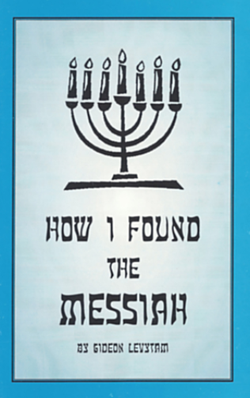
Follow Gideon Levytam's journey and discover how he was led by God, through a series of exciting circumstances, to find the One his people are still waiting for.
Past Episodes

Featured Offer
Follow Gideon Levytam's journey and discover how he was led by God, through a series of exciting circumstances, to find the One his people are still waiting for.
About Holy Scriptures and Israel
As time passed by, the Lord Yeshua took dear brother John Van Stormbroek to himself. The ministry of Holy Scriptures and Israel continued with additional development. In the early 1990’s, a weekly morning Bible class began which brother Gideon Levytam led regularly in the City of Toronto. This weekly open Bible class was held in the Willowdale assembly meeting hall. Eventually, a second mid-week evening Bible class was added. In April 2002, the need for an additional outreach Bible teaching meeting arose. We begun a Saturday (Shabbat) ministry meeting in which a systematic teaching of God’s word is presented to all who attend. Together we learn God’s Word, pray for each need and the salvation of Israel, and sing songs of worship unto our God, praising Him and our Lord Yeshua the Messiah.
In Mid 2004 we started to air on Joy 1250 Radio station a 15 minute Bible teaching program called "The Holy Scriptures and Israel" with Gideon Levytam. The broadcast teaches God’s word from a Hebrew Messianic perspective and has proved to be a blessing to many. It's now aired seven days a week. Our prayer is that many more of our Israeli people will have a clear understanding of who Yeshua is, why we all need him, and come to know him as their Lord and Messiah.
About Gideon Levytam
Contact Holy Scriptures and Israel with Gideon Levytam
426 Simcoe Street
Niagara-on-The-Lake
Ontario L0S 1J0
Canada
(905) 325-1234