

Daniel 1:1, Part 1


Introduction Part 1
Intro Voice: Shalom. Holy Scriptures and Israel is a ministry designed to share with the Jewish people the good news of the Lord Jesus, Yeshua the Messiah, and to instruct Christians on the Jewish roots of their faith. And now, teaching God's word from a Hebrew Messianic perspective, here is Gideon Levytam.
Gideon Levytam: Please turn to the book of Daniel. I hope you brought a pen and a paper because tonight you're going to get some introduction material that I have gleaned by studying, from listening to others, and so on.
I think one of the most beautiful things when I was a little boy and we used to read Bible stories in my grandparents' or my parents' home—Jewish stories from the history of our people—one of the most wonderful stories was to read about stories such as the life of Daniel, or the life of Moses, or the life of some simple man from among the people of Israel who have gone through experiences in our lives. I think it's so wonderful if we just read that story and just imagine some of the things that were going on in the lives of these Jewish boys. It is a tremendous story to read.
But what we're going to do this evening is first of all, I want to speak a little bit to introduce the book of Daniel. It's very important to introduce the book of Daniel. So if you have notes, if you have a paper and a pen and you're writing about this book by way of introduction, I want you to just follow me up as I'm giving some points of introduction to the book of Daniel.
First of all, one of the questions that we have to—and I think it's very important—the critics, those who do not believe, those who reject the book of Daniel because there are certain things that are written in this book, try to set this book aside, telling us that perhaps this book of Daniel did not exist or Daniel did not exist. One of the things that we want to be sure about this book is that we know from the word of God—not only in this book but elsewhere—that Daniel was a real man, just like you and I.
Daniel was a real person just like you and I, who lived in a certain period of time in the history of the Jewish people, in the history of the people of Israel. We want to make sure that from this book and from elsewhere in the scripture that Daniel was existing and we can trust in the book of Daniel and what Daniel had said, because the critics try to denounce or to set aside the book of Daniel like other books in the Bible.
Let me first speak about Daniel to make sure that we understand. Daniel is the one who has written the book of Daniel. The author of the book of Daniel is none else but Daniel himself. I want you to just quickly notice with me. Daniel oftentimes, as he's writing this book, he is mentioning himself and writing in first person. Turn to chapter seven. If you don't want to turn to all of them, you don't have to. Just write these down.
In Daniel chapter seven, verse two, notice what Daniel is saying: "Daniel spake and said, 'I saw in my vision by night.'" Daniel is speaking himself. He's saying, "I saw in a vision by night." Notice in verse 15, he's speaking in first person: "I, Daniel, was grieved in my spirit." Then if you go to verse 28, the last verse of chapter seven, notice what we read: "Hitherto is the end of the matter. As for me, Daniel, my..." and he continued to speak. Notice that Daniel is speaking of himself and his name is mentioned and he's calling himself "I, Daniel."
Turn to chapter eight now and verse one: "In the third year of the reign of King Belshazzar, a vision appeared unto me, Daniel." Then move on to verse 15 of the same chapter: "And it came to pass when I, even I, Daniel." Then verse 27, the last verse of chapter eight: "And I, Daniel, fainted."
Now we can go on, and as we look in this book, we can find that Daniel is speaking of himself in first person as he is writing for us that book. For those of you who are writing, I'm not going to turn to them, chapter 9, verse 2 and verse 22; chapter 10, verse 2, 7, 11, and 12; and chapter 12, verse 5 also are speaking concerning Daniel—Daniel speaking in first person, "I, Daniel."
So you can see throughout the book, Daniel is speaking of himself. Daniel is the one that wrote the book of Daniel. He did exist. He was a man that existed in a certain time in the history of the people of Israel. As he's writing this book, he's speaking of himself.
Then, if you just turn one book back to the prophet Ezekiel by way of introduction, because there's a lot of material for introduction this evening, beloved brothers and sisters. In Ezekiel chapter 14, here is a contemporary prophet who was speaking and mentioning in his prophecy this man by the name of Daniel. Ezekiel chapter 14, notice what Ezekiel is saying in verse 14. Ezekiel—Yechezkel in Hebrew—notice what Yechezkel is saying.
Notice he's mentioning not only Daniel, but he says, "Though these three men—Noah, Daniel, and Job, or in Hebrew, Iyov—were in it, they should deliver but their own souls by their righteousness," saith the Lord God. Do you know that Ezekiel wrote his book? He was a contemporary of Daniel, and he was one of those that had been taken captive just like Daniel had been taken captive by the Babylonians. Ezekiel specifically is mentioning the name of Daniel in his prophecy.
But not only Daniel, by the way, he mentioned Noah, which was many years before, and he mentioned Job, which was also in the time approximately the time of Abraham. He is specifically mentioning individuals. Those who are critics and saying the book of Daniel is not really a book that was written by Daniel—somebody put it there and therefore they are setting this aside—well, the prophet Ezekiel mentioned Daniel in his prophecy.
Notice, by the way, in the same chapter 14 and verse 20, he says again, "Though Noah, Daniel, and Job were in it, as I live, saith the Lord God." Again, Ezekiel is also mentioning the name of Daniel in his prophecy. By the way, in chapter 28 of the same book of Ezekiel, verse 3—this is, by the way, we learn a little bit about the prince and the king of Tyre, which is ultimately looking to Satan himself—notice what we read in verse three of chapter 28: "Behold, thou art wiser than Daniel. There is no secret that they can hide from thee."
And so God is speaking, and through the prophet Ezekiel, God is mentioning the name of Daniel in the prophetic ministry of Ezekiel to the people of Israel. But it's not only that. It's not only that Daniel himself, as the author in his book, is speaking of himself in a first person. It's not only that Ezekiel, who was a contemporary prophet who was taken captive about the same time when Daniel had been taken captive by Nebuchadnezzar.
But there is someone that is greater than both of them that mentioned Daniel. I want you to turn to the book of Matthew, chapter 24, in the New Covenant, the New Testament. Matthew chapter 24, and you and I believe that Jesus' words are true. We can say amen to that, right? And therefore, notice what Jesus says—Jesus the Messiah, the Lord Jesus the Messiah said in Matthew 24 and verse 14 and 15. Maybe I'll just read verse 15.
Matthew chapter 24, the Lord Jesus is speaking about the tribulation time, the tribulation period, and notice what he says in verse 15: "When ye therefore shall see the abomination of desolation, spoken of by Daniel the prophet, stand in the holy place, whoso readeth, let him understand." Now you see this is so important for us. Why do we believe that the book of Daniel is divinely inspired and Daniel was a real man who lived in a certain time, who was a prophet that prophesied the prophetic word that he spoke concerning the future of Israel, concerning the Messiah?
Why do we believe it? Not only because he said that he wrote it, not only because Ezekiel have mentioned his name in his prophecy, but also because none else but the Lord Jesus the Messiah himself, Yeshua the Messiah, said, "When ye therefore shall see the abomination of desolation, spoken of by Daniel the prophet, stand in the holy place." Notice: "whosoever readeth." Where are you going to read? You're going to read in the book of Daniel. "Whosoever readeth, let him understand what Daniel the prophet has spoken."
And so that is clear for us, beloved brothers and sisters, that the author of the book of Daniel is none else but Daniel himself. Let me give you one more verse. Turn to Mark chapter 13. One more verse, Mark chapter 13. It's really the same words of our blessed Lord Yeshua, Jesus the Messiah, who also spoke about Daniel. Mark 13 and verse 14 is the same thing. Mark is writing his gospel.
Notice what he says in verse 14. Again, the Lord is speaking: "But when ye shall see the abomination of desolation, spoken of by Daniel the prophet, standing where it ought not, let him that readeth understand, then let them that be in Judea flee to the mountains." This is verse 14 of Mark chapter 13. So the first thing that we want to learn by way of introduction—and there is a lot of material and I don't know if I'm going to cover even introduction tonight—but the first thing we want to know is that the author of the book of Daniel is none else but Daniel himself.
Okay, the second thing that we want to learn tonight: What is the meaning of his name? This is very important. The name of Daniel really comes with two Hebrew words. The two Hebrew words are really, number one, Dan or Dani, and the second word is El. In other words, if you'll take these two Hebrew words and put them together, the name is Daniel. It simply means, "God is my judge." You know, there was a man by the name of Dan, one of the tribes of Israel was a man by the name of Dan. But when you say "Dani," Dan means judge, Dani means my judge, and El simply means God. So Daniel: God is my judge.
Now, by the way, there are other—at least two or three—other Daniels found in the scriptures. If you write this down quickly, I'm going to give it to you. One of them was David's son, in 1 Chronicles chapter three and verse one. We don't need to go there, but in 1 Chronicles chapter three and verse one, David's son was named also Daniel. One of the priests in the book of Ezra, chapter eight and verse two, his name was also Daniel. And one of the elders of Israel in the book of Nehemiah, Nehemiah chapter 10 and verse six, his name also was Daniel.
So at least we have about three or four Daniels in the scriptures, and specifically in the Old Testament or in the Old Covenant. But by the way, all of these four, the one that we are speaking about is neither David's son, it's neither the priest that was one of the priests in the book of Ezra, neither one of the elders of Israel in the book of Nehemiah. This is the man Daniel that had been taken captive as a Jewish boy from the city of Jerusalem all the way to Babylon.
And so the author is Daniel. The name of this person simply means "God is my judge." God is my judge. Can you imagine every time his mother called him, "Daniel," she was really saying, "God is my judge." Every time you call this person by the name of Daniel, you really had the name of God in your mouth constantly. That is one of the most beautiful things about the Hebrew names, and we'll see that as we're going to look at the other Jewish boys' names later on.
Every time you mention those names, you mention the name of God. And so God was in the mind, and in the hearing, and the ears, and in the hearts of these individuals all the time, even by virtue of their names. Daniel: God is my judge. Now thirdly, the dates in which the book was written, the dates in which these 12 chapters took place of the book of Daniel is beginning at 605 BC to about 536 BC.
If you notice, by the way, in Daniel chapter 1 and verse 1, where we began our reading today, it says here, "In the third year of the reign of Jehoiakim, king of Judah, came Nebuchadnezzar, king of Babylon, unto Jerusalem and besieged it." This year of the taking of the city of Jerusalem by Nebuchadnezzar was 605 BC. And then if you just turn to chapter 10 of the book of Daniel and verse 1, it says here, "In the third year of Cyrus king of Persia, a thing was revealed unto Daniel."
This is approximately 536, 535 BC. So it really took a span of about 69 to 70 years, the whole 12 chapters. From 605 BC till about 536 BC, it's approximately 69 to 70 years span, those 12 chapters of the book of Daniel. Okay, so we've got so far the author is Daniel. Secondly, we discovered that the name of Daniel means "God is my judge." Thirdly, we discovered that the dates about 605 BC to 536 BC, it's approximately 69-70 years, the whole span of these 12 chapters.
Now fourthly, what is the place that the book of Daniel has in the canon of scriptures? It is interesting that it is a little bit different in the Old Testament, Hebrew scriptures, than what we know today, the Old Testament, the King James that you have in our hand, or the English Bible. It is located in different order in the scriptures.
Now let me just give you some of the things. In the Septuagint—the Septuagint, by the way, is the Greek translation of the Old Testament Hebrew Bible. The Septuagint has been translated to Greek by 70 Jewish rabbis. They translated from Hebrew into Greek to make it available for others than not only the Jewish people, the Hebrew speakers, but it made it available for others. It was translated about 250 BC by 70 Jewish rabbis. That's why the number Septuagint simply means 70, "the 70."
It was translated by those places, by those individuals, and it was placed, by the way, it was placed among the prophets, like Isaiah, Jeremiah, Ezekiel, Daniel. So when it was translated from Hebrew into the Greek language, it was placed among the prophets. But do you know, beloved brothers and sisters, if I will take my Bible, my Hebrew Bible here and I will open that, you will not find the book of Daniel among the prophets.
In fact, the Hebrew scripture, the Old Testament is divided into three sections: Torah—this is the first five books of Moses: Genesis, Exodus, Leviticus, Numbers, Deuteronomy; and then Nevi'im—this is the prophets; and then the Ketuvim—this is the writings. And the book of Daniel in the Hebrew Old Testament is finding itself not among the prophets, but among the writings.
You remember he became a man that became like second to the king, if you will, Nebuchadnezzar, and they looked at him as more a politician rather than a prophet. And by the way, very little today the book of Daniel's been understood by the Jewish people today. And the rabbis today, by virtue of the fact that they don't recognize that in the book of Daniel we see prophetically speaking about the Messiah's coming—like specifically in chapter nine—many of the rabbis do not see it. Their eyes are not being open. Some do, but in general, they don't see that he is in a sense as a prophet. They look at him as a statesman, as a politician.
And so while the Septuagint is looking and placed the book of Daniel among the prophets, in the particular Tanakh, he is placed among the writings and he is not placed among the prophets. Now, let me give you some historical background. The fifth thing that we learn: authorship, Daniel; his name, God is my judge; the dates, 605 to 536; the place in the canon, under the Old Testament Hebrew scriptures he is found among the writings, while with the Septuagint and with what you call the English scriptures, he is found among the prophets.
Fifthly, notice about the historical background. King Nebuchadnezzar had three campaigns against Israel, three times King Nebuchadnezzar came against the Jewish people and the city of Jerusalem. And if you're writing them down, let me just quickly pass them to you. The first campaign was in 605 BC. This is the book of Daniel where we are here. In the first campaign, Nebuchadnezzar came in 605 BC, and he took with him Daniel and some of his friends or some of the young boys, the young children from among the Jewish people.
And in addition to them, he took some of the temple's—some of the vessels from the temple. That was in 605 BC. Turn with me to 2 Chronicles chapter 36. 2 Chronicles chapter 36, this is the last chapter in the book of Chronicles. Actually, it is the last chapter in the Hebrew Bible. Notice, I'm going to read some of these verses here. In verses five and six, we see the first time that King Nebuchadnezzar came against Jerusalem.
Chapter 36 of 2 Chronicles, verses five and six, and I'm reading: "Jehoiakim was twenty and five years old when he began to reign, and he reigned eleven years in Jerusalem: and he did that which was evil in the sight of his God." And notice what we read: "Against him came up Nebuchadnezzar king of Babylon, and bound him in fetters, and carried him to Babylon." That was, beloved, 605 BC.
By the way, Nebuchadnezzar at that time was really not yet a king. He was a crown prince. His father's name was Nabopolassar. He was really the king of Babylon at that time. But Nebuchadnezzar, which was with the Babylonian army, had a conflict against Egypt. They were the two major nations that were at conflict at that particular time, 605 BC. Apparently, as the battle raged, Nebuchadnezzar won the battle against the Egyptians.
And as the Egyptians was going back from the north all the way back through Israel back to the south, to their own country, then Nebuchadnezzar had the opportunity to come and to go against the nation of Israel. As it says here, "Against him came Nebuchadnezzar king of Babylon, and he bound him in fetters, and he carried him to Babylon."
Intro Voice: You have been listening to the Holy Scriptures and Israel with Gideon Levytam. Gideon teaches God's word from a Hebrew Messianic perspective. For more information about this ministry, write to Holy Scriptures and Israel, Box 1411, Niagara on the Lake, Ontario, L0S 1J0, or visit our website at holyscripturesandisrael.com.
You are also invited to Gideon's weekly Bible teaching on Fridays at 11 a.m. and 7 p.m., and Saturdays at 1 p.m., at Willowdale Christian Assembly Hall, 28 Martin Ross Avenue in Toronto. Holy Scriptures and Israel is made possible by your prayers and financial support. If you would like to support the program, visit holyscripturesandisrael.com. God bless you. Shalom, shalom.
Featured Offer
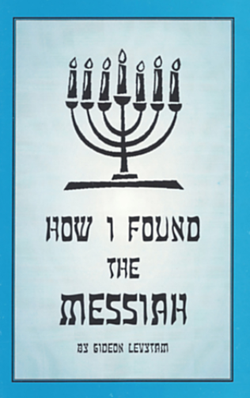
Follow Gideon Levytam's journey and discover how he was led by God, through a series of exciting circumstances, to find the One his people are still waiting for.
Past Episodes

Featured Offer
Follow Gideon Levytam's journey and discover how he was led by God, through a series of exciting circumstances, to find the One his people are still waiting for.
About Holy Scriptures and Israel
As time passed by, the Lord Yeshua took dear brother John Van Stormbroek to himself. The ministry of Holy Scriptures and Israel continued with additional development. In the early 1990’s, a weekly morning Bible class began which brother Gideon Levytam led regularly in the City of Toronto. This weekly open Bible class was held in the Willowdale assembly meeting hall. Eventually, a second mid-week evening Bible class was added. In April 2002, the need for an additional outreach Bible teaching meeting arose. We begun a Saturday (Shabbat) ministry meeting in which a systematic teaching of God’s word is presented to all who attend. Together we learn God’s Word, pray for each need and the salvation of Israel, and sing songs of worship unto our God, praising Him and our Lord Yeshua the Messiah.
In Mid 2004 we started to air on Joy 1250 Radio station a 15 minute Bible teaching program called "The Holy Scriptures and Israel" with Gideon Levytam. The broadcast teaches God’s word from a Hebrew Messianic perspective and has proved to be a blessing to many. It's now aired seven days a week. Our prayer is that many more of our Israeli people will have a clear understanding of who Yeshua is, why we all need him, and come to know him as their Lord and Messiah.
About Gideon Levytam
Contact Holy Scriptures and Israel with Gideon Levytam
426 Simcoe Street
Niagara-on-The-Lake
Ontario L0S 1J0
Canada
(905) 325-1234