

Daniel 1:1-7, Part 1


Nebuchadnezzar’s Instructions Part 1
Narrator: Shalom. Holy Scriptures and Israel is a ministry designed to share with the Jewish people the good news of the Lord Jesus, Yeshua the Messiah, and to instruct Christians on the Jewish roots of their faith. And now, teaching God's word from a Hebrew Messianic perspective, here is Gideon Levytam.
Gideon Levytam: I'd like everyone please to take your Bibles and turn to the prophet Daniel. I'm reading Daniel chapter one, beginning from verse one: "In the third year of the reign of Jehoiakim king of Judah, came Nebuchadnezzar king of Babylon unto Jerusalem and besieged it. And the Lord gave Jehoiakim king of Judah into his hand, with part of the vessels of the house of God, which he carried into the land of Shinar to the house of his god; and he brought the vessels into the treasure house of his god.
And the king spake unto Ashpenaz the master of his eunuchs, that he should bring certain of the children of Israel, and of the king's seed, and of the princes; children in whom was no blemish, but well-favored, and skillful in all wisdom, and cunning in knowledge, and understanding science, and such as had ability in them to stand in the king's palace, and whom they might teach the learning and the tongue of the Chaldeans.
And the king appointed them a daily provision of the king's meat, and of the wine which he drank; so nourishing them three years, that at the end thereof they might stand before the king. Now among these were of the children of Judah, Daniel, Hananiah, Mishael, and Azariah: Unto whom the prince of the eunuchs gave names: for he gave unto Daniel the name of Belteshazzar; and to Hananiah, of Shadrach; and to Mishael, of Meshach; and to Azariah, of Abednego."
We are going to begin today to talk a little bit about the first chapter of the book of Daniel. The first thing that I want to emphasize this evening is this: Let us remember one of the most important things that I said last session together, that the theme of this book is the sovereignty of God. The theme of the book of Daniel is the sovereignty of God.
Where do we know that? Just turn your pages to chapter 4 and verse 17. Listen to this. Most people believe that that is the central verse of the book of Daniel. Daniel chapter 4 and verse 17, where it says: "This matter is by the decree of the watchers, and the demand by the word of the holy ones: to the intent that the living may know that the most High ruleth in the kingdom of men, and giveth it to whomsoever he will, and setteth up over it the basest of men."
In the book of Daniel, we really learn the sovereignty of God—that God is in full control over the affairs of this world. He was in the period of time of the history of Israel as a nation, and he is as well in this present day of the church age. God is the one who is in full control over the affairs of this world.
Chapter 1 of the book of Daniel serves as the basis of the whole book of Daniel. Chapter 1 is really an introduction chapter, and this chapter really deals with the question of how in the world these Jewish boys, including specifically Daniel, have arrived into the place called Babylon. How did they get there? In fact, not only how did they get there, why did they go there, or why did the Jewish people end up to be in the place called Babylon?
Notice, first of all, chapter 1 is the training of Daniel in Babylon. That is the theme of this chapter. The first few verses give us a historical background. It says here, notice verses 1 and 2 is the deportation of the Jewish people to Babylon. Notice what it says: "In the third year of the reign of Jehoiakim king of Judah, came Nebuchadnezzar king of Babylon unto Jerusalem and besieged it. And the Lord gave Jehoiakim king of Judah into his hand, with part of the vessels of the house of God, which he carried into the land of Shinar to the house of his god; and he brought the vessels into the treasure house of his god."
Notice it says here, "in the third year of the reign of Jehoiakim king of Judah." The third year of the reign of Jehoiakim king of Judah was 605 BC. In the summer of 605 BC, there was a great war between two empires: the Babylonian Empire versus the Egyptian Empire. It was a great war in the north of Israel, in the northern part of the promised land of Canaan. At that particular time, Egypt and Babylon were having such a great fight, a struggle there, right in the north of Israel.
In about that time in July, sometimes, the Egyptians retreated, and the Babylonians won the war against the Egyptians. The Egyptians retreated, went back south, back to the land of Egypt, and that gave an opportunity and an open space for Nebuchadnezzar to come all the way down into the land of Israel, to the land of Canaan. And where did he go? He went to none other but to the city specifically, to the city of Jerusalem.
At that time when he came there at 605 BC, it was about July when he had come down all the way to Jerusalem, to Israel. Sometime about the middle of summer, August, sometime in the middle of the month of August, Nebuchadnezzar's father passed away. Nebuchadnezzar was the heir to be the son; he was the prince of Babylon. He was not yet the king. Once his father died, he had quickly to go back to Babylon to take the throne and to inherit the kingdom.
As Nebuchadnezzar went back to Babylon, guess what he did? He did not only go to Babylon alone, but he took with him quite a few Jewish boys or Jewish people. And what did he do else? He took with him some of the parts of the vessels that belonged to the house of God in the temple in Jerusalem. You notice that it says in the third year of the reign of Jehoiakim king of Judah came Nebuchadnezzar the king of Babylon unto Jerusalem in verse 1, and he besieged that city. It was that in 605 BC. He besieged it; he took it over.
We find out in verse 2 that the Lord gave Jehoiakim king of Judah into his hand. Just pause here for a moment. Notice that it says that the Lord gave him. Notice that it doesn't say that Nebuchadnezzar had done it in a sense by his own strength. Really what we find out in verse 2 is that the Lord—by the way, when you see here capital L, small o, small r, small d in the English, it is the Hebrew word Adonai.
It is only in chapter 9 that Daniel is mentioning the name Jehovah in chapter 9. Here in this chapter 1 and verse 2, it's the Hebrew word Adonai, "my Master, my Lord." It is not the Jehovah that is mentioned here, but it is "my Master, my Lord." What happened? The Lord gave Jehoiakim the king of Judah unto his hand. You ask yourself the question: Lord, the people of Israel, they are your people, they are your chosen people, how could you give the Jewish people into the hand of this wicked man by the name of Nebuchadnezzar?
Beloved, there are two reasons why the Jewish people had to be taken captive into the land of Babylon. I'm going to give it to you in a minute why there are two reasons for the captivity of the Jewish people in Babylon for 70 years. Turn to Leviticus chapter 25 first of all. This is a Bible study, so you have to dig with me. Leviticus chapter 25, in the Hebrew is Vayikra. Look at the command that God had given our people, the people of Israel, as they were on the way to the Promised Land.
He said to Israel: "Six years shalt thou sow thy field, and six years thou shalt prune thy vineyard, and gather the fruit thereof; but in the seventh year shall a Sabbath of rest be unto the land, a Sabbath for the Lord: thou shalt neither sow thy field, nor prune thy vineyard. That which groweth of its own accord of thy harvest thou shalt not reap, neither gather the grapes of thy vine undressed: for it is a year of rest unto the land."
God said to Israel: "In the land, when you are in the land, I want you to work the land for six years. Sow and reap. Sow and reap. Sow and reap. And on the seventh year, I do not want you to do anything into the land. Don't do anything, let the land rest." In fact, the Hebrew word 'lishbot' or 'Shabbat' comes from the word to rest, 'lashevet,' to sit down, 'lishbot,' to strike, not to touch the land on the seventh year.
God says to our people of old, "Six years thou shalt sow thy field, six years thou shalt prune thy vineyard, and gather the fruit thereof; but in the seventh year shall be a Sabbath of rest." Do you know how it is just the same like you and I today? Spiritually, God gives us various instructions, and it doesn't take too long for us to disobey God's instruction. We are not different. Now, if you please turn with me to Jeremiah chapter 25. Jeremiah is before Daniel—Isaiah, Jeremiah. Look what happened.
We find out that in the history of Israel, in the history of our people Israel, they did not follow this instruction. What happened? They did not give the rest to the land that God had intended for the land. So in Jeremiah chapter 25, we read in verse 9: "Therefore thus saith the Lord of hosts; Because ye have not heard my words, behold, I will send and take all the families of the north, saith the Lord, and Nebuchadnezzar the king of Babylon, my servant, and will bring them against this land, and against the inhabitants thereof, and against all these nations round about, and will utterly destroy them, and make them an astonishment, and a hissing, and perpetual desolations."
Verse 10: "Moreover I will take from them the voice of mirth, and the voice of gladness, the voice of the bridegroom, and the voice of the bride, the sound of the millstones, and the light of the candle. And this whole land shall be a desolation, and an astonishment; and these nations shall serve the king of Babylon seventy years. And it shall come to pass, when seventy years are accomplished, that I will punish the king of Babylon."
God is saying, "I'm going to bring Nebuchadnezzar, and he's going to come, and he's going to punish the people of Israel, his beloved nation. He's going to take them away for 70 years." Now I want you to turn to 2 Chronicles chapter 36 to make the connection. 2 Chronicles is after 1 Kings, 2 Kings, 1 Chronicles, 2 Chronicles chapter 36, verse 21. Remember in Leviticus, he said to them, "Six years you work the land. The seventh year, Sabbath rest."
Jeremiah shows us, "I promised to bring Nebuchadnezzar," God said, "to bring it against the nation of Israel, to take them away for 70 years." Now 2 Chronicles 36:21 says: "To fulfill the word of the Lord by the mouth of Jeremiah, until the land had enjoyed her Sabbaths: for as long as she lay desolate she kept Sabbath, to fulfill threescore and ten years."
Beloved, I want you to see that. God had given an instruction to Israel to keep that Sabbath year, not only weekly Sabbath, which the Jewish people have every seventh day called to rest, not to do any manner of work on the seventh day. But not only the weekly Sabbath he had given to the people of Israel, he also had given our own people the yearly Sabbath when it comes to the land.
Apparently, for many years from the time that Israel had entered into the land, there were already violation and disobedience. God says, "What I'm going to do in order to give the land 70 years of rest—for every seven years, one year—I'm going to take my people whom I love dearly, and I'm going to take them captive by Nebuchadnezzar for the land to fulfill 70 years of rest to the land."
Let's be careful not to point at Israel, because we know very well that the church of Jesus the Messiah, oftentimes God needs to deal with the church in various ways because of disobedience to the word of God. God has to deal with us personally and with the collective company of believers in various local areas or in a total church community. God also needs to deal, and the Apostle Paul gave us instruction in the New Testament that God also had to deal with the believers because of disobedience.
That's the first reason. That is not the only reason why the people of Israel have been taken to Babylon. There is a second reason why the people of Judah—the southern tribes right now we are speaking about—the second reason is 2 Kings chapter 21. Notice 2 Kings chapter 21. I'm not going to read everything, the first 15 verses really we need to read, but I'm just going to read just a few verses.
Listen to what we read in 2 Kings 21:1: "Manasseh was twelve years old when he began to reign, and reigned fifty and five years in Jerusalem. And his mother's name was Hephzibah. And he did that which was evil in the sight of the Lord, after the abominations of the heathen, whom the Lord cast out before the children of Israel. For he built up again the high places which Hezekiah his father had destroyed; and he reared up altars for Baal, and made a grove, and did as did Ahab king of Israel; and worshipped all the host of heaven, and served them.
And he built altars in the house of the Lord, of which the Lord said, In Jerusalem will I put my name. And he built altars for all the host of heaven in the two courts of the house of the Lord. And he made his son pass through the fire, and observed times, and used enchantment, and dealt with familiar spirits and wizards: he wrought much wickedness in the sight of the Lord, to provoke him to anger. And he set a graven image of the grove that he had made in the house, of which the Lord said to David, and to Solomon his son, In this house, and in Jerusalem, which I have chosen out of all tribes of Israel, will I put my name for ever.
Neither will I make the feet of Israel move any more out of the land which I gave their fathers; only if they will observe to do according to all that I have commanded them, and according to all the law that my servant Moses commanded them. But they hearkened not: and Manasseh seduced them to do more evil than did the nations whom the Lord destroyed before the children of Israel. And the Lord spake by his servants the prophets, saying, Because Manasseh king of Judah hath done these abominations, and hath done wickedly above all that the Amorites did, which were before him, and hath made Judah also to sin with his idols:
Therefore thus saith the Lord God of Israel, Behold, I am bringing such evil upon Jerusalem and Judah, that whosoever heareth of it, both his ears shall tingle. And I will stretch over Jerusalem the line of Samaria, and the plummet of the house of Ahab: and I will wipe Jerusalem as a man wipeth a dish, wiping it, and turning it upside down. And I will forsake the remnant of mine inheritance, and deliver them into the hand of their enemies; and they shall become a prey and a spoil to all their enemies; Because they have done that which was evil in my sight, and have provoked me to anger, since the day their fathers came forth out of Egypt, even unto this day."
Beloved, these are biblical records. What we find out in the biblical record is there's a reason why God had to punish his beloved nation. He punished the people whom he loved dearly, the chosen people, our own people, of all because of disobedience and because of idolatry. Because of those two things. Number one, it was because Israel kept not the Sabbath. Number two, because Israel have fallen into idolatry.
By the way, do you know God said to Israel this way: "Do you want idolatry? Do you want to be like the other nations? Okay, I'm going to send you to the central place where idolatry have been reigning so you can have for breakfast and lunch and supper idolatry." So Israel had so much idolatry, or the Jewish people had so much idolatry at that time, that they began to remember the true and living God who wanted to dwell in the midst of our people in the city of Jerusalem.
Remember, I often repeat that. It was there in Babylon when Psalm 137 was sung: "By the rivers of Babylon, there we sat down, and we wept, as we remembered Zion. There they said to us, those that took us, as the Psalmist says, 'Sing unto us one of the Lord's songs.' And there the Jewish people said, 'How shall we sing the Lord's song in a strange land?'" They made a commitment. They said, "If I forget thee, Jerusalem, let my right hand forget her cunning." They hung their harps upon the willows, and they sat down, and they wept when they remembered Zion.
Narrator: You have been listening to Holy Scriptures and Israel with Gideon Levytam. Gideon teaches God's word from a Hebrew Messianic perspective. For more information about this ministry, write to Holy Scriptures and Israel, Box 1411, Niagara-on-the-Lake, Ontario, L0S 1J0, or visit our website at holyscripturesandisrael.com.
You are also invited to Gideon's weekly Bible teaching on Fridays at 11:00 AM and 7:00 PM and Saturdays at 1:00 PM at Willowdale Christian Assembly Hall, 28 Martin Ross Avenue in Toronto. Holy Scriptures and Israel is made possible by your prayers and financial support. If you would like to support the program, visit holyscripturesandisrael.com. God bless you. Shalom, shalom.
Featured Offer
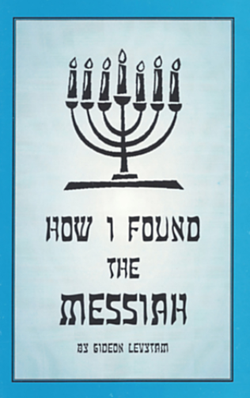
Follow Gideon Levytam's journey and discover how he was led by God, through a series of exciting circumstances, to find the One his people are still waiting for.
Past Episodes

Featured Offer
Follow Gideon Levytam's journey and discover how he was led by God, through a series of exciting circumstances, to find the One his people are still waiting for.
About Holy Scriptures and Israel
As time passed by, the Lord Yeshua took dear brother John Van Stormbroek to himself. The ministry of Holy Scriptures and Israel continued with additional development. In the early 1990’s, a weekly morning Bible class began which brother Gideon Levytam led regularly in the City of Toronto. This weekly open Bible class was held in the Willowdale assembly meeting hall. Eventually, a second mid-week evening Bible class was added. In April 2002, the need for an additional outreach Bible teaching meeting arose. We begun a Saturday (Shabbat) ministry meeting in which a systematic teaching of God’s word is presented to all who attend. Together we learn God’s Word, pray for each need and the salvation of Israel, and sing songs of worship unto our God, praising Him and our Lord Yeshua the Messiah.
In Mid 2004 we started to air on Joy 1250 Radio station a 15 minute Bible teaching program called "The Holy Scriptures and Israel" with Gideon Levytam. The broadcast teaches God’s word from a Hebrew Messianic perspective and has proved to be a blessing to many. It's now aired seven days a week. Our prayer is that many more of our Israeli people will have a clear understanding of who Yeshua is, why we all need him, and come to know him as their Lord and Messiah.
About Gideon Levytam
Contact Holy Scriptures and Israel with Gideon Levytam
426 Simcoe Street
Niagara-on-The-Lake
Ontario L0S 1J0
Canada
(905) 325-1234