

Acts 9:20-31, Part 1


Shaul’s Early Days of Ministry Part 1
Guest (Male): Shalom! Holy Scriptures and Israel is a ministry designed to share with the Jewish people the good news of the Lord Jesus, Yeshua the Messiah, and to instruct Christians on the Jewish roots of their faith. And now, teaching God's word from a Hebrew Messianic perspective, here is Gideon Levytam.
Gideon Levytam: Shabbat Shalom. We will turn today to the book of Acts, and we will go ahead and begin with reading the following verses. The verses that we have dealt with last Shabbat meeting was in chapter 9, verses 1 to 19. I would like today to continue from verse 20 of Acts 9 and read into verse 31.
Amazing to see how Shaul has come to know Yeshua the Messiah with this what we call the Damascus road experience. And he experienced something unique when Yeshua said to him, "Shaul, Shaul, why persecutest thou me?" And the Lord spoke to him from glory, from heaven. And then he said to him, "I am Yeshua, whom you are persecuting." And so Shaul responded to him, if you remember, and he said to him, "Lord, what will you have me to do?" And Yeshua gave him instruction and told him what to do: to go to Damascus and there to await for a person by the name of Hananya, who was going to come and lay his hands on him, give him his sight, that Shaul will continue on to serve his master, the Lord whom he first persecuted.
And so we read in verse 20 of chapter 9 of Acts: "And straightway he," this is Shaul, "preached the Messiah in the synagogues, that he is the son of God. But all that heard him were amazed and said, Is not this he that destroyed them which called on this name in Jerusalem, and came hither for the intent that he might bring them bound unto the chief priests? But Shaul increased the more in strength and confounded the Jews which dwelt in Damascus, proving that this is the very Messiah. And after that many days were fulfilled, the Jews took counsel to kill him. But their laying await was known of Shaul. And they watched the gates day and night to kill him. Then the disciples took him by night and let him down by the wall in a basket.
And when Shaul was come to Jerusalem, he assayed to join himself to the disciples, but they were all afraid of him and believed not that he was a disciple. But Bar Nabba took him and brought him to the apostles and declared unto them how he had seen the Lord in the way and that he had spoken to him, and how he had preached boldly at Damascus in the name of Yeshua. And he was with them coming in and going out at Jerusalem, and he spake boldly in the name of the Lord Yeshua, and disputed against the Grecians. But they went about to slay him. Which when the brethren knew, they brought him down to Caesarea and sent him forth to Tarsus. Then had the churches rest throughout all Judea and Galilee and Samaria and were edified, and walking in the fear of the Lord and in the comfort of the Holy Spirit were multiplied."
That is the end of the text for today, and here in this text is the last portion in that section of the book of Acts where we have Shaul mentioned, because for a while from here on, the Spirit of God is shifting from the service of Shaul, Saul, Paul to the service of Petros, Peter, Shimon Petros. But here we can see, brothers and sisters, that immediately after Shaul had accepted Yeshua the Messiah, he received his sight in a unique way when Hananya came to him and he laid his hand on him, and he received his sight.
And you remember what Yeshua said to Hananya, who was afraid to come to even speak to Shaul because he heard about Shaul, how he came from the city of Jerusalem and how he came for the purpose of taking the Hebrew believers from Damascus, bringing them to Jerusalem and causing them to be afflicted and ultimately many sought to kill. When he came to Damascus, and so Hananya needed to hear a word from the Lord, from the glorified Messiah, who said to him in verse 15 of chapter 9, "Go your way, for he is a chosen vessel unto me, to bear my name before the Gentiles and the kings and the children of Israel. For I will show him what a great things he must suffer for my name's sake."
Can you imagine, brothers and sisters, here is the man that brought letters from Jerusalem to Damascus in order to take those Jewish believers who were still mingling in the synagogue there in Damascus, to bring them to Jerusalem to cause them affliction. Here he is on the way to Damascus and he saw that great vision. He had this experience. He met Yeshua the Messiah on the road to Damascus and he got gloriously saved. There was a change in his life. Instead now of persecution of the Jewish believers, the Hebrew Christians, now he ends up taking side with them. He changed camps. He moved. He shifted from those who oppose the Messiah followers to those who continue in following Yeshua the Messiah.
And what happened here is the last verses we spoke about, verse 18 and 19. He received his sight, he was baptized—we talked about it last time—identified with the rejection of the Messiah in verse 18. He ate food and mingled with the disciples, and he was with them, he had fellowship with the believers in Damascus. Right now, there was a great change in the life of Shaul of Tarsus. Now, I want to mention one thing. Many times when we are talking about Shaul, people—at least they said it to me—they say, "Brother Gideon, you see Shaul, as long that he was Jewish, his name was Shaul. When he became a Christian, his name was changed to Paul."
Let me say that this is not what the Bible teaches us. Shaul was always Shaul and Paul at the same time because every Hebrew individual who lives outside of the land of Israel has more than one name. He has his Hebraic name and he also has his what is known to be the diaspora, the name that is not the Hebrew, the non-Hebrew name. And Shaul had two names. His name was Shaul, his Hebrew name, and he also was called Paul. And how do I know that he was having those two names all along? Because notice that, if you just turn the page to chapter 13 for a moment, in Acts chapter 13, look what the scripture says very clearly in verse 9 of Acts chapter 13: "When Saul, who also is called Paul, was filled with the Holy Spirit, he set his eyes on him."
Notice, the Bible gives us very clearly that his name was called Shaul—this is his Hebrew name—but he was also called Paul. Now, as long that he was in affiliation and in connection with his Hebrew brethren, the name Shaul was prominent. When he was beginning now to minister to the Gentile world with the minister in the Gospel all the time in the epistle, his name Paul is being used. But let us not misunderstand that he was a Jew and his name was Shaul and he became a Christian and his name became Paul. This is not what the Bible teaches. And when he became a believer in Yeshua the Messiah and he was reaching out for the Gentile world with the Gospel, he was oftentimes, if not all the time, used the name Paulos, Paul.
And therefore, here you can see that his name even after his conversion, after he became a believer in Yeshua, the book of Acts still calls him Shaul. Look now, we are moving on to the next verses, and you will see more than once that his name Shaul is mentioned as he's now the starting of his service to the Messiah among his own Jewish brethren. Notice that, first of all, in verses 20 to verse 25, we have Shaul's first experience of opposition. Up to this point, he was opposing all those Hebrew believers. He was consenting to the death of Stephen. He was the one that made havoc among the Jewish believers in Jerusalem. But right now there is a shift, there is a change. Now he's beginning to experience what he had done to those brethren of his before he became a believer in Yeshua.
And so notice that verses 20 to 25, first of all, you see the beautiful thing that Shaul began to preach in the synagogues in the city of Damascus. Verse 20 says, "Straightway he preached Messiah, Messiah in the synagogues, that he is the son of God." Now you notice that the word synagogues, in Hebrew we call it Batei Knesset or Beit Knesset, is in plural. There is no one synagogue, but there are many synagogues in Damascus. The Jewish community was a large Jewish community in Damascus. There were many synagogues, and you see Shaul going to the synagogues, began to present the person of the Messiah to his very own people, the Jewish people.
And notice what it says here: it says that he said to them, or he went to the preach the Messiah in a synagogue, that he is the son of God. You know, this is the only time in the book of Acts that we find the title "The Son of God" that Shaul was saying to his brethren in the synagogue about the Lord Yeshua being the Son of God. Later on in the epistles, he used the word "Son of God" many times. But here it is the first time that he is using this expression, "The Son of God." And we know this by experience, how much trouble we have with the truth that Yeshua the Messiah is the Son of God. You know how much trouble we as Jewish people have with this expression? "What do you mean, the Son of God? We have only one God," our people say. "God does not have a son," our Jewish community says.
Well, how can you say that God has a son? Well, you see, where did the apostle Paul get this information? He went to the synagogue, he was telling to his Jewish brothers in the synagogue that Yeshua the Messiah, who was going to come, he is the Son of God. Well, you know, there are many other passages, even before the New Testament were written, in the Tanakh, in the Old Testament, that God had described the coming Messiah as the son. For example, if we just read Psalm 2, the psalmist speaks and he says—and the Father is speaking about the Son—he says, "Kiss the Son." Psalm 2 and verse 12, "lest he be angry and ye perish from the way." This is the voice of the Holy Spirit who is speaking concerning the Messiah and giving a warning to the world, saying, "Kiss the Son, lest he be angry and you perish from the way."
If you go a little bit back in Psalm 2 and verse 7, Yeshua the Messiah prophetically speaking where he says, "I will declare a decree: the Lord had said unto me, You are my Son; this day have I begotten thee. Ask of me, and I shall give thee the heathen for thine inheritance." You see, the truth concerning Yeshua, the promised Messiah being the Son of God, is not only a New Testament teaching. Shaul did not have the New Testament when he went to the synagogues in Damascus. He just got saved. He just accepted the Messiah. But he taught them that this, the Messiah, is the Son of God. And we can go on to other verses. For example, Proverbs chapter 30 and verse 4: "Who has ascended into heaven and descended? Who have created all the ends of the earth? What is his name and what is his son's name? Can you tell?"
In the book of Proverbs chapter 30, we read, and even prior to what Solomon said, God promised David that there will be coming a day when his son, a descendant of David, is going to sit on the throne of David and God says, "I will be to him a father, and he will be to me a son." So there are plenty of information in the Old Testament, in the Tanakh, concerning the Messiah of Israel, who is also the Son of God. Remember what Isaiah said? "Unto us a child is born; unto us a son is given." You see, as a child in his humanity, he was born. As the Son of God in eternity past, he was given. We see his divine nature and his human nature united there in this passage that Isaiah spoken about.
And beautiful to see, so here is Shaul is going to the synagogue, and in verse 20 he's telling that the Messiah, the Mashiach, is the Son of God. Now when they have heard that, it says in verse 21, the amazement of those that have heard what Shaul was saying to them. It says in verse 21, "But all that heard him were amazed and said, Is not he that destroyed them which called on this name in Jerusalem, and came hither for that intent that he might bring them bound unto the chief priests?" You see, they were amazed. Now what would you do if you would have someone who would come to our midst here and he would seek to destroy and to kill and to take people, believers from this little local fellowship here and try to take away and to bring us bound and seeking ultimately to destroy those who believe in Yeshua the Messiah?
What would you do? What would I do? If there's all of a sudden a change in this person, and instead of coming and taking us away from here, coming and sitting in our midst and listening to the word and sharing with us his experience, how he became a believer in Yeshua the Messiah, we would be amazed. We'll say, "Wait a minute." We may not even trust that person. How can we have confidence? Yesterday you sought to destroy us, today you are coming to our synagogues and telling us that Yeshua is the Messiah and that Messiah is the Son of God? We would be amazed as well. So they were amazed and they said, "Look, how is it possible? Is not this he that destroyed them which called on this name?"
You see, when he was in Jerusalem with the Sanhedrin at that time, and when Stephen was stoned by the leadership at that time, Shaul was right there. He was consenting to the death of Stephen. And it was there that the Sanhedrin said also to Peter and to the others, that "We do not want you to preach in this name," and that was the name of Yeshua. And brothers and sisters, it's not only 2,000 years ago, up till today, every time you share with others the name of Yeshua, the opposition is still the same. And yet God says that in the name of Yeshua every knee will bow and every tongue will confess that Yeshua the Messiah is Lord to the glory of God the Father. And yet men by nature do not want to hear about the name of Yeshua. And what a lovely name he has. "And you shall call his name Yeshua," Matthew chapter 1, verse 21, for he will save, Hu Yoshia, he will save his people from their sins.
And so in verse 21, the amazement of the change in the life of Shaul. They were amazed in the synagogue in Damascus. And so, brothers and sisters, in the next verse, we see the growth of Shaul. It says in verse 22, "And Shaul have increased the more in strength." This is not physical strength. This is spiritual strength. Physical strength, we got to go to the exercise room and we do some exercise so we can get strong physically, but here it's a spiritual strength. Now, how do we know when a brother or a sister are growing spiritually and becoming strong in the Lord? Well, you know what? When a person is growing, you can say, "Well, this person spent time with the Lord. This individual is really learning from Yeshua. He's spending time, he's growing, he's developing spiritually."
That's what happened to Shaul. He grew, increased the more in strength, and he confounded the Jewish people that dwelt in Damascus, proving to them that this is the very Messiah. That's the thing that we have to do today with our own Jewish brothers: to just prove to them through the word of God with the help of the Spirit of God that the one that we are speaking of is the very Messiah. Which other the Messiah we have? Israel as a nation is waiting for the Messiah now for years and anticipating our own nation for the coming of the Messiah. You will hear these words about the Mashiach, "When the Messiah will come, we will be rejoicing, we will have Shalom, we will have peace." But for years they're awaiting on the Messiah and he hasn't come, according to our nation.
But Shaul is telling them in a synagogue, "Listen, this is the one that you do not want to hear of his name. He is the very promised Messiah of Israel. He is the Messiah. Accept him." And so he was continually confounded the Jewish people there that dwelt in Damascus, proving to them. And I can assure you, brothers and sisters, in order to prove, you got to take your Bible and open it, and it is the scripture that prove to us that Yeshua is the Messiah. It is God's word on a basis of the scripture that he could prove to them that Yeshua was the very promised Messiah of Israel. Now I want you to see here that we don't read it here in this passage and for some reason Luke the physician who wrote the book of Acts did not mention it here, but between verse 22 and verse 23...
Featured Offer
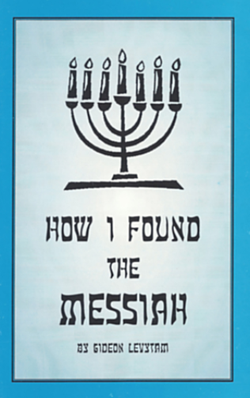
Follow Gideon Levytam's journey and discover how he was led by God, through a series of exciting circumstances, to find the One his people are still waiting for.
Past Episodes

Featured Offer
Follow Gideon Levytam's journey and discover how he was led by God, through a series of exciting circumstances, to find the One his people are still waiting for.
About Holy Scriptures and Israel
As time passed by, the Lord Yeshua took dear brother John Van Stormbroek to himself. The ministry of Holy Scriptures and Israel continued with additional development. In the early 1990’s, a weekly morning Bible class began which brother Gideon Levytam led regularly in the City of Toronto. This weekly open Bible class was held in the Willowdale assembly meeting hall. Eventually, a second mid-week evening Bible class was added. In April 2002, the need for an additional outreach Bible teaching meeting arose. We begun a Saturday (Shabbat) ministry meeting in which a systematic teaching of God’s word is presented to all who attend. Together we learn God’s Word, pray for each need and the salvation of Israel, and sing songs of worship unto our God, praising Him and our Lord Yeshua the Messiah.
In Mid 2004 we started to air on Joy 1250 Radio station a 15 minute Bible teaching program called "The Holy Scriptures and Israel" with Gideon Levytam. The broadcast teaches God’s word from a Hebrew Messianic perspective and has proved to be a blessing to many. It's now aired seven days a week. Our prayer is that many more of our Israeli people will have a clear understanding of who Yeshua is, why we all need him, and come to know him as their Lord and Messiah.
About Gideon Levytam
Contact Holy Scriptures and Israel with Gideon Levytam
426 Simcoe Street
Niagara-on-The-Lake
Ontario L0S 1J0
Canada
(905) 325-1234