

Acts 28:17-31, Part 1


Paul’s Appeal to The Jewish Community in Rome Part 1
Guest (Female): Shalom! Holy Scriptures and Israel is a ministry designed to share with the Jewish people the good news of the Lord Jesus Yeshua the Messiah and to instruct Christians on the Jewish roots of their faith. And now, teaching God's word from a Hebrew Messianic perspective, here is Gideon Levytam.
Gideon Levytam: Shabbat Shalom, everyone. Turn to Acts chapter 28, verses 17 to 31. And I believe again, as I've mentioned before, that this whole book is a very important book. By the time that it had been concluded by the pen of the Holy Spirit of God, the acts of the Holy Spirit of God still continue on through His servants, even up till this day.
And so we read, beloved brothers and sisters of the apostle Paul now in the city of Rome. Finally have arrived there, and now we see as the topic for today's message is "Paul's Appeal to His Jewish Brethren" in the city of Rome to accept the message of the gospel.
And it came to pass that after three days, Paul called the chief of the Jews together. And when they were come together, he said unto them, "Men and brethren, though I have committed nothing against the people or custom of our fathers, yet was I delivered prisoner from Jerusalem into the hands of the Romans, who, when they had examined me, would have let me go because there was no cause of death in me.
But when the Jews spoke against it, I was constrained to appeal unto Caesar, not that I had aught to accuse my nation of. For this cause therefore have I called for you to see you and to speak with you because that for the hope of Israel I am bound with this chain."
And they said unto him, "We neither received letters out of Judea concerning thee, neither any of the brethren that came showed or spoke any harm of thee. But we desire to hear of thee what thou thinkest, for as concerning this sect, we know that everywhere it is spoken against."
And when they had appointed him a day, there came many to him into his lodging, to whom he expounded and testified the kingdom of God, persuading them concerning Yeshua, both out of the law of Moses and out of the prophets, from morning till evening. And some believed the things which were spoken, and some believed not.
And when they agreed not among themselves, they departed after that Paul had spoken one word. "Well spake the Holy Spirit by Isaiah the prophet unto our fathers, saying, 'Go unto this people and say, "Hearing ye shall hear and shall not understand, and seeing ye shall see and shall not perceive. For the heart of this people is waxed gross, and their ears are dull of hearing, and their eyes have they closed, lest they should see with their eyes and hear with their ears and understand with their heart and should be converted and I should heal them."'"
"Be it known therefore unto you that the salvation of God is sent unto the Gentiles, and that they will hear it." And when he had said these words, the Jews departed and had great reasoning among themselves. And Paul dwelt two whole years in his own hired house and received all that came in unto him, preaching the kingdom of God and teaching those things which concern the Lord Yeshua the Messiah with all confidence, no man forbidding him.
And that's how, beloved brothers and sisters, the book of Acts ended with these specific last words here, the appeal of Paul, Sha'ul, to his Jewish brethren from the bottom of his heart concerning the person of our blessed Lord Yeshua the Messiah. I would like to remind you, beloved brothers and sisters, that Paul, though he was used by God to establish local assemblies, local churches among the Gentile world, yet he had always a burden in his heart to minister to his own brethren, the people of Israel.
And you can see it here in these last verses of the book of Acts, how this man, the first thing he does here where finally he arrived at the city of Rome, he practiced what he had taught in the letter to the Romans. He said, if you remember, in Romans chapter one and verse 16, he says, "For I am not ashamed of the gospel of the Messiah, for it is the power of God unto salvation to everyone that believeth."
And then he said to the Jew first, and also unto the Greek. And here the apostle Paul, being a prisoner bound in his hands, had gone through all this ordeal of the trip from Caesarea all the way to the city of Rome. He finally arrived at the city of Rome and the first thing that he does, he practiced what he preached.
And he says, "I'm going to share the message of the gospel with my Jewish brothers and sisters." And he could not go to the synagogue as he had done previously in many other cities where he preached the message of the gospel, but this time instead of going to the synagogue, he had invited the Jewish leaders to come to the very place where he had been living.
On and on throughout his ministry in the Gentile world, he always went to the Jewish people first. He had gone to the synagogue, spoke to his brethren, the Jewish people, and then turned to the nations and presented the messiahship of Yeshua to the nations of the world.
And what here he does in Acts chapter 28 in the city of Rome, the first thing he does, he presents the Messiah to the Jewish brethren. While he could not go to the synagogue, so he is inviting them into the place where he was staying. Now look at this, brothers and sisters, there are four points that we have here in Acts chapter 28, verses 17 to 31.
The first portion that we have, verses 17 to 20, the appeal of the apostle Paul to the Jewish leaders. In verses 21 and 22 of this chapter is the response or the answer of the Jewish leaders to Paul's appeal. Then in verses 23 to 29, Paul appeals again to the Jewish community, but this time not only to the leaders, but to the many who came to see and to hear what he had to say.
And finally, in verses 30 and 31, Paul's ongoing preaching of the kingdom of God while he was still chained for two years in the city of Rome. So let's go over this, beloved brothers and sisters in this ministry meeting. The first thing is verses 17 to 20, the appeal to the Jewish leaders.
Look at that, first of all, he's inviting them in verse 17a. It says here, "And it came to pass that after three days Paul called the chief of the Jewish people together." He is inviting the Jewish leaders to come to where he stayed. Now you notice that the previous verse 16, that he was in Rome, the centurion delivered the prisoners to prison, but when it comes to Paul, he allowed him to dwell by himself when a soldier kept him.
So Paul, Sha'ul, was remaining alone. He did not go to that prison where all the prisoners who came from Caesarea that arrived to Rome, he was not taken to a prison, but he was left alone, but he was always in chain to a soldier. The rest went to prison, and who knows, many of them may have died.
Maybe they took them into the stadiums where they were playing there with animals in Rome, and many of those prisoners perhaps have been killed while they were watched by the multitude, how the prisoners were fighting with an animals in the Roman arenas. But Paul at this time was alone, chained to a Roman soldier.
And the first thing he does, he doesn't wait too long. Three days pass by and he's calling the Jewish leaders to come to see him. And so in verse 17b to verse 20, we see that he shared his heart with the Jewish leaders of the city of Rome. And he began, of course, in verse 17b.
And look at this, what he does. He said unto them, "Men and brethren." The Hebrew word here is Anashim Achim. He's calling them these brethren. They were not brethren in the Messiah, but they were his brethren in the flesh. They were Achim, they were brethren in accordance to the national link that they have had.
He's Jewish, they are Jews. He's an Israeli, they are an Israelis. He's a Hebrew, they are Hebrews. They are part of the nation of Israel. And we today do the very same thing. There is a national brotherhood that all the Jewish communities around the world have to one towards another.
We belong to one nation called the nation of Israel, and we call each other Achim. That is a biblical way in which we find it in the Old Testament, you find it in the New Testament. You remember Psalm 133, where the psalmist said, "Behold, how good and how pleasant it is for brethren, for Achim, to dwell together in unity."
This is the way in which we who are Jewish communicate with each other even until today. And then he's telling them, "Men and brethren, though I have committed nothing against the people or the custom of our fathers, yet was I delivered prisoner from Jerusalem into the hands of the Romans."
He's saying to them, "Brethren, Achim, listen, I haven't done anything. I didn't commit anything wrong to the people," meaning to the Jewish community of Jerusalem when he was there in the temple, you remember earlier in the book of Acts where they have captured him and then they delivered him to the Roman. He says, "I didn't do anything against our custom."
And notice he said "the custom of our fathers." Now again, I want you to see, though the Jewish leaders were not believers in Yeshua, Paul was a believer in Yeshua, as far as he is concerned, what the fathers, what the prophets of old have spoken, it is our fathers. Paul's father and the Jewish leaders who did not yet believe, the fathers.
It was the fathers of our nation. I haven't committed anything wrong against not the people, not the customs of our fathers, yet I was delivered a prisoner from Jerusalem to the hands of the Roman. And you remember how previously, beloved brothers and sisters, he was delivered by the Jewish leaders to the Romans.
And the Roman soldiers have taken him, and the centurion have protected him, and all that ordeal that he had experienced in arriving finally to the city of Rome. And he says, "I'm guiltless. I haven't done anything wrong. There was no reason in the world that I will be here. I didn't do anything wrong."
But here I am in the city of Rome, bound with chain to a Roman soldier, a prisoner, because there was no guilt in me at all. And again, I want to emphasize, he's calling them brethren and he called them "our fathers." And this is the expression that you find Peter mentioning this already earlier in the book of Acts, Peter mentioning in Acts chapter two and verse 29 and verse 37.
And throughout the whole book of Acts when even Stephen was calling the brethren, the people of Israel, his brethren, he longed to share with them the message of the messiahship of Yeshua. So here's the apostle Paul now beginning to share with the leaders, the Jewish leaders, what he's on his heart. And so we continue on and now notice that in verse 18.
He says, "Listen, the Romans, they have examined me, they would have even let me go because there was no cause of death in me." Even the Roman soldiers and their commander, the centurion, and the Roman leaders, if you remember, Felix and Agrippa and all those that were there, Festus, they could not find any fault in Paul, in Sha'ul. There was nothing wrong that he have done.
And yet the Jewish leaders ended up letting him be taken by the Roman soldiers. So there was nothing that was wrong that he have done. The apostle Paul, verse 19, he spoke, "But when the Jews spoke against it, I was constrained to appeal unto Caesar, not that I had anything to accuse my nation." He says, "The reason that I'm here is not because I want to accuse my nation."
Again, he used the word "my nation." He always considered himself as part of the nation of Israel. And he says, "Listen, I'm not here to accuse my nation. I'm here because the leaders of Jerusalem have led me to the Romans and accuse me of something that I haven't done, and here I am in your presence today," he's mentioning in verse 19.
So he is now in verse 20, and that is a beautiful verse. And I really enjoy so much to read verse 20. He says the reason that I'm in this chain, and probably he lifted up his hand and he showed them his chain. "The reason, for this cause therefore have I called for you to see you and to speak with you because that for the hope of Israel I am bound with this chain."
You know why I have this chain in my hand? Do you know why I'm here, beloved Jewish brothers of the leadership of the city of Rome? I'm here because of the hope of Israel. And what is the hope of Israel? Tikvat Yisrael. The hope of Israel is nothing else but the blessed Lord Yeshua the Messiah, Israel's glorious Messiah. Who is the hope of Israel?
In other words, the God of Israel in the person of the Messiah of Israel is the hope of the nation of Israel. And Paul is saying to them in this verse 20, he says, "I am here because of the hope of Israel I'm bound with this chain." And you know there's a few times that the Old Testament speaks about the hope of Israel.
And one of them we read already earlier in our reading, but I want you to turn back with me to the prophet Yirmiyahu, Jeremiah, one more time for a moment, please. There are two passages that speaks about the hope of Israel in Jeremiah. Chapter 14 is the first time. And look what Jeremiah is writing by inspiration. We read in verse eight.
"Oh, hope of Israel, the savior thereof in a time of trouble. Why shouldest thou be as a stranger in the land and as a wayfaring man that turneth aside to tarry for a night?" God is speaking to the nation, and the cry it is, "Oh, the hope of Israel, Mikveh Yisrael." It is found here in Jeremiah chapter 14 and verse eight.
"The savior thereof in time of trouble." Why is it that You would be as a stranger in the land? And you know prophetically, when the Messiah Yeshua came, he became as a stranger to the nation. We read in the prophets and the Psalms, "I became as a stranger to my brethren." The Messiah Yeshua in his first coming became as a stranger to the nation.
And yet he was the hope of Israel. Mikveh Yisrael, Tikvat Yisrael. You know when Israel became a state in 1948, do you know what is the name of the national anthem? It is called Hatikvah, the hope. And if you read the national anthem and you will sing it, and you will notice that it is the hope of the Jewish people is to come back to the land.
The hope of the Jewish people is to restore as a nation, and it is always linked with the land and with the word of God and with the God of the nation of Israel, the God of our fathers. That is the hope of Israel. But when he came, the Messiah at his first coming, he was rejected, he was misunderstood, he was not accepted by the vast majority of the nation.
Specifically led by the spiritual leaders of Israel who did not acknowledge him. You notice that it says here in chapter 17 of the prophet Jeremiah where we read the passage today, in verse 13 it says, "Oh Lord, the hope of Israel, Mikveh Yisrael, all that forsake thee shall be ashamed. And they that depart from me shall be written in the earth, because they have forsaken the Lord, the fountain of the living waters."
Now you know many Bible teachers use this verse to remind us of what Yeshua the Messiah did in John chapter eight, where that sinning woman came to him and the Pharisees wanted to stone the woman. And remember, they asked him about this woman. He says, "What does the law say about her?" And of course, they expected from him to say that she should be stoned and die.
But he said to them, "Who is without sin, cast the first stone." And then he's laid on the ground and he began to write on the earth. And he may have wrote the name of every one of them that have been there present. And so it says here, "The hope of Israel, all that forsake thee shall be ashamed, and they that depart from me shall be written in the earth."
Because they have forsaken the Lord, the fountain of the living water. And some have applied this to what the Messiah Yeshua have done in John eight, when he was writing on the earth with his finger. And beloved brothers and sisters, he's the hope of Israel. The hope of Israel is the coming of the Mashiah.
The hope of Israel is the restoration of the nation. The hope of Israel is the Messianic kingdom. The hope of Israel is that which God have promised in the word of God. And Paul is speaking to the leaders of the Jewish community and of Rome, and he says, "Listen, for this cause therefore have I called you to see and to speak with you because for the hope of Israel I am bound with this chain."
The hope of Israel. Now it is also very interesting because the word Mikveh is mentioned here. Tikvah, Mikveh is what we usually use to speak of baptism. It's where the Mikveh is the gathering of water into one pit. That's called Mikveh, Mikvah. And one time it speaks of Mikveh, speaks of gathering of water into one location, and other time it speaks of the word for hope, that which is something that you look forward.
And it is interesting because the gathering of the water into one pit which we call Mikvah, where we do tevilah, baptism, it's really a gathering of the nation in time to come into a one pit, a one location where it is in the land of the Bible, in the Promised Land where God will be the one who will gather the nation into one place and He will reign and rule through the Messiah Yeshua over the nation of Israel.
So this interesting expression that Paul is mentioning, "For the hope of Israel I'm bound with this chain." One more time it's mentioned in Jeremiah chapter 50, in the same prophet, and verse six. "My people has been lost sheep, their shepherd have caused them to go astray. They have turned them away on the mountain. They have gone from the mountain to hill, they have forgotten their resting place."
"All that found them have devoured them, and their adversary said, 'We offend not because they have sinned against the Lord, the habitation of justice,' even the Lord," listen, the end of verse seven, "the hope of their fathers." The hope of Israel is none else but the Messiah Himself. The hope of the fathers of Israel is the restored nation, the kingdom that will come one day to fruition when Israel the nation will accept the Messiah.
And Paul sitting there bound in chain, telling the Jewish leaders who came in Rome to visit him, he says, "Listen, the reason that I'm here with this chain, it is because I stood and I spoke and I believe of the one that is the hope of our people Israel, and that's why I'm here with this chain."
So they responded now to him. Beloved, I'm back in Acts chapter 28, verse 21 and 22. The Jewish leaders answer him and they said, look, two things they said. Verse 21, they said to him, "We neither receive letters out of Judea concerning thee, neither any of the brethren that came showed or spoke any harm of thee."
Well, apparently those that accuse him in Jerusalem did not send any information to the Jewish community of Rome about Paul, Sha'ul. Those that have accused him and put him in the hand of the Roman leaders, they did not come to Rome, neither sent any letter to inform the Jewish community of Rome about this man by the name of Paul. So they didn't even come, they didn't even send anything.
So the Jewish community of Rome didn't hear about Paul's actions and condition. But then in verse 22, they said to him, "We desire to hear of thee what you think, for as concerning this sect, we know that everywhere it is spoken against." "Paul, we didn't hear anything about you, but you know what, Paul? We heard a lot about this sect."
"We heard a lot about this sect and everywhere where we hear about this sect, we hear things that are against the sect that is called the sect of the Notzrim or the Meshichim, the Messianic believers. We hear everywhere things against this sect." Now the word sect comes from the Greek word hairesis. You know we hear of a heresy.
We hear of somebody speaking false doctrine or false teaching. From the Greek, the word sect mean heresy, false teaching, something that these people are a sect of this, a sect of that. And the word sect is really giving us a red light, it's warning us, "Hey, listen, don't get involve with this sect." But I want you to understand that when it come to the book of Acts and the Jewish people speaking to the apostle Paul, the Jews of Rome speaking to the apostle Paul about this sect, it is the sect within the Jewish community.
There was a sect of the Pharisees. There was a sect of the Sadducees. There was a sect of the Nazarene, of the Notzrim, of the Meshichim. It is a section from among the Jewish community, the worldwide Jewish community. In Acts chapter five, we have the sect of the Sadducees mentioned. It's called Kat HaTzadokim.
Guest (Female): You have been listening to Holy Scriptures and Israel with Gideon Levytam. Gideon teaches God's word from a Hebrew Messianic perspective. For more information about this ministry, write Holy Scriptures and Israel, Box 1411 Niagara on the Lake, Ontario, L0S 1J0, or visit our website at holyscripturesandisrael.com.
You are also invited to Gideon's weekly Bible teaching on Fridays at 11:00 AM and 7:00 PM and Saturdays at 1:00 PM at Willowdale Christian Assembly Hall, 28 Martin Ross Avenue in Toronto. Holy Scriptures and Israel is made possible by your prayers and financial support. If you would like to support the program, visit holyscripturesandisrael.com. God bless you. Shalom shalom.
Featured Offer
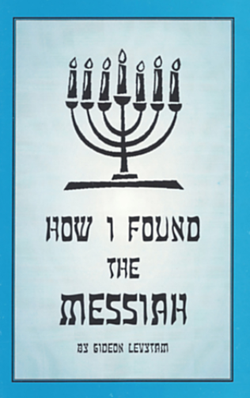
Follow Gideon Levytam's journey and discover how he was led by God, through a series of exciting circumstances, to find the One his people are still waiting for.
Past Episodes

Featured Offer
Follow Gideon Levytam's journey and discover how he was led by God, through a series of exciting circumstances, to find the One his people are still waiting for.
About Holy Scriptures and Israel
As time passed by, the Lord Yeshua took dear brother John Van Stormbroek to himself. The ministry of Holy Scriptures and Israel continued with additional development. In the early 1990’s, a weekly morning Bible class began which brother Gideon Levytam led regularly in the City of Toronto. This weekly open Bible class was held in the Willowdale assembly meeting hall. Eventually, a second mid-week evening Bible class was added. In April 2002, the need for an additional outreach Bible teaching meeting arose. We begun a Saturday (Shabbat) ministry meeting in which a systematic teaching of God’s word is presented to all who attend. Together we learn God’s Word, pray for each need and the salvation of Israel, and sing songs of worship unto our God, praising Him and our Lord Yeshua the Messiah.
In Mid 2004 we started to air on Joy 1250 Radio station a 15 minute Bible teaching program called "The Holy Scriptures and Israel" with Gideon Levytam. The broadcast teaches God’s word from a Hebrew Messianic perspective and has proved to be a blessing to many. It's now aired seven days a week. Our prayer is that many more of our Israeli people will have a clear understanding of who Yeshua is, why we all need him, and come to know him as their Lord and Messiah.
About Gideon Levytam
Contact Holy Scriptures and Israel with Gideon Levytam
426 Simcoe Street
Niagara-on-The-Lake
Ontario L0S 1J0
Canada
(905) 325-1234