

Acts 28:1-16, Part 3


Paul Arrives to The City of Rome Part 3
Guest (Female): Shalom. Holy Scriptures and Israel is a ministry designed to share with the Jewish people the good news of the Lord Jesus Yeshua the Messiah, and to instruct Christians on the Jewish roots of their faith.
Guest (Male): And now, teaching God's word from a Hebrew Messianic perspective, here is Gideon Levytam.
Gideon Levytam: The study of Acts chapter 28. And so you see, beloved brothers and sisters, the way that the enemy work, and yet God in His goodness, in His grace, preserving His servant to give a testimony to Yeshua the Messiah in the city of Rome.
And how precious it is here. They call him first of all a murderer, and when he shook the serpent and nothing happened to him, they called him a god. If Paul would have not been a true servant of the living God, he would expect some worship for himself. But Paul was not that kind of a man. He was a true humble servant of our Lord Jesus the Messiah. Instead of expecting some honor and glory to himself, he ended up bringing blessing on the people of Melita. In the next verses, verse 7, 8, 9, and 10, there is the miraculous healing of Publius' father and others that have been healed by God who had used the Apostle Paul in His service.
First of all, we find in verses 7 and 8, in the same quarters, in other words, in the same island, the same area, there were possessions of the chief men of the island. There was a man who was one of the chief men of the island. His name was Publius, who received us and he lodged us for three days courteously. Now, he used the word "us," and us includes Luke and all the 276 people who came from the sea and escaped the storm and landed in Melita. Can you imagine? Here is a gracious man. I don't know when was the last time you have hosted 276 people who were soaking wet with the rain coming upon them and much fear and destitute. He hosted 276 people.
You can see the graciousness of this man. He brought them into homes, tents, and huts that they had. He hosted them and he provided for them and he took care of them. What an amazing thing to experience here by this man by the name of Publius. He lodged them for three days courteously and graciously. When we go sometimes to visit our homeland in Israel and we take groups of tourists, sometimes we visit the Bedouins. Whether we are in Sinai or the Negev in the desert area, they invite us into their tent and we sit for a cup of coffee and they are hosting us. It is that Middle Eastern hospitality.
Melita is not in the Middle East, but that gracious hospitality is something to emulate, something to desire, to have a heart for hospitality. Here is a man, not a Messiah follower, yet hospitable. We are exhorted in the book of Hebrews to have hospitality. It is important for the people of God that we are exhorted to be hospitable. What an example we have here by this man who hosted those who came from the sea. But he had a problem. According to verse 8, the father of Publius was laying sick of fever and of a bloody flux. Apparently he was in a poor state. Paul entered in to the place and he prayed. He laid hands on him and he healed him.
The Apostle Paul first committed the need of the father of Publius to the Lord Yeshua the Messiah in prayer. We learned about it earlier on the ship. Before the ship broke, the Apostle Paul took the bread, he prayed, and he gave thanks. He gave it to the disciples, they all ate together, and the Lord met the need. Here we can see that there is sickness in the island of Melita. They needed help and the Apostle Paul did the thing that is natural to a believer. He committed the need to our Lord Yeshua the Messiah in prayer.
Remember the very command that Yeshua the Messiah gave to the early Hebrew disciples when He sent them away? He said to them that those preaching the message of the Gospel would not only take up serpents and nothing would harm them, but they would lay hands on the sick and they would recover. This is in Mark chapter 16 and verse 18. Look at the reality of the promise that had been given to the early apostles and disciples of our Lord Yeshua the Messiah. He prayed and laid his hand on him. By the way, it is not the hand of the Apostle Paul that did anything. It is simply identifying with the person.
The hand itself has no value. The laying on of hands is a Jewish biblical expression of identification, the way it had been done in the history of Israel. By the laying on of the hand, we identify with the person. It shows the care for that individual who was sick. Paul prayed to God, laying his hand in identification with the need, and God in His mercy healed him. That might give a reason to the people of Melita to say that here is a god again. But the Apostle Paul did not take glory for himself. He was a minister of the Gospel and he was simply doing the ministry that Yeshua gave him to do.
After doing that, other people in the island of Melita came. As it says in verse 9, when this was done, others also which had diseases in the island came and were healed. Again, Paul prayed, laid his hand on them, and the God of creation healed them. By the way, God may choose to heal one and He may choose not to heal others. Paul himself, the very fact that he did not see the viper there could very well suggest because of his eye problem that he did not see it. He besought the Lord three times to take this thorn that he had in his flesh. The Lord said to Paul, "My grace is sufficient."
In other words, I do not have to answer your prayer in the way that you want. I will answer your prayer in the way that I want. I may heal you and I may not. We do not command God to heal. If He wishes, He allows us to be the way we are. If He wishes, He totally restores us. It is His will that will ultimately come to pass. In this case, He chose to heal the father of Publius and those that were on the island of Melita. Many of them were healed. Verse 10 says they honored us with many honors, and when we departed, they laded us with such things as were necessary.
One more time, emphasize the word "barbarian." Don't ever for a moment think that when the Bible says barbarian that it speaks of people who are evil and bad. They behaved so kind and gracious to people that they never knew. Long before Publius' father was healed, they were gracious enough to host those that had a need. Barbarian simply means that they were not part of the culture of the day. They were foreigners to the Greek culture. They did not speak the language and therefore they are called barbarians. They need the Messiah just the same like the cultured individual who knows the language.
With those 10 verses, we covered the experience of the Apostle Paul on the island of Melita, the reaction of the Melitans to the viper bite, and the miraculous healing of many on the island. Let's move on to the next verses. In verses 11 to 15, there is a sailing from Melita to Italy and the final arrival to the city of Rome. Verse 11 says that after three months, they departed in a ship of Alexandria which had wintered in the island. They stayed in Melitus for three months. Now they are taking a third ship.
The first ship was in chapter 27 and verse 2. The second ship was in chapter 27 verse 6, and that was the ship that experienced shipwreck. Now it is the third ship that they are taking. It was an Egyptian ship from Alexandria that wintered there on this island. They had a sign on that ship called Castor and Pollux. They are called the twin brothers, the sons of Zeus. Many looked at them as gods and they worshiped them. They were supposed to be the gods of the sea to help the sailors. They took that ship that had this sign and began to sail towards Rome.
In verse 12, there is the landing in Syracuse, and then they tarried for three days. In verse 13, they fetched a compass and came to Rhegium. After one day, the south wind blew and they came to Puteoli. On this three days' journey, they went from Melitus to Syracuse, to Rhegium, and then to Puteoli. There in Puteoli, they found believers. The Gospel was spreading. Many had heard the message of the Gospel and local assemblies and congregations had been established. We read that they found brethren.
The Hebrew word for brethren is Achim. These are believers in the Lord Jesus the Messiah. They desired that Paul would tarry with them for seven days. He stayed in Puteoli for seven days. That reminds me of what they had already experienced in Sidon earlier, where he met believers who refreshed the Apostle Paul. He spent seven days with them and had good fellowship. They gathered together and had special meetings. Sha'ul was a Jewish rabbi, but he was also a believer in Yeshua the Messiah. To these brethren, he shared of the beauty of the Lord, the grace of God, and the need to follow Yeshua. I can assure you that he sat with them under the sound of the word and they had a wonderful time.
In verse 14, it says that they went toward Rome. From Puteoli all the way to Rome is about 125 miles, and the Apostle Paul did not do this journey with a ship. He did this journey by land as a prisoner bound in chains. The centurion and the soldiers were taking him. Paul was going to stand before Caesar to be judged. If he were guilty, he would be condemned. If he were not guilty, he would be acquitted. They did this journey by land on the Appian Way. They were heading towards the city of Rome.
In verse 15, we find out the brethren from Rome. These are Jewish and Gentile believers in Yeshua the Messiah. When they heard that Paul had arrived at Puteoli and was on the way to Rome, they sent groups to meet with him. Apparently they sent two groups. Verse 15 says that when the brethren heard of us, they came to meet us as far as Appii Forum and the Three Taverns. Those are the two places mentioned here. The brethren came about 40-something miles while Paul and the rest of the people took the rest of the journey and they met in those two places. When Paul saw them, he thanked God and took courage. It was an encouragement to Paul to meet the brethren in Rome.
Apparently these believers in the city of Rome had already received the epistle that he wrote to the Romans. They had heard about this servant of the Lord and they wanted to see him. He always wanted to get to Rome. He said in the first chapter of Romans that he was ready to preach the Gospel unto those in Rome. He was ready to come but had been hindered. There were many hindrances that happened to him and he could not arrive. But now he was heading there. Rome is the central place of the Roman Empire. Every road leads to Rome.
Ultimately he would lose his life and die in the city of Rome. But in verse 15, they met him. Those two groups of believers from the assembly at Rome met him and he was encouraged by the visit. I can imagine that when you are in prison, held by a chain, and when you have experienced that awful experience on the sea for 500 miles, what a refreshment it was for his own heart to meet the brothers and sisters who came from the city of Rome. Finally, in verse 16, he arrived at the city of Rome.
When they came to Rome, the centurion delivered the prisoners to the captain of the guard, but Paul was suffered to dwell by himself with a soldier that kept him. It must be an amazing thing how they treated him. This centurion and the soldiers had traveled with him for many, many days. They spent three months with him in Melitus and much time in Caesarea. They had spent a lot of time with him. The centurion delivered the prisoners, but with Paul, he did something different. He suffered Paul to dwell by himself with a soldier that kept him.
Can you imagine what happened to this man by the name of Julius the centurion when he spent so much time with Paul? Paul shared with him the message of the Gospel. He talked with him about the need to be right with God. You need your sins forgiven and the Messiah came and died for the sin of this world. This centurion saw the difference in Sha'ul. He saw that he was not a criminal. He saw that he was not an evil man. He saw the Messiah in the life of the Apostle Paul. He saw his behavior, his conduct, his faithfulness, and his preaching of the person that is able to give salvation.
He must have been so influenced by the message of the Apostle Paul that he treated him so well all along. I personally believe that this centurion became a believer in Yeshua the Messiah through the preaching of the Apostle Paul. I believe many soldiers who had taken the journey and hearing him must have heard the message of the Gospel throughout the journey as they spent time on the ship, on the island, and all the way to the city of Rome. They heard again and again the message of the love of God.
I want to make a reference back to chapter 24 and verse 23 where Paul defended himself before Felix. When Felix heard of these things, having a more perfect knowledge of that way, he deferred them. He commanded the centurion to keep Paul and to let him have liberty, and that he should forbid none of his acquaintance to minister or come unto him. Already then, Felix and this centurion had given to Paul liberty to have visitors when he was kept in the city of Caesarea.
In chapter 27 and verse 3, it says that the next day we launched at Sidon and Julius, this centurion, courteously entreated Paul and gave him liberty to go unto his friends to refresh himself. You see, they knew that there was no fault with Paul. They knew that he was innocent. But he was there because of the testimony that he had to the Messiahip of Yeshua. Doesn't it remind you of John, the one who was taken to the island of Patmos? He himself said that he was on the island because of the testimony that he gave to the person and the work of Yeshua the Messiah.
That is the only reason that John and Paul found themselves in chains or outcast. It is because they had given testimony to Yeshua the Messiah. We have no idea of these kinds of experiences in our life. Sometimes we feel so offended because somebody speaks against us or treats us not so nice. Can you imagine how these brethren must have felt when they were rejected by their own brethren and despised by the men of this world? The rulers and the leaders cast them away, put them in prison, and they ended up suffering for the name of Yeshua the Messiah.
We have no idea whatsoever. The only thing we can do is thank God for His mercy towards us, who gives us what He allows us to enjoy today. He challenges us to seek to follow Him even when things are well and comfortable for us. He still wants us to stay close to Him, to follow after Him, to seek to minister to others, and to share with others the message of the love of God that is found through our Lord Yeshua the Messiah.
Guest (Male): You have been listening to the Holy Scriptures and Israel with Gideon Levytam. Gideon teaches God's word from a Hebrew Messianic perspective. For more information about this ministry, write to Holy Scriptures and Israel, Box 1411, Niagara-on-the-Lake, Ontario, L0S 1J0, or visit our website at holyscripturesandisrael.com.
You are also invited to Gideon's weekly Bible teaching on Fridays at 11:00 AM and 7:00 PM and Saturdays at 1:00 PM at Willowdale Christian Assembly Hall, 28 Martin Ross Avenue in Toronto. Holy Scriptures and Israel is made possible by your prayers and financial support. If you would like to support the program, visit holyscripturesandisrael.com. God bless you. Shalom, shalom.
Featured Offer
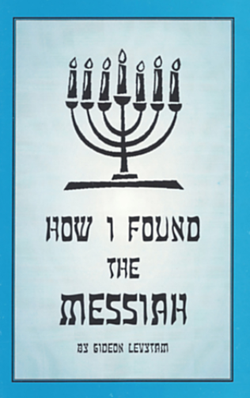
Follow Gideon Levytam's journey and discover how he was led by God, through a series of exciting circumstances, to find the One his people are still waiting for.
Past Episodes

Featured Offer
Follow Gideon Levytam's journey and discover how he was led by God, through a series of exciting circumstances, to find the One his people are still waiting for.
About Holy Scriptures and Israel
As time passed by, the Lord Yeshua took dear brother John Van Stormbroek to himself. The ministry of Holy Scriptures and Israel continued with additional development. In the early 1990’s, a weekly morning Bible class began which brother Gideon Levytam led regularly in the City of Toronto. This weekly open Bible class was held in the Willowdale assembly meeting hall. Eventually, a second mid-week evening Bible class was added. In April 2002, the need for an additional outreach Bible teaching meeting arose. We begun a Saturday (Shabbat) ministry meeting in which a systematic teaching of God’s word is presented to all who attend. Together we learn God’s Word, pray for each need and the salvation of Israel, and sing songs of worship unto our God, praising Him and our Lord Yeshua the Messiah.
In Mid 2004 we started to air on Joy 1250 Radio station a 15 minute Bible teaching program called "The Holy Scriptures and Israel" with Gideon Levytam. The broadcast teaches God’s word from a Hebrew Messianic perspective and has proved to be a blessing to many. It's now aired seven days a week. Our prayer is that many more of our Israeli people will have a clear understanding of who Yeshua is, why we all need him, and come to know him as their Lord and Messiah.
About Gideon Levytam
Contact Holy Scriptures and Israel with Gideon Levytam
426 Simcoe Street
Niagara-on-The-Lake
Ontario L0S 1J0
Canada
(905) 325-1234