

Acts 26:1-32, Part 2


Paul’s Defense Before King Agrippa Part 2
Guest (Male): Shalom. Holy Scriptures and Israel is a ministry designed to share with the Jewish people the good news of the Lord Jesus Yeshua the Messiah and to instruct Christians on the Jewish roots of their faith. And now, teaching God's word from a Hebrew Messianic perspective, here is Gideon Levytam.
Gideon Levytam: The study of Acts chapter 26. Now, I want you to notice, beloved brothers and sisters, he says, "unto which promise our 12 tribes instantly serving God night and day." Now, he used the word 12 tribes. At about 722 BC, the northern tribes of Israel, ten tribes, were taken captive by the Assyrians. Many people over the years today are teaching us that they are the lost ten tribes, but the Bible doesn't teach that. The Apostle Paul says at that time, this is about 50-something AD, he is speaking about the tribes of Israel, the 12 tribes of Israel worshiped God night and day.
Well, there is no such thing in the theology of the Apostle Paul that there are ten lost tribes. Whoever is bringing this theology, it's not found in the Bible because even though the ten tribes were carried captives by the Assyrians in 722 BC, many of them migrated and mingled with the rest of the two tribes of Judah and Benjamin, like Hannah from the tribe of Asher found in Luke chapter 2. And many others who mingled with the rest of the nation, the two tribes, and they are part of these 12 tribes.
There are those who believe in the ten lost tribes and then there are all kind of doctrines coming. Some claim that they are the ten lost tribes in Britain and other places. There is all sort of teaching came over these claims of the lost tribes. Well, they are not lost to God, and the Apostle Paul apparently knew his word pretty well. He could not say only two tribes because the other ones are lost. He says, "unto which promise our 12 tribes instantly serving God night and day."
Why night and day? Because in the Hebrew calendar, the day does not begin in the morning. It begins in the evening. And it was evening and morning the first day, night and day, night and day. Not day and night, but night and day. This is biblical accounting of a full day. It began in the evening and it ends at the end of the second day. So it's evening and morning and not morning and evening.
Just to elaborate this a little bit about this interesting word, "the 12 tribes," I would like you just for a moment to turn with me to the book of Ya'akov, James chapter 1. You will notice that Ya'akov also, James his name, his Hebrew name is Ya'akov. James in chapter 1 also wrote to the 12 tribes when he was writing his epistle, his letter. James chapter 1 and verse 1, it says here, "Ya'akov, James, a servant of God and of our Lord Yeshua the Messiah, to the 12 tribes which are scattered abroad, greetings."
Ya'akov wrote to the 12 tribes. They were scattered, yes, but he knew that those 12 tribes are in existence. There was not some tribes are lost and some tribes are not lost. No, as far as the scripture is concerned, the 12 tribes are in existence. God knew them, and also the people of Israel knew of them, even though, yes, it's true that the ten tribes were taken captive by the Assyrians in 722 BC, but they were not lost to God and they were not lost totally from among the nation of Israel.
Let me show you another verse that is interesting in Matthew chapter 19. If you just turn there for a moment, Yeshua in his life before his death pointed to the 12 tribes in Matthew chapter 19 and verse 28. And Yeshua said unto them, "Verily I say unto you, that ye which have followed me in the regeneration," this is in the Messianic Kingdom, "when the son of man shall sit in the throne of his glory, you shall sit upon the 12 thrones, judging the 12 tribes of Israel." Shnem asar shivtei yisrael, we say in Hebrew, the 12 tribes of Israel.
So there are 12 tribes, and even though with all the dispersion of the northern tribes, later on the southern tribes by the Babylonian, over the generation God preserved the 12 tribes and ultimately in the regeneration in the Messianic Kingdom, all those 12 tribes will participate in the Messianic Kingdom. That will be a wonderful day to come. What a day that will be when Israel the nation will gather then and everyone from the tribes of Israel will be part of the future day.
Now one more verse to read here. The last verse about this I want to read in Revelation 21. In the eternal order, beloved brothers and sisters, we can see the 12 tribes of Israel, also their names are mentioned even in the future day of the eternal order that we have from chapter 21, and I'm reading in verse 12. "And had a wall," this is the heavenly city of Jerusalem, "great and high, and had 12 gates, and at the gate 12 angels, and the names written thereon which are the names of the 12 tribes of the children of Israel."
God ever see his nation, his people, even though they are scattered and divided. He sees them as a unity, one company, the 12 tribes of the children of Israel. So Paul speaking to King Agrippa, he says, "King Agrippa, I'm telling you, I'm being condemned today because I believe in the promises that God had given to my forefathers, to our nation, concerning, number one, the coming of the Messiah and then the promises that the 12 tribes of Israel."
But even more, now he says in verse 8, "Why should it be thought a thing incredible with you that God should raise the dead?" King Agrippa, we believe in the resurrection of the Messiah and in the resurrection of the coming day of all those that have trusted in God and in Yeshua the Messiah. And the resurrection of the Messiah was taught in the Hebrew Scriptures. Isaiah 53, where God spoke about the death of the Messiah, and he promised to Yeshua the Messiah, "He shall see his seed." He's speaking about the resurrection of the Messiah.
Notice Isaiah 53:10. It says, "Yet it pleased the Lord to bruise him; he has put him to grief." This is the Messiah in his death. "When you shall make his soul an offering for sin," when he finished the work on the cross, "he shall see his seed; he shall prolong his days, and the pleasure of the Lord shall prosper in his hand." In other words, the Messiah Yeshua will be resurrected and he will prolong his days. If he died, yes, he did, but his days will be prolonged because God is going to resurrect Yeshua the Messiah from among the dead.
And that resurrection had been promised, Isaiah 53:10, Psalm 16:10. The resurrection of the dead in Daniel chapter 12 and verses 1 and 2, and Isaiah 26. There are many, many passages that speak about the resurrection of the Messiah, but also the resurrection of the believers who believed in Yeshua the Messiah. Well, this is those verses in verses 4 to 5. He looked at the past, and now he's turning to the present and he says, "Look what I'm being accused of, because I believe that Yeshua is the Messiah and that he had risen from among the dead."
Now, brothers and sisters, I can assure you that you probably feel very much the same. When we today, those of us who are Jewish here, when we speak to our people, they are saying to us the very same thing today. They say, "How could you believe that Yeshua is the Messiah?" Well, I tell you how, and I open the text from the Bible and I show you why I believe that Yeshua is the Messiah. Because our forefathers, our own forefathers received this information. It is in the word of God. The problem is not with the believer. The problem is with those who reject the simple ABC that is given to us in God's holy word.
So now in verse 9, 10, and 11, Paul confess to his own persecution. I'm sure that throughout the history of the life of Sha'ul Paul, he always remembered what he had done to his Jewish brethren when he persecuted some of them unto death because he thought that he is doing right thing for the God of Abraham, Isaac, and Jacob. And he brings this here in his testimony. First of all in verse 9, he was so hostile to the name of Yeshua from Nazaret. He says, "I verily thought with myself that I ought to do many things contrary to the name of Yeshua min-Nazaret."
I felt that I have to be against the name of Yeshua. Notice it use the word "the name." This is a despised name today. People despise the name of Jesus, of Yeshua. And it started years ago when Yeshua was on Earth among our own nation of Israel. He was not acknowledged, rejected by our own people. Rejected today by the nations of the world. Don't tell me about this Jesus. I don't want to hear about this Yeshua. I have nothing to do with his name, with his person.
And yet, beloved brothers and sisters, the Bible says, "There is none other name given among men whereby we must be saved." Acts chapter 4 and verse 12. We have many passages in the Scripture and God says that he will give him a name that is above every name, that at the name of Yeshua, Jesus, every knee will bow and every tongue will confess that Yeshua Jesus the Messiah is Lord to the glory of God the Father. And Paul was not this one before he became a believer. He was contrary to the name of Yeshua.
Notice it doesn't only say Yeshua, but Yeshua from Nazaret, from Nazareth, min-Nazaret in Hebrew. Nazaret, it is a city in Galilee, a small town, insignificant, unimportant. "Can any good thing come out of Nazaret?" we were told that the question was come. And yes, the good thing that come out of Nazaret is that man, that lover of our souls, the Son of God, the Mashiah of Israel, who came, was born in Bethlehem, but lived his life in the city of Nazaret in obscurity, in humility, in simplicity.
The word netzer, it's a shoot that come out of the ground. In his lowliness he grew up in submissiveness to his family, to his mother and to his stepfather, in obedience to God. What a man he was, but here we have Sha'ul contrary to the man from Nazaret. And that's why he was so much offended when Jewish believers had followed this man from Nazaret. So he said, "I thought that I will be contrary" in verse 9 "to the name of Yeshua from Nazaret." Notice what he says in verse 10.
"Which thing I also did in Yerushalayim; and many of the saints I shut up in prison, having received authority of the chief priests; and when they were put to death, I gave my voice," or my vote, "against them." In other words, in olden time they used to give votes against those, against and for. So when in the Sanhedrin when there was the voting against the Jewish believers, Paul said, "I cast a vote. I voted against those Jewish people who believe in Yeshua. I voted for persecution of those people."
Notice that he use this expression here, "I did shut up in prison." And then "I received authority from the chief priest." In other words, they gave him letters and so on. "And when they were put to death." Now here we learn something we don't have in other passages. Apparently first century Jewish believer, and I'm emphasizing Jewish believers because at that time the Pharisees and the Sanhedrin didn't deal with non-Jewish people. They dealt with those of their own who have gone astray. And therefore what he's really saying here, some of them have been put to death.
And he says, "I voted for that thing to happen." He participated in persecution of Hebrew believers in Yeshua the Messiah. I want again and again to underline that Sha'ul did not persecute Gentile Christians, but Jewish Christians. He didn't persecute non-Jewish believers, but he persecuted Jewish believers of his own people. And how do we know it? Look at the next verse, beloved brothers and sisters, verse 11. He punished Jewish believers that confessed that Yeshua is the Messiah by compelling them, by going against them, by persecuting them.
Notice that verse 11, "I punished them often in every synagogue." Now who go to the synagogue? Only Jewish people going to the synagogue. We're not talking about any church group here because apparently in first century, Jewish believers still went to the synagogue. It was a time of transition that they need to understand that now in the body of Christ, the body of Messiah, Jewish and non-Jewish people are united in one body. They needed to understand that, but they were in the process of maturity.
They still went to the synagogue, and as they go to the synagogue, they were sitting among their Jewish brethren who did not believe as yet, and they were worshipping God in that way, but they believed that Yeshua was the Messiah. So Sha'ul, he says in verse 11, "I punished them often in every synagogue." So notice, every synagogue. It was not only one synagogue. It was going from synagogue to synagogue, in Hebrew we call it Beit Knesset, a place of the gathering of our Jewish people, Beit Knesset. From Beit Knesset to Beit Knesset, from synagogue to synagogue.
And what did he do? Number one, he compelled them to blaspheme. In other words, what he wanted them to do, he forced them to blaspheme against the name of Yeshua. Apparently they didn't, because when they didn't, they end up being in prison and some lost their life. But he forced them, he sought to compel them to blaspheme the name of Yeshua the Messiah. And then notice that he was exceedingly against them. That was his life mission to go against these Hebrew believers.
And then notice it says at the end, "I was persecuting them even unto the strange cities." Now again I want you to notice, it's not one city but many cities. We always read Damascus. So he gone to Damascus, one city of Damascus. But that is not so. Long before he ever arrived to Damascus to persecute those Jewish brethren of his who believe in Yeshua, he have gone to many other cities and to many other synagogues seeking to persecute those early first century Jewish believers in Yeshua the Messiah.
So it is interesting to see how much information we get here from Sha'ul Paul as he testify here before King Agrippa. So we move on now in the next portion of this chapter, from verse 12 to verse 18. Paul now once again has an opportunity to rehearse his Damascus experience. He is now telling the story. This is very important for us to do in our life. When somebody ask us about what we believe and why we believe, in whom we believe, we don't need to know to be scholars.
We only need to be faithful to what we do know. I know that once I was blind and now I see. I know that once I was lost and now I am found. And we tell how we became believers in Yeshua the Messiah. And every time we rehearse the story, it become again precious to our hearts. And I'm sure you can remember, and I remember the days when I have been exposed to the message of the Gospel. And I tell you, I'm Jewish, and in the beginning I said, "I don't want to hear about that. I'm Jewish. I'm not going to do such a thing."
Why my grandfather is not a believer in Yeshua? If Yeshua is the Messiah, why my family are not believers? And I was really resisting the message that had been proclaimed to me because I said I'm Jewish, I don't believe in this stuff. We believe in the true and living God, and the God of Abraham, Isaac, and Jacob, the God of Israel. Well, the truth of the matter is that Yeshua is the one whom the God of Abraham, Isaac, and Jacob had promised that he will come, that he will pay for the penalty of our sin and sins, and that he will save not only Israel but the nations of the world.
Just open the prophets, just read it in the Hebrew Tanakh and Hebrew Nevi'im and Ketuvim. It is right there in the scripture. So Paul is saying in verse 12, "Whereupon as I went to Damascus." Look what happened to me, King Agrippa. "I went with authority and the commission from the chief priest." Apparently he became responsible over the persecution of his Jewish brethren who believe in Yeshua. That was his mission. "I got letters, I've been commissioned, I had authority to do what I am doing."
But then look what happened to me, King Agrippa. "At midday, oh king, I saw in the way a light from heaven, above the brightness of the sun, shining round about me and them which journeyed with me. And when we were all fallen to the earth, I heard a voice speaking unto me in the Hebrew tongue, language. Sha'ul, Sha'ul lama tirdefeni. In English, Sha'ul, Sha'ul, why persecutest thou me? It is hard for thee to kick against the pricks."
"And I said, 'Who are thou, Lord?' And he said, 'I am Yeshua whom you persecute. Ani Yeshua asher ata rodef oto,' it's in Hebrew. But he says, 'Rise, stand upon thy feet, for I have appeared unto thee for this purpose: to make thee a servant and a witness both of these things which thou hast seen and of those things in the which I will appear unto thee. Delivering thee from the people and from the Gentiles unto whom now I send thee, to open their eyes and to turn them from darkness to light and from power of Satan unto God, that they may receive forgiveness of sins and inheritance among them which are sanctified by faith that is in me.'"
So what Sha'ul Paul did here, he simply rehearsed again of his experience on the way to Damascus that is found in Acts chapter 9. What I like about this is there is always a progression. When Sha'ul Paul had actually experienced this in chapter 9, in verse 3 he only saw a light according to the experience that we read in Acts chapter 9 and verse 3. But then when he shared this in chapter 22, he didn't say, "I've seen a light." "I've seen a great light." Acts chapter 22 and verse 6.
But now this is the third time, and he is now does not only say a light. It doesn't only say a great light, but he says, "I saw in the way a light from heaven, above the brightness of the sun." So it seem to be, beloved brothers and sisters, that there is a progression in the appreciation by Sha'ul Paul of the person and the work of Yeshua the Messiah. That light that is brighter than the sun, it could only be the Shekhinah, the Shekhinah glory of God.
The manifest Shekhinah glory that God revealed to Sha'ul Paul on the way to Damascus. A light, Acts 9:3. A great light, Acts 22:6. A light above the brightness of the sun, Acts 26 and verse 13. You can see a growth and appreciation. And it should be with us as well. I hope that the Lord will help us to appreciate Yeshua and the work that he have done for us and his glory, the Son of God, God the Son who became a man and suffered for our sins and now he is resurrected and seated at the right hand of the Majesty on high interceding on our behalf.
It is a wonderful thought to meditate upon, to appreciate the Lord Yeshua the Messiah in the testimony. And what Yeshua told him, he says, "Sha'ul, Sha'ul, why, lama tirdefeni, why do you persecute me?" When Paul, Sha'ul was persecuting his Jewish brethren, he was actually persecuting the head of the body who is in heaven. Every time there is a persecution of the believers here on Earth, it's always a persecution of the Messiah as well as the head of the body. He is the head, the believers are the body, the church, the assembly is the body, and we are linked with him.
So when there is a persecution of believers, is actually a persecution of Yeshua the Messiah. So you notice he said to him, "It is hard for thee to kick against the goads." That goad or that prick is really the sting that a farmer would give to an ox when he farmed the land. Or when we sit on a horse and we ride, we kick him in the side. And what we do is we poking him so he will be actually active and do faster the work that he has to do.
Well, Paul was kicking, resisting what Yeshua was doing in his life, resisting the message of the Gospel. He said, "It is hard for thee to kick against the goads" is a resisting against the poking of the Lord as he was speaking to him concerning his Messiahship. And brothers and sisters, who of us can say, "I have never resisted. I've accepted the Lord immediately"? No, we resisted the message. And I'm sure today as we preach the message of the Gospel, there are those who resist the message, who go against it saying, "No, it's not for me. Yeshua is not for me. He didn't die for my sins."
And really it is exactly like Paul Sha'ul did, is kicking against the pricks, against the goad that the Lord was sharing through his servants resisting the message of the Gospel. And so at the end he ask him, "Lord, who are you?" and Yeshua said to him, "I am Yeshua whom you are persecuting." Then he told him arise, verse 16. He was sending him to be a messenger of Yeshua the Messiah, a minister in order to be a witness unto him unto many of the Gentile world concerning the person of the Messiah. Notice in verse 17 and 18, he says, "I will deliver you from people."
Guest (Male): You've been listening to Holy Scriptures and Israel with Gideon Levytam. Gideon teaches God's word from a Hebrew Messianic perspective. For more information about this ministry, write to Holy Scriptures and Israel, Box 1411, Niagara-on-the-Lake, Ontario, L0S 1J0, or visit our website at holyscripturesandisrael.com. You are also invited to Gideon's weekly Bible teaching on Fridays at 11:00 AM and 7:00 PM and Saturdays at 1:00 PM at Willowdale Christian Assembly Hall, 28 Martin Ross Avenue in Toronto. Holy Scriptures and Israel is made possible by your prayers and financial support. If you would like to support the program, visit holyscripturesandisrael.com. God bless you. Shalom, shalom.
Featured Offer
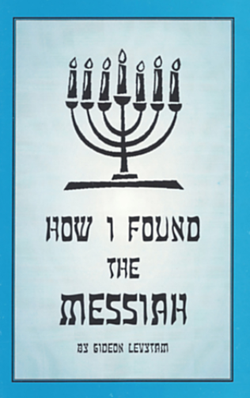
Follow Gideon Levytam's journey and discover how he was led by God, through a series of exciting circumstances, to find the One his people are still waiting for.
Past Episodes

Featured Offer
Follow Gideon Levytam's journey and discover how he was led by God, through a series of exciting circumstances, to find the One his people are still waiting for.
About Holy Scriptures and Israel
As time passed by, the Lord Yeshua took dear brother John Van Stormbroek to himself. The ministry of Holy Scriptures and Israel continued with additional development. In the early 1990’s, a weekly morning Bible class began which brother Gideon Levytam led regularly in the City of Toronto. This weekly open Bible class was held in the Willowdale assembly meeting hall. Eventually, a second mid-week evening Bible class was added. In April 2002, the need for an additional outreach Bible teaching meeting arose. We begun a Saturday (Shabbat) ministry meeting in which a systematic teaching of God’s word is presented to all who attend. Together we learn God’s Word, pray for each need and the salvation of Israel, and sing songs of worship unto our God, praising Him and our Lord Yeshua the Messiah.
In Mid 2004 we started to air on Joy 1250 Radio station a 15 minute Bible teaching program called "The Holy Scriptures and Israel" with Gideon Levytam. The broadcast teaches God’s word from a Hebrew Messianic perspective and has proved to be a blessing to many. It's now aired seven days a week. Our prayer is that many more of our Israeli people will have a clear understanding of who Yeshua is, why we all need him, and come to know him as their Lord and Messiah.
About Gideon Levytam
Contact Holy Scriptures and Israel with Gideon Levytam
426 Simcoe Street
Niagara-on-The-Lake
Ontario L0S 1J0
Canada
(905) 325-1234