

Acts 25:1-27, Part 2


Paul’s Testimony Before Festus The New Governor Part 2
Narrator: Shalom. Holy Scriptures and Israel is a ministry designed to share with the Jewish people the good news of the Lord Jesus, Yeshua the Messiah, and to instruct Christians on the Jewish roots of their faith. And now teaching God's word from a Hebrew Messianic perspective, here is Gideon Levytam.
Gideon Levytam: The study of Acts chapter 25. They want to awaken this issue with this person by the name of Paul. You know why? Because they did not like at all what he has done. They believed that he was such an influence upon the world that he caused a lot of people, some Jewish people as well, to move out of what they have known and introduce to them what is known the new way, the way of the following of the men from Nazareth.
And so they did not want to keep this situation dead, if it will. They wanted to bring it up to the surface and they ask him, notice, they have a plan again. And the plan was they ask him a favor. You know who it was? It was the high priest. By now it was a new high priest. It was not the old one that was there before. It was a newer one. He was replaced.
And also the leaders, the chief of the Jews. This is the leadership from the Sanhedrin. They informed him against Paul. Now he knew perhaps very little about Paul, about Sha'ul, but they awakened this situation. They came to him and they asked him a favor. They said to him, "You know Festus, can you do us a favor?" Well, what is the favor? You would send for him to Jerusalem, that is Paul. And as you're going to send him to Jerusalem, they had a plan that they have somebody waiting for him and that they ultimately will kill him.
Do you remember earlier in chapter 23 and verse 13 to 15, there were 40 individuals who took a vow that they will not eat or drink until they would kill Sha'ul, Paul? But now it's again, they did not succeed. More than two years passed by. They couldn't kill yet the apostle Paul. I don't know what they have done for those two years. I hope they have eaten something by that time.
But it's amazing because they were vowed that they are going to kill Paul. Two years pass by, he did not die. He's sitting there in the Herod judgment hall and you know because Felix give him liberty, people to visit him. People must have come, heard the message of Yeshua the Messiah and have gone and spread the news. Others have come, heard the message of the Messiah and heard about being strength in the things of Yeshua and have gone out and strengthen others and built the body of Messiah, whether it is in Israel or outside in the Roman world, in Asia Minor and elsewhere. So you can see how God used Paul even when he was there and then in the prison, in Herod judgment hall there bound.
Well, they ask him for this favor. You know what Festus does? Festus at least was in that sense decent in that way. He responded to them and he says, "No, I'm not going to send Paul to Jerusalem to be judged. Caesarea is the place where he can be judged right there in Caesarea. I can sit at the judgment hall and I'll judge him." So notice he says in verse 4, but Festus answered that Paul should be kept at Caesarea and that he himself would depart shortly there down to Caesarea.
And he said, "Let them therefore which among you are able to go down with me and accuse this man if there be any wickedness in him." So he said to them, "Why should I bring him to Jerusalem? You come down from Jerusalem to Caesarea. If the man is guilty and you have something to accuse him, I will be there. I will go down and I'll see what he is accused of."
Now Festus, remember, it's a new job for him to become that new governor of the province of Judea. So he's being trained that it's not easy to try to understand the situation between the Jewish community and the Romans and the Jewish community among themselves. You have to learn what is going on. And so Festus also had been influenced because the next verses, 6 to 12, we find now Paul stands before Festus the governor.
And you notice that we read here in that verse 6, Festus first of all is sitting on the judgment seat. It says when he had tarried among them more than 10 days, apparently he was there for more than 10 days in Jerusalem, came to meet the leadership, came to show his presence there among the Jewish people, the leadership in Jerusalem. Then after those 10 days, he went down into Caesarea. Again, the word down from Jerusalem, it is down always.
And the next day, he sat on the judgment seat, commanded Paul to be brought. So he's sitting down at the judgment seat as the judge ready to hear the accusation against Sha'ul Paul. Apparently there were many grievous complaints against Paul by the leadership of our Jewish people. So sad to see accusation against their own brother, a Jewish believer in Yeshua. There was no reason to accuse him. He didn't do anything wrong.
But you can see it's almost like a family story. I mean the church today, non-Jewish people who read this text, they read an internal conflict among our own people, the Jewish people. Some were Sadducees, some were Pharisees, some were Messianic or followers of the Nazarene. And so you can see that here is this man sitting at the judgment seat and in verse 7, when he was come, this is the apostle Paul, the Jews which came down from Jerusalem stood round about and laid many grievous complaints and accusation against Paul which they could not prove.
They accused him of so many things but there was no proof because he haven't done any of the things they were accusing him of. Imagine to be accused by your own brethren, your own people, when you sit in prison and you are alone, accused for the things that you have not done. You're going to understand if you're accused because of wrong things that you have done. You are guilty and if somebody accused you, you will ask for mercy and forgiveness and maybe they will have grace enough to forgive you.
But this was more than just that. And in the whole world in which we live in, brothers and sisters, how many individuals have been accused wrongfully, some by their own family, by their own friends, by their own nation, by their own people been accused for no reason at all because they did not have anything to prove of the wrong deeds that they claimed that he had done?
So in verse 8, of course, Paul is responding there to Festus the governor of the province of Judea. He answered for himself and he says, notice three times the word "neither" or "nor" mentioned. "Neither against the law of the Jews, neither against the temple, nor yet against Caesar have I offended anything at all." I haven't done three things he said. "I didn't speak against the law of our Jewish people, I didn't speak against the temple, I did not speak against Caesar. I haven't done. I have not offended in all these things at all," he said to Festus as he was accused there before him in Caesarea. He have not been guilty in that which he is accused of.
And so in verses 9, Festus' words to Paul and you know here you can see that Festus, the new governor, now learned that you cannot be 100% fair. You're going to try to please people and you can see the failure of Festus here because it says in verse 9, Festus willing to do to the Jews a pleasure, he answered Paul and said, "Wilt thou go up to Jerusalem and there be judged of these things before me?"
In other words, he was saying that if Paul will be willing not to be judged here in that judgment hall in Caesarea but all the way back in Jerusalem, then I'm going to be the one that is going to judge you. But you know very well that this was not what was going to happen and Paul knew that. Paul knew that the moment he is going to be sent to the city of Jerusalem, there he will not be judged anymore as a Roman citizen. Of course he's Jewish, he's an Israeli, he's a Hebrew, but yet he was a Roman citizen and he used this situation as a Roman citizen as well in order for him to get a fair judgment, a fair justice.
And so we read here in this next verse 10 and 11 of Acts 25, Paul responding to Festus. And he said to him two things. Number one, "I stand at Caesar's judgment seat where I ought to be judged. To the Jews I have done no wrong as you very well knowest. And if I be an offender or have committed anything worthy of death, I refuse not to die. But if there be none of these things whereof these accuse me, no man may deliver me unto them. I appeal unto Caesar."
Paul as a Roman citizen right now, he knew what was going to happen to him if he was going to go to Jerusalem to allow himself to be judged there rather than by the Roman governor. Because the accusation was remaining for so many years, passes by. Even when he was preaching the gospel in Asia Minor, often time he was being persecuted and misunderstood. And now two years in the palace there in Caesarea, he knew what's going to happen to him if he was going to go to Jerusalem. He knew that his brethren will not understand it and ultimately they will seek to take his life away.
So he did not allow this to happen. He used the fact that he was a Roman citizen. Of course he trusted the law and you can see how he trust the law here by the expression that he says in verses 10 and 11. In verse 10 he says, "Listen, I stand at Caesar's judgment. This is the judgment I'm really standing before Caesar's judgment. This seat that you Festus sitting on, it is the judgment hall that really belonged to Caesar. And I would like to be judged by Caesar's judgment if I've done anything wrong. I want to be judged by Caesar's judgment."
Then he says in verse 11 two things. "If I be an offender or have committed anything worthy of death, I refuse not to die." In other words, he said if I have done something wrong against the Roman empire, against Rome, and I deserve to be punished and die, he says, "I refuse not to die." In other words, I deserve death. But then the other thing he says, "But if there be none of these things whereof these accuse me, no man gonna deliver me to them." You see he took his Roman citizenship rights.
And he knew very well that even though sometimes we think of Rome as an unfair judgment oftentimes because of we hear of crucifixion and what happening in Roman history, yet the apostle Paul knew that no Roman citizen can be condemned unless he was found guilty. And he was not guilty. His conscience was free. He knew that he could not be accused correctly and rightfully.
And that's why he says, "Listen, if I deserve to die, I should die. I refuse not to die. But if what they say against me and accuse me is wrong," he says, "No man gonna deliver me to them. I," and notice this expression, "I appeal unto Caesar." In Hebrew we call him the Keisar, Caesar. He's the one who sat at Rome. He's the one that will be the one who will judge him and he doesn't want any other to judge him but none else but the Roman judgment seat and he appealed unto Caesar and he took his rights as a Roman citizen to appeal unto Caesar. Well, that was something for him to do.
Again, when you look at a story, it's an internal story of our Jewish people. We are exposed here, you know the spirit of God exposed the Jewish people and Israel the nation before the nations of the world that when people read such a story, can see Jewish friction between one group and another group and one person against another person.
And you can see how much there is a reason why the spirit of God have allowed this to be revealed in such a way to teach us the lessons about wrongdoing even within families and friends and people of God and so on, one nation. And it happen everywhere. What we read here in this text concerning Israel, it happen in many nations, in many groups and in many countries, the injustice that is going on, that which is wrong, that which is not right, the wrong accusation and so on that is happening. In this case, of course, it happen within those that are part of the Jewish community. And so it is sad to see that, but it is reality.
And brothers and sisters, we know very well the way the Lord reveal the men of God, the women of God in the Bible. Like for example, father Abraham, God shows us the faith of this man and how he was a godly man, but also God reveals his failure when he disobeyed him and he exposed his failure as well. We can think of Noah. Noah was a just man. Noah believe in and he trusted God, but we see Noah is being exposed when he got drunk and he failed before God and his sons saw him in his drunkenness and his nakedness and so on.
And so you can see this God revealed that which is for him, but he also reveal that which is not for him, that which is against him. So he is keeping us naked and we are naked and empty before the Lord and he knows everything about the people of God. And here he exposing the reality among our Jewish people that have existed in the first century, especially between the Jewish believers and the Jewish non-believers, the Messiah and the rest of the nation and in his rejection and so on. He's exposing this.
And the world can see that, but they should not point to it, they should realize that this is existing in every one of our own hearts, the hearts of mankind. So what we have here in the next verse 12, the answer that Festus gave to Paul. "You asked to go to appeal to Caesar? Okay." Festus then, we read in verse 12, when he had conferred with the council, he answered, "Hast thou appealed unto Caesar? Unto Caesar shalt thou go."
Paul, if you appeal to Caesar, you appeal to go to Caesar, you didn't want to go to be judged in the city of Jerusalem, Paul, you are going to go to Caesar. You are going to go to be judged by Caesar at Rome. Now when you see that, you can see how God work behind the scene. You see that the hand of God is right here because remember, when we read in Acts chapter 9, when Sha'ul have accepted Yeshua as his Messiah and Lord, he was told that he will preach and be before governors and before kings.
He already was told that, you remember what Yeshua said to Chananyah in verse 15 of Acts chapter 9? "Go thy way. I have chosen him, this is Sha'ul, he's a chosen vessel unto me to bear my name before the Gentiles, before kings, and before the children of Israel." And the Lord in his wisdom allow all things to work around in order to bring about his plan for the apostle Paul, for Sha'ul.
And so here, beloved brothers and sisters, the hand of God is working to lead Sha'ul, to lead Paul, to ultimately go to Rome and ultimately to present the message of the Messianship of Yeshua not only before the Gentiles, not only before the children of Israel, but also before kings and leaders and rulers. "So you have appealed to go to Caesar, unto Caesar shalt thou go." And he made that decision that Sha'ul Paul will go to testify before Caesar.
And now here, we have two more points that I want to mention in this ministry meeting. First of all, in verses 13 to 22, we see Festus share Paul's situation with this king Agrippa. It began with verse 13 where Festus receive a visit from this king Agrippa. It says here after certain days, King Agrippa and Bernice came unto Caesarea to salute Festus. Now this is interesting about this man. He's really called King Herod Agrippa II. This man have a lot of history because in his family, he was the last Herodian kings.
This King Agrippa, his great-grandfather was this King Herod who killed the Jewish boys who were at the time where Yeshua the Messiah was born. Do you remember in Matthew chapter 2, when the Messiah was born and the Magi, the wise men came from the east and said, "Where is the king of the Jews? Melech ha'Yehudim." Well, Herod did not like this word at all because he was his competition because Herod the Great was at that time the king.
And so Herod was an Edomite. An Edomite is really a descendant of Esau, kind of relative to Israel and he was the brother of Ya'akov, the twin brother. And the Edomites came out of Esav. Esav's name was actually Edom as well, the country of Edom, the Edomites came from Esav. The word Adom mean red. He's coming in the area called Edom in the Middle East.
And so when Yeshua, Matthew chapter 2, when Yeshua was born in Bethlehem of Judea in the days of Herod, this is Herod the Great, the king, says behold the wise men came from the east and they say, "Where is he that was born a king of the Jews? Melech ha'Yehudim. Where is he that was born the king of the Jews?" Well, when Herod heard that there's another king that was born and a wise men come all the way from the east to say that there is a king that was born, he was not too happy.
And if you remember, if you read the text in Matthew chapter 2, you will notice what he did because he wanted to make sure that he kills the king of the Jews. We read in Matthew chapter 2 and verse 16, Herod when he saw that he was mocked of the wise men, he was exceedingly wroth and he sent forth and he slew all the children that were in Bethlehem and all the coasts thereof from two years old and under according to the time which he had diligently inquired of the wise men. This Herod was so wicked that he have ended up to kill every Jewish boy from two years and under because he wanted to make sure that the newborn king, Yeshua the Messiah, will be eliminated.
Now of course he was no longer in Israel, he was taken sent to Egypt and later on he came from Egypt. But that is this King Herod Agrippa II, his forefather already have sought to kill the Messiah himself. And what happen is that when he came to visit this one, he was the last Herodian kings. He's called King Agrippa II, King Herod Agrippa II. He came with Bernice. He came unto Caesarea to salute Festus, as we read here in verse 13.
Here's another thing we find out about this man by the name of King Herod Agrippa II. He came with Bernice. You know Bernice was actually his sister and he was living with his sister. He knew that the Jewish community did not like at all and they condemned him for living this kind of lifestyle, living with his sister as his wife. And so he knew some of what the Jewish believers understood and believe in Yeshua. He also knew about the Jewish community in general because they had a great history with his father and grandfather and the whole history in connection with the coming of the Messiah.
So now he's coming. And apparently when he became the king he was very young, about 17 years of age. He was a younger king. He's appearing coming to Caesarea. And by the way he was the Tetrarch of Galilee, but he had responsibility also of the temple in the city of Jerusalem. He had control and rights over the arrangement in the temple in Jerusalem. So he's coming with all his authority and all his power. He's coming to visit Festus, as we read in verse 13.
And what happen here, first of all in verse 14 to verse 21, Festus give him all the information about the apostle Paul. He shares with him. Because after all, Festus is a new governor, the King Herod Agrippa II is responsible and he's sharing with him all the details concerning the apostle Paul and the whole problem, the whole issue around it. And I just gonna point out a little bit, in verse 14 he points to Paul and Paul's situation.
He says, "When they had there many days, Festus declared Paul's cause unto the king and he said, 'There is a certain man left in bonds by Felix.'" He's talking to the king and he says, "You know there is a certain man that is left in prison, in bonds by Felix the previous governor of the province of Judea." And apparently of course, Paul was for over two years now in prison, in bonds. Now you can see Paul whenever he was, he was always a news to talk about.
Why? Because the message that he had is a message that affected the lives of people, convicted individuals when they heard about the message of Yeshua the Messiah. And so there is a certain man in verse 14 that his left in prison, left in bond by the previous governor. In verse 15 and 16, Festus point to the chief priests and the elders' request. He says in verse 15, "About whom Paul, when I was in Jerusalem—"
Narrator: You have been listening to Holy Scriptures and Israel with Gideon Levytam. Gideon teaches God's word from a Hebrew Messianic perspective. For more information about this ministry, write to Holy Scriptures and Israel, Box 1411, Niagara on the Lake, Ontario, L0S 1J0, or visit our website at holyscripturesandisrael.com.
You are also invited to Gideon's weekly Bible teaching on Fridays at 11:00 AM and 7:00 PM and Saturdays at 1:00 PM at Willowdale Christian Assembly Hall, 28 Martin Ross Avenue in Toronto. Holy Scriptures and Israel is made possible by your prayers and financial support. If you would like to support the program, visit holyscripturesandisrael.com. God bless you. Shalom, Shalom.
Featured Offer
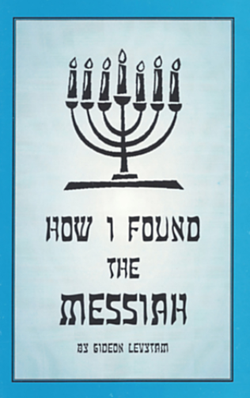
Follow Gideon Levytam's journey and discover how he was led by God, through a series of exciting circumstances, to find the One his people are still waiting for.
Past Episodes

Featured Offer
Follow Gideon Levytam's journey and discover how he was led by God, through a series of exciting circumstances, to find the One his people are still waiting for.
About Holy Scriptures and Israel
As time passed by, the Lord Yeshua took dear brother John Van Stormbroek to himself. The ministry of Holy Scriptures and Israel continued with additional development. In the early 1990’s, a weekly morning Bible class began which brother Gideon Levytam led regularly in the City of Toronto. This weekly open Bible class was held in the Willowdale assembly meeting hall. Eventually, a second mid-week evening Bible class was added. In April 2002, the need for an additional outreach Bible teaching meeting arose. We begun a Saturday (Shabbat) ministry meeting in which a systematic teaching of God’s word is presented to all who attend. Together we learn God’s Word, pray for each need and the salvation of Israel, and sing songs of worship unto our God, praising Him and our Lord Yeshua the Messiah.
In Mid 2004 we started to air on Joy 1250 Radio station a 15 minute Bible teaching program called "The Holy Scriptures and Israel" with Gideon Levytam. The broadcast teaches God’s word from a Hebrew Messianic perspective and has proved to be a blessing to many. It's now aired seven days a week. Our prayer is that many more of our Israeli people will have a clear understanding of who Yeshua is, why we all need him, and come to know him as their Lord and Messiah.
About Gideon Levytam
Contact Holy Scriptures and Israel with Gideon Levytam
426 Simcoe Street
Niagara-on-The-Lake
Ontario L0S 1J0
Canada
(905) 325-1234