

Acts 24:1-27, Part 2


Paul’s Testimony Before Felix The Governor Part 2
Guest (Female): Shalom! Holy Scriptures and Israel is a ministry designed to share with the Jewish people the good news of the Lord Jesus Yeshua the Messiah and to instruct Christians on the Jewish roots of their faith. And now, teaching God's word from a Hebrew Messianic perspective, here is Gideon Levytam.
Gideon Levytam: The study of Acts Chapter 24, and they are called Notzrim. Now, this is important. Most of us do not know Hebrew and most of us did not live in the land of Israel. But I want to say something that you will understand, and I hope you will. You see, every time a Jewish person became in Israel a believer of Yeshua the Messiah, because the religious community did not accept that Yeshua was a Mashiach, so they did not call them Meshichiyim, but they called them Notzrim.
In other words, instead of calling them followers of the Messiah, they called them followers of the man from Nazareth, Notzrim. Why? Because if they will call them Meshichiyim, that means that they will have to accept the fact that Yeshua is the Messiah and they're followers of the Messiah. But because they do not accept that Yeshua is the Messiah, so they don't call them Meshichiyim, but they call them Notzrim, meaning that they are followers of the man of Nazareth.
Now, that is interesting because even today, beloved brothers and sisters, if you go to Israel, you walk in the city of Yerushalayim today and you will tell somebody, "You know, I believe that Jesus, that Yeshua is the Messiah." So they say, "Ah, you became Notzri." In other words, you became a follower of the man of Nazareth. They will not call them, "You became a Meshichi, Messianic," because they don't believe that Yeshua is the Messiah.
But the believers themselves call themselves Messiah followers, or Meshichiyim. We don't call ourselves Notzrim, we call ourselves Meshichiyim because we believe that He is the Messiah. We understand that He redeemed us and paid the price for our sins. But the non-believing Jewish community do not call the Jewish believers Meshichiyim, but they call them Notzrim, followers of the man from Nazareth. And that's why you use the word here Nazarenes in plural. There are many who followed the man from Nazareth.
I want you just to seek a couple of things in order to make a connection here with this accusation. If you first of all turn with me to Isaiah 11, just for a moment, and verse one. That's where we first have the word netzer, where we get the word netzer. Netzer simply means a branch or a shoot. Isaiah 11 verse one: "And there shall come forth a rod out of the stem of Jesse," first is a rod. Secondly, "and a branch shall grow out of his roots."
The Hebrew word for branch here is netzer. This is where you get the word Notzri, that's where we get the word a branch or a shoot, netzer. It's a small thing, a small shoot that comes out of the roots of the family of Jesse. And that is one of the titles of Yeshua the Messiah. He was a netzer. He was a shoot. He was a branch that came out of the family of Yishai, the father of King David. That's where you get first of all the word netzer in the scripture.
Now, also, please turn with me to Matthew now, Matthew chapter two and the last verse of Matthew chapter two, where we get this expression that the Spirit of God gives us in verse 23. "And he came and he dwelt in a city called Nazareth," Natzeret, "that it might be fulfilled which was spoken by the prophets, he shall be called a Nazarene," a Notzri, or a person who came from the city of Natzeret. You see, that's where you get this thought of Nazarenes following the man who is from Natzeret, Yeshua the Messiah.
Now, one more verse I would like to read in the Gospel of John in connection with this. And this time in chapter one, please bear with me. And it was this question that Nathaniel said. And you remember Netanel, he was one of those who have heard about Yeshua the Messiah. Look what he said in verse 46. "And Netanel said unto him, Can there any good thing come out of Natzeret?" Philip said unto him, "Come and see."
So you see, when the Messiah was born, He was born in Bethlehem, but where He lived, He lived in a city of Natzeret. And everyone that is living in a city of Natzeret is called Notzri. Notzri means one who belongs to the city of Natzeret. And so what happened, when the Jewish people who did not accept the Messiah saw that some of their brethren became believers in Yeshua the Messiah, they didn't want to call them Meshichiyim because they didn't believe that He was the Messiah.
So they called them Notzrim, Nazarenes, as we have in the text here, because they deny the fact of the Messiahship of Yeshua. And so here's the accusation of Paul, the third, he says that he's a ringleader among the sect of the Nazarenes. He didn't say he's a ringleader among the sects of the Meshichiyim, the Messianics. No, because they didn't believe that Yeshua was the Messiah. By the way, the word Messiah or Mashiach in Hebrew, come in the Greek is where you get the word Christian or Christos.
And you and I call ourselves Meshichiyim or Christians because the Bible teaches us in Acts 11 and verse 26, the believers who follow the Messiah were first called Meshichiyim, Messiah followers. It was in Antioch as we have already covered that in the earlier study of the book of Acts. And so here's the accusation. Verse five, you have three accusations. He is a pestilent fellow, he is a mover of sedition, he is a ringleader of the sect of the Nazarenes.
They called him a ringleader of the sect. Well, he was a leader, definitely. And by the way, they use the word sect. In the first century, the Jewish people look at those who follow Jesus the Messiah as a sect. There was a sect of the Pharisees, there was a sect of the Sadducees, there was a sect of the Herodians, there was a sect of the Nazarenes, the Messiah followers. So there were many sects that existed in the first century, so the Jewish believers were still looked at as part of the nation, the sect of the Nazarene.
And fourthly, in verse six, it says, "who also has gone about to profane the temple." In other words, they call him a profaner of the temple in the city of Jerusalem. It was again a false accusation that this man by the name of Tertullus accused Paul before Felix. Four accusations, but every one of them without exception was wrong and it was false accusation. So now in verses seven and eight, Tertullus pointing to the chief captain who removed Paul from those who wanted to kill him.
It says in verse seven and eight, "But the chief captain Lysias came upon us and with great violence took him away out of our hands, commanding his accusers to come unto thee by examining of whom thyself mayest take knowledge of all these things whereof we accuse him." So now they blamed the chief captain, that he took them as it says here violently took him away from our hands. Well, they wanted to kill him. And he took him away, he saved Paul's life by bringing him into the castle to protect him from those who wanted to kill the Apostle Paul.
And so now this lawyer, if you will, Tertullus, this orator, blaming now this chief captain Lysias that he saved the Apostle Paul out of their hand. Maybe they could have done something to him right there and then, but the chief captain had saved him from those who wanted to kill the Apostle Paul. And so those four accusations against Paul-Shaul by this man, the orator Tertullus, which really was presented before Felix.
And then in verse nine, notice that now how the rest of the people who came with Tertullus, they have agreed with him. It says in verse nine, "And the Jews also assented, saying that these things were so." In other words, Hananiah and the rest of the elders who came, they said, "Yes, all these things really happened." In other words, they have agreed with what this man, this orator has said to the governor Felix. They said, "Yes, he was guilty of all those four things."
Now you can see how the accusation against the Apostle Paul before Felix, it wouldn't be the hands of the Lord, he could have been right there and then totally removed from this world by execution because Felix had the right to put him in judgment because of this accusation. But now, brothers and sisters, look how precious the Word of God is. Here the Apostle Paul now defending himself before Felix. In verses 10 to verse 21, he answers to Felix to all what he was accused.
And Paul does something so much beautiful, so much different than his accusers. He doesn't paint Felix as a great man. He doesn't butter him up. He doesn't kind of give him all these flattery words as if, "Felix, you are such a great man." He basically tells Felix what really had happened. And so he began in verse 10, Paul began to speak before the governor. Paul, after that the governor, this is Felix, had beckoned unto him to speak, he must have made a move with his hand. He said to him, he probably didn't even say anything, he just told him, "Go ahead and speak."
And he answered, he says, "Forasmuch as I know that thou hast been of many years a judge unto this nation, I do the more cheerfully answer for myself." In other words, the only good things that he could say about Felix is, "Felix, you have been for many years a judge over this nation." That's probably the only good thing that could be said about Felix, because he was not really a decent individual. He had a lot of things that he caused to the Jewish community.
And the only thing that Israel could do is because they were under the hands of the Romans, they had to accept it, they had to submit to the authority of the Romans because the Romans were occupying the land. The Jewish community were under the occupation of the Romans. Do you know they didn't have the liberty that they would like to have? They didn't have the freedom that they would like to have. They couldn't express themselves even in their own temple area, they were watched by the Roman authority, the Roman chief captain who could see what was going on there.
They didn't have the freedom that they would like to have. So believe me, there was not a good relationship. But because they could not help it, they were under the occupation of the Romans, they had to submit to it. And Paul, he's just saying, "I know that you have been for many years a judge unto this nation." Apparently, by that time he was at least five years the governor of the Roman province of Judea. Apparently he was a commander in the Roman army previous to becoming a governor.
So he knew a lot about the Jewish people, about the nation of Israel. In fact, notice in verses 11 to 16, Paul answered the accusation of Tertullus and he began by saying this in verse 11. He says, "Listen, I was only 12 days in the city of Jerusalem. How much problems could I have made in those 12 days?" He says, "Because that thou mayest understand that there are yet but twelve days since I went up to Jerusalem for to worship."
Here's the reason that I came to Jerusalem, Governor Felix: I came to Jerusalem to worship. I'm a Jew among my people came to the city of Yerushalayim for to worship. And you notice again the Apostle Paul used the word up, knowing that geographically it is yes, going up, but it is also you can say spiritually when the presence of the Lord, when you're going into the presence of the Lord, you're going up. Now mind you, at that time, the nation rejected the Messiah and Israel were not in a healthy spiritual state, so he has a reference to physically going up to the city of Jerusalem.
"But I went to worship, just like any other Jewish person would go to worship in the temple in the city of Jerusalem." And then, brothers and sisters, look at that. He's speaking about himself, Paul, in a very profound way. In verse 12 and 13, he says, "I've really haven't done what I am accused of. They neither found me in the temple disputing with any man, neither raising up the people, neither in the synagogues, nor in the city: Neither can they prove the things whereof they now accuse me."
You know, Paul used the word neither about five times here in these two verses. "Neither they found me in the temple disputing, neither raising up the people, neither in the synagogue, nor in the city, neither they can prove anything that they say against me. Let them prove that. They cannot prove that I have done all these things. What they say and what I have done are two different things." Brothers and sisters, look at this for a moment.
How many believers have been accused of things that they have not done? But those who hated them and opposed them, and some of them even lost their lives and they were innocent. They haven't done anything wrong. And here Paul said, "I haven't done those things. They cannot prove the things whereof they now accuse me," Shaul-Paul is saying to the governor Felix. And notice here the next verse, he says, "Now here's something that I want to confess before you, Felix."
In verse 14 he confessed before him something that he can be maybe accused of. He says, "But this I confess unto thee, Felix." Listen to this, brothers and sisters: "After the way which they call heresy, so worship I the God of my fathers, believing all things which are written in the law and in the prophets." Here is Paul. "Listen, if there is anything that I'm guilty of," he's saying to him, "is I am guilty that I believe in all the things that my forefathers have taught us in the Hebrew scriptures."
He used the word the law and the prophets. Torah, the law, prophets, Nevi'im. And he says, "Listen, they can accuse me of this, that I simply believe, and I call them heresy because I worship the God of my fathers." Now, you notice that Paul does not say the God of their fathers. Not because God is not the God of Israel's fathers, yes, he is. But Paul never disassociated himself from Israel. As a Jewish man, as an Israeli man, as a Hebrew man, he always associated himself with the nation of Israel.
He always did, but he was misunderstood by his people. And so he says, "Listen, I confess, Felix, that after the way," notice this expression, "the way" which they call heresy, I follow after this way. You know who was the first one who talked about the way? It was Yeshua. In John chapter 14 and verse six, Yeshua said to his Hebrew disciples, "I am the way, I am the truth, I am the life. No one come to the Father but by me. I am the way to God. I am the Messiah. I am the Mashiach," he said.
And so here Paul is saying, "Listen, I confess to you that after the way they call heresy, I follow after this way." And then he says, "This is the way that I worship the God of my fathers." And who is his fathers? Abraham, Isaac, Jacob, Moses, Isaiah, Jeremiah, Yechezkel, Netanel, and Daniel, and on and on we can go with all the fathers of the nation of Israel who wrote in the Word of God concerning the coming of the Messiah.
And Shaul-Paul is saying, "Listen, I do not introduce something new. I follow after that which the God of my fathers have shared through the law and through the prophets." And we do the same thing, beloved brothers and sisters. By believing that Yeshua is the Messiah, we are actually fulfilling what God had promised in the scripture. To be a believer in Yeshua the Messiah, it's not to deviate from the Word of God, actually it is to accept the totality of the Word of God and to submit to the fact that this is indeed the Word of God.
And so he's saying, "This is something that I admit." In other words, he admitted that he's a believer in Yeshua the Messiah, the way, the truth, and the life. And so he continue in verse 15 and he says, "I have the hope of the resurrection which our forefathers were teaching about the resurrection of the Messiah and the resurrection of the just and the unjust." That's what he says in verse 15. He says, "I have the hope toward God," notice that, "which they themselves also allow, that there shall be a resurrection of the dead, both of the just and of the unjust."
And he is, of course, pointing the they is not the Sadducees, Tzadukim, because the Tzadukim, the Sadducees, did not believe in the resurrection. But it was the Pharisees who did and the rest of the sects among our people Israel. They believed that there is a resurrection. And where did they come to the understanding that there is a resurrection? They must have read Isaiah chapter 26. They must have read Daniel chapter 12, which we just read in the text of our reading.
There is a day coming that there is a resurrection of the just and the unjust. And I want to read to you Daniel chapter 12 and verses one and two, where God spoke to Daniel and he said to him, we read here in that chapter 12 and verse one. Look what it says: "And at that time shall Michael stand up, the great prince which standeth for the children of Israel, the children of thy people: and there shall be a time of trouble," he's talking about the tribulation period, "such as never was since there was a nation even to that same time: and at that time thy people shall be delivered, every one that shall be found written in the book."
And then he says, "And many of them that sleep," these are people who died, "in the dust of the earth shall awake, some to everlasting life, and some to everlasting contempt." In other words, there is that two resurrection: the resurrection of the ones who believed in God and the resurrection of the one who did not believe in God. Some to everlasting life and some to everlasting contempt and judgment. And Paul believed in that, he believed in the resurrection.
And the Sadducees didn't. And by the way, Hananiah, the high priest, he was a Sadducee. He was Tzaduk or Tzadik, he did not accept the resurrection. And when Paul stood for that and shared it and believed in that and professed that and preached that, Hananiah didn't like it. And those Sadducees who did not believe in the resurrection actually sought to oppose Paul because of his faith. And so we have here Paul defending himself and he answering to those who accuse him and especially the accusation of Tertullus, the orator.
In verse 15 he says, "I have the hope towards God, which they themselves also allow, that there shall be a resurrection of the dead, both of the just and the unjust." And, brothers and sisters, let's not make a mistake. Some believe about the resurrection, but they believe that everyone going to rise at the same time. Some believe all sort of things concerning the resurrection. But the Bible is clearly teach us that we have the first resurrection, which is a resurrection of believers only.
And even those believers, there are stages of the first resurrection. And then we have the second resurrection, and this is the resurrection of the unbelievers. There is at least a thousand years different between the one and the others. The first resurrection has to do with the resurrection of the believers, the dead in the Messiah shall rise first. Then we which are alive and remain shall be caught to meet the Lord in the air. That's going to happen at the end of the church age.
But then we have the resurrection of the unbelievers and they will rise at the end of the millennial age, the kingdom age, only to be cast into the lake of fire, spirit, soul, and the resurrected body. All together to be cast into the lake of fire. That's why he speaking here the resurrection both of the just, this is the believers, and the unjust, this is the unbelievers. And so after he finished here in verse 16, Paul says, "And herein do I exercise myself, to have always a conscience void of offence toward God, and toward men."
And Paul says, "I exercise myself to have a clean conscience, a conscience that is void of offense. I did not want to offend them. I love my brethren," Paul is really saying to Felix. "But they were offended because I believe in those things, but they do not believe. This is what our forefathers have taught us in the Word of God. But they reject it. I do not want to offend them. I exercise myself, I work hard and not offending my brethren, my people.
But they became offended because they have rejected what God had spoken in his Word. So in verses 11 to 16, Paul answered to the accusation of Tertullus and he ended up with this. And now he is giving an answer in verses 17 to 19 to those who accuse him, came from Asia Minor. These are the Jewish people of the diaspora. By the way, they were not here before Felix, they were not there to accuse him. They have probably finished the time in the temple, gone back to Asia Minor, did not even come to Caesarea to accuse him.
But they were the ones that caused all this riot to happen. And so Paul in verse 17, 18, and 19, he's answering to the accusation of those from Asia Minor. He says, "Now after many years I came to bring alms to my nation, and offerings. Whereupon certain Jews from Asia found me purifying in the temple."
Guest (Female): You have been listening to Holy Scriptures and Israel with Gideon Levytam. Gideon teaches God's Word from a Hebrew Messianic perspective. For more information about this ministry, write to Holy Scriptures and Israel, Box 1411, Niagara-on-the-Lake, Ontario, L0S 1J0, or visit our website at holyscripturesandisrael.com.
You are also invited to Gideon's weekly Bible teaching on Fridays at 11 a.m. and 7 p.m., and Saturdays at 1 p.m. at Willowdale Christian Assembly Hall, 28 Martin Ross Avenue in Toronto. Holy Scriptures and Israel is made possible by your prayers and financial support. If you would like to support the program, visit holyscripturesandisrael.com. God bless you. Shalom, shalom!
Featured Offer
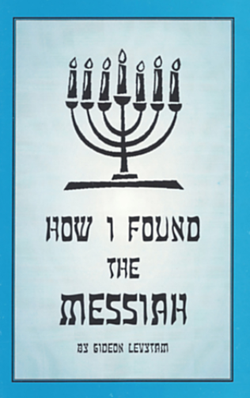
Follow Gideon Levytam's journey and discover how he was led by God, through a series of exciting circumstances, to find the One his people are still waiting for.
Past Episodes

Featured Offer
Follow Gideon Levytam's journey and discover how he was led by God, through a series of exciting circumstances, to find the One his people are still waiting for.
About Holy Scriptures and Israel
As time passed by, the Lord Yeshua took dear brother John Van Stormbroek to himself. The ministry of Holy Scriptures and Israel continued with additional development. In the early 1990’s, a weekly morning Bible class began which brother Gideon Levytam led regularly in the City of Toronto. This weekly open Bible class was held in the Willowdale assembly meeting hall. Eventually, a second mid-week evening Bible class was added. In April 2002, the need for an additional outreach Bible teaching meeting arose. We begun a Saturday (Shabbat) ministry meeting in which a systematic teaching of God’s word is presented to all who attend. Together we learn God’s Word, pray for each need and the salvation of Israel, and sing songs of worship unto our God, praising Him and our Lord Yeshua the Messiah.
In Mid 2004 we started to air on Joy 1250 Radio station a 15 minute Bible teaching program called "The Holy Scriptures and Israel" with Gideon Levytam. The broadcast teaches God’s word from a Hebrew Messianic perspective and has proved to be a blessing to many. It's now aired seven days a week. Our prayer is that many more of our Israeli people will have a clear understanding of who Yeshua is, why we all need him, and come to know him as their Lord and Messiah.
About Gideon Levytam
Contact Holy Scriptures and Israel with Gideon Levytam
426 Simcoe Street
Niagara-on-The-Lake
Ontario L0S 1J0
Canada
(905) 325-1234