

Acts 23:12-35, Part 2


The Conspiracy to Kill Paul Part 2
Guest (Male): Shalom. Holy Scriptures and Israel is a ministry designed to share with the Jewish people the good news of the Lord Jesus, Yeshua the Messiah, and to instruct Christians on the Jewish roots of their faith. And now, teaching God's word from a Hebrew Messianic perspective, here is Gideon Levytam.
Gideon Levytam: This study of Acts chapter 23. Now he was threatening to them because of what he taught. He was teaching that the Messiah had come. They did not accept that Jesus, Yeshua, was the Messiah. He taught that sins can be forgiven to anyone who would believe in the person of Yeshua the Messiah.
They were still under the law. They did not accept the fact that the Messiah had come. There were two conflicting messages, if you will. The one was speaking about waiting for the Messiah and the Messiah haven't come, the other was saying the Messiah has come and Yeshua is his name, and the price that he paid for our sins was his death, burial, and resurrection.
And so here is the ones that were bounding themselves with this purpose to kill the Apostle Paul. In verse 14 and verse 15, we see the conspirators how they share their ambitions with the leaders of Israel. There were 40 of them. They may be Jewish people who came from the diaspora, from Asia Minor, who heard and knew what Paul was sharing—the message of the gospel—already in his three missionary journeys, and they came to Jerusalem, they wanted to worship in Jerusalem in the Temple, and here now they have a conspiracy against him.
Notice what they are doing, they are trying to involve the whole council, the whole Sanhedrin, on that plan. And so in verse 14, the conspirators share their ambitions with the leaders of Israel. It says they came to the chief priests and the elders and they said to them, "We have bound ourselves under a great curse, under a great anathema, that we will eat nothing until we have slain Paul."
So they share it with the leaders. They say to the leaders, the chief priests and the elders, that they want them to speak to the whole council and that they, together with the council, the Sanhedrin, they will come about and fulfill their ambition to kill the Apostle Paul.
In verse 15, we find out the conspirators' plan itself. Look at their plan. They said in verse 15, "Now therefore you," this is the leaders, "you with the council signify to the chief captain that he bring him down unto you tomorrow, as though you would inquire something more perfectly concerning him, and we, or ever he comes near, we are ready to kill him."
So you know what these 40 people said? They said to the elders of Israel, "You know what? You call the captain, tell him to bring Paul as if you're going to ask him some question and bring him this time, not that you go into the castle, but he bring him out of the castle into the Temple compound where the council is gathering in some of the sections there, and have Paul in our midst and say to the chief captain that you want to inquire of Paul more perfectly concerning what he believe or what he's doing and what he's saying. And then we can be sure," he says, "we, when he come near, are ready to get up and kill him."
What a plan to kill the Apostle Paul. Now can you imagine, brothers and sisters, it's sad that in religion, whether it is our own people, the Jewish people historically, or whether it is Christianity or Christendom, or whether it is all sorts of religious groups around the world, it is amazing how you can worship God, praise God, go to Temple if you will, or go to church meeting, and at the same time plan to murder.
It seems to be like a contradiction. Instead of committing things to God, you are making a plan to kill someone by making a vow to do something that God strictly commands not to do. You remember one of the commandments that we have in the book of Exodus, "Thou shalt not murder." Lo tirtzach. And yet here's a plan, and the plan to do it with the religious leaders.
We don't have to talk about what happened over the generations, whether it is in church history with the leaders of the time in the dark ages and what happened in the name of God or the name of Yeshua, and what happened in the name of other religion whether it is Islam or Hinduism and so on. But in the name of religion, when God is not really submitted to, things have happened and we fail in it so much.
And here the plan. Usually when you say "I'm going to fast, I'm not going to eat, I'm not going to drink," it is because I have a burden for somebody. Sometimes we say, "I'm so concerned about the salvation of someone or because of my family or because of the situation in certain countries, I'm going to eliminate necessary thing for my body in order to be so devoted to prayer and fasting that God will give an answer."
But here it seems to be the opposite. "I will not eat, I will not drink, and then I'll kill." It's not "I will pray for him, I will ask God to restore him," but not, it's exactly the opposite. And again I want to mention, while the context here is what happened historically to the Apostle Paul among his own Jewish brethren, these things is not just to point to because it happened everywhere in church history, in the history of many other religion.
It happened the very same thing. That just shows us the nature that man has. "In sin," David said, "did my mother conceive me," and all of us, "all have sinned and come short of the glory of God." And so here in the first verses 12, 13, 14, 15, the plan to kill Paul.
But then look what happened, how God intervenes. Even though we don't see necessarily God speaking from heaven, we see how things are working behind the scene. And here we find out that Paul's sister's son is reporting the conspiracy to Paul.
You can see how interesting, because it says in verse 16, "And when Paul's sister's son heard of their lying in wait, he went and entered into the castle and told Paul." Now let's just pause here for a moment. Very interesting here because what Paul's sister's son is doing in this closed high community of the priests and the leaders of Israel? How does he hear this conspiracy? It was supposed to be quiet only within the Sanhedrin or the council.
How does he know that? Apparently, first of all we know that Paul, Shaul, though he was from Cilicia—and if you remember that we read of him that he was of Tarsus of Cilicia, a Jew that was born in Tarsus—but he lived and he grew up in this city. As he mentioned in chapter 21 when he says, "I am a man which am a Jew, a city of Cilicia, a citizen of no mean city," and so on.
And he actually grew under the instruction of Gamaliel in the city of Jerusalem. Apparently he may have had a family there that lived in the city of Jerusalem. And we find also that he had a sister—we don't have her name here—and her sister apparently have a son, his nephew.
We don't read that any of his family became believers in our Lord Yeshua the Messiah. It seems to be that he lost everything for the sake of the Messiah, including his own family. There is a verse in Philippians chapter 3 and verse 8 where the Apostle Paul said, "Yea doubtless, I count all things but loss for the excellency of the knowledge of the Messiah Yeshua my Lord," and then he said, "for whom I have suffered the loss of all things and do count them but dung that I may win Messiah."
You notice Paul said, "I have suffered the loss of all things." He has lost perhaps even his relationship with his family for the name of our Lord Yeshua the Messiah. What a man he has been, this Shaul, Paul.
But we find now, very interesting, that even though he may not have had this connection or communication anymore with his family—and by the way, most of us who are Jewish believers experience this regularly as well in a small way of course. Many of our family do not want to speak to us anymore. They don't want to hear about the message of Yeshua, they reject this message. They don't understand us, they think we have gone so wrong by believing that Yeshua, Jesus our Lord, is the Messiah.
Some are opening to us a little but in general, it's really something that happened to the Jewish believers throughout the last 2,000 years of church history. But you can see that even though Paul's sister might have had some link or some connection with the Sanhedrin or with the council because of the very fact that her son hears that, it shows us that the family still had some dignity with respect to the Word of God.
And when this young man heard about this conspiracy, perhaps he was thinking of the verse that we read earlier in Exodus chapter 23, where God said to His people Israel, "Thou shalt not follow a multitude to do evil." Exodus 23 and verse 2.
What he was seeing, this nephew of Paul, he was seeing the multitude was going to do something wrong, they were going to do evil. They're planning to kill this man. And he did not want to follow that. There was some dignity you can see here, how beautiful to see.
So what does he do, the nephew that heard that? He came and he told this to Paul. Now how could he get in? He must have a way to get in. And he got to Paul. Apparently because Paul was a Roman, the chief captain had to give him some privileges.
Because he was also—if you remember he called himself, "I was a Pharisee of the Pharisees"—he must have had some position in the past among the leaders of Israel. He therefore had his family could come in, and as we see in verse 16, when Paul's sister's son heard of their lying in wait, he went and he entered into the castle—now again this is the Antonia Fortress—and he told this to Paul.
Apparently he could somehow get in, get the permission to get in and he told to Paul. There were 40 men who made a vow and these 40 men put themselves under a curse. They said that they would neither eat nor drink until they are going to kill you, Paul. That's what his nephew had said to the Apostle Paul.
Immediately when Paul heard this, in verse 17 and 18, Paul requested from the centurion to bring his nephew, his sister's son, to the chief captain. We read here in verse 17 and 18, "Then Paul called one of the centurions unto him and he said, 'Bring this young man unto the chief captain, for he has a certain thing to tell him.'"
So that centurion took him. Remember again, I want to suggest here, beloved brothers and sisters, because Paul was also a Roman citizen, he had certain privileges, certain rights. They could not bind him, they could not hit him. They would allow him to hear someone, they couldn't even accuse him. There was nothing to accuse him, they couldn't find any fault in him. So the very fact that they kept him in a castle still allowed him to have all these privileges.
Here the chief captain now needed to hear what the young man said to the Apostle Paul. We read that he took him, the centurion in verse 18, and he brought him to the chief captain and he said, "Paul the prisoner called me unto him and he asked me to bring this young man unto thee who has something to say unto thee." So the centurion brought Paul's sister's son, Paul's nephew.
He took him inside even closer to the chief captain. You notice how many times that particular chief captain is being mentioned, because all this event, this chief captain ends up spending a lot of time around this subject of what Paul believes and what Paul stood for. And so in those verses 17 and 18, the request from the centurion and he actually brought him to the chief captain. He brought Paul's sister's son to the chief captain.
We find out in the next verses, 19, 20, 21, and 22, the communication between the chief captain and Paul's sister's son. Here's the deliberation. It says here in verse 19, "Then the chief captain took him," this young man, "and he took him by the hand, he went with him aside privately and he asked him, 'What is that you have to tell me?'"
He said unto him, "The Jews have agreed to desire thee that thou wouldest bring down Paul tomorrow into the council as though they would inquire somewhat of him more perfectly." By the way you notice the word "down," it mentioned more than once the word "down."
Because there were steps from the Temple mount, the Temple compound, steps in order to go to the castle. And there, in order to come out, you needed to come down and this time to bring him down from the castle, Antonia Fortress, to bring him into the Temple mount, into the compound where he could be heard by the council.
The young man saying to the captain, "You know, that is their plan." But he said to him in the next verses, he said to him in verse 21, "But do not do so. Don't yield unto them, for there lay in wait for him of them more than 40 men which have bound themselves with an oath that they will neither eat nor drink until they have killed him, and now are they ready looking for a promise from thee."
So he told him the whole story. Told him the plan, he told him what happened. Now it's interesting, brothers and sisters, that the captain was listening to this young man. You might say, "What does this young man have to say? Maybe it's not true, maybe he's just giving me all kind of stories to try to help this man by the name of Paul." But he listened to him. He heard what he had to say and apparently he believed him because in the next verse, in verse 22, the chief captain let the young man depart, this is Paul's sister's son, and he charged him.
He says, "See thou tell no man that thou hast showed these things unto me." Apparently he believed him and he charged him, he says, "Listen, you told me what their plan is. Go away, don't tell anyone what you have told me."
Again, brothers and sisters, I would like to suggest that this nephew of the Apostle Paul endangered himself. He has really made a decision in a sense to help his uncle and he endangered himself. He may not have come yet to faith in a Messiah. We do not know what happened to Paul's family later on.
Paul, by virtue of trusting that Yeshua was the Messiah, lost a relationship even with his very own family. That must have been so grieving to his heart. And now he is in danger of being killed. And so in those verses we have learned today about Paul's sister's son's report and how the chief captain has really grasped it, believed it, and now you can see how he's going to act upon that.
Again, allow me to just mention that you can see the providence of God. You can see that behind the scene, God is working. Like in your life and in my life, certain things happen to us in our life and we don't even realize that behind the scenes there is the providence of God. He preserves His own people.
How many a time maybe we could have have, let's say, an accident, so-called accident, whether it is a car accident or whether a danger that has happened, and how by the grace of God we have been preserved in a way that God has just preserved us.
Many people tell stories of, let's say, they were supposed to go on a plane and then something happened, they delayed the plane, the plane flew and they did not go on the plane. And then what happened is that some accident happened and the plane, something has happened, and they were preserved from those kind of things that would have happened today had they would have been on that plane.
So you can just see of the ways that God is dealing with us. And so this shows us that the verse in Romans 8 and verse 28, "For we know that all things work together for good to them that love God, to them who are called according to His purpose." We can see that even such an event as this where Paul was endangered in his life as he follows the Lord, there was a danger to his life.
You can see that it is also through the hand of the Lord. We are now in chapter 23 of Acts and we continue now from verse 23 to verse 24 and we can see how the chief captain really planned to deliver Paul from the hands of these individuals who have vowed to kill him. And so we find in verse 23 and verse 24 the plan.
This time it's not the plan of those 40 Jewish people who wanted to kill Paul. Here we find the plan of the commander, the chief captain, of delivering the Apostle Paul. It's found in verse 23 and verse 24. He, the chief captain, called unto him two centurions and he said, "Make ready 200 soldiers for to go to Cesarea, Caesarea."
By the way, Caesarea is about 65 miles from Jerusalem. It's about 100 kilometers, a little bit over 100 kilometers from Yerushalayim. It is on a coast, on the Mediterranean. It is an amazing place to see where Caesarea was a Roman city. Apparently at that time was a beautiful city.
There the Governor Felix was there and that's where the place where the Romans had their station in that city, one of the stations in the land of Israel. So it's about 65 miles from Yerushalayim. And what is that chief captain saying? He says, "Take 200 soldiers to go to Cesarea," but he adds, "Listen, take an horsemen three score and ten," this is 70.
"And then," he says, "and spearmen 200." Now you take 470 soldiers to bring the Apostle Paul 65 miles from Yerushalayim to Cesarea. 470. This is including of course the 70 horsemen that were to go. In other words, 70 horses and those that are horsemen sitting upon them. To bring one man from Yerushalayim to Cesarea.
Can you imagine? 470. Now that shows to us how sincere was this chief captain and how he really wanted Paul to be delivered out of the hands of those who sought to kill him. And so now he's telling them when they are to do that, because in verse 23 he said "at the third hour of the night."
The Bible gives us the third hour of the day but also the third hour of the night. You remember that the Bible shows us that there were divisions of the day and the night. You remember when the Lord Jesus, when Yeshua the Messiah, died on the tree, we find out that in Mark 15 verse 25 it was the third hour and they crucified Him. Now this is the third hour of the day, it's 9:00 in the morning. They put the Lord on the tree at 9:00 in the morning.
When it was the sixth hour, there was darkness over the whole earth. This is verse 33 of Mark chapter 15. The sixth hour was 12 noon. And then it says "until the ninth hour." In the ninth hour of the day, Yeshua cried with a loud voice, "Eloi, Eloi, lama sabachthani?" "My God, my God, why hast Thou forsaken me?"
It was on the ninth hour, that was 3:00 p.m. about. By the time we get to the 12th hour, that will be 6:00 p.m. Now here we find out that when the Lord was on the cross of course it was the third hour of the day, but in a case of the Apostle Paul to be driven and taken away to Cesarea, it was the third hour, but notice that the Bible adds "the third hour of the night."
So here we find out that it was about—and we give an approximate—9:00 p.m. It was an evening session where he was going to get the Apostle Paul in a haste out of the city of Yerushalayim lest he be killed by those who made that vow.
This was the plan and you notice what he did in verse 24, "He provided them with beasts that they may set Paul on and bring him safe unto Felix the governor." What we have in those two verses is the plan of the chief captain to deliver the Apostle Paul from the hands of those who sought to kill him.
Sure it's going to happen. 470 soldiers to take care of this situation. There were a lot of soldiers covering him, protecting him in order to bring him to the governor that is in Cesarea by the name of Felix.
Apparently this governor that he's going to be standing before, Felix, was a cruel man apparently. He was a wicked man. He was the one that became the governor and he ended up of course being that governor under which Paul had to stand and explain to him certain things why he believed in what he believed and why he was accused. Paul was going to stand before him, but first of all that chief captain had to write a letter for the reason why Paul had to stand before him.
What does he do? He gives us the plan, verse 23 and 24, and then verse 25 to verse 30, he writes a letter to Felix the governor. Notice it was a nice letter, but he didn't tell him everything. It was kind of, you know, sometimes when we write a letter we kind of make it a little nicer, we kind of change a few things just to make it appear a little nicer when we write something. So look what he's writing in verse 25 to 30. "And he wrote a letter after this manner."
Guest (Male): Shalom. Holy Scriptures and Israel with Gideon Levytam. Gideon teaches God's word from a Hebrew Messianic perspective. For more information about this ministry, write to Holy Scriptures and Israel, Box 1411, Niagara-on-the-Lake, Ontario, L0S 1J0, or visit our website at holyscripturesandisrael.com.
You are also invited to Gideon's weekly Bible teaching on Fridays at 11 a.m. and 7 p.m. and Saturdays at 1 p.m. at Willowdale Christian Assembly Hall, 28 Martin Ross Avenue in Toronto. Holy Scriptures and Israel is made possible by your prayers and financial support. If you would like to support the program, visit holyscripturesandisrael.com. God bless you, Shalom, Shalom.
Featured Offer
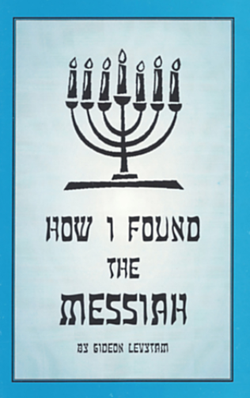
Follow Gideon Levytam's journey and discover how he was led by God, through a series of exciting circumstances, to find the One his people are still waiting for.
Past Episodes

Featured Offer
Follow Gideon Levytam's journey and discover how he was led by God, through a series of exciting circumstances, to find the One his people are still waiting for.
About Holy Scriptures and Israel
As time passed by, the Lord Yeshua took dear brother John Van Stormbroek to himself. The ministry of Holy Scriptures and Israel continued with additional development. In the early 1990’s, a weekly morning Bible class began which brother Gideon Levytam led regularly in the City of Toronto. This weekly open Bible class was held in the Willowdale assembly meeting hall. Eventually, a second mid-week evening Bible class was added. In April 2002, the need for an additional outreach Bible teaching meeting arose. We begun a Saturday (Shabbat) ministry meeting in which a systematic teaching of God’s word is presented to all who attend. Together we learn God’s Word, pray for each need and the salvation of Israel, and sing songs of worship unto our God, praising Him and our Lord Yeshua the Messiah.
In Mid 2004 we started to air on Joy 1250 Radio station a 15 minute Bible teaching program called "The Holy Scriptures and Israel" with Gideon Levytam. The broadcast teaches God’s word from a Hebrew Messianic perspective and has proved to be a blessing to many. It's now aired seven days a week. Our prayer is that many more of our Israeli people will have a clear understanding of who Yeshua is, why we all need him, and come to know him as their Lord and Messiah.
About Gideon Levytam
Contact Holy Scriptures and Israel with Gideon Levytam
426 Simcoe Street
Niagara-on-The-Lake
Ontario L0S 1J0
Canada
(905) 325-1234