

Acts 22:22 to 23:11, Part 3


The Response to Paul’s Testimony Part 3
Guest (Male): Shalom. Holy Scriptures and Israel is a ministry designed to share with the Jewish people the good news of the Lord Jesus Yeshua the Messiah and to instruct Christians on the Jewish roots of their faith. And now, teaching God's Word from a Hebrew Messianic perspective, here is Gideon Levytam.
Gideon Levytam: The study of Acts chapter 22. They that stood by said to him, "Revilest thou God's high priest?" In other words, "Do you speak like this, Paul, to the high priest? Don't you know that he was the high priest?" And immediately Paul corrected himself and apparently he did not know that it was the high priest.
Because he said in verse five, "Then said Paul, 'I wist not. I did not know, brethren, that he was the high priest. For it is written, thou shall not speak evil of the ruler of thy people.'" He's actually quoting Exodus chapter 22, verse 28, where Moses had been instructing the people of Israel not to speak evil of the rulers of Israel.
And therefore, immediately Paul, Shaul, knowing his Hebrew scriptures, immediately he says, "I did not know, brethren, that he was the high priest, because it is written." Remember, we don't have Acts yet written. We don't have Romans yet written. But we have all the Tanakh written. So he's quoting the Old Testament and says, "It is written in the Hebrew scriptures that you shall not speak evil against the ruler of thy people." And immediately he corrected himself.
Now, there's a question that we need to raise here for a moment. How come the Apostle Paul did not know that he was the high priest? What was the reason? Now, remember, let me give you a couple of thoughts here. First of all, some suggest that it's very possible that the Apostle Paul by that time had some problem with his eyes.
Apparently, it's very possible that the thorn that he had in his flesh was his eye issue. That's why he needed a lot of help in writing some of his epistles. And you remember in the book of Second Corinthians that he sought thrice the glorified Messiah that he will take away this thorn that he had in his flesh.
But Yeshua said to him, "My grace is sufficient for you." And so it may be that Shaul, Paul's sight was not as well, and therefore he did not recognize that he was the high priest. Secondly, it may also be that immediately that captain gathered together the Council. And the Council had to gather in the castle. The Sanhedrin had to come into that Antonia Fortress.
In other words, it was a hasty meeting. And it may be that all the priests came in and maybe they were not dressed with the high priestly gowns and so on. So Shaul, Paul, could not discern or could not see if truly he was that high priest and he didn't recognize him. So there maybe one or two or three reasons why Paul said, "I did not know that he was that high priest, because it is written, thou shall not speak evil against the ruler of thy people."
So here we have in the first five verses Paul before the Council of Israel and what happened to Paul when he appeared before them. You notice that the name of the high priest is Ananias. In Hebrew, we call him Hananiah. And if you notice, we have already talked about three Hananiahs in the book of Acts.
We have the Hananiah from Jerusalem, Hananiah and Sapphira. Remember Ananias and Sapphira in Acts chapter five? They were believers in Yeshua the Messiah. We have the Hananiah that Paul had had to meet in the city of Damascus, who was also a Jewish believer, who also told him about his ministry that the Lord called him to do. And you remember he prayed for him and Paul Shaul received his sight.
That's the second Hananiah. And here we have the third Hananiah, the high priest. Hananiah in Hebrew simply means Jehovah is gracious. It's a beautiful name. Many times you find on people we give name Hananiah or Hananiel. Hananiah means Jehovah is gracious, God is gracious.
Beautiful names that's given to our own people, Israel. The Hebrew names are beautiful, very attractive. And all of them are connected with the God of Abraham, Isaac, and Jacob. Like Daniel and Hananiel and Mishael and Azariah, and all the Hebrew names that we have in the Hebrew scriptures, Isaiah, Hosea. All the Hebrew names have to do with God's name mingled with what God had done for his people.
Here, God is gracious. But apparently this Hananiah did not accept the grace of God through our Lord Yeshua the Messiah. And he took the Apostle Paul and he commanded him to be smitten. And now listen to what happened to the last verses here for us for today. In verses six to 11, not only that Paul appeared before the Council, now we find Paul appeals to the Council.
He's appealing to them concerning the resurrection and the resurrected one. And so notice that in verse six, Paul presented the truth of the resurrection before the Sanhedrin. "And Paul perceived that one part were Sadducees and that the other side were Pharisees. He cried out in the Sanhedrin, in the Council, 'Men and brethren.'" The same thing that he did earlier in verse one. "Anashim achim, men and brethren. I am a Pharisee, the son of a Pharisee. Of the hope of the resurrection of the dead, I am called in question."
Paul immediately recognized that you have here the two groups of people, the Sadducees. In Hebrew, we call them the Tzadokim. It comes from the word Tzaddik. Tzaddik means righteous. It's the Hebrew word for righteous. Tzadokim mean righteous ones, plural. And then you have on the other side were Pharisees. The Hebrew word parush. It is those who mepharshim. They are the ones who expound the word of God and give interpretation to God's word.
You have these two expressions here, the Sadducees and the Pharisees. Now, together, they combined, they're making up the Sanhedrin. Some were Sadducees and some were Pharisees. Mostly, actually, they were the Sadducees, the Tzadokim. Now, I know, brothers and sisters, that many times people talk about the people of Israel and how the Sadducees and the Pharisees, and many times condemn them all. "Don't be a Pharisee. Don't be a Sadducee." And you know, we look at that.
Let me tell you, 2,000 years of church history provided a lot of Sadducees and Pharisees in the church as well. Their divided condition that existed in Israel, and this divided condition existed even today in the church of our Lord Yeshua the Messiah. So we find out that when he recognized, he perceived that one part were Sadducees and that the other were Pharisees. Look what he cried in the middle of the Council.
He says, "Men and brethren, anashim achim, listen. I am a Pharisee. I'm a son of a Pharisee." Now, I took a note of it. He doesn't say, "I was a Pharisee." He says, "I am a Pharisee." Now, why Paul said, "I am a Pharisee?" You see, we oftentimes look at the Pharisees and say, "Don't be a Pharisee." We often look at that in a negative way.
But let me tell you, beloved brothers and sisters, that the first Pharisee that we find in the scripture is the very man that we read about in the book of Ezra. He was, if you remember that we read Ezra, in Ezra chapter seven, we find out that he was a ready scribe. We read and Ezra went up from Babylon and he was a ready scribe in the law of Moses.
In verse 10, we read Ezra had prepared his heart to seek the law of God, to do it, and to teach it in Israel a statute and a judgment. The first one after the restoration of Israel from Babylon to instruct the people of Israel, to give them the word of God and to keep them close to the Hebrew scripture and to the word of God. A man who was used by God by the name of Ezra.
And everything began in a very appropriate way. The Pharisees meant well. They wanted to keep the people of Israel together, to keep them under the instruction of the word of God. But just like in everything, you begin right and you end up adding things and opening things and placing things that were not belong there at all.
And that's what happened here with our people Israel, with the Sanhedrin. Things and time have passed us by and you find that so many things have crept in and so many teachings of rabbis, teaching of men, human teaching have crept in. And when you come and you look at the start, you say you start so well. Where are you today?
And you see how far it had been gone away from the basic ABC that God had given in his word. And I want to say this again. It's the same with Christianity or Messiah-following. It started very well. 120 people in the city of Jerusalem. The Holy Spirit of God came upon them. The body of Messiah was built. If you remember, thousands were saved.
But time passed by and the church grew. More people came in. But the more it grew, it also had been divided and scattered. And you have the Sadducees of the church and the Pharisees of the church. And on and on the division of the church of the body of Messiah and teaching creeping in. And you have what you call the liberals, represented by the Sadducees, and the legalists, represented by the Pharisees. And that's what we have today in the church age.
Paul had to face this in his own first century experience when he was standing before the Sadducees and the Pharisees from among the nation of Israel. So he's saying to them, "I'm a Pharisee." In other words, "I'm a parush. I want to do the will of God according to the word of God. I'm one that just like you, want to hear the word and expound on it and learn from that," he's saying to them.
And then he says, "I'm a son of a Pharisee." Apparently, his father was also a parush, a Pharisee. And then he says, "Look, I'm standing here before you of the hope of the resurrection of the dead. I'm called in question. You see, I'm standing here before you, Council, Sanhedrin, because of the question of the resurrection."
And I can assure you that he also had a reference here to the resurrection of the Mashiach of our Lord Yeshua the Messiah. The whole question that you are accusing me, and I'm standing here as if I'm guilty, is because I believe in the resurrection. Why you accusing me? What is the problem with the fact that I'm here teaching and speaking and standing for the fact that the Messiah rose from among the dead, the resurrection?
And so you notice what happened there because he knew very well the different views among the Sanhedrin people. The leaders of Israel held different views. Like today, brothers and sisters, in many church groups or part of the body of Messiah, the views that some have are unbelievable. Things that are not found in the word of God.
And he's saying to them, "For the hope of the resurrection." You know, yesterday when we stood by the graveside, just before the body of this gentleman was going down into the ground, we read two passages. One of them from the Tanakh, the Old Testament, Job 19. The other passage was from the New Testament, First Corinthians chapter 15. The resurrection is something that had been taught throughout the history of scripture.
God had given to us the assurance of resurrection. The believers, when they die, death become only a servant to bring us to the presence of God. The body is only temporarily is being placed in the ground awaiting the day of the resurrection. This is such a precious truth to get a hold of. When we stood there by the graveside and the body began to go down into the six feet under, the family were weeping.
It's very hard to take the loss of a loved one. And death sever ties. Where you going to look? What hope you going to have? If there's an end and the body's going down to the grave and the ground is covering, there is no hope, you might say, humanly speaking. But because we are believers in our Lord Yeshua the Messiah, there is a hope of the resurrection.
This body, this grave is not defeating the believer. It's only an avenue, if you will, a servant that lead the believer to the presence of the Lord and the promise that we have in the scripture that there is a day coming that the dead in the Messiah shall rise first and that we which are alive and remain shall be caught up together to meet the Lord in the air.
Death have been defeated by the work of our Lord Yeshua, our Lord Jesus the Messiah. And so we are sad when somebody dies, but our sadness should be, in a sense, we sorrow, but our sorrow is temporary because we have a hope of the resurrection.
And Paul is here standing before his brethren, the leaders of Israel, who should know the promise of the resurrection. And he's standing before them and he says, "Of the hope of the resurrection of the dead I'm called here in question. They are challenging me because I believe in the hope of the resurrection."
And you notice, brothers and sisters, what happened here because it says here in verse seven of our chapter, verses seven, eight, nine and 10, actually, there was a dissension between the Pharisees, the Prushim, and the Sadducees, the Tzadokim. There was a disagreement between them. The Bible is clear. It's a problem with men's understanding of the Bible.
The problem is with us as what we take from the word and what we don't take from the word. And here we find out that there was a dissension. Notice verse seven, "And when he had said this, there arose a dissension between the Pharisees and the Sadducees and the multitude was divided." You know, this is the thing.
What divide men in general is those who believe in the death and burial resurrection of the Messiah and in the future hope of the resurrection of every believer to be in the glorified body to see the one who loved us and gave himself for us and the rest of the others who reject the death and burial and the resurrection of the Messiah, who say there is six feet underground and that's it and no more, no future. It's such a hopeless, hopeless statement.
And so we find out, look what happened in the following verse, verse eight. We find the beliefs of the two groups. The Pharisees believe in one thing and the Sadducees believe in another. It says in verse eight, "For the Sadducees say that there is no resurrection, neither angel nor spirit. But the Pharisees confess both."
In other words, he understood, and Paul understood that, and that's why he spoke about the resurrection, because he knew the Pharisees did believe in the resurrection. But you know the Sadducees, they read the scriptures, the Old Testament, the Hebrew scripture, but apparently it says that they didn't believe in the resurrection.
Do you know what the Bible teaches us? For example, Job. Before the Messiah came, he says in his book, remember when Job was there as he was standing before those friends of his, Job says, "I know," in chapter 19 and verse 25, "for I know that my redeemer is alive and that he shall stand at the latter day upon the earth."
Job, how do you know that? Yeshua the Messiah haven't come yet. The Redeemer was not even born to this world. But Job knew that. And Job lived about the time of Abraham Avinu. It's about 2,000 years prior to the coming of the Messiah. And Job, Iyov in Hebrew we call him, knew by faith, through God's communication with him, that the Redeemer is alive and that one day he will stand at the latter day upon this earth.
He may have meant to the both coming of the Messiah, coming first to stand on the earth to accomplish redemption and coming the second time to restore this sad earth to the Lord to God. And he said, "I know." Job, how do you know? Job, what makes you be so sure? He says, "I know." Just like Paul said, "I know whom I have believed," Second Timothy. "And I'm persuaded that he is able to keep that which I committed unto him against that day."
Paul knew. Job knew. They believed it. They have accepted the word of God. Notice what he says in verse 26 of Job chapter 19, "And though after my skin worms shall destroy this body, yet in my flesh shall I see God." Job, you are talking about the body that's going to be destroyed when it's going into the grave. And it doesn't take too long time where the skin would be eaten up by the worms and the decay of the body.
But Job knew that one day he will see God. He believed in the resurrection, beloved brothers and sisters. This is a wonderful passage that we can read. In fact, other passages just quickly to point, in Psalm 16:10, we speaking about the resurrection of the Messiah, "For thou wilt not leave my soul in Sheol, neither wilt thou suffer thine holy one to see corruption."
Psalm 16, David was speaking about the resurrection of our Lord Yeshua the Messiah. So there is that assurance of the resurrection that we have in the word of God. And I can go on, Isaiah chapter 53. Isaiah was speaking about the resurrection of the Messiah in chapter 53 and verse 10, where we read, "Yet it pleased the Lord to bruise him and he will put him to grief. And when you shall make his soul an offering for sin, he shall see his seed. He shall prolong his days, for the pleasure of the Lord shall prosper in his hand."
Prolonging the day of the Messiah after death speaks of the resurrection. And so, brothers and sisters, that's what the Apostle Paul had to face when he was standing before the Sadducees, who did not believe in the resurrection. They did not believe in angels. They did not believe in the spirit realm. And yet the Pharisees, who did believe in the resurrection, and he stood before them and he noticed that they were two groups with two views and he spoke to them about the resurrection.
Well, look at this. In verse nine, "There arose a great cry. And the scribes that were of the Pharisees part arose and strove and they said, 'We find no evil in this man. But if a spirit or an angel has spoken unto him, let us not fight against God.'" So here we see, you notice, it calls here in verse nine, the scribes that were of the Pharisees.
You remember that the word scribe first was mentioned in Ezra chapter seven about Ezra, a ready scribe? You see, a Pharisee is a scribe, is a sofer, as we say in Hebrew. He's the one that writing and reading the scripture, the word of God. And here we see there were scribes of the Pharisees and apparently there were scribes of the Sadducees and there was a dissension and they strove among themselves.
But the scribes of the Pharisees said, "We found no evil in this man. If an angel spoke with him or if a spirit spoke to him," he says, "let us not fight against God." And look at this at the end here in verse 10, the deliverance of Paul again by the chief captain. "And when therefore arose a great dissension, the chief captain, fearing lest Paul should have been pulled in pieces."
Apparently they were ready to pull Paul into pieces. They so much were offended at the fact that he taught about the Messiah Yeshua and the resurrection that they were ready to pull him into pieces. So the chief captain, he pulled Paul and he commanded the soldiers to go down and that to take Paul, him by force from among them and to bring him into the castle.
Again, the castle is the Antonia Fortress, where the Roman military stood and looked over the court of the Temple Mount to see if there's any problem or troublemakers in the temple compound. So they pull Paul out of there, they put him into the castle and now Paul had been really delivered three times by that chief captain.
And the final verse, and I'm going to conclude with this, is verse 11. And I think it is very encouraging to see verse 11, how the Lord himself had to encourage Shaul, Paul. It says, "And the night following, the Lord stood by him, by Paul, and he said to him, 'Be of good cheer, Paul, for as thou have testify of me in Jerusalem, so must thou bear witness also at Rome.'"
Yeshua HaMashiach, Jesus the Messiah have given to the Apostle Paul, to Shaul, another vision and encouraged him there. And he says, "Shaul, Paul, be of good cheer, for you just as you have testify of me here in Jerusalem, you also going to testify of me in the city of Rome."
Now, I want to make just a closing remark. Some among the people of God believe that Paul was in a state of disobedience. Some say Paul should not have come to Jerusalem. Paul should have listened to what he was warned by Agabus and others. "Don't go to Jerusalem. Something going to happen to you there."
But others, and I include myself, I don't believe that Paul was here in disobedience. I personally understand from this text that actually Paul was simply in the will of the Lord all the way through. Because listen, if Paul was disobedient by coming to Jerusalem, he would have been told like this by the Lord, "Paul, be of good cheer. You have disobeyed me by giving testimony here in Jerusalem. Now you're going to be captured and I'm going to send you to Rome and there you're going to give a testimony of me."
But the Lord does not say this to him. The Lord said to him, "Be of good cheer, Paul, for just as you have testify of me in Jerusalem, so must you bear witness also at Rome." In the same way, in the same manner, in the same experience, Paul, that you have testify of me here in the city of Jerusalem, you will testify of me at Rome.
Some say, "You see Paul, because of his disobedience, he was captured and he was taken as a prisoner to Rome and he was locked in Rome, chained." We're going to get to it later on and because of his disobedience some suggest that. I don't agree with it because whenever you are going to testify for Yeshua the Messiah, you will experience persecution.
And some believers are in prison today because they spoke for the Lord and they paid a price for that. When Paul was at Ephesus, the mob got against him. He was among the gentile preaching the message. The mob wanted to kill him. There was a time that he was taken dead because they stone him. How can we say that Paul was not in the will of the Lord? Paul simply submitted to the Lord and there was definitely consequence.
Here his own brethren did not accept the message in Jerusalem and they end up desiring to put him away. But the Lord preserved him because he has to use the Apostle Paul more specifically to be an apostle among the gentile world to share the message of the gospel with the gentile world.
Well, brothers and sisters, praise God to see such a man as Shaul, Paul, that really have sold his life for the Lord. He sold himself for the person of Yeshua the Messiah and you and I have benefited so much from the ministry and the work of the Apostle Paul. May the Lord encourage us and strengthen us and help us as well to be in some small measure a testimony for Yeshua the Messiah.
Guest (Male): You have been listening to Holy Scriptures and Israel with Gideon Levytam. Gideon teaches God's Word from a Hebrew Messianic perspective. For more information about this ministry, write to Holy Scriptures and Israel, Box 1411, Niagara-on-the-Lake, Ontario, L0S 1J0, or visit our website at holyscripturesandisrael.com. You are also invited to Gideon's weekly Bible teaching on Fridays at 11:00 AM and 7:00 PM, and Saturdays at 1:00 PM at Willowdale Christian Assembly Hall, 28 Martin Ross Avenue in Toronto. Holy Scriptures and Israel is made possible by your prayers and financial support. If you would like to support the program, visit holyscripturesandisrael.com. God bless you. Shalom, shalom.
Featured Offer
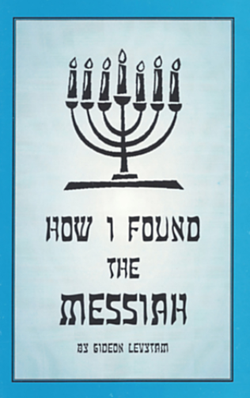
Follow Gideon Levytam's journey and discover how he was led by God, through a series of exciting circumstances, to find the One his people are still waiting for.
Past Episodes

Featured Offer
Follow Gideon Levytam's journey and discover how he was led by God, through a series of exciting circumstances, to find the One his people are still waiting for.
About Holy Scriptures and Israel
As time passed by, the Lord Yeshua took dear brother John Van Stormbroek to himself. The ministry of Holy Scriptures and Israel continued with additional development. In the early 1990’s, a weekly morning Bible class began which brother Gideon Levytam led regularly in the City of Toronto. This weekly open Bible class was held in the Willowdale assembly meeting hall. Eventually, a second mid-week evening Bible class was added. In April 2002, the need for an additional outreach Bible teaching meeting arose. We begun a Saturday (Shabbat) ministry meeting in which a systematic teaching of God’s word is presented to all who attend. Together we learn God’s Word, pray for each need and the salvation of Israel, and sing songs of worship unto our God, praising Him and our Lord Yeshua the Messiah.
In Mid 2004 we started to air on Joy 1250 Radio station a 15 minute Bible teaching program called "The Holy Scriptures and Israel" with Gideon Levytam. The broadcast teaches God’s word from a Hebrew Messianic perspective and has proved to be a blessing to many. It's now aired seven days a week. Our prayer is that many more of our Israeli people will have a clear understanding of who Yeshua is, why we all need him, and come to know him as their Lord and Messiah.
About Gideon Levytam
Contact Holy Scriptures and Israel with Gideon Levytam
426 Simcoe Street
Niagara-on-The-Lake
Ontario L0S 1J0
Canada
(905) 325-1234