

Acts 22:22 to 23:11, Part 2


The Response to Paul’s Testimony Part 2
Guest (Female): Shalom. Holy Scriptures and Israel is a ministry designed to share with the Jewish people the good news of the Lord Jesus, Yeshua the Messiah, and to instruct Christians on the Jewish roots of their faith. And now, teaching God's word from a Hebrew Messianic perspective, here is Gideon Levytam.
Gideon Levytam: The study of Acts chapter 22, they could gain an entrance so they can share with them and they can speak with them about Yeshua the Messiah, they can spread the Bible, maybe to bring Bibles into this country, which other people who are not citizens could never do so. So here the Apostle Paul used this in order to be spared from the scourging that they were about to give him because he was a Roman citizen.
And so now in the next verses in chapter 22, the last verse into the first 11 verses of chapter 23, we have now the Apostle Paul’s testimony not only before the people in the temple, but this time he is going to give his testimony before the Sanhedrin. The Sanhedrin is really the council in the city of Jerusalem. The council is the leadership of our people Israel. It's composed of 71 elders, and those 71 elders are the spiritual leaders of the nation of Israel.
In fact, if you will turn with me for a moment to Numbers chapter 11. Just go back with me for a moment. In chapter 11 of the book of Numbers, we have the first time that the Sanhedrin in a sense were put together, and it's actually was put together by Moses, as the Lord had instructed Moses in Numbers chapter 11 and verse 16 and 17. You remember Moses, it was so hard for him to bear with the nation of Israel as he was leading them into the Promised Land.
We read in verse 14 of Numbers chapter 11, "I am not able," Moses says to God, "to bear all this people alone because it is too heavy for me." In a sense, Moses was complaining before the God of our fathers, the God of Israel. He says, "God, it's too heavy for me to take responsibility over the whole nation of Israel." And he said, "If you will deal with me thus," he says, "kill me, I pray thee, out of hand." And then he said, "If I have found favor in your sight, let me not see my wretchedness."
In other words, Moses was complaining to the Lord that he cannot handle this anymore. And I can tell you any leader today who leads in the Lord's work today can say sometime, "Oh, Gevalt! How much can one take?" because there’s a lot of pressure. Can you imagine Moshe Rabbeinu, Moses, our lawgiver, leading thousands upon thousands of the children of Israel from Egypt to Canaan and the grumbling, they complained, all the issues that arises as the people of God following Moses? And then Moses at some point says, "God, I am not able to bear the people anymore."
Actually, he shouldn't have complained. Humanly speaking, you might say he should, but as far as the Lord concerned, he shouldn't because God is the one that was leading the nation. He gave the strength to Moses. But here's a man who could only take so much and he was saying, "God, I am not able to bear the people." And so look what God told him in verse 16 and 17 of Numbers 11.
"And the Lord said unto Moses, 'Gather unto me seventy men of the elders of Israel, whom thou knowest to be the elders of the people and officers over them; and bring them unto the tabernacle of the congregation, that they may stand there with thee. And I will come down and talk with thee there: and I will take of the spirit which is upon thee, and will put it upon them; and they shall bear the burden of the people with thee, that thou bear it not thyself alone.'"
"Moses, Moshe, you gather seventy elders. I will take of the very same Holy Spirit of God that is resting upon thee, I will put it also upon them, and they along with you, 70 plus you, 71, will be the ones that will be bearing the responsibility over the people of Israel." And really, it is called the council. And in Greek, actually, that's where we get the word "synedrion", which is the Hebrew word Sanhedrin, which is simply means the council, the spiritual government of the nation of Israel who are to lead and to rule, give instruction to our people Israel. So it started already long ago, before even Israel entered into the land, on the way to the Promised Land, the instruction concerning the 71 men had been given to Moses.
Now the Apostle Paul is going to give his testimony before the council. I want you to notice that, brothers and sisters. First of all, the last verse of Acts chapter 22, verse 30. Paul is being loosed and we see here the gathering of the Sanhedrin. "On the morrow, because he would have known the certainty wherefore he was accused of the Jews, he loosed him," this is the chief captain, "from his bands, and commanded the chief priests and all their council to appear, and brought Paul down, and set him before them."
So what did the chief captain of the Roman army have done? He have loosed Paul, first of all. He was afraid because he found out that he was a Roman. Secondly, what he did, he called the Sanhedrin to come. Now this time, it's not in the normal place where the Sanhedrin would usually council. It will be really in the Antonia Fortress. He called them quickly to come in haste. He brought everyone from the council because he wanted to know what is going on, why Paul is being accused, why the people wanted to kill him, what is the problem?
So he gathered everyone from the council. Notice he said "the chief priests", plural, many priests, as well as all their council to appear. Notice he commanded them. You know, the Jewish people were under the Roman authority. They couldn't do what they want. The council had to be brought immediately to the presence of the chief captain because he wanted to know what was going on with this situation. So everyone is gathering together. And again, I want you to notice the word "council" in verse 30 is simply in the Greek "synedrion", which means Sanhedrin, which means council. And this is the 71 elders that would be leading the nation of Israel and giving them instruction.
Now one more point before we're going to go into those 11 verses of chapter 23. If you remember, it was not only Paul that is now been standing before the council. This Sanhedrin have been meeting many times before. You remember Yeshua the Messiah. When He, before His crucifixion, before Yeshua died, we find the person of our Lord Yeshua the Messiah also standing before the council in Matthew chapter 26 where they wanted to know whether He was the Messiah.
And you remember how it says there, "Then assembled together the chief priests, and the scribes, and the elders of the people unto the palace of the high priest who was called Caiaphas, and there they counseled together that they might take Jesus by subtlety and they wanted to kill Yeshua." It was the council that Yeshua the Messiah had to stand before them and speak with the leaders of Israel and tell them that He was truly the Promised Messiah. That's what we find in Matthew chapter 26 and the first verses, verses 3 and 4.
Later on, if you remember in Acts chapter 4, it was Peter himself, Shimon Petros, who stood before the council and he himself also in Acts was speaking to the council. And I want to read this Acts chapter 4 and verse 5 where Peter, Shimon Petros, stood before them. It said, "And it came to pass on the morrow, that the rulers, and elders, and scribes, and Annas the high priest, Caiaphas, and John, and Alexander, they all gathered together in Jerusalem." And Peter himself stood before the council and testified concerning the person of Yeshua the Messiah.
Later on, at the end of Acts chapter 6, it was Stephen himself. In verse 15, we read, "And all that sat at the council, looked steadfastly on him, and they saw his face." And Stephen himself stood before the council, the Sanhedrin. By the time we get to Acts chapter 23, it is the fourth person that is standing before the council. This time is none else but Paul himself. So Yeshua first, Shimon Petros next, Stephen following him, and now we have Shaul, Paul, all standing before the council, testifying to the Sanhedrin concerning the work that Yeshua the Messiah have done. You can say, "What nerve! How could they do that?" to stand before the religious leaders of Israel and tell them so boldly about Yeshua the Messiah. These were men that were given the strength by the Spirit of God to testify concerning the Lord Yeshua the Messiah.
And so brothers and sisters, listen to two points I want to belabor here in chapter 23. First of all, verses 1 to 5, we have Paul before the council of Israel, the Sanhedrin. And then verses 6 to 11, we have Paul appeal to the Sanhedrin, to the council in boldness, how he appealed to them concerning the resurrection of Yeshua the Messiah. So let's look at those verses one by one. First of all, verses 1 to 5, Paul is standing before the council of Israel. First of all, his opening words in verse 1. "And Paul earnestly beholding the council, said, 'Men and brethren, I have lived in all good conscience before God until this day.'"
Notice he called them "men and brethren", Anashim Achim. Brethren, they were not believers, but they were brethren as a nation. They were part of the nation of Israel. So he was calling them and appealing to his own brethren according to the flesh, the Jewish brethren. He as a Jew to his own Jewish brethren. He as an Israeli to his own Israeli brethren. He as a Hebrew to his own Hebrew brethren. And he's calling them looking earnestly towards them. What a boldness he must have had. And he said to them, "Listen, I have lived in all good conscience before God until this day."
The word "conscience" is the mechanism which God had given to man when sin entered into this world. You remember when Adam have disobeyed God and he ate of the tree of the fruit of the knowledge of good and evil? The moment he disobeyed God and he ate of it, he recognize that he was plunging himself into sin. It was at that time that conscience entered into this world. Before this time, he did not have in that sense that conscience because sin did not enter into this world. But the moment that he disobeyed God, sin came in. Conscience is the buzzer that tells us when we are wrong, when we disobey the Lord. And it is at that time that Adam plunged the whole human race into sin.
And Paul says, "Listen, I have sought to live my life in all good conscience before God," and later on he says "before men until this day." In other words, he sought to judge himself. When he have done wrong, he confessed it before the Lord. He wanted to have a clean conscience. You know, sometime when our conscience are not clean, we have no liberty. We feel defeated. There's no blessings because our conscience bothers us. It's like that buzzer that says, "Uh-uh, I have done something wrong. I should deal with it. I should confess it." And Paul have lived his life, sought to live with a good conscience before God until this day.
If you just turn the page for a moment to chapter 24, the next chapter, Paul mentioning this again in verse 16. He said, "Herein I do exercise myself to have always a conscience void of offense toward God and toward men." Paul always said, "I exercise myself. I challenge myself. I seek to always have my conscience right before God and before men." Why? Because a guilty conscience does not give liberty. When there's friction between two people, it doesn't give us liberty to share and to have fellowship and to enjoy a friendship and love and care because our conscience bother us. We have done something wrong. But to clear the conscience, one has to confess and to say, "I have wronged you and I confess it." The moment we do so, the cloud have been removed and the air is clear and we can continue our fellowship with each other.
And so the Apostle Paul says, "You know, I have lived in good conscience before God until this day." You know, by the way, brothers and sisters, before he became a believer in our Lord Yeshua the Messiah, when he persecuted the believers, he assumed that he does it for the glory of the God of Israel. He assumed that he is honoring the God of Abraham, Isaac, and Jacob, and he is dealing with those who have gone astray and have gone wrong and disobey the Lord, until the Lord revealed to him that these Jewish believers trusted in Yeshua the Messiah and that you need for yourself Yeshua the Messiah and that He is truly the Messiah, the Savior. Then Paul turn around and he got saved. And he grieved him for what he have done. And from here on, he is now seeking to live in a life that is pleasing to the Messiah, Yeshua. And so now from here on, he said, "I sought to live in a good conscience before God even until this day." He was speaking to the council.
And so in verse 2, then look what happened. As he was speaking, what a bad start it was because immediately the high priest have commanded that Paul will be smitten. In verse 2, "The high priest Ananias commanded them that stood by to smite him on the mouth." Ananias, that was the high priest who was actually Israel's high priest from about 47 AD to 59 AD. He was one that was pro-Romans. He was not really light. He was not an honest man. He was not really living a life for God. When Paul said, "I lived in a good conscience before God," he was speaking to the council. "Before God until this day," this high priest by the name of Ananias said to those that were there, "Smite him in the mouth." And apparently it says here, those that stood by him actually smote him in his mouth, hit the Apostle Paul in his face, in his mouth.
And you can see that the Apostle Paul reacted because in the next verse, look what the Apostle Paul is saying here. "God shall smite thee, thou whited wall: for sittest thou to judge me after the law, and commandest me to be smitten contrary to the law?" In other words, Paul is saying to him, "Listen, you're sitting here to judge me as if you're supposed to judge me under the law that God had given our people Israel, but you are commanding someone to smite me on my face contrary to the law before you find me guilty."
And notice he called him "whited wall". Why did he call him whited wall? This is a Hebraic expression when a wall is being painted white. The reason to paint the wall white is because one would cover to give it a better appearance, an external appearance that looks much nicer, white, while actually inside it is in ruins. And usually in olden time, they used to paint graves with white in order to give it a better appearance.
I'll show you this verse that Yeshua used the same expression here. Matthew chapter 23, we find the Lord is using the same expression there in verse 27. Yeshua is speaking to the Pharisees and He says, "Woe unto you, scribes and Pharisees, hypocrites! For ye are like unto a whited sepulcher, which indeed appear beautiful outward, but are within full of dead men's bones, and of all uncleanness." In other words, what He was saying, when he was calling the high priest here, this is Shaul, Paul, this expression in verse 3, he said to him, "God shall smite thee, thou whited wall." In other words, he was calling him, "You are a hypocrite. You give an appearance as if you're doing things God's way, but in reality you are doing things against the will of God." That is another Hebraic expression to call to someone a hypocrite is basically calling him a whited wall, as Yeshua said, a whited grave, but inside is dead bone.
And here is the man Ananias who is the high priest at that time who was actually pro-Romans. He was not a godly man. He was not a man that really wanted the welfare of the nation, but he had been placed into this position and therefore he used that and in a case such as the Apostle Paul, he was smiting him, giving an appearance as if Paul or Shaul was speaking wrong when he said that "I have lived with a good conscience until this day before God, the God of Israel." And so he told the one to smite him in the face.
You know the same thing happened to Yeshua when He was actually before the council, and they actually smote Him as well. We read this in the gospel of John. But Yeshua reacted differently. You know Paul have reacted right away and he called him "whited wall". But Yeshua reacted differently. You can see that we are all coming short of the perfection of our Lord Yeshua the Messiah.
Allow me please to read the verses in John 18 for a moment when Yeshua was smitten. In verse 19, "The high priest then asked Jesus of His disciples and of His doctrine. Jesus answered him, 'I spoke openly to the world. I have taught in a synagogue and in the temple, whither the Jews always resorted; and in secret have I said nothing. Why do you ask Me? Ask them which heard Me, what I have said unto them; behold, they know what I said.'" He is speaking to the high priest.
Then listen to verse 22. "And when He had thus spoken, one of the officers which stood by struck Jesus with his palm of his hand, and said, 'Answering thou the high priest so?' Jesus answered him, 'If I have spoken evil, bear witness of the evil: but if well, why do you smite Me?'" You see that? See the different between the way He was speaking to the high priest. He says, "I have spoken openly. I have shared with everyone the fact that I came from heaven, the Son of God, the Mashiyach of Israel. I came down and ask everyone, ask them which heard Me, I have said unto them, behold they know what I said."
So one of the people that were by the high priest also struck Yeshua with a palm of his hand to his mouth. And he said to Him, "Do You answer like this to the high priest?" And then we find out that He said, "I have spoken no evil. I bore witness of the evil of the nation, but if well, why do you smite Me?" You see, He just asked him. But Paul kind of gone a little bit beyond because after all, Paul was a man. But even here, you can see how he correct himself.
Beloved brothers and sisters, look and go back to Acts chapter 23 and notice now what we read after that. We find out that in verse 4 of Acts chapter 23, "And they that stood by said to him, 'Revilest thou God's high priest?'" In other words, "Do you speak like this, Paul, to the high priest? Don't you know that he was the high priest?" And immediately Paul corrected himself. And apparently, he did not know that it was the high priest because he said in verse 5, "Then said Paul, 'I wist not, I did not know, brethren, that he was the high priest: for it is written, thou shalt not speak evil of the ruler of thy people.'"
He is actually quoting Exodus chapter 22 verse 28 where Moses have been instructing the people of Israel not to speak evil of the rulers of Israel. And therefore, immediately Paul, Shaul, knowing his Hebrew scriptures, immediately he says, "I did not know, brethren, that he was the high priest because it is written." Remember, we don't have Acts yet written. We don't have Romans yet written. But we have all the Tanakh written. So he's quoting the Old Testament and says, "It is written in the Hebrew scriptures that you shall not speak evil against the ruler of thy people." And immediately he corrected himself.
Now there's a question that we need to raise here for a moment. How come that the Apostle Paul did not know that he was the high priest? What was the reason? Now remember, let me give you a couple of thoughts here. First of all, some suggest that it is very possible that the Apostle Paul by that time had some problem with his eyes. Apparently, it is very possible that the thorn that he had in his flesh was his eye issue. That's why he needed a lot of help in writing some of his epistles.
And you remember in the book of Second Corinthians that he sought thrice the glorified Messiah that He will take away this thorn that he had in his flesh. But Yeshua said to him, "My grace is sufficient for you." And so it may be that Shaul, Paul's sight was not as well and therefore he did not recognize that he was the high priest. Secondly, it may also be that immediately that captain gathered together the council. And the council had to gather in the castle. The Sanhedrin had to come into that Antonia Fortress. In other words, it was a hasty meeting. And it may be that all the priests came in, maybe they were not dressed with the high priestly gowns and so on, so Shaul, Paul could not discern or could not see if truly he was that high priest and he didn't recognize him.
So there may be one or two or three reasons why Paul said, "I did not know that he was that high priest because it is written, thou shalt not speak evil against the ruler of thy people." So here we have in the first five verses Paul before the council of Israel and what happened to Paul when he have appeared before them. You notice that the name of the high priest is Ananias, in Hebrew we call him Chanan-yah.
Guest (Female): You have been listening to the Holy Scriptures and Israel with Gideon Levytam. Gideon teaches God's word from a Hebrew Messianic perspective. For more information about this ministry, write to Holy Scriptures and Israel, Box 1411, Niagara-on-the-Lake, Ontario, L0S 1J0, or visit our website at holyscripturesandisrael.com.
You are also invited to Gideon's weekly Bible teaching on Fridays at 11:00 AM and 7:00 PM and Saturdays at 1:00 PM at Willowdale Christian Assembly Hall, 28 Martin Ross Avenue in Toronto. Holy Scriptures and Israel is made possible by your prayers and financial support. If you would like to support the program, visit holyscripturesandisrael.com. God bless you, Shalom, Shalom.
Featured Offer
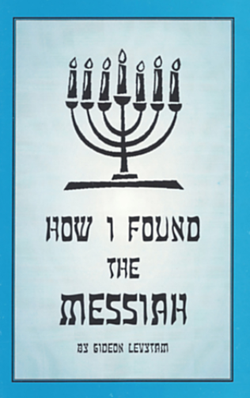
Follow Gideon Levytam's journey and discover how he was led by God, through a series of exciting circumstances, to find the One his people are still waiting for.
Past Episodes

Featured Offer
Follow Gideon Levytam's journey and discover how he was led by God, through a series of exciting circumstances, to find the One his people are still waiting for.
About Holy Scriptures and Israel
As time passed by, the Lord Yeshua took dear brother John Van Stormbroek to himself. The ministry of Holy Scriptures and Israel continued with additional development. In the early 1990’s, a weekly morning Bible class began which brother Gideon Levytam led regularly in the City of Toronto. This weekly open Bible class was held in the Willowdale assembly meeting hall. Eventually, a second mid-week evening Bible class was added. In April 2002, the need for an additional outreach Bible teaching meeting arose. We begun a Saturday (Shabbat) ministry meeting in which a systematic teaching of God’s word is presented to all who attend. Together we learn God’s Word, pray for each need and the salvation of Israel, and sing songs of worship unto our God, praising Him and our Lord Yeshua the Messiah.
In Mid 2004 we started to air on Joy 1250 Radio station a 15 minute Bible teaching program called "The Holy Scriptures and Israel" with Gideon Levytam. The broadcast teaches God’s word from a Hebrew Messianic perspective and has proved to be a blessing to many. It's now aired seven days a week. Our prayer is that many more of our Israeli people will have a clear understanding of who Yeshua is, why we all need him, and come to know him as their Lord and Messiah.
About Gideon Levytam
Contact Holy Scriptures and Israel with Gideon Levytam
426 Simcoe Street
Niagara-on-The-Lake
Ontario L0S 1J0
Canada
(905) 325-1234