
Acts 22:22 to 23:11, Part 1


The Response to Paul’s Testimony Part 1
Guest (Female): Shalom! Holy Scriptures and Israel is a ministry designed to share with the Jewish people the good news of the Lord Jesus Yeshua the Messiah and to instruct Christians on the Jewish roots of their faith. And now, teaching God’s word from a Hebrew Messianic perspective, here is Gideon Levytam.
Gideon Levytam: Shabbat shalom everyone. Let us open our Bibles to the passage that we have been studying for a while: Acts chapter 22 today. We are going to conclude with chapter 22 and enter into chapter 23 and verse 11. Acts 22, verse 22.
Guest (Male): And they gave him audience unto this word, and then lifted up their voices, and said, Away with such a fellow from the earth: for it is not fit that he should live. And as they cried out, and cast off their clothes, and threw dust into the air, the chief captain commanded him to be brought into the castle, and bade that he should be examined by scourging; that he might know wherefore they cried so against him.
And as they bound him with thongs, Paul said unto the centurion that stood by, Is it lawful for you to scourge a man that is a Roman, and uncondemned? When the centurion heard that, he went and told the chief captain, saying, Take heed what thou doest: for this man is a Roman. Then the chief captain came, and said unto him, Tell me, art thou a Roman? He said, Yea. And the chief captain answered, With a great sum obtained I this freedom. And Paul said, But I was free born.
Then straightway they departed from him which would have examined him: and the chief captain also was afraid, after he knew that he was a Roman, and because he had bound him. On the morrow, because he would have known the certainty wherefore he was accused of the Jews, he loosed him from his bands, and commanded the chief priests and all their council to appear, and brought Paul down, and set him before them.
And Paul, earnestly beholding the council, said, Men and brethren, I have lived in all good conscience before God until this day. And the high priest Ananias commanded them that stood by him to smite him on the mouth. Then said Paul unto him, God shall smite thee, thou whited wall: for sittest thou to judge me after the law, and commandest me to be smitten contrary to the law? And they that stood by said, Revilest thou God's high priest? Then said Paul, I wist not, brethren, that he was the high priest: for it is written, Thou shalt not speak evil of the ruler of thy people.
But when Paul perceived that the one part were Sadducees, and the other Pharisees, he cried out in the council, Men and brethren, I am a Pharisee, the son of a Pharisee: of the hope and resurrection of the dead I am called in question. And when he had so said, there arose a dissension between the Pharisees and the Sadducees: and the multitude was divided. For the Sadducees say that there is no resurrection, neither angel, nor spirit: but the Pharisees confess both.
And there arose a great cry: and the scribes that were of the Pharisees' part arose, and strove, saying, We find no evil in this man: but if a spirit or an angel hath spoken to him, let us not fight against God. And when there arose a great dissension, the chief captain, fearing lest Paul should have been pulled in pieces of them, commanded the soldiers to go down, and to take him by force from among them, and to bring him into the castle. And the night following the Lord stood by him, and said, Be of good cheer, Paul: for as thou hast testified of me in Jerusalem, so must thou bear witness also at Rome.
Gideon Levytam: This is the conclusion of the reading in chapter 23 and verse 11. The setting is very well known to all of us as we have already read the previous chapters that find Apostle Paul concluded his third missionary journey and he find himself now in the city of Jerusalem. Paul, of course, a lover of his own brethren just the same like Yeshua, a lover of his own people Israel, desire to share with our people Israel that Yeshua is the Messiah.
Not only because he desired this for himself, but as you remember in chapter nine and verse 15 which we have already covered where the Lord, the glorified Messiah Yeshua said to him: "For he is a chosen vessel unto me to bear my name before the Gentiles and kings and the children of Israel." So the Apostle Paul, Sha'ul, have arrived to Jerusalem at the end of his missionary journey and found himself now in the temple having that vow that we have talked about.
Many of the Jewish people of the diaspora capture him and the chief ruler of the Roman army have delivered him from them. Paul gave them in the beginning of chapter 22, verse 1 to 21, the experience of his life: how he became a believer in the Lord Yeshua the Messiah. He rehearsed before the Jewish people there in the temple of Jerusalem his experience, how he became a believer and what happened to him.
He said to them in this chapter how he himself was the one that was a persecutor of the believers and wanted the death of the martyr Stephen, consenting to the death of Stephen and he kept the clothes of those that accused Stephen and actually slew Stephen. That's what Paul was saying to them. He spoke to them in the Hebrew language, not in Greek, not in Aramaic, but in the Hebrew tongue, *be-Ivrit*, as we say it.
You can read the text in its original in chapter 21 and 22, you can see in Greek it said that he spoke unto them in *Hebraidi*, the Greek word for Hebrew. He spoke to his brethren in Hebrew wanting them to understand why he believed that Yeshua was the Messiah. That long speech that he gave to them rehearsing before them the experience that he have had when he became a believer, there was so much that they could take and no more.
In verses 22 to the end of the chapter, we find out first of all the response of the people to Paul's testimony. It is so easy for us to not realize the price that this man had to pay by simply sharing the testimony with his brethren, the Jewish people. In verse 22 and 23, we read the response itself. When they have arrived to this statement in verse 21 that the Lord, the glorified Messiah said to him: "Depart, for I will send thee far away unto the Gentiles," they stopped him right there.
We read in verse 22: "And they gave him audience unto this word, and then lifted up their voices and said, Away with such a fellow from the earth: for it is not fit that he should live." They were so angry with Sha'ul Paul because he told them how the Lord called him to be a vessel to the Gentile world and to be a witness of the Gospel of our Lord Yeshua the Messiah. They were so angry that now he's in a sense teaching a new teaching as far as they are concerned that they could not take it anymore.
Remember, the Apostle Paul is speaking to them from this castle called the Antonia Fortress and he is from the steps speaking to them, using it as a platform. He is preaching the message about what the Messiah have done and how the Messiah have called him. They couldn't take it any longer and they say: "Away with such a fellow from this earth. He is not fit that he should live upon the face of this earth."
They said it because they felt that he bringing a false teaching, that he is bringing another god. That he is now in a sense called to preach to the Gentile world, yet everything they assumed has to go through the nation of Israel. These individuals, Jewish people from the diaspora who came to the temple for worship, they have recognized that he was the one that was preaching in Asia Minor about the Lord Jesus, about Yeshua Hamashiach, and that he was the one that was spreading the things that they don't need anymore to keep the law and they don't need to be circumcised.
They were so upset with Sha'ul Paul that they said: "Away with such a fellow from the earth. He is not fit to live upon the face of this earth." We read that they cried—look what they have done in verse 23—they cried out and they cast off their clothes and they threw dust into the air. These are some of the action that one does when he is in mourning as if someone has died.
The action of the Apostle Paul as far as they were concerned in teaching about another Messiah or another god, that for them was like a person that is suitable for death. This is a sign of mourning for them. They say that a Jewish person who become a believer in Yeshua the Messiah, usually our own people, our religious family would actually consider us to be dead. In some families they will literally have a funeral service.
Historically it was like this: person is cut off from among the nation. That's why they say: "He is not fit that he should live." They did these things such as cast off their clothes, ripping their clothes, and they threw dust in the air. Do you remember when the friends of Job came, you read it in Job chapter one and chapter two? When they saw Job, Iyov, and they saw what happened to him: how he lost his family, how he lost his health, and how he was totally devastated.
We read that they also cast dust. We read that they sit for seven days and they mourn as if he was a dead person. In Hebrew we call it *Shiva*. You sit *Shiva*, because you only sit for seven days for a person who is dead. As far as they were concerned, this man Sha'ul, this man Paul have violated the word of God, have violated the law that God had given Israel. As far as they were concerned, he is not fit to live in this earth.
Away with such a fellow, they said. They cried out, they cast off their clothes, they threw dust into the air as a sign of mourning, a sign of weeping, a sign of death. Look what happened: again Paul Sha'ul needed to be delivered from their hands because it says here in verse 24 to 29 how the chief captain had delivered him again because they were ready to kill him.
It says in verse 24: "The chief captain commanded him to be brought into the castle and he bade that he should be examined by scourging that he might know why they cried so against him." The chief captain who was a commander of a thousand, he did not know Hebrew. He was a Roman. The Hebrews were in the temple compound. Paul Sha'ul, a Hebrew of the Hebrews speaking to his own brethren in the Hebrew tongue, and he did not know what's going on, what this whole chaos that is going on, what this man have done that they want to kill him.
He deliver him again, but this time he took him in and he bade that he should be examined by scourging and that he might know why they cried so against him. In verse 25 we read that as they bound him, apparently they tied Paul. The Romans tied Paul with thongs as it says here. And then Paul had to say something. Paul was a very wise man.
He was not only a heavenly man, a man that belonged to heaven, to the Messiah, that have a citizenship in heaven from whence the Messiah is going to come to take us to be with him in glory, but he also was living here on earth. He used some of the privileges he had here on earth for the furtherance of the Gospel and for making sure that he used the privileges that he had, not to abuse it but to use it.
Look what we read in verse 25b: that Paul was speaking to the centurion. The centurion is a commander between 80 to 100 soldiers, which the chief captain gave him the responsibility over Paul. When this centurion after he bound him, Paul said to this centurion, he says: "Is it lawful for you to scourge a man that is a Roman and uncondemned?"
A Roman citizen had a privilege: he could not be bound, he could not be scourged without first of all going through the court system and being actually condemned. Then they would deal with him if he had been wrong and if he had been found guilty. But here in a case of Sha'ul Paul, he was not guilty. There was no reason for him to be bound, there was no reason for him to be scourged. But they wanted to know what happened.
They didn't know that he was a Roman citizen. They thought he was one of these Jewish people, which he was, but they didn't recognize that he was also a Roman citizen. Just the same like myself: I am an Israeli citizen, I am also a Canadian citizen, but I am also a heavenly citizen. My citizenship in heaven, from whence the Messiah is going to come to take us to be with him in glory.
We are still citizens of this earth, you as well. Every one of us is a citizen of one country or another. So the Apostle telling him: "Is it lawful for you to scourge a man who is a Roman citizen and not condemned?" Immediately look what happened, notice the next verse: the centurion immediately, it says in verse 26, when the centurion heard the saying, he went into the chief captain, he went to his commander and he said to him: "Take heed what you doing because this man is a Roman. Be careful chief captain what you are telling me to do because this man is a Roman citizen."
He was warning the chief captain, he was alerting him. The law of Rome was that no Roman citizen could be bound before he was taken into court. In the next verse: "Then the chief captain came and he said unto him, Tell me, are you a Roman? And he said, Yes, I am a Roman." He said, the chief captain answered and he said to him: "You know, I paid a lot of money to become a citizen." Apparently you can be born a Roman citizen or you can pay in order to become and to be considered a Roman citizen.
This chief captain said: "With a great sum obtain I this freedom." You remember brothers and sisters how many slaves were at the time of the Romans? You remember for example like this slave by the name of Onesimus in the book of Philemon. Onesimus was a slave, Philemon was a free man. Onesimus was a slave of Philemon and he fled from Philemon, have arrived to Rome, became a believer in Yeshua the Messiah.
Paul sent him back to Philemon and he asked him to accept this man by the name of Onesimus who was a slave who became a believer. They said that there were about 50/50 in the then known Roman Empire: so many slaves, but so many free. To become a free Roman citizen some had to pay actually a roundabout in order to become and to be considered a Roman citizen because the rest of them were slaves to the Romans.
That's why you remember sometimes we read in scripture like in the book of Corinthians that those that we are in the Messiah it says: "neither bond nor free." What does that mean? That means that the slave who became a believer is just as much a part of the body of Messiah as the free, the Roman citizen. They became one in Christ, one in Messiah when they became believers, even though the other one remain a slave and the free man, the Roman citizen, remain a free man, but yet in the Messiah they are one.
This chief captain saying to Sha'ul to Paul: "You know, I paid a lot of money to become a citizen of Rome." Yet notice what Paul said to him. The chief captain answered in verse 28: "With a great sum of money obtain I this freedom." Paul said to him: "But I was freeborn citizen." Now we do not know exactly how his father and mother have received their citizenship. Remember Paul Sha'ul is a Jewish man, he is a Hebrew man, he is an Israeli man, and yet he was born as a Roman citizen.
He using this citizenship in this occasion to be delivered out of scourging by the Roman centurion. He is telling the centurion as well as the chief captain, he said: "I was born free citizen here into this Roman Empire." Immediately look what happened in verse 29: the fear that came upon the chief captain because it says then straightway they departed from him which would have examined him.
The chief captain also was afraid after he knew that he was a Roman and because he had bound him. You should not even bind a Roman citizen before he is declared guilty. He bound him and he should not have done it. He was ready to scourge him and he should not have done it. He have done two things that were wrong against a Roman citizen. Now he was so afraid because he have done that to a Roman citizen and that is something that could endanger the chief captain.
That's why he immediately left him and they didn't scourge him, they didn't bind him, they loosen him. Those verses 22 to 29 describe for us the response of the people to Paul's testimony and the action of the Roman chief captain and the centurion. Interesting to see how Paul used his Roman citizenship to gain an advantage. Sometime we can use our citizenship to gain an advantage.
What does that mean? Not a selfish advantage, but an advantage to further the Gospel. There are certain people that let's say can enter into a country which they could not enter with another citizenship. They can use this citizenship to share the message where there are people who could not hear the message of the Gospel. They could gain an entrance so they can share with them and they can speak with them about Yeshua the Messiah.
They can spread the Bible, maybe to bring Bibles into this country which other people who are not citizens could never do so. Here the Apostle Paul used this in order to be spared from the scourging that they were about to give him because he was a Roman citizen. Now in the next verses, in chapter 22 the last verse into the first 11 verses of chapter 23, we have now the Apostle Paul testimony not only before the people in the temple, but this time he is going to give his testimony before the Sanhedrin.
The Sanhedrin, it's really the Council in the city of Jerusalem. The Council is the leadership of our people Israel. It's composed of 71 elders and those 71 elders are the spiritual leaders of the nation of Israel. In fact, if you will turn with me for a moment to Numbers chapter 11, just go back with me for a moment in chapter 11 of the book of Numbers.
We have the first time that the Sanhedrin in a sense were put together and it was actually put together by Moses as the Lord had instructed Moses in Numbers chapter 11 and verse 16 and 17. You remember Moses, it was so hard for him to bear with the nation of Israel as he was leading them into the promised land. We read in verse 14 of Numbers chapter 11: "I am not able," Moses says to God, "to bear all this people alone, because it is too heavy for me."
In a sense Moses was complaining before the God of our fathers, the God of Israel. He says: "God, it's too heavy for me to take responsibility over the whole nation of Israel." He said: "If you will deal with me thus," he says, "kill me, I pray thee, out of hand," and then he said, "if I have found favor in your sight, let me not see my wretchedness."
Moses was complaining to the Lord that he cannot handle this anymore. I can tell you any leader today who lead in the Lord's work today can say sometimes, oh, *gevalt*, how much can one take because there's a lot of pressure. Can you imagine Moses, our lawgiver, leading thousands upon thousands of the children of Israel from Egypt to Canaan? The grumbling, the complaining, all the issues that rises up as the people of God following Moses.
Moses at some point says: "God, I am not able to bear with this anymore." Actually he shouldn't have complained. God is the one that was leading the nation. He gave the strength to Moses. But here's a man who could only take so much and he was saying: "God, I am not able to bear the people." Look what God told him in verse 16 and 17 of Numbers 11: "And the Lord said unto Moses, Gather unto me seventy men of the elders of Israel, whom thou knowest to be the elders of the people, and officers over them; and bring them unto the tabernacle of the congregation, that they may stand there with thee. And I will come down and talk with thee there: and I will take of the spirit which is upon thee, and I will put it upon them; and they shall bear the burden of the people with thee, that thou bear it not thyself alone."
Moses, you gather 70 elders. I will take of the very same Holy Spirit of God that is resting upon thee, I will put it also upon them and they along with you, 70 plus you, 71, will be the one that will be bearing the responsibility over the people of Israel. Really, it is called the Council.
Guest (Female): You have been listening to Holy Scriptures and Israel with Gideon Levytam. Gideon teaches God’s word from a Hebrew Messianic perspective. For more information about this ministry, write to Holy Scriptures and Israel, Box 1411, Niagara-on-the-Lake, Ontario, L0S 1J0, or visit our website at holyscripturesandisrael.com. You are also invited to Gideon’s weekly Bible teaching on Fridays at 11:00 AM and 7:00 PM and Saturdays at 1:00 PM at Willowdale Christian Assembly Hall, 28 Martin Ross Avenue in Toronto. Holy Scriptures and Israel is made possible by your prayers and financial support. If you would like to support the program, visit holyscripturesandisrael.com. God bless you. Shalom shalom.
Featured Offer
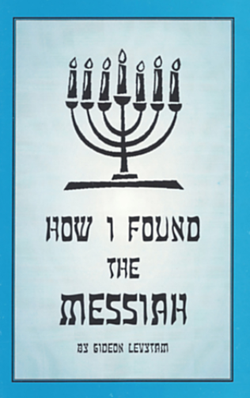
Follow Gideon Levytam's journey and discover how he was led by God, through a series of exciting circumstances, to find the One his people are still waiting for.
Past Episodes

Featured Offer
Follow Gideon Levytam's journey and discover how he was led by God, through a series of exciting circumstances, to find the One his people are still waiting for.
About Holy Scriptures and Israel
As time passed by, the Lord Yeshua took dear brother John Van Stormbroek to himself. The ministry of Holy Scriptures and Israel continued with additional development. In the early 1990’s, a weekly morning Bible class began which brother Gideon Levytam led regularly in the City of Toronto. This weekly open Bible class was held in the Willowdale assembly meeting hall. Eventually, a second mid-week evening Bible class was added. In April 2002, the need for an additional outreach Bible teaching meeting arose. We begun a Saturday (Shabbat) ministry meeting in which a systematic teaching of God’s word is presented to all who attend. Together we learn God’s Word, pray for each need and the salvation of Israel, and sing songs of worship unto our God, praising Him and our Lord Yeshua the Messiah.
In Mid 2004 we started to air on Joy 1250 Radio station a 15 minute Bible teaching program called "The Holy Scriptures and Israel" with Gideon Levytam. The broadcast teaches God’s word from a Hebrew Messianic perspective and has proved to be a blessing to many. It's now aired seven days a week. Our prayer is that many more of our Israeli people will have a clear understanding of who Yeshua is, why we all need him, and come to know him as their Lord and Messiah.
About Gideon Levytam
Contact Holy Scriptures and Israel with Gideon Levytam
426 Simcoe Street
Niagara-on-The-Lake
Ontario L0S 1J0
Canada
(905) 325-1234