

Acts 22:1-21, Part 3


Paul’s Testimony to his Jewish Brethren in Jerusalem Part 3
Guest (Male): Shalom! Holy Scriptures and Israel is a ministry designed to share with the Jewish people the good news of the Lord Jesus, Yeshua the Messiah, and to instruct Christians on the Jewish roots of their faith. Now teaching God's Word from a Hebrew-Messianic perspective, here is Gideon Levytam.
Gideon Levytam: The study of Acts chapter 22. When he lived here on earth, the rejected one, the despised one, we call him Yeshua Ha-Notzri, the one that was rejected and despised by men. He is now seated at the right hand of God the Father, but he came once in humility and he was despised and rejected of men. Saul here was really persecuting him by persecuting his own people. So he's rehearsing before his Jewish brethren the fact that he responded to the Lord, who told him, "I am Jesus, I'm Yeshua from the city of Nazareth, and you, by persecuting the believers, actually persecute me."
And so in verse 9, Paul's companion responds. It says here in verse 9, "And they that were with me saw indeed the light and were afraid, but they heard not the voice of him that spake with me." So those that had been with him, who traveled with him, they saw the light, they had been very much afraid, but they didn't hear what the Lord was telling Saul.
And so finally in verses 10 and 11, Paul's words to Yeshua and Yeshua's answer to him. He says, "What shall I do, Lord?" he says in verse 10. "And the Lord said unto him, Arise, go to Damascus, and there it shall be told thee all things which are appointed for thee to do." You see, he asked him, "What do you want me to do?" I guess when the Lord spoke with him on the way to Damascus and he challenged him, "Why do you persecute me?" he said, "Well, Lord, what should I do now?" And the Lord Jesus, the glorified Messiah, had given him instruction. He said to him, "You get up, you go to Damascus. There in the city of Damascus you will be told what you are going to do."
And then we find out what happened to Paul, to Saul, because when he got up he discovered that he became blind. He couldn't see. So he needed somebody to lead him by the hand all the way to the city of Damascus, when he could not see for the glory of the light. Being led by the hand of them that were with him, he came and arrived to the city of Damascus. He finally arrived to Damascus, but he needed to be led by men. You know, the brightness of the light that shone around him had literally blinded him and made him incapable to walk, and he needed the help of others to take him by the hand and to move him into the city of Damascus.
I found it kind of interesting that we never read of the others that they became blind, but we read that he became blind. And yet we see that they saw the light in verse 9. Those that were with him saw the very same light that he saw, and yet they did not become blind and he became blind. Well, there was a message for him from the glorified Messiah. The Lord in a sense struck him to show him that he is in total dependence upon him, that he cannot do anything against the Lord and against the Lord's people should the Lord want to stop him from doing it. But yet in grace, he allowed him to be led by the very people who saw that light to be brought to the city of Damascus because there Yeshua had a message for Saul in order for him to be a servant of the Messiah.
And so here in verses 6 to 11, we find Paul sharing with his Jewish brethren in the Temple in Jerusalem what happened to him as he was journeying from Jerusalem to the city of Damascus. Now, brothers and sisters, listen to the next verses, verses 12 to 16. Now he is telling them his experience in the city of Damascus. A few points here. First of all, we hear about a man by the name of Ananias. In Hebrew we call him Chananyah. It comes from the word grace, Chanan, meaning mercy, grace. We find this man himself living in Damascus, one by the name of Chananyah, a devout man according to the law, having a good report of all the Jews which dwell in this city of Damascus.
Apparently this man by the name of Chananyah, a believer in the Lord Yeshua the Messiah, apparently he had a good report among all the Jewish community, both believers and unbelievers. They looked at this man by the name of Chananyah, he had a good testimony. He had a good report. He had a good testimony among all the Jewish community, even though he was a believer in Yeshua the Messiah. He had some respect, some acknowledgment by the Jewish community.
Then we find out in verse 13 that he is the one who was used to give the sight to Saul, because it says in verse 13, "He came unto me and stood and said unto me, Brother Saul, receive thy sight. And the same hour I looked up upon him." Now notice he called him Saul, he doesn't call him Paul. You know, sometimes people say when he was a Jew he was Saul, when he became a believer he became Paul. That is not correct. He was always Saul before he became a believer and after he became a believer. His Jewish Hebrew name was Saul. His diaspora name was Paul. This is something that is still practiced today by the Jewish community. A Jewish person who lives in the diaspora, lived outside of the land, has two names: his Hebraic name to communicate with his Jewish brethren and his non-Hebraic name, a gentile name in which he uses in his work or school or wherever he is among the non-Jewish community.
Apparently he already became a believer because he called him "Brother Saul, receive thy sight." And at that moment, Saul, Paul, received his sight and he could look at this man, and he could see this man by the name of Chananyah looking upon him, seeing this man that was used by the Lord Yeshua to give him the sight. And now notice what the message that Chananyah gave him from the glorified Messiah. Look at the things that Chananyah is saying to Saul. He said to him, now verses 14 and 15, "The God of our fathers has chosen thee that thou shouldst know his will, and that you will see that Just One, and that you should hear the voice of his mouth, and that thou shalt be his witness unto all men and what thou hast seen and have heard."
The Lord gave the apostle Paul, or the Lord gave Saul, four things that he's pointing out about the call of the apostle Paul. Do you remember when we read earlier in the prophet Jeremiah when Jeremiah, Yirmeyahu, was called for ministry? He was called for ministry long before he was born. God already had purposed that Jeremiah would be a servant of the Lord. God had already purposed in the heart of the mother of Moses that even before he was born, the child was called to be a servant to the God of Israel. The same thing with Saul, Paul. Even before he was born, he was chosen by the Lord to be a servant in the body of Messiah.
That word for "chosen" is really the word for election. God had elected you to become a vessel of service and a minister in the gospel. You and I also, according to Ephesians chapter 1, we were chosen in the Messiah before the foundation of this world. Can you imagine the grace of God to choose us before the world began, and he brought us in time to be part of the people of God? Same thing with the apostle Paul. He was chosen by the God of our fathers in order for him to do four things. Number one, to know God's will. Notice in verse 14, that you should know the will of God. God had chosen Saul, Paul, that he will know the will of God. The amount of knowledge that God had given to Saul, to Paul, that he had given to us in the Word of God, to know the will of God. Paul was chosen by the Lord for this purpose.
Number two, Saul was chosen to see that Just One. You know, we believe that the Lord Jesus is the Messiah. We read of him in the Bible. The Spirit of God had revealed the truth concerning the Lord Jesus, but who of us can say, "I have seen the Lord"? But Paul can say that. That's why, do you remember earlier in other passages, he reflects upon the fact that he was taken to paradise, to the third heaven? And in chapter 9, he had actually seen the glory of the Lord shining right about him. Not everyone has seen the glorified Messiah, but the apostle, but Saul, could say that he had been chosen to see that Just One.
Thirdly, notice that in the same verse 14, that you should also hear the voice from his mouth. Again, he's reflecting of the experience that he had on the way to Damascus. Who can say, "The heavens were open and I heard the voice of God"? Now, we can say that we hear his voice through the scripture, but the apostle Paul literally had heard the voice of that Just One, the Lord Yeshua the Messiah, on the way to Damascus and in other experiences that he had in his life. He was a unique, chosen vessel by the Lord Jesus the Messiah.
And lastly, what Ananias is pointing out in verse 15, that the Lord had chosen Paul to be a witness. Notice verse 15, "that you should be a witness unto all men and what you have seen and what you have heard." So the apostle was chosen to be a witness unto all men. No wonder why he was willing to lay down his life. No wonder why he was willing to be sold out totally for the Lord, because he had received these special, unique things, that he should see the Lord, know his will, hear his voice, and to be a witness unto all men. He was an elect vessel, a unique elect vessel. He was an apostle that was chosen not by the will of men, but he was chosen by the glorified Messiah.
And by the way, beloved brothers and sisters, in his lifetime on earth, he had never seen Yeshua the Messiah before he died. He never saw him. The early apostles did. Peter had handled him. John had handled him and spoke with him. James and Jude and the others had seen him and walked with him and sat with him and ate with him and studied with him, but not Saul. Saul had never seen the Messiah in his life here on earth. But what made him qualify to be an apostle? Because he saw the resurrected Messiah. And that's how we have here in these verses 14 and 15 that he was chosen by God to be a vessel that will know God's will, that will see the Just One, that will hear the voice of the Messiah from heaven, and that he will be a witness to all men of the person and the work of Yeshua the Messiah.
And so here in verse 16, look what Ananias is telling Saul. He's giving him instruction and he says, "Don't tarry now. Arise and be baptized and wash away your sins, calling on the name of the Lord." You know, there are people who believe that baptism is that which washes away our sins, and that's why they use this verse 16 to say that when you get baptized, only then—this is water baptism—only then your sins can be washed away. But we have to be careful that the Bible does not teach us that water baptism washes away sins, but water baptism is identification with the rejected Messiah, Yeshua. What shall wash away my sin? Nothing but the blood of Yeshua. The thief on the cross never had an opportunity to go to be baptized by water, but his sins were washed away because he trusted in the upcoming finished work of our Lord Jesus the Messiah.
But I want to mention that for a Jewish person in the first century, to identify with the rejected Messiah, Yeshua, was such an important thing because he is now, by getting water baptized, he identified with the Messiah in his rejection, and he avoided the year 70 judgment that was going to come upon the people of Israel when the Romans came and destroyed the Temple in Jerusalem and burned the whole city. It was really a deliverance from the coming judgment that was going to come upon the people of Israel.
Well, let's conclude here with the last verses here, verses 17 to 21. And this is the final point in Paul's testimony to his Jewish brethren. In verses 17 to 21, Paul shares about a vision that he received after he became a believer in the Lord Jesus the Messiah. He's sharing with them something that we never read about before, but he shares it with them right now. And that is interesting because it says in verse 17, he points to them that he received a vision after he became a believer. It says here, "It came to pass, when I was come again to Jerusalem, even while I prayed in the temple, I was in a trance." Apparently he became a believer in Jesus on the way to Damascus. He served in Damascus for a little while. And then, remember, he came back. We read about him in chapter 9 and verses 29 and 30. He came to the city of Jerusalem. And then he was recognized and acknowledged by the leaders in Jerusalem in chapter 9, because there it says that Barnabas took him and he brought him to the apostles in Jerusalem, and he declared to them how he became a believer.
And when he came to Jerusalem, we don't read it in Acts chapter 9, but apparently here he gives us information that he received an additional revelation from Yeshua the Messiah. What was the revelation? We find out in verse 18. It says that he was praying in the Temple, he was in a trance, and look, "and I saw him saying unto me"—he's speaking about Yeshua, he saw again, notice that—he says, "I saw Yeshua and he said unto me, Make haste and get thee quickly out of Jerusalem, for they will not receive thy testimony concerning me." Apparently when Paul arrived back to Jerusalem, the glorified Messiah had revealed himself to Saul, Paul, and he told him, "Saul, Paul, leave Jerusalem. Why? Because they will not receive your testimony about me. Saul, your Jewish brethren will not receive the testimony."
He wanted so much to talk to his brethren. He loved his Jewish brethren. He cared for them. He wanted to tell them what happened to him, how his life was changed and how he became saved, and how that Yeshua is truly the Messiah. But the Lord knew that he will not be received by the Jewish brethren in the beginning. And that's why the Lord called him to be an apostle to the gentile world. The apostle Paul is called the apostle to the uncircumcision, while Peter is called an apostle to the circumcision.
So the Lord gave him that additional vision and he told him, "Get out quickly from the city. They will not receive thy testimony concerning me." And look what the answer of Paul in verses 19 and 20. Paul answered and he said to Yeshua, "Lord, they know that I imprisoned and beat in every synagogue them that believe on you." He was speaking to the Lord, he says, "Lord, you know they know me. They know my past history. They know how I behaved before I have trusted that you were the Messiah." And you know, he always—again, I want to say this, brothers and sisters—it always hurt his heart because he knew how he behaved towards his own brethren and how he hurt them, how he persecuted them, how he brought them into prison, and some he even killed. They were even killed because of their faith in the Messiah. And it grieved him. It grieved him so much that he wanted now to tell them, "Brethren, I was behaving like this. Look what happened to me." But the Lord had to tell him, "Listen, they will not receive your testimony." The time was not then.
Notice in verse 20 the apostle adding, he says, "And when the blood of thy martyr Stephen..." You know, he's going back to Acts chapter 7 when the first Jewish believer in Yeshua the Messiah became a martyr. His name was Stephen. He was a Jew of the diaspora who became a believer in Yeshua. He shed his blood. He died for the name of Yeshua. He was stoned. And Saul says, "Listen, when he was stoned, I also was standing by and I was consenting unto his death." In other words, Saul is saying, "You know, when they were throwing stones at Stephen, I was standing by. I was watching it. I saw it. And not only this, I was consenting unto his death. I was in agreement with this. So they should accept the message that I tell them, Saul the Jew, the Hebrew, the Israeli. They will accept it, Lord. They know that."
And then he said, "I even kept the raiment of them that killed him." Do you remember in Acts chapter 7, the last verses, chapter 7, verse 58, 59, and 60? They left their garments, those who were actually stoning Stephen, before a man by the name of Saul. In chapter 7 they say that they laid down their clothes by Saul, but here Saul tells us not only that they laid down their clothes, but I actually kept for them their clothes. I participated in the death of Stephen. And he was so grieved in his heart that he wanted to share the same message with his brethren, that they will become believers in our Lord Yeshua the Messiah because he behaved like they behave now, but he got saved. He became a believer in Yeshua, and he longed that they will believe as well.
And the Lord had to tell him, "Paul, Saul, go quickly. Make haste. Go quickly out of Jerusalem. They will not receive your testimony concerning me." And so the conclusion of this portion in chapter 22, it's found in verse 21, where Yeshua answered and Yeshua commanded Saul. Yeshua said unto me, "Depart, for I will send you far away unto the Gentiles, the Goyim." Saul, leave Jerusalem. I will send you to be a testimony to me unto the gentile world. You are going to be used as a vessel to the gentile world. I know your love for your people Israel. I love them as well. But you are called to be a message to the gentile world.
And dear brothers and sisters, most of us are not Jewish. Some of us are Jewish here together today. Most of us have benefited from the messenger that was sent by the Lord Jesus by the name of Saul, who became an apostle to the gentile world. Everywhere he went, he preached the message of the gospel. Of course he went to the Jew first, but he also went to the gentile, and he became this vessel that was chosen by God to become a vessel to the gentile world, to let them know that Yeshua, Jesus, is truly that promised Messiah and Redeemer of mankind.
And I want to conclude with this one verse in Galatians chapter 1. It's so precious to see how the apostle Paul was chosen. And he said in verse 15, "When it pleased God, who separated me from my mother's womb and called me by his grace, to reveal his son in me, that I might preach him among the heathen. Immediately I conferred not with flesh and blood, neither did I go up to Jerusalem to them which were the apostles before me, but I went to Arabia and returned again to Damascus. Then after three years, I went up to Jerusalem to see Peter and abode with him for fifteen days." But just notice that one more time. "When it pleased God," verse 15, "who separated me from my mother's womb and he called me by his grace to reveal his son in me that I might preach him among the heathen, among the Gentiles." It pleased God, who have chosen Saul from his mother's womb to be a testimony to the gentile world that Yeshua Jesus is the Son of God, the Messiah, the Savior, the Lord, the Redeemer of mankind. Saul went and he preached that message among the gentile world. When we read chapter 21 and 22, he finished, in a sense, three missionary journeys. And now he's coming to Jerusalem seeking to share this message with his Jewish brethren. And he did so, but it cost him. You will see the price that he paid by going to Jerusalem to share this message and his testimony with his Jewish brethren.
May the Lord help us to have the same heart like the apostle, like Saul, Paul, in sharing the message of the gospel, in testifying concerning this wonderful person whose name is Yeshua, the man from Nazareth, who came and gave his life for you and I.
Guest (Male): You have been listening to the Holy Scriptures and Israel with Gideon Levytam. Gideon teaches God's word from a Hebrew Messianic perspective. For more information about this ministry, write to Holy Scriptures and Israel, box 1411 Niagara-on-the-Lake, Ontario, L0S 1J0, or visit our website at holyscripturesandisrael.com. You are also invited to Gideon's weekly Bible teaching on Fridays at 11 a.m. and 7 p.m. and Saturdays at 1 p.m. at Willowdale Christian Assembly Hall, 28 Martin Ross Avenue in Toronto. Holy Scriptures and Israel is made possible by your prayers and financial support. If you would like to support the program, visit holyscripturesandisrael.com. God bless you. Shalom, shalom.
Featured Offer
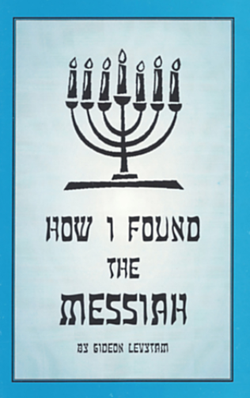
Follow Gideon Levytam's journey and discover how he was led by God, through a series of exciting circumstances, to find the One his people are still waiting for.
Past Episodes

Featured Offer
Follow Gideon Levytam's journey and discover how he was led by God, through a series of exciting circumstances, to find the One his people are still waiting for.
About Holy Scriptures and Israel
As time passed by, the Lord Yeshua took dear brother John Van Stormbroek to himself. The ministry of Holy Scriptures and Israel continued with additional development. In the early 1990’s, a weekly morning Bible class began which brother Gideon Levytam led regularly in the City of Toronto. This weekly open Bible class was held in the Willowdale assembly meeting hall. Eventually, a second mid-week evening Bible class was added. In April 2002, the need for an additional outreach Bible teaching meeting arose. We begun a Saturday (Shabbat) ministry meeting in which a systematic teaching of God’s word is presented to all who attend. Together we learn God’s Word, pray for each need and the salvation of Israel, and sing songs of worship unto our God, praising Him and our Lord Yeshua the Messiah.
In Mid 2004 we started to air on Joy 1250 Radio station a 15 minute Bible teaching program called "The Holy Scriptures and Israel" with Gideon Levytam. The broadcast teaches God’s word from a Hebrew Messianic perspective and has proved to be a blessing to many. It's now aired seven days a week. Our prayer is that many more of our Israeli people will have a clear understanding of who Yeshua is, why we all need him, and come to know him as their Lord and Messiah.
About Gideon Levytam
Contact Holy Scriptures and Israel with Gideon Levytam
426 Simcoe Street
Niagara-on-The-Lake
Ontario L0S 1J0
Canada
(905) 325-1234