

Acts 22:1-21, Part 1


Paul’s Testimony to his Jewish Brethren in Jerusalem Part 1
Guest (Male): Shalom. Holy Scriptures and Israel is a ministry designed to share with the Jewish people the good news of the Lord Jesus Yeshua the Messiah and to instruct Christians on the Jewish roots of their faith. And now teaching God's word from a Hebrew Messianic perspective, here is Gideon Levytam.
Gideon Levytam: Shabbat shalom, everyone. I would like you to turn in your Bibles to the Book of Acts. In Hebrew, we call it Ma'asei Shlichim, the acts of the Holy Spirit of God. We are today going to read in Acts chapter 22 and verse 1 to 21. Let's just read that first and please follow me and listen to the reading.
"Men, brethren, and fathers, hear ye my defense which I make now unto you. And when they heard that he spake in the Hebrew language to them, they kept the more silence: and he saith, I am verily a man which am a Jew, born in Tarsus, a city in Cilicia, yet brought up in this city at the feet of Gamaliel, and taught according to the perfect manner of the law of the fathers, and was zealous toward God, as ye all are this day.
And I persecuted this way unto the death, binding and delivering into prisons both men and women. As also the high priest doth bear me witness, and all the estate of the elders: from whom also I received letters unto the brethren, and went to Damascus, to bring them which were there bound unto Jerusalem, for to be punished.
And it came to pass, that, as I made my journey, and was come nigh unto Damascus about noon, suddenly there shone from heaven a great light round about me. And I fell unto the ground, and heard a voice saying unto me, Sha'ul, Sha'ul, why persecutest thou me? And I answered, Who art thou, Lord? And he said unto me, I am Yeshua of Nazareth, whom thou persecutest. And they that were with me saw indeed the light, and were afraid; but they heard not the voice of him that spake to me.
And I said, What shall I do, Lord? And the Lord said unto me, Arise, and go into Damascus; and there it shall be told thee of all things which are appointed for thee to do. And when I could not see for the glory of that light, being led by the hand of them that were with me, I came into Damascus. And one Hananyah, a devout man according to the law, having a good report of all the Jews which dwelt there, came unto me, and stood, and said unto me, Brother Sha'ul, receive thy sight. And the same hour I looked up upon him.
And he said, The God of our fathers hath chosen thee, that thou shouldest know his will, and see that Just One, and shouldest hear the voice of his mouth. For thou shalt be his witness unto all men of what thou hast seen and heard. And now why tarriest thou? arise, and be baptized, and wash away thy sins, calling on the name of the Lord.
And it came to pass, that, when I was come again to Jerusalem, even while I prayed in the temple, I was in a trance; and saw him saying unto me, Make haste, and get thee quickly out of Jerusalem: for they will not receive thy testimony concerning me. And I said, Lord, they know that I imprisoned and beat in every synagogue them that believed on thee: and when the blood of thy martyr Stephen was shed, I also was standing by, and consenting unto his death, and kept the raiment of them that slew him. And he said unto me, Depart: for I will send thee far hence unto the Gentiles."
I'm stopping here in verse 21 because immediately following these remarks of the Apostle Paul, of Sha'ul, we hear the response from the Jewish people in the temple at the time when the Apostle Paul was preaching there. Now, let me just make a few remarks, beloved brothers and sisters, for those of you that have not been with us in our previous meetings together.
We are studying the Book of Acts, the Acts of the Holy Spirit. In Hebrew, we call it Ma'asei Shlichim, the Acts of the Apostles. We have arrived at a portion of scripture, chapters 21 and 22, in which the Apostle Paul finalized his third missionary journey. You remember the Apostle Paul was called by the glorified Messiah to preach the message of the gospel to the Gentile world.
In chapter 9 and verse 15, the Apostle Paul was chosen a vessel to bear the name of Yeshua the Messiah before Gentiles, before kings, and also before the children of Israel. Wherever the Apostle Paul preached the message of the gospel in those three missionary journeys, he always first of all went to the Jew first. You can see that in every passage every time that you read in those chapters of the Book of Acts.
In Romans chapter 1 and verse 16, the Apostle Paul gives us a principle upon which we learn that in the preaching of the gospel, he always made it right before God in sharing the message with his Jewish brothers, the Jewish people. He said in Romans 1:16, "I am not ashamed of the gospel of the Messiah, for it is the power of God unto salvation to everyone that believe, to the Jew first and also unto the Gentile."
That was his practice. Everywhere he went, he went to the Jewish brothers first in the synagogue, and then he preached to the Gentile. When he concluded his third missionary journey, he arrived at the city of Jerusalem, assuming that when he shared the message with his brethren in the city of Jerusalem, he would win them to the Messiah Yeshua and they would become part of the church of the assembly. He hoped many of them would acknowledge that Yeshua, that Jesus, is truly their Lord and Messiah.
In chapter 21, Paul was warned by some not to go to Jerusalem. Some warned him, "Paul, Sha'ul, don't go to Jerusalem." In chapter 21 in verse 4, finding disciples there in Tyre, they said to him through the spirit that he should not go up to Jerusalem. They sensed that there would be a persecution of the apostle in the city of Jerusalem.
In chapter 21 and verse 10, there was another man by the name of Agabus, who was a prophet. He said in verse 11 that when he came unto us, he took Paul's girdle, bound his own hand and feet, and said, "The Holy Spirit saith this way: so shall the Jews in Jerusalem bind the man that owns this girdle and shall deliver him into the hands of the Gentile."
But Paul, for one reason or another, loved his brethren, the Jewish people. He wanted to go to Jerusalem to bring the gifts that he had for the Jewish believers, but also to share the message of the gospel. Notice what he says in chapter 21 and verse 13: "What mean ye to weep and to break my heart? For I am ready not to be bound only, but also to die at Jerusalem for the name of the Lord Yeshua the Messiah."
He was ready to give his life over for the name of Yeshua in the city of Jerusalem. That is why believers sometimes feel there are two ways of looking at it. Some say Paul was wrong in going to Jerusalem. Others say Paul was right in going to Jerusalem because that, in a sense, concluded his third missionary journey by being captured in Jerusalem.
Whichever way one leans, we know that the Apostle Paul was a man of God who wanted to please our Lord Yeshua the Messiah. He got to Jerusalem and went into the temple. He had the vow of the Nazarite with four other individuals, and then he was captured by the Jewish people who were in the temple, especially those who came from Asia Minor. They heard about this man by the name of Paul and they captured him, as we read in chapter 21, verses 28 to 30.
The Roman captain really delivered him from the hand of his own Jewish brothers who wanted to kill him. He delivered him and brought him into what we know today as the Antonia Fortress. I just came from the Antonia Fortress area on the temple mount in Israel, right by the Wailing Wall. Paul was captured by his brethren, ultimately delivered by the Roman chief captain, and brought into the Antonia Fortress, which was overlooking the temple mount and held by the Romans who were in charge at that time.
He was brought in and now, beloved brothers and sisters, we are coming into chapter 22, where we have the Apostle Paul's testimony to his Jewish brethren in the city of Jerusalem. Verses 1 to 21 are the testimony of the Apostle Paul to his brethren. I want to mention a few points in these verses.
The first thing we want to point out is in verses 1 to 5, where the apostle introduces himself to the multitude. Notice that, first of all, he began to speak in the Hebrew language. This is very interesting because he wanted the attention of the people and he did not speak to them in Greek or even Aramaic. It is very clear from these verses that he spoke with them in the Hebrew tongue.
Let me read verses 1 and 2. He began by saying, "Men and brethren and fathers, hear ye my defense which I make now unto you. And when they heard that he spake in the Hebrew language to them, they kept the more silence." He began to say, in Hebrew we say "Achim," brethren, and "Avot," fathers. He was speaking the same way that Stephen was speaking in chapter 7 when he was facing the leadership of Israel.
This is a Hebrew expression which we who are Jewish often use with each other. They are the brethren because of our affiliation as a nation. They are the fathers because of the ones that led the nations over the years. He was speaking to them in Hebrew, "be'Ivrit" we say, and when they heard him, they quieted themselves down and began to listen to what he had to say.
Just imagine: a multitude in the temple seeking to run against him and to kill him. He was delivered by the chief captain of the Roman legions and now he asks to be able to speak to the multitude. Paul wanted to share with his brother how he became a believer in Yeshua the Messiah.
In the third verse, the Apostle Paul points to his background. That is very important in our testimony, to share with others about who we are, where we came from, and what happened to us as we became believers in our Lord Jesus the Messiah. He points out his background by saying a few things to his brethren.
In verse 3, he says, "I am verily a man which am a Jew." He does not say "I was a Jew," but "I am a Jew." Paul was already a believer for many years, a Christian and a Messiah follower, but he never for a moment said "I used to be a Jew." He said "I am a man which am," present tense, "a Jewish man."
In Romans 11, he says, "I am an Israeli." In Philippians chapter 3, he says, "I am from the tribe, I am a Benjamite, I am a Hebrew of the Hebrews." He never said he was a Hebrew, a Jew, or an Israeli. He was at all times a Hebrew, an Israeli, and a Jewish man, but a believer in our Lord Jesus the Messiah.
Secondly, he is saying that he came from a city called Tarsus. Tarsus is in present-day Turkey. He says, "I am a man which am a Jew, born in Tarsus, a city in Cilicia." In other words, he was born in the diaspora, the dispersion. He was a Jewish man who was born outside of the land of Israel.
Today, Jewish people who are born in Israel are called Sabarim or Sabra. But he was born in the diaspora. There are Jewish people born in Canada, the United States, Europe, and all over the world. They are born outside of the land, but they are part of the Jewish community in that foreign land. He is telling them, in this testimony, that he is a Jew who was born in the diaspora.
Even so, he says in verse 3C, "I was brought up in this city at the feet of Gamaliel." This city is the very city where he was preaching, where the temple was, the city of Jerusalem. Even though he was born in Tarsus, he was growing up and taught in the city of Jerusalem, the center of Israel where all the schooling concerning the things of God were being taught.
Fourthly, in this verse, he points out that he was taught by Rabban Gamaliel. The word Rabbi is for a rabbi, but a high rabbi is called Rabban in Hebrew. We call him today Gamaliel. Gamaliel was a very important rabbi for the people of Israel and Paul was sitting at his feet and learning from him.
We hear of Rabban Gamaliel earlier in Acts chapter 5 and verse 34, when Peter was persecuted. It says, "Then stood there up one in the council, a Pharisee, by the name of Gamaliel, a doctor of the law, and he had a reputation among all the people, and he commanded to put the apostles forth a little space."
When the apostles were captured by the Sanhedrin and they wanted to condemn them, Rabban Gamaliel was a doctor of the law and a teacher who was very much respected among the people of Israel. He was the one who held back the persecution of the apostles in the earlier part of the Book of Acts.
The name Gamaliel is very interesting. It simply means "my recompense is of God." Gamli El means "my recompense is of God." He was a respected man among the Jewish people in the city of Jerusalem. Finally, in verse 3, the Apostle Paul points out that he was taught exactly in the perfect law that the Jewish people were taught by the leaders of Israel. He said, "I was taught according to the perfect manner of the law of the fathers."
Sha'ul wanted to show his Jewish brethren before he told them about his faith in the Messiah that he was taught in the city of Jerusalem by Rabban Gamaliel according to the perfect manner of the law of our fathers. He wanted them to know who he was and what his past history was.
He also told them in verse 3 that he was zealous toward God, just as they were. When Paul came into the temple in Jerusalem, they knew he was a believer in Yeshua the Messiah. They assumed he was teaching against the law, the temple, the God of Israel, the commandments of God, and Moses. They wanted to kill him because they believed he violated that which God had given to Israel.
Paul said to them, "Listen, I had the same kind of zealousness towards the God of our fathers just like you have today. I was just like you because I myself was zealous towards God as you are today zealous towards the God of Israel and you want to capture me and to kill me." In verse 3, Paul pointed to his background and to what he had done before he became a believer in Yeshua the Messiah.
In verse 4, the Apostle Paul said that he persecuted the assembly, the church. He said, "I persecuted this way." I think this haunted him all his life because he always felt guilt for persecuting his Jewish brethren who believed in that way. He told these Jewish brethren in the temple, "I persecuted this way unto the death. I bound them. I deliver them into prisons both men and women."
He is looking back at his history. He remembered that before he became a believer, he was persecuting his Jewish brethren. When we say that he persecuted Christians, I want us to understand the Christians that he persecuted were Jewish believers. He did not care whether Gentile believers believed in Jesus the Messiah at that time.
The importance for him was to persecute the Jewish people who came to faith in Yeshua the Messiah. That is why he took letters from the high priest to go to the synagogue in Damascus in order to bring Jewish believers in Jesus and to imprison them and ultimately to cause them much harm.
In 1st Timothy chapter 1, Paul said about himself, when he spoke to younger Timothy concerning the glorious gospel, "According to the glorious gospel of the blessed God, which was committed unto my trust. And I am thankful to Christ Jesus, to Messiah Yeshua our Lord, who hath enabled me, for that he counted me faithful, putting me into the ministry; who was before a blasphemer, and a persecuter, and injurious: but I obtained mercy, because I did it ignorantly and in unbelief."
Paul tells Timothy that God entrusted him with this glorious message of the gospel even though he was a blasphemer and one that persecuted the believers. It must have hurt him all his life when he remembered what he had done to his Jewish brethren who became believers in Yeshua the Messiah.
That is why in verse 4, the Apostle Paul was repeating this when he was standing there in that Antonia Fortress and speaking in the Hebrew language to his Jewish brethren who were in the court of the temple. In verse 5, as he continued to introduce himself to the multitude, he said, "As also the high priest doth bear me witness, and all the estate of the elders: from whom also I received letters unto the brethren, and I went to Damascus, to bring them which were there bound unto Jerusalem, for to be punished."
Confessing the fact that he himself was the one that persecuted the ones that believed in this way. In verse 4, it is called "this way." In the first century, "this way" was the name of those who followed Jesus. Yeshua said, "I am the way, the truth, and the life." The word Christianity or Christians was not as well known among the Jewish people. It was known as "this way," the way to follow Yeshua the Messiah. In verses 1 to 5, he is introducing himself before the multitude.
Guest (Male): You have been listening to the Holy Scriptures and Israel with Gideon Levytam. Gideon teaches God's word from a Hebrew Messianic perspective. For more information about this ministry, write to Holy Scriptures and Israel, Box 1411, Niagara-on-the-Lake, Ontario, L0S 1J0, or visit our website at holyscripturesandisrael.com.
You are also invited to Gideon's weekly Bible teaching on Fridays at 11:00 AM and 7:00 PM and Saturdays at 1:00 PM at Willowdale Christian Assembly Hall, 28 Martin Ross Avenue in Toronto. Holy Scriptures and Israel is made possible by your prayers and financial support. If you would like to support the program, visit holyscripturesandisrael.com. God bless you. Shalom, shalom.
Featured Offer
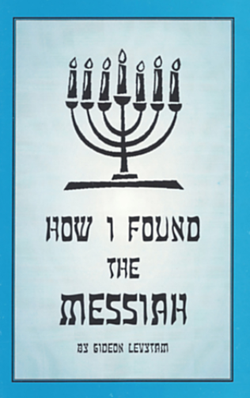
Follow Gideon Levytam's journey and discover how he was led by God, through a series of exciting circumstances, to find the One his people are still waiting for.
Past Episodes

Featured Offer
Follow Gideon Levytam's journey and discover how he was led by God, through a series of exciting circumstances, to find the One his people are still waiting for.
About Holy Scriptures and Israel
As time passed by, the Lord Yeshua took dear brother John Van Stormbroek to himself. The ministry of Holy Scriptures and Israel continued with additional development. In the early 1990’s, a weekly morning Bible class began which brother Gideon Levytam led regularly in the City of Toronto. This weekly open Bible class was held in the Willowdale assembly meeting hall. Eventually, a second mid-week evening Bible class was added. In April 2002, the need for an additional outreach Bible teaching meeting arose. We begun a Saturday (Shabbat) ministry meeting in which a systematic teaching of God’s word is presented to all who attend. Together we learn God’s Word, pray for each need and the salvation of Israel, and sing songs of worship unto our God, praising Him and our Lord Yeshua the Messiah.
In Mid 2004 we started to air on Joy 1250 Radio station a 15 minute Bible teaching program called "The Holy Scriptures and Israel" with Gideon Levytam. The broadcast teaches God’s word from a Hebrew Messianic perspective and has proved to be a blessing to many. It's now aired seven days a week. Our prayer is that many more of our Israeli people will have a clear understanding of who Yeshua is, why we all need him, and come to know him as their Lord and Messiah.
About Gideon Levytam
Contact Holy Scriptures and Israel with Gideon Levytam
426 Simcoe Street
Niagara-on-The-Lake
Ontario L0S 1J0
Canada
(905) 325-1234