

Acts 21:27-40, Part 1


The Capturing of Paul in Jerusalem Part 1
Guest (Female): Shalom. Holy Scriptures and Israel is a ministry designed to share with the Jewish people the good news of the Lord Jesus, Yeshua the Messiah, and to instruct Christians on the Jewish roots of their faith. And now, teaching God's word from a Hebrew Messianic perspective, here is Gideon Levytam.
Gideon Levytam: Shabbat Shalom. We will turn today to the book of Acts, to chapter 21, and we by the grace of God will seek to finish the verses that remain in the 21st chapter. I would like to read from verse 27 this Shabbat meeting and to read to the end of the chapter. And we can see in these verses how the Apostle Paul, Sha'ul, was captured by the Jewish people, specifically by the Jewish people who came from Asia Minor to the city of Jerusalem, and how he was taken by the Romans. And listen to those verses.
Verse 27: And when the seven days were almost ended, the Jews which were of Asia, when they saw him in the temple, stirred up all the people, and laid hands on him, crying out, "Men of Israel, help: This is the man, that teacheth all men everywhere against the people, and the law, and this place: and further brought Greeks also into the temple, and hath polluted this holy place." For they had seen before with him in the city Trophimus an Ephesian, whom they supposed that Paul had brought into the temple.
And all the city was moved, and the people ran together: and they took Paul, and drew him out of the temple: and forthwith the doors were shut. And as they went about to kill him, tidings came unto the chief captain of the band, that all Jerusalem was in an uproar. Who immediately took soldiers and centurions, and ran down unto them: and when they saw the chief captain and the soldiers, they left beating of Paul.
Then the chief captain came near, and took him, and commanded him to be bound with two chains; and demanded who he was, and what he had done. And some cried one thing, some another, among the multitude: and when he could not know the certainty for the tumult, he commanded him to be carried into the castle. And when he came upon the stairs, so it was, that he was borne of the soldiers for the violence of the people. For the multitude of the people followed after, crying, "Away with him."
And as Paul was to be led into the castle, he said unto the chief captain, "May I speak unto thee?" Who said, "Canst thou speak Greek? Art not thou that Egyptian, which before these days madest an uproar, and leddest out into the wilderness four thousand men that were murderers?" But Paul said, "I am a man which am a Jew of Tarsus, a city in Cilicia, a citizen of no mean city: and, I beseech thee, suffer me to speak unto the people." And when he had given him license, Paul stood on the stairs, and beckoned with the hand unto the people. And when there was made a great silence, he spake unto them in the Hebrew tongue, saying—
And I stop at the end of this chapter because the sayings of the Apostle Paul in the Hebrew language, as we say, b'Ivrit, will be found in the next chapter, in chapter 22, what he had said to his Hebrew brethren. But the portion that we're going to deal with in this ministry meeting is the capturing of Paul in the city of Jerusalem and in the temple specifically, as the uproar came because of those Jewish people who came from Asia Minor to worship in the city and in the temple.
Now, brothers and sisters, we concluded in our last meeting together, and I'd like always to review for a couple of statements, we looked in the 21st chapter how the Apostle Paul wanted from Miletus to travel all the way to the city of Jerusalem. And we understood in our previous message that Paul had already arrived at Jerusalem, and there was a warning that had been given to him by various individuals, various brethren, that when he's going to be in the city of Jerusalem, he will be bound and ultimately he will be captured.
And you remember what Paul, Sha'ul, said in chapter 21, in verse 13. He said to the brethren that were concerned for him, "What mean ye this? Why do you weep? Why do you break my heart? I'm ready not to be bound only, but also to die at Jerusalem for the name of the Lord Yeshua." He was so devoted to his master that he was willing to give his life for Yeshua the Messiah. And so he arrived at Jerusalem. And you remember from verse 14 to verse 26 in our discussion previously that he arrived at Jerusalem. He heard about the great things that happening in Israel and in the city of Jerusalem, how many thousands of Jewish people became believers in Yeshua the Messiah.
And he shared with them also how many from among the Gentiles became believers in Yeshua the Messiah. The brethren rejoiced over the fact of the ministry of the Apostle Paul, and then we find out that Paul was exhorted to show that he really does not speak against the law, against Moses, against the temple. And he have been encouraged to have that vow of the Nazirite with those other four men which we read about in verse 23 to verse 26. And you remember he went into the temple. He made the vow of the Nazirite. At the end of this vow, he was there in the temple and he paid the price for those other four men at the end of that Nazirite vow.
And now as he enters into the temple, notice what we read here in these verses from verse 27 to 40, how he had been captured right then and there when he was in the temple, in Beit HaMikdash, in Jerusalem. So in the next verses, we find this important thing, and I want just to emphasize something here before we're going to read verse by verse. Paul, on the basis of a voluntary way, he showed by taking the Nazirite vow that he practiced what he preached. What does that mean? You know, people were accusing Paul, and by the way, they accuse him still today, that he was the one that was speaking against the God of Israel, against the Jewish people, against the temple, against Moses, against the law.
They were accusing him then and they accuse him today. You know very well that when we share the gospel with our people, Israel, with our Jewish community, one of the main problems that Israel have today, and they have had it throughout the ages, is "Oh, you believe in the writings of the Apostle Paul, oh this Jewish man, and when became a Christian and a hater of our people and the one that really didn't care for the Jewish people." But you see, beloved brothers and sisters, it is exactly the opposite and we're going to see it in a moment. Paul loved Israel. He loved his Jewish brethren. He loved the God of Israel, but he also loved the Messiah Yeshua and the truth that we have in the person and the work of Yeshua the Messiah.
He never spoke against the temple. He never spoke against Moshe. He never spoke against the law. He never spoke against the people of Israel, but he spoke for them. But he also wanted them to understand the truth of the gospel, that the answer for salvation is not through animal sacrifices but through the sacrifice of Yeshua the Messiah, the Savior of this world. So they accused him all the time, still accusing him today. And now look what happened in the temple in Jerusalem. First of all, you find out in verse 27, 28, and verse 29 the accusation against Paul in the temple. Look at this, verse 27. Who did this accusation? Who was the one who accused him? Look at this. These were the Jewish people who did not believe in Yeshua the Messiah, who came from Asia Minor.
These were the Jewish people who lived in the diaspora, in the dispersion, and every feast, three times a year at least, they would come to Yerushalayim, to Jerusalem, to celebrate the feast. Pesakh, the Feast of Weeks, Shavuot, the Feast of Sukkot, Booths, they would come for the celebrations of the feast. So we find out in verse 27 that when the seven days were almost ended, the seven days of the vow of the Nazirite, he was now in the temple. The Jewish people which were of Asia, when they saw him in the temple, they stirred up all the people and laid hands on the Apostle Paul, on Sha'ul.
As he was there to finalize the vow with the other four men at the end of the vow of the Nazirite, in Hebrew we call Nazirite "Nazir," we find now that he's right there in the temple. These Jewish people who came from Asia Minor to worship at the time of the feast, they saw him. Now they heard about him. They have seen him already in Ephesus and all Asia Minor wherever he was preaching the message of the messiahship of Yeshua, and they remember him. They marked him. They knew of him. So when they saw him now in the temple, they have stirred up all the people, all the people in the temple and in the city. They stirred them up and they laid hand on the Apostle Paul, on Sha'ul.
And we find out that what did they do in verse 28. What was the accusation? And look, brothers and sisters, this is important for us to understand. They cried, "Men of Israel, help! This is the man," pointing to Sha'ul, Paul, "that teach all men everywhere three things." They said, number one, "He teach everywhere all people against the people." This is against the Jewish people. Secondly, "Against the law," against the law that God given Israel. And thirdly, "Against this place," namely the temple in the city of Jerusalem.
Now, brothers and sisters, look at the accusation itself that the Apostle Paul was accused by these Jewish people of the diaspora that came for the feast. They accused him three things, that he speak against Israel, against the Jewish people, that he speak against the law, and he speak against the holy place. And you know, I was searching in scripture, specifically in the book of Acts throughout the history of Paul speaking and throughout the epistles, and you don't find ever the Apostle Paul speaking against his own brethren. In fact, you remember what he said in Romans chapter 9 when he wrote to the Romans believers. He said to them, "I wish that I myself was accursed from the Messiah for my brethren, my kinsmen according to the flesh."
He was wishing that he will be separated from the Messiah on behalf of his Jewish brothers. You remember in chapter 10 of the book of Romans and verse 1, he says, "Brethren, my heart's desire and prayer to God for Israel that they might be saved." How could anybody ever accuse Sha'ul, Paul, ever speaking against the people of Israel, against the Jewish people? Unfortunately, many do speak against Israel. Many do accuse the people of Israel. Many do speak against the Jewish people, but not the Apostle Paul. He have always spoke for the nation, for the Jewish people, and he prayed for them. He longed for his brethren.
They were wrong in accusing him speaking against his people. Secondly, they said that he was speaking against the law. Now, beloved brothers and sisters, I want you to understand that never the Apostle Paul spoke against God's law. Never. In fact, if you remember in the book of Romans in chapter 7, the Apostle Paul in Romans 7 and verse 7, notice that I'm going to read some of these verses. Romans chapter 7, verse 7: "What shall we say then? Is the law sin? God forbid. Nay, I had not known sin but by the law." In other words, the law is pure.
If you remember in verse 12 and verse 14, the Apostle Paul said of Romans chapter 7, "Wherefore the law is holy, and the law and the commandment holy, and just, and good." He never spoke against the law. In verse 14 he said, "For we know that the law is spiritual." The problem is not with the law, it is holy. The problem is with me, Paul says, with man, Paul says, with sin nature, not with the law. So they were wrong about accusing him that he spoke against the law. In fact, it is the law that shows us as a mirror how sinful we are, that demanded for us to look elsewhere for salvation, and it is the law that promised the coming of the Messiah.
And so the Apostle Paul definitely never spoke against the law. And thirdly, you notice that they accused him in Acts chapter 21, in verse 28, that he spoke against this place, against the temple. Well, he is right now in the temple. And he is doing the Nazirite vow, and he's in the temple there in order to show his brethren that he does not speak against the law or against the people of Israel or against the temple, but he speaks for the nation of Israel, for the law, and for the temple of God. But he goes beyond that by saying that the law spoke about the coming of the Messiah, the Jewish people through whom the Messiah was going to come, and this place the temple, the Messiah once will sit there and stand there and he will ultimately rule over the nation of Israel from the city of Jerusalem and over the whole world.
But they accused him that he's speaking against the people of Israel, against the law of God, and against the temple in Jerusalem. So you notice what they also accuse him, that it says in verse 28, that he brought a Greek person into the temple and has polluted this holy place. Now I want you to see, in the temple in Jerusalem, after Herod have enlarged the temple, there were actually five courts. There was the Holy of Holies, only the High Priest could enter once a year. There was the Holy Place, the second court, the priests only could go in and minister in the Holy Place and they could do it all the time.
Then there was the larger outside court and that was the court of the men of Israel, of the Hebrew men who could enter in and worship there. And then the fourth court was the court of the Jewish or the Hebrew women. That was the fourth court. But there was a fifth court that is called the Court of the Gentiles. And the Gentiles could only come into this court. They could never go into the court of the Jewish women. They could never go into the court of the Jewish men. They could never go into the Holy Place and they could never go into the Holy of Holies. In other words, they were in the fifth court.
And the Apostle Paul knows very well that he was not allowed to bring any person who was not Jewish beyond that fence that had a sign there. There was an inscription that actually had been found, brothers and sisters, that it says something like this: "No alien may enter within the wall of the temple." In other words, there was a fence that a Gentile could not go beyond that fence there. Archeologists have found that, and you can see it, some of this inscription is found even today if you would visit the land of Israel. And so no one, no Gentile, could enter in. The Apostle Paul understood that. He would not violate purposely, intentionally, the conscience of the people of Israel.
And biblically speaking, prior before the time of the grace, this present day church age, God did make a distinction between Israel and the Gentile world. That's why Paul says in Ephesians chapter 2 and verse 11, when he was writing to the Gentiles, he says, "Remember that ye being in time past Gentiles in the flesh, who are called Uncircumcision by that which is called the Circumcision in the flesh made by hands; that at that time you were without the Messiah, being aliens from the commonwealth of Israel and strangers from the covenants of promise, having no hope and without God in this world." And he knew that.
But he wouldn't bring them into the immediate presence of the Lord. But in the Messiah right now, a Jew and a Gentile are united. There is no distinction anymore. So he would not bring them to the temple, but a Jew and a Gentile would be able to enjoy the presence of the Lord at any time, immediately to draw into His presence now as believers in Yeshua the Messiah. So they assumed that he brought this person into the court of the men and so, if you notice in that verses in Acts chapter 21, look at these verses, it says in verse 29, "For they had seen before with him in the city Trophimus an Ephesian, whom they supposed that Paul had brought into the temple." You see, they were accusing him of something that he have not done. He actually did not bring this brother into the inner court because he understood how the nation would feel, and therefore we do not read that Paul brought him in, but they supposed that he had done so.
And so they accused him. They have gathered all the people there and they were really all men of Israel. Look, here is that man who speak against the people of Israel, who speak against the law, and who speak against this place. And so verses 27, 28, and verse 29 we see the accusation against the Apostle Paul. To just remind you, brothers and sisters, as I read in Ephesians chapter 2, that right now in this present day the Gentile believer is no longer in the fifth court. The Gentile believer, together with the Jewish believer, we can enter into the immediate presence of God through our Lord Jesus the Messiah. This is something that is very important to get a hold of because we can now draw near, as Paul said in this Ephesians 2 passage. He says, "But now in the Messiah Yeshua, ye who were sometime were far off are made nigh by the blood of the Messiah." There is now the nearness that we all have through Yeshua Jesus the Messiah.
So the accusation against Paul, verses 27, 28, and verse 29. Now verse 30 to 33, we see the uproar not happen only in the temple but the whole city of Jerusalem was in uproar. All the city was moved. Verse 30 we read: "And all the city was moved, and the people ran together: and they took Paul, and drew him out of the temple: and forthwith the doors were shut." You see, they were so angry with Sha'ul, Paul, they captured him. They took him and they immediately moved him outside of the temple, and they shut the temple's door. Why? Because they assumed that he defiled the temple by assuming that he brought a Greek into the temple. They push him quickly, they drew him, and shut the door so no one can enter in. Now they kept him out and they actually, they intended to kill him. They really hated what he believed in.
And so this verse 30 really shows us that they took him and they drew him into the outer court and completely shut the temple door lest he and anybody else will enter in. And now you notice in the first part of verse 31, the people were about to literally kill Sha'ul. Verse 31: "And as they went about to kill him," just pause here for a moment. Do you know that throughout the life of the Apostle Paul, he was always in danger? Always he was in situation that he was literally almost near death. They sought to stone him. They sought to kill him. In fact, we have a verse in Second Corinthian, if you just turn there for a moment when he recorded his history, he says in Second Corinthians chapter 11 and verse 23, Paul, Sha'ul, said, look at this, verse 23: "Are they ministers of the Messiah? I speak as a fool. I am more; in labors more abundant, in stripes above measure, in prisons more frequent," and notice the last three words in verse 23: "in death oft."
Can you imagine to live your life often in a danger of death? They wanted to kill him in Asia Minor. Wherever he was travel, and now they wanted to kill him right there outside of the temple after they shut the door. They wanted to kill him, and the Apostle Paul says, "I was in my life as a servant of the Lord oftentimes I experience near death." You remember earlier also in chapter 14 when they took him as if he was dead after they stone him? So he was all his life under the danger of maybe he's going to leave this scene because there was so much opposition to the message of the gospel of the messiahship of Yeshua. And he was the one that was used by the glorified Messiah to send him to the Gentile world to preach the message of the gospel. You remember we were just talking in our Bible class in the book of Corinthians, First Corinthians chapter 1, "For the preaching of the cross is to them that perish it is foolishness; but to us that believe it is the power of God."
Guest (Female): You have been listening to the Holy Scriptures and Israel with Gideon Levytam. Gideon teaches God's word from a Hebrew Messianic perspective. For more information about this ministry, write to Holy Scriptures and Israel, Box 1411, Niagara-on-the-Lake, Ontario, L0S 1J0, or visit our website at holyscripturesandisrael.com. You are also invited to Gideon's weekly Bible teaching on Fridays at 11:00 AM and 7:00 PM and Saturdays at 1:00 PM at Willowdale Christian Assembly Hall, 28 Martin Ross Avenue in Toronto. Holy Scriptures and Israel is made possible by your prayers and financial support. If you would like to support the program, visit holyscripturesandisrael.com. God bless you. Shalom, Shalom.
Featured Offer
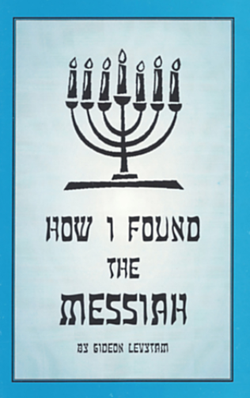
Follow Gideon Levytam's journey and discover how he was led by God, through a series of exciting circumstances, to find the One his people are still waiting for.
Past Episodes

Featured Offer
Follow Gideon Levytam's journey and discover how he was led by God, through a series of exciting circumstances, to find the One his people are still waiting for.
About Holy Scriptures and Israel
As time passed by, the Lord Yeshua took dear brother John Van Stormbroek to himself. The ministry of Holy Scriptures and Israel continued with additional development. In the early 1990’s, a weekly morning Bible class began which brother Gideon Levytam led regularly in the City of Toronto. This weekly open Bible class was held in the Willowdale assembly meeting hall. Eventually, a second mid-week evening Bible class was added. In April 2002, the need for an additional outreach Bible teaching meeting arose. We begun a Saturday (Shabbat) ministry meeting in which a systematic teaching of God’s word is presented to all who attend. Together we learn God’s Word, pray for each need and the salvation of Israel, and sing songs of worship unto our God, praising Him and our Lord Yeshua the Messiah.
In Mid 2004 we started to air on Joy 1250 Radio station a 15 minute Bible teaching program called "The Holy Scriptures and Israel" with Gideon Levytam. The broadcast teaches God’s word from a Hebrew Messianic perspective and has proved to be a blessing to many. It's now aired seven days a week. Our prayer is that many more of our Israeli people will have a clear understanding of who Yeshua is, why we all need him, and come to know him as their Lord and Messiah.
About Gideon Levytam
Contact Holy Scriptures and Israel with Gideon Levytam
426 Simcoe Street
Niagara-on-The-Lake
Ontario L0S 1J0
Canada
(905) 325-1234