

Acts 20:1-16, Part 2


Paul’s Ministry on the Way to Jerusalem Part 2
Narrator: Shalom. Holy Scriptures and Israel is a ministry designed to share with the Jewish people the good news of the Lord Jesus, Yeshua the Messiah, and to instruct Christians on the Jewish roots of their faith. And now, teaching God's word from a Hebrew Messianic perspective, here is Gideon Levytam.
Gideon Levytam: The study of Acts chapter 20 is the Feast of Passover because Paul did not arrive to Jerusalem to celebrate the Passover, so he had to forbear to wait a bit longer. He is going to get there a little bit later. So we read that after the days of unleavened bread, he came unto them to Troas in five days, where we abode for seven days. So now he left Philippi and now he arrived to the place that is called Troas.
And there something very interesting happened. The story about Troas is very intriguing because we learn a few lessons here about the events that happened in the local assembly, the local church in the city that is called Troas. First of all, notice now in the first part of verse 7, there was the local gathering of the assembly at Troas. It says, "And upon the first day of the week, when the disciples came together to break bread."
Now I want to pause here for a moment. Over the church age, we are now 2,000 years of church history since the Messiah died, was buried, rose again, and the Holy Spirit came in Acts chapter 2 to establish what is known to be the Ecclesia, the church. In the earlier part of the church age, we are talking about 57, 58 AD. This is very early in the church history. We know the time in which the assembly, the believers, were gathering together.
Notice this is the first time that we find it in the book of Acts when the believers were gathered together upon the first day of the week when the disciples came together to break bread. We learn here a very important principle. Here, when the church, the body of Messiah, was built, we learn from the early apostles that now the believers would gather together on what is known to be as the Resurrection Day. Why the first day of the week?
Because the first day of the week is the day in which Yeshua, Jesus, our Lord and our Messiah, rose from among the dead. You remember He was placed in the tomb. He was for three days and three nights in the grave, and on the third day, He rose from among the dead. And this suggests a new beginning, a new start. Now why it is so important to understand it? Because the years in which we have been part of the church for a little time, some of us are, say, five years, 10 years, 20 years, 30 years, 40 years.
If you notice, believers over the years may be arguing or debating or don't have necessarily the same view about when the church, the assembly, the congregation, the body of Messiah, as a collective gathering, should gather together. And some say we should meet on Shabbat, on Saturday. Others say we should meet on Sunday. And all these things, and there is conflict over the years, and really, that brought a lot of divisions among the people of God.
Now, right or wrong or how one feel or other feel is one thing, but it's always, beloved brothers and sisters, good to be basing what we do on the principles that are taught for us in the Word of God. We don't want to have our feeling placed into it, even not our desire placed into it, but we want to always take the principles that we have in the Word of God. And this is important because you remember, and I want you for a moment to turn with me to Exodus chapter 31, please.
I want you to notice about the Shabbat day that God had given our people Israel. And I want you to see that when God gave our forefathers and the nation of Israel the seventh day to keep as a day that belonged to God and that they are to live and to use the day to rest but also to use the day for God, He gave it specifically as a sign to our people Israel. I'm reading verse 12: "And the Lord spake unto Moses, 'Speak unto the children of Israel, saying, Verily My Sabbaths ye shall keep, for it is a sign between Me and you throughout your generation, that ye may know that I am the Lord that does sanctify you.'"
"Ye shall keep the Sabbath therefore, for it is holy unto you. Everyone that defileth it shall surely be put to death. For whosoever doeth any work therein, that soul shall be," notice that, "cut off from among his people." It was serious to keep the Shabbat day as God had given it to our people Israel. Notice what it says in verse 15. He says, "Six days any work shall be done, but on the seventh day," notice that the Shabbat is the seventh day. It's not the fifth, fourth, or sixth day.
It's not the first day. It is the seventh day. And the seventh day is a Shabbat day of rest, holy to the Lord. Whosoever doeth any work in the Shabbat day, he shall surely be put to death. Then He adds to it in verse 16: "Wherefore the children of Israel shall keep the Sabbath, to observe the Sabbath throughout their generation," notice, "for a perpetual covenant." The Shabbat was given to our nation Israel as a covenant between God and the people of Israel.
Notice in verse 17: "It is a sign between Me," that is God, "and the children of Israel," not for six months, not for 60 or 600 years, it is forever a sign with God and the people of Israel. For in six days the Lord made the heaven and earth, and on the seventh day the Lord rested and was refreshed. And He gave to Moses and he wrote those two tablets and so on as a testimony to the people of Israel. Now, what I wanted to emphasize here was that the Shabbat day, the Sabbath, is the seventh day.
It is not the first day. And secondly, it is given to our people Israel, the nation, as a sign of the covenant between God and Israel. But now, Israel the nation have not accepted Yeshua the Messiah. They are still awaiting a restoration that is going to be in a future day when the church age will come to a conclusion. We must understand that there are principles that are given to us in the Word of God on how the believers are to meet together in this present day of the church age.
Israel as a nation is still in unbelief, still waiting the time of restoration. So, notice he says, "Upon the first day of the week, when the disciples came together to break bread." This is in Troas. We learn that believers already in the early part of the church age gathered together already on the first day of the week. Now I'm calling it the first day. In Hebrew we call it Yom Rishon, meaning the first day, not so much the word Sunday, because the word Sunday came from the Sun Day, and then Monday came from the Moon Day.
But we are talking about biblical first day. Biblically speaking, days do not begin after midnight. We have to realize that, brothers and sisters. I know we are living here in a Gentile world with a calendar that is not a Bible calendar. But from a biblical calendar and accounting, already in the book of Genesis we learn that the day began in the evening. We read it in Genesis, in the beginning of the book of Genesis: "And it was evening," Erev, "and morning," Voker, "day," Yom, "and it was the first day."
Everything began from the evening. Actually, Leviticus chapter 23, verse 32 says, "From even to even ye shall celebrate your Sabbaths." In other words, the actual day does not begin after midnight; it always began when the sun came down on a Shabbat day and then the new day began. And so you notice here that we find these believers gathered together on the first day of the week. Now, where did they learn that from?
Now here, please bear with me. Go back to John chapter 20. Here we have a real Bible lesson that will help us to understand the principles that first-century believers in the church age had to learn as they were developing and growing and maturing. Where does the first day of the week really begin to be taught to believers to gather together? Well, we find out that after Yeshua died, bore our sins in His body on the tree, then He was buried and placed in the tomb.
And on the first day of the week He rose. If you notice in verse 1: "The first day of the week cometh Miriam Magdalene early, when it was yet dark, unto the sepulcher, and seeth that the stone was taken away from the sepulcher." Then notice that the Messiah rose in the later verses of chapter 20 where, in verse 13, they said unto her, "Woman, why weepest thou?" She saith unto them, "Because they have taken away my Lord."
And if you remember, He called her in verse 16. Yeshua, Jesus, said unto her, "Miriam." And she turned herself and she said unto Him, "Rabboni," or "Rabbi," which is "Master." And He told her, "Touch Me not," and so on. He revealed Himself to Miriam. And now notice in verse 19, a week later, the Jewish disciples who have trusted that Yeshua was the Messiah were meeting already together after His resurrection.
They met as well in Jerusalem on the first day of the week. Look at this, verse 19: "Then the same day at evening," notice it was an evening meeting, "being the first day of the week, when the doors were shut where the disciples were assembled for fear of the Jews," this is the Jewish leaders. All the disciples were Jewish believers, but they were afraid of their Jewish brethren, the leaders, the Pharisees and the Sadducees, who did not believe that Yeshua was the Messiah.
And then notice came Yeshua and He stood in the midst and He said unto them, "Shalom aleichem," peace be unto you. Here we find now that the early Jewish believers in the city of Jerusalem understood the time in which they would gather together because it speaks to us about the resurrection of the Messiah. It does not say that there is a problem with the Shabbat, no. But what it does teach us is that there is a new beginning.
The Messiah rose from among the dead, and a new beginning was establishing now what is known to be the Ecclesia, the church age. And here we find that the early first-century believers, even before the Holy Spirit of God came, they were already meeting on the first day of the week, and it was an evening meeting. You know today, when you would go to many church groups today, they would normally come together at about 9:00, 9:30, 10:00, 11:00 on the first day, on Sunday morning.
But actually biblically speaking, the gathering of the saints were already when the Shabbat ended, after sundown, and then the first day of the week had begun. It was an evening meeting where the saints were gathered together, but it was the first day of the week. And why it is, brothers and sisters? Because it speaks of the resurrection of the Messiah. Had Yeshua remained in the tomb and haven't risen from among the dead, we would be without hope.
We would be lost in our sin and sins because He would not be resurrected and finished the work that God had given Him to do. But the Lord not only died on the cross and buried, but He rose on the first day of the week. And if you will read all the four Gospels without exception, they speak about the fact that it was the first day of the week that the Messiah have risen from among the dead. Matthew 28 and verse 1. Mark 16 and verse 2, also verse 9.
Luke 24 and verse 1. And John 20 and verse 1. All are speaking about the resurrection of the Messiah on the first day of the week. And this is important for us to understand. So here the believers at Troas were gathering together on the first day of the week. And we can see how important it is. It is not a binding law because we don't have any command from the Lord, "Thou shalt keep the first day of the week." We don't have that.
We do have that about the Shabbat. The Shabbat you didn't have any choice under the law. If Israel could say to God, "I don't feel like keeping the Shabbat," well, God said, "If you are going to violate My seventh day, the Shabbat," you notice that we read in Exodus chapter 31, "his soul shall be cut off from among his people." God will judge the Israeli who fail to keep the Shabbat. The first day of the week was not given to us as a law in the Brit Chadashah, in the New Covenant.
But it is a guideline to help us understand that it speaks to us of the resurrection of Yeshua the Messiah, who rose on the first day of the week. It's a new beginning. It's a new creation in the resurrection of the Messiah. I have got to show you one more verse. If you turn with me to 1 Corinthians chapter 16 as well. Now Paul is writing to believers, and he gives them instruction. And notice what he tell them because they already understood the principles of when the early saints were gathered together.
The apostle Paul says in verses 1 and 2, they were raising funds for the saints in Jerusalem. He says, "Concerning the collection for the saints, as I have given order to the churches in Galatia, even so do ye: upon the first day of the week let every one of you lay by him in store, as God has prospered him, that there be no gatherings when I come." In other words, Paul says, "Listen, when you come together on the first day of the week, then it is a time that you can collect the funds in order to bring it for the poor saints in Jerusalem."
But again, brothers and sisters, he used this first day of the week, Yom Rishon. The new beginning, the resurrection of the Messiah, is seen by the gathering of the saints on the first day of the week. But I want to remind you, it's not necessarily applied to 9:30, 10:00, 11:00 in a morning on Sunday or the first day of the week, but the first day of the week Bible is already when the Shabbat ended. Right after sundown, the first day of the week had begun.
This is just for your thoughts. Now, I have got to make a couple more remarks here before I'm going to move on. So what do we do? How do we handle such a situation? Let me tell you. For example, there are believers who believe that the first day of the week is a good and a healthy time to gather together, but they can't do it because they live in countries that they don't have the ability to meet on the first day of the week, on Sunday.
So you know what they do? They meet on other days that it is allowed them by the government. For example, in Muslim countries, there are many Christians who gather there because Friday is usually the day that they have off. It is a day when everybody is resting and don't go to work, and then the believers gather at that time. They are not bound by any law to meet on the first day of the week, but it's healthy to take principle.
What about Israel? Most of our own people in Israel meet on Shabbat, on Saturday. Why is it? Because Shabbat is a day where people don't work and then people can meet together. It is also, just like we meet here on Shabbat, it is a great opportunity to open the door for other Jewish people who are not yet believers in Yeshua the Messiah to come to hear the message of the Gospel of our Lord Yeshua the Messiah.
But it does not change the principles that we have in a Bible that help us to understand why and what and when we do. So some people are struggling with this situation. So look what the apostle Paul continue to teach. Turn again to the book of Romans, this time chapter 14. And I want to emphasize this as well today because it is important to take it in light of what we are speaking about. There were those who were arguing, like many of us often do, over which day we are to keep in a sense, which day we are to meet on.
Look what Paul is saying in verse 1: "Him that is weak in the faith receive, yet not to doubtful disputation. For one believeth that he may eat all things, another who is weak eateth herbs. Let not him that eateth despise him that eateth not; let not him which eateth not judge him that eateth: for God hath received him." Here he is talking about food. But then notice in verse 5: "One man esteemeth one day above another: another esteemeth every day alike."
"Let every man be fully persuaded in his own mind. He that regardeth the day regardeth it unto the Lord; and he that regardeth not a day, to the Lord does he not regard it. He that eateth, eateth to the Lord, and he that giveth to God thanks; and he that eateth not, to the Lord he eateth not, and he giveth God thanks." Now, he teaching the Romans believers, listen, he says to the brethren, let's not go to the extent that we argue and we actually cause divisions among the people of God when we go to the extent that we focus on the day instead of on the person of our Lord Yeshua the Messiah.
That's what he is really saying here. So some one person, like we, most of us who are coming from a Jewish background know very well how difficult it is for us to violate what we understood the Shabbat is all about. When we grew up in our circles, at least in our family, some of us when we were younger, Shabbat was Shabbat. You don't walk, you don't hold money on Shabbat, you don't drive on Shabbat.
You don't light fire on Shabbat, you don't cook on Shabbat, you don't work on Shabbat. You don't do anything on Shabbat because what we have been taught by the rabbis and also what God have instructed our people, Shabbat was Shabbat. And oh, if you dare to violate the Shabbat. And so the apostle Paul says now that we are in the Messiah, the binding of the Shabbat was in the Messiah. Jew and Gentile, Israel is still in unbelief.
We are no longer under these obligations that God had given to the nation of Israel biblically. And we have liberties today. What about food? When we grew up, there would never dare to eat in a plate that is painted blue underneath for milk. You would never dare to put meat inside there because we are to keep kosher. Separated dishes, separated sinks. You are separated. You never dare to eat pork.
You'll never even mention the name pork or chazir. You can't do it because God had given instruction to our people not to eat certain things and to keep the Shabbat day. But under the present day dispensation of the Ecclesia, the church age, where Jewish people and Gentiles who believe in the Messiah are united in the body of Messiah, these obligation no longer apply to the believers because we are in this present day dispensation of the church age of grace.
And this is important to understand. And the meeting of the saints on the first day of the week is not because there's something wrong with the Shabbat, but it is because it representing to us a new beginning, the resurrection of Yeshua the Messiah. But it was in an evening meeting. It was immediately after the Shabbat day over. Let's go for one more last verse in connection with this to Colossians chapter 2.
And the apostle Paul is saying to the believers at Colossi, there he is telling to them, notice in verse 16. This was very hard for me, I remember, when I first read these verses by people who are not Jewish. And for them it is very easy to read those verses. And they say in verse 16, "Let no man therefore judge you in meat," this is food, "or in drink, or in respect of an holy day, or of the new moon, or of the Shabbat days."
And then it says in verse 17, "Which are a shadow of things to come." You see even the things which God had given our people Israel to maintain and to keep faithfully, they were a shadow of things to come. And that is why it says in verse 17b, "but the essence, the reality, is the Messiah," is Christ. If I'm going to show you a picture of mine and you're going to say, "Boy, this is brother Gideon, here's a picture of Gideon."
What you're going to do? You're going to take the picture and talk to the picture and speak to the picture. But what if I'm here? Wouldn't you want to speak with me? Wouldn't you want to have fellowship with me? Well, that is the truth that we learn about the thing that God has given our forefathers. Everything is culminate in the person of Yeshua the Messiah. He is the object, He is the purpose, He is the goal, He is the center.
He is the Messiah of Israel and the Savior of this world. So all our sacrifices, the feasts, the Shabbats of all, all are pointing to the person of our Lord Yeshua, Jesus, the Messiah. When He came, we have the real gem. We not need to be occupied with that which is shadow, but you want to be occupied with that which is real. And I can tell you from what I can see, we can be occupied with religion and keep days and eat this way and keep all kind of things.
If the heart is not focused on the person of Yeshua the Messiah, it become empty and shallow. And all the mundane of keeping things without the beauty of the person of Yeshua the Messiah do not avail us at all. It become a religion without reality. And that is why, beloved brothers and sisters, the Lord and all the early Hebrew apostles have emphasized on the person of Yeshua the Messiah.
So when the saints come together on the first day of the week, Acts chapter 20 and verse 7, that is where we see that they have gathered together as an evening meeting. It was not Sunday evening; it was already Saturday evening. After sundown, they were gathering together in the beginning of the week, the resurrection day. And so in chapter 20 of the book of Acts and verse 7, the saints gather together on the first day of the week.
And notice they were breaking bread. Now again, this is another issue that our hearts are grieved over this, that if there is anything that the church had been so divided over is the issue of the breaking of the bread. In the beginning, in the first century, the breaking of the bread, the remembrance of the Lord...
Narrator: You have been listening to Holy Scriptures and Israel with Gideon Levytam. Gideon teaches God's word from a Hebrew Messianic perspective. For more information about this ministry, write to Holy Scriptures and Israel, Box 1411, Niagara on the Lake, Ontario, L0S 1J0 or visit our website at holyscripturesandisrael.com. You are also invited to Gideon's weekly Bible teaching on Fridays at 11:00 AM and 7:00 PM and Saturdays at 1:00 PM at Willowdale Christian Assembly Hall, 28 Martin Ross Avenue in Toronto. Holy Scriptures and Israel is made possible by your prayers and financial support. If you would like to support the program, visit holyscripturesandisrael.com. God bless you. Shalom, shalom.
Featured Offer
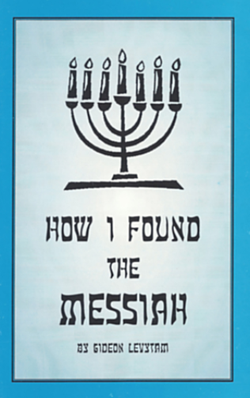
Follow Gideon Levytam's journey and discover how he was led by God, through a series of exciting circumstances, to find the One his people are still waiting for.
Past Episodes

Featured Offer
Follow Gideon Levytam's journey and discover how he was led by God, through a series of exciting circumstances, to find the One his people are still waiting for.
About Holy Scriptures and Israel
As time passed by, the Lord Yeshua took dear brother John Van Stormbroek to himself. The ministry of Holy Scriptures and Israel continued with additional development. In the early 1990’s, a weekly morning Bible class began which brother Gideon Levytam led regularly in the City of Toronto. This weekly open Bible class was held in the Willowdale assembly meeting hall. Eventually, a second mid-week evening Bible class was added. In April 2002, the need for an additional outreach Bible teaching meeting arose. We begun a Saturday (Shabbat) ministry meeting in which a systematic teaching of God’s word is presented to all who attend. Together we learn God’s Word, pray for each need and the salvation of Israel, and sing songs of worship unto our God, praising Him and our Lord Yeshua the Messiah.
In Mid 2004 we started to air on Joy 1250 Radio station a 15 minute Bible teaching program called "The Holy Scriptures and Israel" with Gideon Levytam. The broadcast teaches God’s word from a Hebrew Messianic perspective and has proved to be a blessing to many. It's now aired seven days a week. Our prayer is that many more of our Israeli people will have a clear understanding of who Yeshua is, why we all need him, and come to know him as their Lord and Messiah.
About Gideon Levytam
Contact Holy Scriptures and Israel with Gideon Levytam
426 Simcoe Street
Niagara-on-The-Lake
Ontario L0S 1J0
Canada
(905) 325-1234