

Acts 18:23 to 19:7, Part 2


The Preaching of Paul in Ephesus Part 2
Guest (Female): Shalom! Holy Scriptures and Israel is a ministry designed to share with the Jewish people the good news of the Lord Jesus Yeshua the Messiah and to instruct Christians on the Jewish roots of their faith. And now, teaching God's word from a Hebrew Messianic perspective, here is Gideon Levytam.
Gideon Levytam: The study of Acts Chapter 18. And then he entered into the synagogue as we read it in verse 19 of Chapter 18, and he reasoned with his Jewish brethren from the word of God. We have talked about it already. And then they desired him, verse 20, to stay longer with them at Ephesus, but he consented not.
So he stayed very short time, Paul, at Ephesus because he was going to go to the feast in the city of Jerusalem. And indeed, he have gone to the city of Yerushalayim and that's where he have gone to the church there, to the assembly, and visited the brothers and sisters in the local assembly in Yerushalayim, in the city of Jerusalem.
But now Apollos arrived to the city of Ephesus, a Jewish man that was born in Alexandria. He was an eloquent man. He was mighty in the Hebrew scriptures, in the Tanakh, but it doesn't stop here. When he arrived to Ephesus, it tells us a little bit more about this man. Notice it says in verse 25 that he was also instructed in the way of the Lord. Look at this, verse 25: this man, Apollos, was instructed in the way of the Lord.
Now, we have to pause here for a moment because you can see later on as we move down in these verses that when it says that he was instructed in the way of the Lord, it does not mean that he actually knew the Lord Yeshua the Messiah yet. But he was instructed in the way of the Lord, meaning the scriptures, the Old Testament scriptures, in the way of the Lord and he was not yet where he should have been.
He will become a believer in the Messiah, but at this point, we find that he was instructed in the way of the Lord. In other words, he was taught by word of mouth. In other words, somebody told him about the Lord Yeshua. He was instructed about him, but he was not yet, we would say in what we call it a New Testament time, he was not as yet born-again believer in Yeshua the Messiah.
He was instructed about him by word of mouth. He heard about him, but he was not yet established in what the Messiah Yeshua have done and in what is known for us today in the present-day teaching of the church age. So he was instructed in the way of the Lord. And then it continues, and the fifth thing that it says about him, that he been fervent in the spirit. Again, it's not the Holy Spirit here. He had this zealousness and he was speaking. In other words, his spirit was so fervent when he was speaking about the things of the word of God, the things of the Lord.
And then it said here that he spoke and taught diligently the things of the Lord. In other words, he was teaching and teaching the things of the Lord. But now notice that thing, beloved brothers and sisters, what it says here in verse 25 at the end. Notice it said: knowing only the baptism of John, of Yochanan. The moment you arrive to the end of verse 25, knowing only the tvilla, the baptism of Yochanan, that tells you that he only gone so far and no more.
Now, whatever the reason may be at that time that Apollos only knew about the baptism of Yochanan tells us that yet even though he came to Ephesus and he was speaking in a synagogue, he was not yet what we would know this today a born-again believer in Yeshua the Messiah who is part of the body of Christ, the body of Mashiach, the body of the Lord Jesus the Messiah. He was not yet where he was heading towards to become a child of God, part of the body of Messiah, but he was a Jewish believer that have arrived so far with his knowledge concerning the things of the word of God.
Now, let's for a moment make sure that we understand this expression knowing only the baptism of John. Now the word baptism comes from the Hebrew word "lehitavel". "Tvilla" means to be put under, to be immersed. And what he really came to, if you will, the threshold of understanding what John was presenting when he presented himself before the nation of Israel.
You know that John, Yochanan, was a forerunner of our Lord Jesus the Messiah. John, Yochanan, he presented the Mashiach, the Messiah, in his first coming. When he went down to the Jordan River in Judea, he was a Jewish man, John the Baptizer, actually he's not called John the Baptist, he really should be called John the Baptizer. He was presenting himself before the nation and he was saying to our people Israel, he says, "Repent, for the kingdom of God is at hand! Repent!"
He was preparing the people of Israel for the coming of the Messiah. And it may have been, beloved brothers and sisters, that Apollos went to the land of Israel, to the land of his forefathers, for the time of one of the feasts perhaps. And as he have arrived there, he have learned the ministry of Yochanan the Baptizer. And he was listening to what he was saying. In fact, I would like you please for a moment turn to Matthew Chapter 3 for a second so we can see what John, what Yochanan was presenting.
In Matthew Chapter 3, we read: in those days, verse one, Yochanan the Baptizer, Yochanan HaMatbil, John the Baptist, came preaching in the wilderness of Judea. And what was he preaching? Look what he said: "Repent ye, for the kingdom of heaven is at hand! For this is he which was spoken by the prophet Isaiah, saying, 'The voice of one crying in the wilderness, prepare ye the way of the Lord and make his path straight.'"
The same Yochanan had his raiment of camel's hair and a leathern girdle about his loins and his food was locusts and the wild honey. Then went out to him Jerusalem and all Judea and all the region about Jordan and they were baptized of him in the Jordan confessing their sins. You see, this is verses one to six of Matthew Chapter 3.
You see, John's baptism was a Jewish baptism, it was a baptism unto repentance and it was Judea and Jerusalem came down to John to be baptized by Yochanan in the Jordan confessing their sins. In a sense identifying with the call of Yochanan because the Lord, the Messiah, was going to come. Prepare, he says to them, remember as Isaiah said, "Prepare ye the way of the Lord, make his path straight. Get ready, the Messiah is coming!"
So Apollos have gone and have heard the message and as a godly Jewish man, he have accepted the message of John and he understood according to Acts Chapter 18 and verse 25, he only knew the baptism of John the Baptizer and no more. So we have to understand in our mind in Old Testament time as well in the first century when there was a message from the Lord, the God of Israel, and he sent a messenger, one of the things that baptism represented is represented identification with the message that the messenger was proclaiming.
So when Yochanan the Baptizer was proclaiming repentance because the Messiah is going to come soon and those of Judea came down to the Jordan and got baptized by Yochanan in the Jordan, they were really identifying with the message of repentance which he was proclaiming to our Jewish people 2,000 years ago before the beginning of the ministry of our Lord Jesus the Messiah.
And so here we find Apollos, a great person in many ways, born in Alexandria, eloquent man, mighty in the scripture, instructed in the ways of the Lord, being fervent in spirit. He taught diligently the things of the Lord, but he only have arrived to the knowledge of the baptism of John the Baptizer and no more. So here we find out the interesting thing that he was really in preparation by the spirit of God to come to the full knowledge of the Gospel and to be part of the Ecclesia, the called out one, the body of Messiah, and to begin to be used by the Lord in the church of our Lord Jesus the Messiah.
So what we find out now in verse 26, that Apollos, he had to learn the ways of God more perfectly. And that's where verse 26 comes in. And you remember he came to Ephesus. Paul has not been yet in Ephesus the second time, he have left Priscilla and Aquila there in Ephesus. And so in verse 26, it says he began to speak boldly in the synagogue. Now here's that Apollos going to the very same local synagogue at Ephesus where Paul previously had preached.
And he have gone to the very same synagogue. Here's another Jewish believer in Yeshua the Messiah and he was presenting there, boldly speaking in a synagogue, whatever the measure of understanding that he had. But apparently, there were those beautiful couple by the name of Aquila and Priscilla, they were as he says in verse 26: when Aquila and Priscilla heard him, they took him aside, or took him unto them, and they expounded unto him the way of God more perfectly or more thoroughly.
So there are a few things that we learn here also, that even though there was already local believers at Ephesus, that Aquila and Priscilla still went to the synagogue on the Shabbat day. Remember that, we are in the first century of the church age. At that time, there were Jewish people who became believers in Yeshua, they retained themselves in a synagogue, they were going on Shabbat to the synagogue, though they still have separate meetings of the believers.
And so we find out Aquila and Priscilla going to the synagogue on the Shabbat day and they were listening to Apollos speaking in the synagogue and boldly presenting what he understood from the word of God. But Aquila and Priscilla discerned that he lacked something. As they were listening to his message, perhaps he was talking a lot about the promise that the Messiah would come and how John wanted to prepare the nation for the coming of the Messiah, but he haven't gone beyond that.
Maybe he even heard John says in John 1:29, "Behold the lamb of God, which taketh away the sin of the world." He may have heard about the Messiah Yeshua and have understood that he was going to be the Messiah, but he didn't go any further, he didn't know any further because he left the city of Jerusalem, have gone back to his own country, perhaps back to Alexandria.
And now he's coming to Ephesus, not yet in the full understanding of what has happened after the finished work of the Messiah and the beginning of the building of the church, the heavenly company. So Aquila and Priscilla heard him speaking. They took him to them and apparently they had to talk to him in the side and they didn't speak publicly there in the synagogue because they wanted to instruct him and to help him to understand, to expound to him the way of God more perfectly.
And I'm kind of wondering what they have talked to him about because they didn't have, again, a complete canon of scripture. They only have the Tanakh, the Old Testament. And maybe they explain to him, they say to him, "Apollos, listen, yes, it's so wonderful that you have been baptized with the baptism of John. And it is good that you understood the message of repentance. And maybe it's so wonderful that you understood that he presented the lamb of God, the Lord Yeshua the Messiah."
"But Apollos, let us tell you a little bit more what happened. You see, after Yeshua came, this Yeshua that have lived among our own people for 33 years, you see, he had to go to the cross and he had to die." And they may have even spoke with him from the Old Testament, from Isaiah 53 and Psalm 22 and other passages that the Hebrew prophet spoke about the Messiah who will suffer for the sin of the nation of Israel.
But they had to teach him things that many, many people need to learn today, the truth concerning the body of Christ, the body of Messiah. That now, in the present day dispensation in which we live in, the Messiah, Christ, is building up something new which called the church, the Ecclesia. And that is called out ones from among Israel and among the Gentile world uniting them together into one body and building what is called the church, the assembly, the Ecclesia.
They probably told him not to worry, Apollos, God is going to restore our people Israel in a coming days, but you have to understand if you are going to preach and to teach and the minister the word, you have to understand the full purposes of God. And that's why it says here: the way of God more perfectly. You know, people need to know that God is dealing today with what is known as the body of Christ, the body of Messiah. He is going to restore Israel in coming days, but he's building the assembly, the church of the living God.
And so they took time with him and they have taught him and they minister to him and they shared with him the fact that the body of Christ, the body of Messiah, is being built now in this present time, in this dispensation. Well, how do we know that he have took it in and how do we know that he grasped it? Because you notice now what happened in verses 27 and 28.
In the first part of verse 27, Apollos departed now from Ephesus to Achaia. Look, it says in verse 27a: and when he was disposed to pass into Achaia. Achaia was a Roman province that was really embracing all the country called Greece, which was including the city of Corinth. So what Apollos did right now, he departed from the city of Ephesus and he went to Achaia, namely really in Achaia, this province, there was the city of Corinth.
And he was going now to the city of Corinth where the apostle Paul was previously ministering with Aquila and Priscilla. And now Apollos is going back to Corinth to this province of Achaia. And he was commended, look how beautiful this here, he was commended by the brethren with a letter of commendation. Look what it says in verse 27b: the brethren wrote and they exhorted the disciples, this is there in Achaia in Corinth, to receive Apollos.
Notice that? So the brethren at Ephesus, this is the Jewish believers and the Gentile believers of Ephesus, wrote a letter to the brethren in the disciples in Achaia in Corinth and they said to them, "Receive the servant Apollos. Receive Apollos there." And it was a nice letter of commendation. Apparently, if they ask them to receive him, that mean that he have acknowledged the fact that Yeshua was his Messiah, that he died, he was buried, and he rose again.
He understood the truth of the scripture now with respect to the church age as well. And that is so precious to see because the brethren commended him. They could not commend him to the disciples at Corinth, the believers, if he was not a believer. They could not commend him if he was not now understanding the truth of the body of Messiah. So the very fact that they wrote this exhortation to the disciples to receive him suggest that he understood the truth that Aquila and Priscilla taught him concerning the person and the work of the Messiah and the church age.
And now he went to Corinth and look at this, brothers and sisters, in verse 27b and verse 28. Look how Apollos was used in two ways at Corinth. He was used among the believers, those who already believe in Yeshua the Messiah, and he was used in the synagogue among his own Jewish brethren as he shared with them concerning Yeshua the Messiah.
First of all, we find out in verse 27b that him, this is Apollos, when he came there, he helped them much to them which believed through grace. In other words, he helped the believers there and he established them, he strengthened them because they already became believers in Yeshua the Messiah. But secondly in verse 28, he mightily convinced the Jewish people in the synagogue and he publicly showed by the scripture that Yeshua was the Messiah.
You see what he did? A twofold ministry in a sense. He first of all have ministered to the brethren, the believers, through grace. And secondly, he must have gone to the synagogue to his own brethren in the flesh, the Jewish non-believers yet, and to them he told them every Shabbat and maybe from door to door and maybe in personal contact he told them showing to them by the word of God, by the scripture, that Yeshua was the anointed, the Messiah, that he was the Christ, the Mashiach.
And so we see how this interesting man by the name of Apollos came to faith in the Messiah, became part of the body of Christ, and then went to Corinth and was used mightily in the city of Corinth. You know later on when the apostle Paul wrote the letters to Corinth, I want you to notice what he wrote to the Corinthian. Could you please turn to 1 Corinthians Chapter 1?
The apostle Paul wrote to the Corinthian, you can see that Apollos had a great ministry in Corinth because in 1 Corinthians Chapter 1 and verse 12, we read: now this I say that every one of you say, "I am of Paul," or "I am of Apollos," or "I am of Cephas," this is Petros, Peter, or "I am of the Messiah." See, there was a division at Corinth apparently. And every one of them apparently they appreciated Paul, but they also appreciated Apollos.
And Paul is saying, "Why is it that you are so divided? One say I am of Paul, and another one I am of Apollos, and another one says I am of Petros or Peter, and then another one says I am of the Messiah." All four of them were Jewish men: whether Paul, whether Apollos, whether Peter, or whether Yeshua the Messiah, all came from among the nation of Israel.
And the assembly there, they were so divided in that time because of the friction they have had. Some says, "I belong to Paul." "I belong to Apollos." "I belong to Cephas." "Oh no, I belong to Christ, I belong to the Messiah." And there was a division among the believers there and Paul was writing to them because he understood that some of them were following this man by the name of Apollos.
Look at 1 Corinthians Chapter 3, another verse that need to be read here. 1 Corinthians Chapter 3 and verse 5, Paul said to them, "Who is Paul? Or who is Apollos? But servants by whom you believe, even as the Lord gave to every man." Verse six: "I have planted, Apollos have watered, but God gave the increase." You see, Paul was used among the Corinthian, but apparently Apollos as well was used in the city of Corinth.
And so some of them looked so highly to him that they in the divisions there, some say I'm following Paul or I'm following Apollos or I'm following Peter and Paul warned them. He says, "Who is Apollos, who is Paul? I sowed, Apollos watered, but God gave us the increase." So the thing that we learn here, that Apollos was used by our Lord Yeshua the Messiah in the city of Corinth and he was very much apparently appreciated.
So verses 24 to 28 concluding Acts Chapter 18, we see the ministry of Apollos and this interesting man, a Jewish man by the name of Apollos who ultimately became a servant of Yeshua the Messiah. Well, let's move on to the first seven verses of Acts Chapter 19 now. And here's another interesting situation that need to be talked about.
And next we find here in verses 1 to 7 that we have some disciples of John the Baptizer that Paul himself now found at the city of Ephesus. Because it says in verse one: and it came to pass that while Apollos was at Corinth, you see so Apollos went to Corinth, Paul now having passed through the upper coasts came to Ephesus and finding certain disciples.
You notice what happened here? Apollos went to Corinth and Paul came to Ephesus. Apollos went to minister at Corinth and Paul now went to minister at Ephesus. And it was at Ephesus that Apollos needed to learn more perfectly things concerning our Lord Jesus Yeshua the Messiah. And so Paul have arrived to Ephesus and what does he see? He see a disciples. We find a certain disciples.
You know, disciples in Hebrew mean "talmid". Talmid is like a student or a follower of the things of the Lord. In this case, those were disciples that we will find out a little bit later in the next verses, that those were actually disciples of John the Baptizer, very similar to Apollos. So now when Paul arrived to Ephesus, he found those disciples and he immediately approached them and he began to speak with them.
And he Paul asked them a very interesting question. And he said to them, "Have ye received the Holy Spirit when ye have believed?" Apparently, they believed the message of John as well.
Guest (Female): You have been listening to the Holy Scriptures and Israel with Gideon Levytam. Gideon teaches God's word from a Hebrew Messianic perspective. For more information about this ministry, write to Holy Scriptures and Israel, Box 1411, Niagara-on-the-Lake, Ontario, L0S 1J0. Or visit our website at holyscripturesandisrael.com. You are also invited to Gideon's weekly Bible teaching on Fridays at 11:00 AM and 7:00 PM and Saturdays at 1:00 PM at Willowdale Christian Assembly Hall, 28 Martin Ross Avenue in Toronto. Holy Scriptures and Israel is made possible by your prayers and financial support. If you would like to support the program, visit holyscripturesandisrael.com. God bless you. Shalom, shalom.
Featured Offer
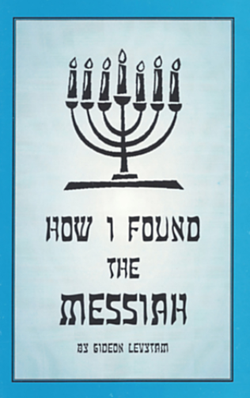
Follow Gideon Levytam's journey and discover how he was led by God, through a series of exciting circumstances, to find the One his people are still waiting for.
Past Episodes

Featured Offer
Follow Gideon Levytam's journey and discover how he was led by God, through a series of exciting circumstances, to find the One his people are still waiting for.
About Holy Scriptures and Israel
As time passed by, the Lord Yeshua took dear brother John Van Stormbroek to himself. The ministry of Holy Scriptures and Israel continued with additional development. In the early 1990’s, a weekly morning Bible class began which brother Gideon Levytam led regularly in the City of Toronto. This weekly open Bible class was held in the Willowdale assembly meeting hall. Eventually, a second mid-week evening Bible class was added. In April 2002, the need for an additional outreach Bible teaching meeting arose. We begun a Saturday (Shabbat) ministry meeting in which a systematic teaching of God’s word is presented to all who attend. Together we learn God’s Word, pray for each need and the salvation of Israel, and sing songs of worship unto our God, praising Him and our Lord Yeshua the Messiah.
In Mid 2004 we started to air on Joy 1250 Radio station a 15 minute Bible teaching program called "The Holy Scriptures and Israel" with Gideon Levytam. The broadcast teaches God’s word from a Hebrew Messianic perspective and has proved to be a blessing to many. It's now aired seven days a week. Our prayer is that many more of our Israeli people will have a clear understanding of who Yeshua is, why we all need him, and come to know him as their Lord and Messiah.
About Gideon Levytam
Contact Holy Scriptures and Israel with Gideon Levytam
426 Simcoe Street
Niagara-on-The-Lake
Ontario L0S 1J0
Canada
(905) 325-1234