

Acts 17:15-34, Part 1


Paul’s Preaching in Athens Part 1
Guest (Male): Shalom! Holy Scriptures and Israel is a ministry designed to share with the Jewish people the good news of the Lord Jesus, Yeshua the Messiah, and to instruct Christians on the Jewish roots of their faith. And now, teaching God's Word from a Hebrew Messianic perspective, here is Gideon Levytam.
Gideon Levytam: Shabbat shalom, everyone. Please open your Bibles. Today we are going to look into the second half of the book of Acts chapter 17, and we are going to read today from verse 15 to the end of the chapter. We're going to deal with the ministry of the apostle Paul, Sha'ul, to the people at Athens.
As he was moving along in his ministry, he entered into Europe, began with Philippi, and continued in his second missionary journey. He had already passed through Thessalonica in chapter 17, continued to Berea, and now we find the apostle Paul ministering in a city that is called Athens. We are going to begin in our reading today from verse 15. Please follow with me as I read today.
"And they that conducted Paul brought him unto Athens: and receiving a commandment unto Silas and Timotheus for to come to him with all speed, they departed. Now while Paul waited for them at Athens, his spirit was stirred in him, when he saw the city wholly given to idolatry. Therefore disputed he in the synagogue with the Jews, and with the devout persons, and in the market daily with them that met with him.
Then certain philosophers of the Epicureans, and of the Stoicks, encountered him. And some said, 'What will this babbler say?' other some, 'He seemeth to be a setter forth of strange gods:' because he preached unto them Jesus, and the resurrection. And they took him, and brought him unto Areopagus, saying, 'May we know what this new doctrine, whereof thou speakest, is? For thou bringest certain strange things to our ears: we would know therefore what these things mean.'
(For all the Athenians and strangers which were there spent their time in nothing else, but either to tell, or to hear some new thing.) Then Paul stood in the midst of Mars' hill, and said, 'Ye men of Athens, I perceive that in all things ye are too superstitious. For as I passed by, and beheld your devotions, I found an altar with this inscription, TO THE UNKNOWN GOD. Whom therefore ye ignorantly worship, him declare I unto you.
God that made the world and all things therein, seeing that he is Lord of heaven and earth, dwelleth not in temples made with hands; Neither is worshipped with men's hands, as though he needed any thing, seeing he giveth to all life, and breath, and all things; And hath made of one blood all nations of men for to dwell on all the face of the earth, and hath determined the times before appointed, and the bounds of their habitation;
That they should seek the Lord, if haply they might feel after him, and find him, though he be not far from every one of us: For in him we live, and move, and have our being; as certain also of your own poets have said, 'For we are also his offspring.' Forasmuch then as we are the offspring of God, we ought not to think that the Godhead is like unto gold, or silver, or stone, graven by art and man's device.
And the times of this ignorance God winked at; but now commandeth all men every where to repent: Because he hath appointed a day, in the which he will judge the world in righteousness by that man whom he hath ordained; whereof he hath given assurance unto all men, in that he hath raised him from the dead.'
And when they heard of the resurrection of the dead, some mocked: and others said, 'We will hear thee again of this matter.' So Paul departed from among them. Howbeit certain men clave unto him, and believed: among the which was Dionysius the Areopagite, and a woman named Damaris, and others with them."
I stop with the reading in verse 34, at the end of the chapter. I've mentioned the name of this hill that is called Areopagus. It is interesting to see some of the names that we have here in the city of Athens that the apostle Paul had to visit and experience preaching the message of the gospel to the people of Athens.
Now, brothers and sisters, as we continue in our study of the book of Acts, we learn very well and very fast that the devotedness that we see in this wonderful man by the name of Paul, his Hebrew name Sha'ul, the devotedness that he had in the seeking to present the message of the gospel, not only to his own brethren, the Jewish people, the nation of Israel, but also to the pagan Gentile community around the world.
How he longed to share the message of the Messiah, Yeshua, and the resurrection of the Messiah, and the finished work of our Lord Jesus the Messiah. You can see now that as he moves about from city to city, he experienced persecution. He experienced sufferings and trials. He found himself experiencing the hatred and misunderstanding, and yet he is persistent in continuing on, moving about from city to city in the preaching of the gospel.
We just finished the study of the first 14 verses of Acts chapter 17, and we find that the apostle Paul left Thessalonica, and how he suffered in Thessalonica from his own Jewish brethren because of his sharing the message of the Messiahship of Yeshua. He ended up fleeing from Thessalonica, and he arrived to Berea. He went to the synagogue of his own brethren, the Jewish people in Berea.
In Berea, they received him. We learn in verse 11 that they searched the Scripture daily to see whether what the apostle Paul was telling them is truly the Word of God. They opened the Hebrew Scriptures. They learned from the Hebrew Scriptures where they could see that what he was sharing concerning the resurrection of the Messiah was truly so, that the Messiah Yeshua came and that he died on the tree, that he was buried, and that he rose again on the third day.
They received the word, but they were searching the Scriptures. You and I need to do that every time. Even though we are already believers in Yeshua the Messiah, we need to search the Scriptures daily. That's why we are coming to the meetings, to learn from the Word of God, to search the Scriptures, to see what the Lord has to teach us.
But even from Berea, beloved brothers and sisters, because some of the people from Thessalonica came to Berea when they heard that he was preaching in Berea, they came and the apostle Paul had to be, as we read here in verse 14, taken away by the brethren through the sea and brought all the way to the city of Athens.
The beautiful thing to see is that there were in Berea already believers that the Bible called them 'achim' in Hebrew, 'brethren.' They were brothers and sisters in our Lord Yeshua the Messiah, part of the body of Messiah. They assisted him. Notice how we begin in our study today in chapter 17 and verse 15. They brought him all the way to the city of Athens.
Look at verse 15: "And they that conducted Paul brought him unto Athens." It's very interesting because they didn't only send him away out of the city of Berea, but they took him on that journey through the sea, and they brought him all the way to Athens because they loved him. They cared for him. They could see what he's experiencing in the rejection both by his own Jewish brethren as well as by the Gentiles.
The Bible tells us here in verse 15 that they conducted Paul. They literally watched over him, took the journey with him, and brought him all the way to the city of Athens. Then Paul gave them a commandment when they were returning back to Berea. They received a commandment from him for Silas and Timothy to come to him with all speed, then they departed.
The apostle Paul gave them instruction in verse 15 concerning these two men, Silas and Timothy. These are two Jewish believers who have already come to faith in the Messiah. They became associates of the apostle Paul, of Sha'ul. They ministered with him the gospel. Now Paul is saying to these brethren, "Listen, when you come back to Berea, tell Timothy, tell Silas to come as soon as they can to visit, to be with me."
Apparently, if you read 1 Thessalonians chapter 3, you will notice that they did come to see Paul eventually in Athens and they ministered with him. The Bible tells us that in verse 1 and 2 of 1 Thessalonians chapter 3: "Wherefore when we could no longer forbear, we thought it good to be left at Athens alone; And sent Timotheus, our brother, and minister of God, and our fellowlabourer in the gospel of the Messiah, to establish you, and to comfort you concerning your faith."
Apparently, Timothy already came later on to Athens and Paul now sent him again to the believers in Thessalonica to see how the brethren have been doing. I love that so much to see in the apostle Paul because he was not only a gospel preacher. It's one thing when we are an evangelist and we are preaching the message of the gospel, but the apostle Paul had the care for the saints.
He loved the believers, whether they were in Athens or Berea or Thessalonica or Ephesus or elsewhere. He loved the brethren and he always sought their well-being. He could not have been everywhere at the same time. Only God can be in many places at the same time. But Paul sent Timothy, sent Silas. He was caring for the welfare of the people of God.
This is something that we really need, that the Lord will develop in our own hearts: love for the gospel, love for souls, but also love for souls that are saved and need encouragement and strength in their spiritual life because there are many problems that the believers are experiencing as they follow Yeshua the Messiah.
Now, from verse 16 to verse 34, there are two major points that we want to focus upon today. The first thing is in verses 16 to 21, where we see the apostle Paul witnessing in the city of Athens. You will study that and you will notice, in fact, for the rest of the chapter, many Bible teachers study very well the witnessing of the apostle Paul here at Athens.
The reason for that is because there is a lot of wisdom in the way that the apostle Paul witnessed. Sometimes we do not witness with wisdom or with discernment. We just tell people, "You are a sinner. You need to go to heaven. If you're not going to go to heaven, you're going to go to hell. You'll die in your sins." We don't seem to meet the message for the individual's need.
We need to have wisdom in the preaching of the Word of God. It's not just sufficient to give a message of judgment and to just go away and to say, "Well, I have presented the message." We need to learn from the apostle Paul how he presented himself to various groups of people.
Notice, beloved brothers and sisters, the first thing we find in verse 16 is that Paul's spirit was really stirred within him when he saw the condition of the people of Athens. Look at verse 16: "Now while Paul waited," he was waiting for his own brethren to come, for Timothy and Silas, but while he was waiting in the city of Athens, it says here that "his spirit was stirred in him, when he saw the city wholly given unto idolatry."
Can you imagine? Here is a Jewish man who had been, prior to his faith in Messiah, a Pharisee of the Pharisees. He knew the God of Abraham, Isaac, and Jacob. He had believed in the true and living God, and for him, idolatry was out of the question. Then later on, he was exposed to the person of Yeshua, Jesus the Messiah.
In his initial information about the Messiah, he was ready to destroy his Jewish brethren who believed that Jesus was the Messiah. He has now become a believer in Yeshua the Messiah, in the God of Israel through the Messiah Yeshua. Now he's coming into a total pagan city by the name of Athens.
He's waiting for the coming of Silas and Timothy. As he's walking about in the city of Athens, downtown Athens, what does he see? The whole city was given to idolatry. In fact, some say that it was easier to find a god with a small "g" than a human being in the city of Athens. There were so many idols and altars and gods in the city of Athens.
Can you imagine? This man who was devoted to the God of Abraham, Isaac, and Jacob, who understood the necessity of the coming of the Messiah, the Lord Yeshua, and accepted him and paid a price, he is coming and walking in the center city of Athens and he sees that the whole city was totally given to idolatry.
That must have been such a shock to the apostle Paul because the Bible tells us here in verse 16 that his spirit was stirred within him. That word for "stirred" is the Greek word "paroxyno," which speaks of being really provoked. His spirit was provoked when he saw the condition of mankind around him in the city of Athens.
It reminds me of many other passages in Scripture. You remember when Yeshua was here on earth, still alive before his death on the tree, and you remember when he saw the people of Israel as a sheep without a shepherd, going astray, all going in their own way? There was no shepherd. There was no leader.
Israel were turning from true belief in the God of Abraham, Isaac, and Jacob into all sort of rabbinical influence and tradition, things that were no longer what God had given to our people historically in the Hebrew Scripture. The apostle Paul, looking at the condition of the people of Athens, he was really provoked in his own heart when he saw the condition.
He was stirred. He was aroused as we have here in this Greek word, paroxyno. He was really stirred in his own heart to see the condition of the people because the whole city was given to idolatry. That's why, by the way, we read in Psalm 115, when God warned our people Israel to show our people the contrast between the God of Israel and the idols of the nations of the world.
It was the psalmist who said, "Not unto us, O Lord, not unto us, but unto thy name give glory, for thy mercy, and for thy truth's sake. Why should the heathen say, Where is their God?" And then the writer of the Psalm says, "But our God is in the heavens: he hath done whatsoever he pleased." But then he's talking about the idols.
He gave Israel an instruction and warning in contrast between the true and living God and the idols of the nations of the world. "Their idols are silver and gold, the work of men's hands. They have mouths, but they speak not: eyes have they, but they cannot see: They have ears, but they hear not: noses have they, but they cannot smell:
They have hands, but they handle not: feet have they, but they walk not: neither can they speak through their throat. They that make them are just like them," the psalmist says. "So is every one that trust in those idols." The psalmist of Israel had already given these instruction to the people of Israel, and you can just see why the apostle Paul, Sha'ul, could be so stirred in his heart when he saw the condition in the city of Athens.
By the way, do you know that the New Testament believers are also exhorted to be careful from idols? You know how you and I are so quickly influenced by things that become like idols for us in our lives? Many things for us become like idols. The apostle taught already in 1 Corinthians chapter 10 and verse 14, he said, "Wherefore, my dearly beloved, flee from idolatry."
The apostle John in 1 John chapter 5 and verse 21 says, "Keep yourselves from idols." This is to believers he is speaking. He doesn't speak to unbelievers like Paul spoke to the people of Athens, but he is speaking to believers to be careful from idols. You and I might have idols influence our lives, things that become so important for us, even more important than giving our time to our blessed Lord Yeshua.
No wonder the apostle Paul was so stirred in his own heart when he saw the condition in the city of Athens. Look what he does, brothers and sisters. It is interesting to me because while he saw the city filled with idolatry, he began to preach the message of the gospel to those pagans who worship those idols.
He did something very interesting because immediately he went to the synagogue. As he taught us in Romans 1:16, where he says, "I am not ashamed of the gospel of the Messiah: for it is the power of God unto salvation to every one that believe." He gave us the order of things: to the Jew first, and then also to the Greek or to the Gentile.
We find out that in verse 17, first of all, in accordance with this principle, he went to the synagogue of the Jewish people. Notice in our chapter 17 and verse 17: "Therefore he reasoned," or "disputed" it says here, "in the synagogue with the Jewish people." He was reasoning with them. That word "disputing" does not mean that he argued and fought with them.
That word, disputed or reasoning, means he was speaking to them and sharing with them from the Hebrew Scriptures concerning the person of Yeshua, Jesus the Messiah. He tells them in verse 17b: he reasoned with the Jewish people, with the devout persons, and in the market daily with them that met with him.
Apparently, he was teaching there in the synagogue to the Jewish people, as well as when they were going to the market to purchase things. Can you imagine? His daily routine was, "Well, Shabbat I'm going to go to the synagogue. Sunday morning, Yom Rishon, the first day of the week, Monday or Tuesday, whenever I go to minister the Word of God, I'll go to the market."
People were going shopping, buying all kind of things, and he was dealing with those as well with his Jewish brethren. What was he dealing with? It says in verse 18: he did it daily with them that met with him, and he was really teaching them concerning the person of Yeshua the Messiah.
We're going to see it in the next verse. He was dealing with the people with whom he communicated: number one, the person of Yeshua, and number two, the resurrection of the Messiah Yeshua. Notice that again as I am reading now verse 18.
"Then certain philosophers of the Epicureans, and of the Stoicks, encountered him. And some said, 'What will this babbler say?' other some, 'He seemeth to be a setter forth of strange gods:' because he preached unto them Yeshua, Jesus, and the resurrection." Apparently, he was sharing in the synagogue on Shabbat, and going to the marketplaces and sharing there as well.
In addition to that, there were certain people, philosophers of the Epicureans and the Stoics, that approached him. They listened to what he had to say. Philosophy is one of the things that, often time in sharing the message of the gospel, people have their own philosophy. Philosophy simply means one that had given himself into human wisdom and understanding.
Philosophy is what today we find ourselves exposed to: humans' wisdom, human opinion, and human learnings. They reject God, but they rather follow human wisdom and human opinion. That's why many reject the person of Yeshua the Messiah, because they rather trust in human opinion rather than the truth of the Word of God.
Apparently, some of those philosophers came to the apostle Paul and they were following two great philosophers from their history. One of them is called the Epicureans, those who follow his teaching. He taught that they should just enjoy life. Live life as it is. Enjoy it to the uttermost. Have as much pleasure of life as you wish.
People do tell us today, "Let's just forget about this religious stuff. Let's just enjoy life. Just have a good time. We only have a certain length of time to live. Let us be merry. Let us drink and live and have a great time and forget about the things of the Lord." That is what those philosophers who follow the Epicureans were taught: to carry on and enjoy life. On the other hand, there were other philosophers, the Stoics. They followed another man's philosophy, and he taught to simply endure life.
Guest (Male): You have been listening to Holy Scriptures and Israel with Gideon Levytam. Gideon teaches God's Word from a Hebrew Messianic perspective. For more information about this ministry, write to Holy Scriptures and Israel, Box 1411, Niagara-on-the-Lake, Ontario, L0S 1J0, or visit our website at holyscripturesandisrael.com.
You are also invited to Gideon's weekly Bible teaching on Fridays at 11:00 AM and 7:00 PM, and Saturdays at 1:00 PM, at Willowdale Christian Assembly Hall, 28 Martin Ross Avenue in Toronto. Holy Scriptures and Israel is made possible by your prayers and financial support. If you would like to support the program, visit holyscripturesandisrael.com. God bless you, shalom shalom.
Featured Offer
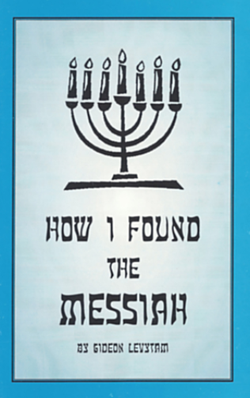
Follow Gideon Levytam's journey and discover how he was led by God, through a series of exciting circumstances, to find the One his people are still waiting for.
Past Episodes

Featured Offer
Follow Gideon Levytam's journey and discover how he was led by God, through a series of exciting circumstances, to find the One his people are still waiting for.
About Holy Scriptures and Israel
As time passed by, the Lord Yeshua took dear brother John Van Stormbroek to himself. The ministry of Holy Scriptures and Israel continued with additional development. In the early 1990’s, a weekly morning Bible class began which brother Gideon Levytam led regularly in the City of Toronto. This weekly open Bible class was held in the Willowdale assembly meeting hall. Eventually, a second mid-week evening Bible class was added. In April 2002, the need for an additional outreach Bible teaching meeting arose. We begun a Saturday (Shabbat) ministry meeting in which a systematic teaching of God’s word is presented to all who attend. Together we learn God’s Word, pray for each need and the salvation of Israel, and sing songs of worship unto our God, praising Him and our Lord Yeshua the Messiah.
In Mid 2004 we started to air on Joy 1250 Radio station a 15 minute Bible teaching program called "The Holy Scriptures and Israel" with Gideon Levytam. The broadcast teaches God’s word from a Hebrew Messianic perspective and has proved to be a blessing to many. It's now aired seven days a week. Our prayer is that many more of our Israeli people will have a clear understanding of who Yeshua is, why we all need him, and come to know him as their Lord and Messiah.
About Gideon Levytam
Contact Holy Scriptures and Israel with Gideon Levytam
426 Simcoe Street
Niagara-on-The-Lake
Ontario L0S 1J0
Canada
(905) 325-1234