

1 John 5:14-21, Part 2


Confidence of Believers in Their Lives Part 2
Guest (Female): Shalom. Holy Scriptures and Israel is a ministry designed to share with the Jewish people the good news of the Lord Jesus, Yeshua the Messiah, and to instruct Christians on the Jewish roots of their faith. And now, teaching God's word from a Hebrew Messianic perspective, here is Gideon Levytam.
Gideon Levytam: This study of 1 John chapter 5. Moses said in Exodus chapter 33, verses 12 to 17, "And Moses said unto the Lord, 'See, thou sayest unto me, Bring up this people: and thou hast not let me know whom thou wilt send with me. Yet thou hast said, I know thee by name, and thou hast also found grace in my sight. Now therefore, I pray thee, if I have found grace in thy sight, show me now thy way, that I may know thee, that I may find grace in thy sight: and consider that this nation is thy people.'"
And he said, this is Jehovah the Lord answering Moshe, "My presence shall go with thee, and I will give thee rest." And he said unto him, "If thy presence go not with me, carry us not up hence. For wherein shall it be known here that I and thy people have found grace in thy sight? Is it not in that thou goest with us? So shall we be separated, I and thy people, from all the people that are upon the face of the earth." And the Lord, Jehovah, Yehovah said unto Moses, "I will do this thing also that thou hast spoken: for thou hast found grace in my sight, and I know thee by name."
See, Moses was very wise. God said to him, "I'm going to send an angel to lead you into the Promised Land," in verse 2 of chapter 33. But Moses didn't want an angel. He wanted the presence of Jehovah, of Yehovah himself. So he said to him, you notice how many times he used the word "thy people," "thy way," "if I found favor in thy sight"?
Moses did not want to take away from God that which really belonged to God. Israel is God's people. Moses wanted God's way. Not my way, not my will, God's way. Moses wanted that all the world will know that Israel is God's people. And that's why he's again and again using the word "in thy sight," "thy way," "thy people." "I will not go unless thy presence is going with us."
Here is a man that prayed in accordance with God's will. But you see, sometimes, brothers and sisters, we don't want God's will. We want to have our own will. And no wonder God does not answer our prayers because we don't say, "Thy will be done." We say, "God, you turn around and fix things in such a way that I will have my will rather than yours." See, no wonder we don't have answers to our prayers many, many times because we don't ask according to his will.
Go back now to 1 John chapter 5. Verse 14 says any request in accordance with the will of God is being heard by God. The conditions are very important. We have to have an uncondemned heart. We have to have confessed sins. We have to have issues with each other settled. And we have to have a fellowship with the Messiah, abiding with him. Then our prayers are being heard, and then we can receive the requests that we have asked from the Lord.
Notice in verse 15, believers who pray in accordance with God's will have God's answer. Look at this. Prayer is much more than merely vocalizing something. Prayer is a real expression of dependence. Do you know that the Bible is filled with exhortations for prayer? And honestly, brothers and sisters, let me ask you a real question. I'm speaking to myself. How often do you pray? Don't answer now, but how often do you really pray?
We know very well many times we don't really pray. Prayer is an expression of dependence upon God. Prayer is an expression of a need. Prayer is an expression of fellowship with God. And many times we don't pray. Look at some exhortation that we have in the Scripture. In Luke chapter 18, verse 1, Yeshua said, "Men ought always to pray." In Romans 12 and verse 12, Paul says, "Continue instant in prayer."
In 1 Corinthians chapter 14 and verse 15, we read, "Praying with my spirit." In 2 Corinthians chapter 1 and verse 11, Paul said, "Help us by prayer." In Ephesians chapter 6 and verse 18, Paul said, "Praying at all times." In Philippians chapter 1 and verse 4, Paul is saying, "Always in every prayer." In Colossians chapter 1 and verse 3, Paul said, "Praying always."
And the famous verse, and one of the shortest verses in the Bible, 1 Thessalonians chapter 5 and verse 17, we read the Apostle Paul encouraging the Thessalonians to "Pray without ceasing." In Hebrews chapter 13, the writer says, "Pray for us." James chapter 5 and verse 16, "Pray for one another."
And finally, in Revelation chapter 8 and verse 4, and I didn't read all of them that I could read for you, the writer John, speaking about those tribulation saints, saying that their prayers of the saints was heard in the midst of the tribulation. They were under trials and difficulties. Their prayers were heard by the God of the nation of Israel during the tribulation time.
The Scripture is filled with the necessity of prayer, but prayer must be done in accordance with God's will. So verses 14 and 15 of 1 John chapter 5, God answer his own people's prayer, and it is important for us to have a suitable condition in order for the Lord to answer our prayer.
Now he is moving on in verses 16 to 19. And now notice this, brothers and sisters, this next is a very difficult text that many Bible teachers perhaps differ on that and try to explain these verses in verses 16 to 19. Specifically verse 16. In those four verses, the thought we have is that God's people do not practice continual, habitual life of sin.
And so John is saying now in verse 16, he says, "If any man see his brother sin a sin which is not unto death, he shall ask, and he shall give him life for them that sin not unto death." But then he added, "There is a sin unto death: I do not say that he shall pray for it." Now this is a very interesting verse, which troubling many who read this text.
And it is important for us to understand the verse here in its context because we just talked about prayer. We just talked about the fact that God would answer prayer. But here John is saying there is a sin unto death, and "I do not say that he shall pray for it." In other words, what Yochanan is saying is that there is a certain sin that leads to death.
It is very important for us to understand the context. Here in 1 John chapter 5, Yochanan is speaking to believers. And oftentimes we mix this verse with another passage that we find in Scripture in Matthew chapter 12, which there we have what you call the unpardonable sin. Remember that? What is the difference between the unpardonable sin that is found in Matthew chapter 12, verses 31 and 32, and the sin unto death that is in 1 John chapter 5 and verse 16?
Important to understand what's the difference between those two. First of all, they are far apart from each other. In Matthew chapter 12, Yeshua was speaking to the unbelievers, leaders of Israel who did not accept him as the Messiah, to the Pharisees and the Sadducees, the spiritual leaders who did not accept Yeshua the Messiah. In 1 John chapter 5, Yochanan, John is not speaking to unbelievers. He is speaking to believers in Yeshua the Messiah who are part of the mishpacha, of the family of God. It's two different things.
In Matthew chapter 12, he is speaking to unbelievers. In 1 John chapter 5, John is speaking to the children of God, to believers. In Matthew chapter 12, the unpardonable sin has to do with spiritual sin that has to do with eternal damnation. In 1 John chapter 5, it doesn't have to do with spiritual separation from God or spiritual death. It has to do with physical death of a believer.
They are two different things. Now go for a moment to Matthew chapter 12. Let me read this verse there before I'm going to deal with the passage of 1 John chapter 5. In Matthew chapter 12, we read in verse 24, "But when the Pharisees heard it, they said, 'This fellow does not cast out demons but by Beelzebub, the prince of the devils' or the demons."
When Yeshua have made miracles in the midst of the leaders of Israel who did not accept him as the Moshiach, as the Messiah, they attributed his healing to none else but to Beelzebub, who is called here the prince of the demons. In other words, what they really said was, he made this healing of that individual in the power of Satan.
And they were accusing him to heal in the power of Satan rather than in the power of the Holy Spirit of God. And that's why he said to them in verse 31 and verse 32, he says, "Wherefore I say unto you, All manner of sin and blasphemy shall be forgiven unto men: but the blasphemy against the Holy Spirit shall not be forgiven unto men. And whosoever speaketh a word against the Son of God, or the Son of man, it shall be forgiven him: but whosoever speaketh against the Holy Spirit, against Ruach HaKodesh, it shall not be forgiven him, neither in this world, neither in the world to come."
You see, he's speaking to unbelievers who rejected the testimony of the Holy Spirit of God that Yeshua the Messiah indeed is the promised Messiah, the Son of God. And all the things that he have done, he have done it in the power of God. And they were saying, no, he was doing it in the power of Beelzebub. It's two Hebrew words: "Ba'al" means lord, "Zevuv" means fly.
They were attributing the miracles that he did to the Ba'al, the Lord of the flies, meaning to Satan himself. By the way, this expression Beelzebub became to be known among our people in those days because there were flies that were so irritating them in those days that they attributed this from Satan, the Lord of those flies that irritate us.
And therefore he said to them, "I say unto you" in verse 31, "all manner of sin and blasphemy shall be forgiven unto men," except one. What is this blasphemy? What is this unpardonable sin? It's the blasphemy against Ruach HaKodesh, against the Holy Spirit, saying that Yeshua is not the Messiah, rejecting the testimony of the Holy Spirit of God concerning this person by the name of Jesus from Nazareth.
And up until today, by the way, Matthew chapter 12, it was a national sin of our own nation Israel. But today there are those who reject the testimony of the Holy Spirit concerning Yeshua the Messiah, and they say he is not the Messiah. And rejecting the testimony of the Holy Spirit of God is rejecting the Messiah and rejecting life. And he says to them, "it shall not be forgiven him" in verse 32 at the end, "neither in this world," but notice he continue, and he said, "neither in the world to come."
So brothers and sisters, don't mix this up. Matthew chapter 12, the unpardonable sin, the blasphemy against the Holy Spirit of God is for unbelievers who reject the testimony of the Holy Spirit of God concerning Yeshua the Messiah. But in 1 John chapter 5 and verse 16, he doesn't speak to unbelievers. He speaks to believers like you and I.
And what does he say? And I'm reading this verse again. "If any man see his brother," notice, "his brother." He's talking to believers who are brothers and sisters in the Messiah. And he says, "if any man see his brother sin a sin which is not unto death, he shall ask, and he shall give him life for them that sin not unto death." And then he adds, "there is a sin unto death, and I do not say that he shall pray for it."
Now let's just talk a little bit about this sin unto death. While we already said that the unpardonable sin is a sin of rejecting the Messiah, which brings a person to eternal death, here he doesn't talk about eternal death. Here he is talking about physical death. You see, there may be a sin in a believer's life that God will say, "Listen, I'm not going to allow you, my child, to remain here in this world. I'm going to take you away from this world unto myself because your testimony in this world has ended because of a certain sin that a believer have committed."
Now it may be different sin in every individual's situation, and you and I really do not know what it would be for a certain person. But let me give you some illustrations from the Word of God. I'm not going to take you to all the verses, but let me just read you something. For example, we read in the life of Korah. Korah was part of the Levites. He was part of the servants of God.
But Korah said to Moshe, to Moses and Aaron, "Who made you so great that only you are going to serve the Lord and to do those things among all the people of Israel? We can do this as well." There was pride in Korah's life. He wanted to take something that God did not give him. You remember Moses said to him, "Do you want also to take the priesthood? Sons of Levi, how much blessing God has blessed you. You have served God in so many ways, and you want to take that which is not belong to you as well?"
And you remember what happened. The ground opened, and the whole family of Korah, Korah himself died. And those who followed him died, physical death. Korah was a believer among our people Israel, and he was taken outside of this scene prematurely because of certain sin. In his case, it was the sin of pride.
But notice, for example, in Leviticus chapter 10, Nadab and Abihu, the two sons of Aaron. They were priests. But what did they do in their ministry? They offered a strange fire. And what God said? He smote them on the spot. And he removed them out of this scene. They did not die eternally. They did not die spiritually. They died physically. God removed them out of this world and took away their lives here from this earth. They were no longer suitable for his service because of this particular sin.
We can mention so many others, but I just particularly want to mention the verses that we read in Numbers chapter 20. I want you to turn to them for a moment. I want to mention for a moment Aaron and Moses, who also sinned a sin unto physical death. Look at Numbers chapter 20. You know what happened with them when God told them to go to Moses. He said, "Moses, you go speak to the rock." Already earlier in chapter 17 of Exodus, he told him to smite the rock.
But now Moses was called to speak to the rock. And so in chapter 20 of the book of Numbers, God said to him to go to speak to the rock. Notice verse 7. "And the Lord spake unto Moses, saying, Take thy rod, gather thou the assembly together, thou and Aaron thy brother, and speak," notice, "speak ye unto the rock before their eyes; and it shall give forth water, and thou shalt bring forth for them water out of the rock: so thou shalt give the congregation and their beasts to drink."
But what Moses did? He was a servant of God. He wanted to please God, but he was not happy with the congregation of Israel. So we read, "And Moses took the rod," verse 9, "from before the Lord, as he commanded him. And Moses and Aaron gathered the congregation together before the rock, and he said unto them, Hear now, ye rebels; must we fetch you water out of this rock?"
He was upset and angry with the people of Israel. So Moses lifted up his hand, and what did he do? Something that he shouldn't have done. God told him, "Speak to the rock." But Moses lifted up his hand, and with his rod, he smote the rock twice. And the waters came out abundantly, and the congregation drank and their beasts also. And look what we read in verse 12.
"And the Lord spake unto Moses and Aaron, Because ye believed me not, to sanctify me in the eyes of the children of Israel, therefore ye shall not bring this congregation into the land which I have given them." God was not pleased with the disobedience of Moses and Aaron. Actually, he said to both of them to speak to the rock. But Moses smite the rock twice. And really both of them, Aaron and Moses, both of them sin that sin which is called 1 John chapter 5 and verse 16, the sin unto physical death.
And you know what happened. You read in the very same chapter, beloved brothers and sisters, in Numbers chapter 20, and look at this. It says here in verse 23, "And the Lord spake unto Moses and Aaron in mount Hor, by the coast of the land of Edom, saying, Aaron shall be gathered, he will die, Aaron shall be gathered unto his people: and he shall not enter into the land which I have given unto the children of Israel: Why God? Why he shall die? Look at the reason. Because ye rebelled against my word at the water of Meribah."
And then Aaron died on that mountain there on Mount Hor. Now what about Moses? Turn to Deuteronomy chapter 3 for a moment. Look what we read about Moses. I was really fascinated when I was reading these verses concerning Moses as well because in chapter 3 of the book of Deuteronomy, we read in verse 23, "And I besought the Lord at that time, saying, O Lord God, thou hast begun to show thy servant thy greatness, and thy mighty hand: for what God is there in heaven or in earth, that can do according to thy works, and according to thy might? I pray thee," verse 25, "let me go over, and see the good land that is beyond the Jordan, that goodly mountain and Lebanon."
Look what the Lord said to him in verse 26. "But the Lord was wroth with me for your sakes, and he would not hear me: and the Lord said unto me, Let it suffice thee; speak no more unto me of this matter. Get thee up to the top of Pisgah, and lift up thine eyes westward, and northward, and southward, and eastward, and behold it with thine eyes: for thou shalt not go over this Jordan."
Now God was serious about Moses, and he says, "Moses, don't even ask me now." You see what we read in 1 John 5:16, "there is a sin unto death, and I do not say that ye shall pray for it." Moses was praying that God will not take away his life and allow him to enter into the Promised Land. And God said to him, "No, Moses." Now you and I might say, God, why is it that you not allowed thy servant Moses to enter into the land? He was longing to see it.
And that's why, brothers and sisters, God knows best. We don't know best. He knows what's better for his own people, for the human race. He knows better than all of us. And that's why we need to be in tune with his mind, with his will. Many times we are not. Now what about New Testament people? You might say, well, those were Old Testament people. They were long before the Messiah came. And that's just not applied to us because we are believers of the present-day dispensation of the Church Age. That does not apply to us.
Doesn't it apply to us? Well, what about Ananias and Sapphira in Acts chapter 5? You know what was their sins? They lied to the Holy Spirit. They sold the possession. They came to the meeting hall and they said, "Here is the amount of money that we sold the possession." And Peter asked, "Is that the amount?" Ananias says, "Yes." And because he lied, he died on the spot. Then it didn't take too long that they took his body out. His wife, Sapphira, she's coming to the meeting hall and she's saying, he asked her, "Is that the amount of money that you sold the property that you say that that..." She says, "Yes." She died on the spot.
Guest (Female): You've been listening to Holy Scriptures and Israel with Gideon Levytam. Gideon teaches God's word from a Hebrew Messianic perspective. For more information about this ministry, write to Holy Scriptures and Israel, Box 1411, Niagara-on-the-Lake, Ontario L0S 1J0, or visit our website at holyscripturesandisrael.com. You are also invited to Gideon's weekly Bible teaching on Fridays at 11:00 AM and 7:00 PM and Saturdays at 1:00 PM at Willowdale Christian Assembly Hall, 28 Martin Ross Avenue in Toronto. Holy Scriptures and Israel is made possible by your prayers and financial support. If you would like to support the program, visit holyscripturesandisrael.com. God bless you. Shalom, shalom.
Featured Offer
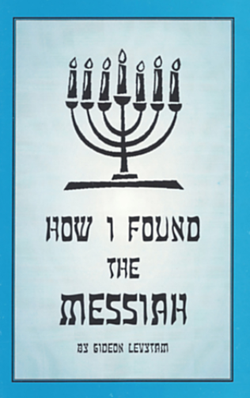
Follow Gideon Levytam's journey and discover how he was led by God, through a series of exciting circumstances, to find the One his people are still waiting for.
Past Episodes

Featured Offer
Follow Gideon Levytam's journey and discover how he was led by God, through a series of exciting circumstances, to find the One his people are still waiting for.
About Holy Scriptures and Israel
As time passed by, the Lord Yeshua took dear brother John Van Stormbroek to himself. The ministry of Holy Scriptures and Israel continued with additional development. In the early 1990’s, a weekly morning Bible class began which brother Gideon Levytam led regularly in the City of Toronto. This weekly open Bible class was held in the Willowdale assembly meeting hall. Eventually, a second mid-week evening Bible class was added. In April 2002, the need for an additional outreach Bible teaching meeting arose. We begun a Saturday (Shabbat) ministry meeting in which a systematic teaching of God’s word is presented to all who attend. Together we learn God’s Word, pray for each need and the salvation of Israel, and sing songs of worship unto our God, praising Him and our Lord Yeshua the Messiah.
In Mid 2004 we started to air on Joy 1250 Radio station a 15 minute Bible teaching program called "The Holy Scriptures and Israel" with Gideon Levytam. The broadcast teaches God’s word from a Hebrew Messianic perspective and has proved to be a blessing to many. It's now aired seven days a week. Our prayer is that many more of our Israeli people will have a clear understanding of who Yeshua is, why we all need him, and come to know him as their Lord and Messiah.
About Gideon Levytam
Contact Holy Scriptures and Israel with Gideon Levytam
426 Simcoe Street
Niagara-on-The-Lake
Ontario L0S 1J0
Canada
(905) 325-1234