

Introduction to Lamentations Part 3 or 3


An introduction to the book of Lamentations part 3
Guest (Female): Shalom. Holy Scriptures and Israel is a ministry designed to share with the Jewish people the good news of the Lord Jesus Yeshua the Messiah and to instruct Christians on the Jewish roots of their faith. And now, teaching God's word from a Hebrew Messianic perspective, here is Gideon Levytam.
Gideon Levytam: The study of Lamentations chapter one introduction. They didn't have an inheritance here in this world, or even in the land of Israel. They were the ones that were the priests. They were the ones that were leading the people of Israel in their worship. And they were the ones who lived in various towns of the portion of the land that belonged to the various tribes of the people of Israel.
And so, Jeremiah prophesied for about 40 years to our own Jewish people from the time of Josiah until the time where the Jewish people were carried away to Babylon. And then he himself eventually had been taken according to Jeremiah chapter 43; he was taken to the land of Egypt and there he stayed for a while when the Jewish people were carried away.
And you can just imagine as he was carried away, he's looking back and he sees the condition of the city. The temple is burned, the smoke is running above, the walls are broken to pieces, and the Jewish people are carried away. And he began to put down in pen these lamentations. One lamentation after another as he is lamenting over the condition of the people of Israel.
Now there are some lessons that we have to bear in mind that we learn from the book of Lamentation. Again, look again at the name Lamentation. In Hebrew, the word is Eichah, meaning "How." How is it possible that the condition are like that? How is it possible that the city that sits solitary now that was full of people, look what happened to this city. Desolation. Carried away the Jewish people away from there, and he began to, you might say, sing and lament over the people whom he loved so much.
Now there are certain lessons that we learn as we're going to study this book together. And I would like to suggest that there are three lessons. The first lesson that I would like to suggest that we learn from the book of Eichah is that God will judge sin. God who is holy, he will punish his own people. And we can be definitely assured by the word of God that God will judge his erring people who rebel against him.
Never mind the world outside; he will judge the unbelieving world. But God will also discipline his own people. He loves his people. He chose his people. He brought them into a relationship with him. He brought them into the land that he had promised to Abraham, Isaac, and Jacob, our forefathers. But when they will rebel against him, he will definitely discipline the very people whom he loved so much.
Let me remind you of a verse that Peter wrote to the assembly to whom he was sharing the word in the early days in 1 Peter chapter 4 and verse 17. Simon Peter said to the brothers and sisters in their locality, "For the time is come that judgment must begin at the house of God. And if first it begin at us, what shall be the end of them that obey not the gospel of God?"
God will discipline his people. And you know what, brothers and sisters, it's very natural. You and I are parents, and when we have our own children that we love them, when they are at their age under responsibility and we are responsible over them, at times we will discipline them. Does that mean that we hate them? Not at all. Does that mean that we want their evil or their bad? Not at all. Whom the Lord loveth he chasteneth, and he scourgeth every son whom he receiveth. It was Solomon who said it in the book of Proverbs.
So, disciplining his people is natural for God. He loved his people, but when they turn away from him, what do you think he's going to do? He will have to discipline his own people. Secondly, what we learn from the book of Lamentation is that there is a consequence to sin. Secondly, there is a consequence to sin as we find it, for example, in Galatians chapter 6. And I'll read now another verse in the New Testament, Galatians chapter 6 and verse 7.
We learn this from the book of Lamentation, and Apostle Paul said, "Be not deceived; God is not mocked. For whatsoever a man soweth, that shall he also reap." There is no doubt, beloved brothers and sisters, that we learn from Eichah, from Lamentation, from the songs that Jeremiah is singing, the mourning, the lament, the wailing that he wailed here that whatsoever a man soweth, he will eventually have to reap.
That speaks to our heart because at times we too neglect to realize the seriousness of being in relationship to Yeshua Jesus the Messiah. And therefore, we have the responsibility, like Israel. So, the body of Messiah have the responsibility to bear whatsoever we sow, we will reap. The third reason, the third lesson that we learn here is very important as well.
Not only that God will judge sin, not only that the consequence of sins will bring results for ourselves like it happened to our people Israel, but also what kind of an attitude we have when God's people are going through experiences of sufferings and so. How do I, how do you, how do Jeremiah—Yirmeyahu—behave and what did he think when he saw the suffering of his own people?
Did he say to them, "I told you so and you are so, here is you deserve and you get that, and I'm so happy that you are going through these problems and these trials"? No, that was not Yirmeyahu. You know when you and I have such a condition in our heart, you better check yourself. We better check ourselves whether our attitude is at all in line with God's ways. But no, Jeremiah was so painful when he had seen the condition of the people of Israel.
We read in Lamentation chapter 1 and verse 15b and verse 16, we read here: "The Lord has trodden down the virgin, the daughter of Judah, as a winepress." And then verse 16: "For these things I weep," he says. "Mine eyes and my eye runneth down with water." That's what Jeremiah's attitude towards the condition of the people of Israel. He didn't point at the wrong, he didn't say, "I told you so and you should have that and you should have that."
Jeremiah sat, you might say, on the ground and wept and prayed to the Lord on behalf of the people of Israel. This is something that we should emulate, that we should seek the Lord to help us, not to be happy when someone suffers, not to be satisfied when even someone who wronged us experiencing some problems in his or her life. But the opposite; we should have an attitude that Jeremiah had as he said, "My eye runneth down with water. I'm weeping for the people of God because I want them to be blessed, and I'm not happy when they are going through these sad experiences."
So, what lessons to learn? I want to notice now in the next slides that we have here in the division of the book of Lamentation. This is very interesting. And I just want to suggest to you today, beloved brothers and sisters, that in the book of Lamentation, we really have five songs of sorrow. Five songs of the experience of the soul in sorrowing over the people of God, the people of Israel, and the city of Jerusalem.
In fact, if we will look at the outline, and here we can see this is very interesting outline: in chapter 1, we see the lonely groaning. In chapter 2, we see the angry exhorting. In chapter 3, we see the broken and weeping. In chapter 4, we have the desperate anguish. And in chapter 5, we have the pleading, really pleading for God that he will restore the people of Israel.
Let me give you another way of reading those five songs of sorrow:
Chapter 1, verses 1 to 22: there, Jeremiah's sorrow over the destruction of Jerusalem.
Chapter 2, verses 1 to 22: there is Jeremiah's sorrow over the anger of God against the city of Jerusalem.
Chapter 3, verses 1 to 66: we see Jeremiah's sorrow and prayer for mercy for the city of Jerusalem.
Chapter 4, and verses 1 to 22: we see Jeremiah's sorrow over the siege of the city of Jerusalem.
And number 5, chapter 5, verses 1 to 22: we see Jeremiah's prayer for the restoration of the city of Jerusalem and the Jewish people, his own brethren. This is when it comes to the divided or to the outline of the book of Lamentation.
Now, we're going to go to another chart now, and this is also extremely interesting. The book of Lamentation is divided into five sections, five chapters. And in every one of these five chapters, you have the 22 Hebrew alphabet that we find in the Hebrew scripture or in the Hebrew language. Let me just give it to you: Aleph, Bet, Gimel, Dalet, Hey, Vav, Zayin, Chet, Tet, Yod, Kaph, Lamed, Mem, Nun, Samekh, Ayin, Pey, Tsadi, Qof, Resh, Shin, Tav.
Twenty-two letters in the Hebrew alphabet. And interesting enough is that those 22 letters have a numerical correspondent. In other words, every letter corresponds to a number. And that's why many times you find out that those who learn the Hebrew and teach the Hebrew often time use the numerical value of every letter. For example, Aleph, the first letter, is one. The value of that, the numerical value of Aleph is one.
And of course, you have Bet, shtayim, two; Gimel, three; Dalet, four; Hey, five; Vav, six; Zayin, seven; Chet, eight; Tet, nine; and Yod. This is the smallest letter. You remember what the Lord Jesus, the Messiah said? Not one jot or one tittle is come from the Hebrew word Yod. In other words, nothing will be taken away from the word of God, even not the smallest letter; this is the Yod. The numerical value is 10.
In other words, you can see that every letter has a number. The moment that you get to number 10, then you don't count 11 or 12 or 13, then you go by 10. Kaph is 20, Lamed is 30, Mem is 40, Nun is 50, Samekh is 60, Ayin is 70, Pey is 80, Tsadi is 90, and Qof is 100. One, two, three, four, five, six, seven, eight, nine, 10. And then 20, 30, 40, 50, 60, 70, 80, 90, 100. And by the time that you get to the last letters, it go by hundreds. Qof is 100, Resh is 200, Shin is 300, and Tav is 400. The letters equivalent to a number in the Hebrew language.
Now, what is interesting here that every one of these Hebrew letters you have included in those five songs of sorrow. But even more that is very interesting, that most of these five sorrowful songs, the Hebrew alphabet is acrostic. In other words, in Jeremiah chapter 1, there are 22 verses. Every verse began with a different letter. Verse one with Aleph, verse two with Bet, verse three with Gimel, verse four with Dalet and so on and so on the divisions of the chapter.
That's why, beloved brothers and sisters, you notice that there are five chapters. Chapter 1 has 22 verses. Chapter 2 has 22 verses. Chapter 3 have three times 22—66 verses. Chapter 4 back to 22 letters. And chapter 5, 22 letters. The first four chapters of the book of Lamentation, the verses goes acrostically in order. Chapter 1, verse 1, Aleph; chapter 2, verse 1, Bet and so on. And you notice that in the third chapter where you have 66 verses, there you have every three verses begin with the same letter. Aleph the first three verses, Bet the second three verses, Gimel the third three verses. Very, very interesting as we study the book of Lamentation.
Now, just to mention another thing, that only chapter 5, which has all the 22 letters of the Hebrew alphabet, yet this chapter, the order is not acrostic. It's not following one after the other in the very same order, for one reason or another, which only really the Lord knows and those that penned for us the book of Lamentation—Jeremiah and the spirit of God who guided him.
Now, this is not the only book of the Bible, the book of the Hebrew scripture that is acrostic and numerical in such a way. For example, the longest Psalm—Tehillim, Mizmor Le'David—the longest Psalm, this is Psalm 119, is divided into 22 sections. And every eight verses begin with a different letter. The first eight verses, all of them begin with the Hebrew letter Aleph. The second eight verses, all of these second eight verses begin with the Hebrew letter Bet. Then you have Gimel and Dalet all the way to the end.
And you know what also is extremely interesting? That if you know in the book of Proverbs, the virtuous woman—those of you sisters that are here who love the Lord and want to be a blessing to her husband and to the people of God—you read the Proverbs chapter 31 from verse 10 on. You will notice that the virtuous woman, the 22 verses that are mentioned there are acrostic. Aleph, Bet, Gimel, Dalet, Hey, Vav, Zayin, and so on all the way to the end to Tav. All of them are going acrostically, 22 verses.
So, immediately one might ask the question: Why is it so that these verses or these passages give us an acrostic, the whole 22 Hebrew letters of the Hebrew language? Why is it all-inclusive and why they are going in such an order? Well, just as a suggestion to think about is when God is working about among his people, he will do a thorough work from the beginning to the end. He will not stop; he will continue on to work in the life of his people.
And when he come in the days of Yirmeyahu, Jeremiah, when he took our own people Israel to Babel in discipline, he looked forward for a time of restoration. He will judge, he will punish, but he will ultimately restore in order that his own people will come to enjoy the presence of the Lord. Same thing in our life, you know, we often time read Romans 8 and verse 28: "For we know that all things work together for good to them that love God, to them who are the called according to his purpose." He know why he allows you and I to go through trials and tribulations and difficulties in our life, because he that began a good work in you will complete it until the day of Yeshua Jesus the Messiah.
One day we are going to be with our blessed Lord and he is going eventually to show us that which he worked about in our life and will bring us eventually to a final time to be with him. Now, the final word that I want to mention about this introduction, there is a theme of course to this book, to these five sorrowful songs that Jeremiah sang out of Lamentation for his people. And the theme really in this book is found here in these verses of this chapter 1 and chapter 3.
And I want to mention, the first thing that we learn here that the theme is the lamentation over the destruction of Jerusalem. He is lamenting over the destruction of Jerusalem. And that's why he says in verse 12, he says, "Is it nothing to you, all ye that pass by? Behold and see if there is any sorrow like unto my sorrow, which is done unto me, wherewith the Lord hath afflicted me in the day of his fierce anger."
This verse is extremely interesting. It is of course in the context, it speaks about Jerusalem, the Jewish people, the city of Jerusalem that had been destroyed and the Jewish people have been carried away. But isn't it amazing when you think about how much Jerusalem is linked with the Lord Jesus the Messiah? You remember what the Lord Jesus the Messiah said in the garden of Gethsemane—Gat Shemanim, we say—"I have sorrows, there is no soul like unto my sorrows." The Lord Jesus the Messiah in the garden of Gethsemane anticipated his sufferings on the tree.
And he was sorrowful even unto death. And you remember when he cried to the Father, he says, "Father, if it's possible, take this cup away from me." That cup was the cup of God's righteous indignation against our own sin. And God was going to lay upon him, upon Yeshua the Messiah, all the sin and sins of this world. And he was so sorrowful, and you remember his sweat was of a great drops of blood falling down to the ground. And yet he had to go and take this cup when he went to the cross.
He says earlier, "Father, not my will but thine be done." And he went indeed to the tree, to the cross, and he suffered for the sin of this world. But there is a link. There is a link between Jerusalem's suffering and sorrow, the people of God, and the Messiah, who is depict here, who can say like Jeremiah and Jerusalem say: "Is it nothing to you, all ye that pass by? Behold and see if there is any sorrow like unto my sorrow, which is done unto me, wherewith the Lord hath afflicted me in the day of his fierce anger."
Jerusalem was guilty and deserved to be afflicted. But Yeshua the Messiah was not guilty. The righteous anger of God fell upon him, not for his own sins, but for yours and for mine, for the sin of the whole world. And he want us to kind of look at him by faith and say, "Is it nothing to you, all ye that pass by? Do you realize what I have experienced where God judged me for your sins, for our sins? Do you meditate upon that? Do you think that we can forget what the Lord Yeshua the Messiah had to experience in his life when he died for us on the tree?"
And of course, the answer is we need to meditate upon the sufferings of the Messiah that he have experienced on our behalf as Jeremiah was pointing here to the sufferings of the city of Yerushalayim, who suffered the hands of God and the judgment of God. But this is not the end because in Lamentation chapter 3, and this is the last verse I'm reading today, in Lamentation chapter 3 and verse 22, we learn that the theme as well is the mercy of God, and the compassion of God, and the faithfulness of God that is never changes.
As we read here: "It is of the Lord's mercies that we are not consumed, because his compassion faileth not. They are new every morning." Jeremiah is saying, and he says, "Great is thy faithfulness." Yirmeyahu looked forward for the day of restoration of the Jewish people and the people of Israel back to the promised land in the Messianic kingdom. And he says we are really sustained because of the mercies of the Lord and because of his compassion which faileth not.
And think of us, beloved brothers and sisters, who are part of the assembly. If it wouldn't be the Lord's compassion and mercy, we would be consumed as well. So we thank the Lord for his compassion, we thank the Lord for his restoration. He will work it out in our life as he will work it out in the life of the people of Israel.
Guest (Female): You have been listening to Holy Scriptures and Israel with Gideon Levytam. Gideon teaches God's word from a Hebrew Messianic perspective. For more information about this ministry, write to Holy Scriptures and Israel, Box 1411, Niagara-on-the-Lake, Ontario, L0S 1J0, or visit our website at holyscripturesandisrael.com.
You are also invited to Gideon's weekly Bible teaching on Fridays at 11:00 AM and 7:00 PM and Saturdays at 1:00 PM at Willowdale Christian Assembly Hall, 28 Martin Ross Avenue in Toronto. Holy Scriptures and Israel is made possible by your prayers and financial support. If you would like to support the program, visit holyscripturesandisrael.com. God bless you. Shalom, shalom.
Featured Offer
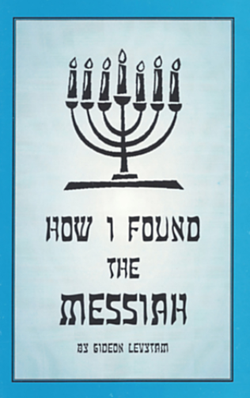
Follow Gideon Levytam's journey and discover how he was led by God, through a series of exciting circumstances, to find the One his people are still waiting for.
Past Episodes

Featured Offer
Follow Gideon Levytam's journey and discover how he was led by God, through a series of exciting circumstances, to find the One his people are still waiting for.
About Holy Scriptures and Israel
As time passed by, the Lord Yeshua took dear brother John Van Stormbroek to himself. The ministry of Holy Scriptures and Israel continued with additional development. In the early 1990’s, a weekly morning Bible class began which brother Gideon Levytam led regularly in the City of Toronto. This weekly open Bible class was held in the Willowdale assembly meeting hall. Eventually, a second mid-week evening Bible class was added. In April 2002, the need for an additional outreach Bible teaching meeting arose. We begun a Saturday (Shabbat) ministry meeting in which a systematic teaching of God’s word is presented to all who attend. Together we learn God’s Word, pray for each need and the salvation of Israel, and sing songs of worship unto our God, praising Him and our Lord Yeshua the Messiah.
In Mid 2004 we started to air on Joy 1250 Radio station a 15 minute Bible teaching program called "The Holy Scriptures and Israel" with Gideon Levytam. The broadcast teaches God’s word from a Hebrew Messianic perspective and has proved to be a blessing to many. It's now aired seven days a week. Our prayer is that many more of our Israeli people will have a clear understanding of who Yeshua is, why we all need him, and come to know him as their Lord and Messiah.
About Gideon Levytam
Contact Holy Scriptures and Israel with Gideon Levytam
426 Simcoe Street
Niagara-on-The-Lake
Ontario L0S 1J0
Canada
(905) 325-1234