

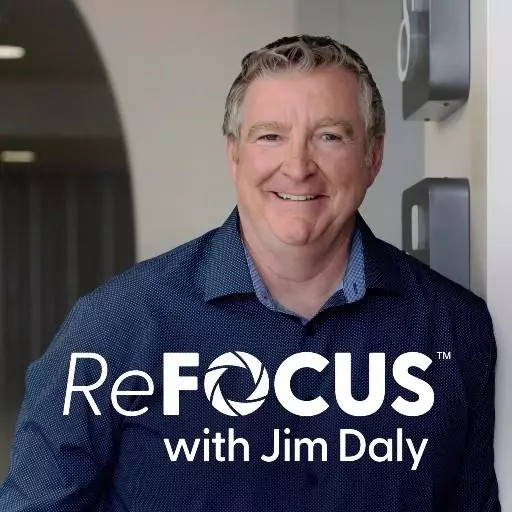
Faithful in the Negative World: Living for Christ in a Post-Christian Culture
Author and business consultant Aaron Renn helps Christians understand the adversarial culture we live in and develop and practice strategies to be effective witnesses and culture influencers for Christ. He examines the decline of the culture since the 1960s and suggests different personal and corporate strategies in the church to effectively impact the culture for Christ – through establishing a positive identity and excellence in our lives.
Aaron Renn: How do people see the light on the lampstand that’s uncovered? How do you win in this culture? How is what we are doing making us appear to other people?
Jim Daly: That’s Aaron Renn, asking questions about how we remain faithful, loving, and effective witnesses for Christ in a culture that misunderstands or, even worse, opposes what we believe. Welcome to Refocus with Jim Daly. Today, I’ll be examining the culture with Aaron Renn, who calls it the negative world. Isn't that a great label?
He argues that in the past decade or so, Christianity is no longer simply one option among many; it’s increasingly viewed as a social problem, some kind of disease that the culture needs to get rid of. Aaron isn't a pastor or theologian; he comes from the world of business consulting and public policy. He served as a senior fellow at American Reformer and previously at the Manhattan Institute for Policy Research.
When he wrote an essay called "The Three Worlds of Evangelicalism," it sparked a national conversation about how Christians should understand this cultural moment that we're in. In his book, *Life in the Negative World*, he suggests that old strategies for cultural engagement may no longer be enough. He suggests that we need to be open to change in our personal, institutional, and missional efforts.
Refocus is here to help you do just that. That’s the purpose of the podcast: to be bold and gracious and loving and kind in your witness for Christ. Let’s get started with that recent conversation with Aaron Renn on today’s Refocus with Jim Daly. Aaron, welcome to Refocus. Great to have you.
Aaron Renn: Thanks for having me on.
Jim Daly: I’m intrigued. You’ve written this great book, *Life in the Negative World*, but you’re coming originally from a business background, which I so appreciate. That’s my background as well. I did the MBA, worked for International Paper, and that was the way I was going until the Lord said, "No, I’m going to take you over here." Explain to me, as a Christian being a business consultant, how did you get into this space of Christian culture and evangelism?
Aaron Renn: I sort of had three careers. I started off in management consulting and worked for probably 15 to 18 years in that space. Then I sort of got interested in cities. I grew up in a town of fewer than 100 people in very rural southern Indiana. I moved to Chicago after college, and as someone said, "Aaron, you love cities like only someone from a town of 29 people can."
I actually started writing about cities. I wrote a blog about cities of the Midwest and the Rust Belt, and it really took off because people liked what I was saying. That kind of turned into a second career for me writing about cities, which landed me at the Manhattan Institute for Policy Research in New York for several years.
When I was there, I saw this problem over a decade ago of young men turning away from the churches and towards online influencers. At the time, nobody knew who any of these people were. Today, there are big names out there, but I wanted to investigate that phenomenon and engage on that phenomenon to help the church to become more competitive in winning the affections of young men. I started writing a little newsletter about that, and then it just expanded from there into essentially a third career writing about Christianity and culture. It’s more broad than that, but that’s how it originated.
Jim Daly: It’s intriguing how God sets the path of a person, and it’s great that you followed through on that. You write in the book about the 50s and 60s, and we’re going to cover all that ground as we continue our discussion. I was born in the 60s, so that is more relevant to me. I kind of saw it once I could understand what I was living in. Probably the late 60s, I had enough cognitive ability to get beyond Batman. In that context, what were your observations about the 50s and the 60s?
Aaron Renn: It’s interesting because none of us remembers the 50s, certainly not as adults. Even the boomers and people who are older who remember the 50s remember it through the lens of their childhood, which is why we tend to have this very childlike innocence view of the decade. I was not born until 1969.
There was a big contrast between the 50s and the 60s. In the 1950s, half of all adults were attending church every week. That was the high-water mark of church attendance in America. We were adding "In God We Trust" to our money and "under God" to the Pledge of Allegiance. We had prayer and Bible reading in our public schools. That was the kind of country that it was.
This really began to become unraveled in the 60s, and that old kind of consensus began to be questioned and go into decline. Church attendance began going down. The white Anglo-Saxon Protestant establishment collapsed. The Kennedy assassination was an interesting moment. Not that I think it really caused anything, but you had this sort of Camelot moment where it seemed like everything was coming together with Ellis Island America into the old Anglo-Protestant America. It was going to be this great thing, and then he’s killed, and everything goes crazy.
Of course, the Martin Luther King assassination followed, and all the turmoil of the late 60s, the Bobby Kennedy assassination, the cultural revolutions, the sexual revolutions, and the Vietnam War. There was just a massive cultural upheaval in America. One kind of outcome of that was that Christianity started to go into decline in America in terms of attendance, personal adherence, and increasing questioning of the Christian moral system.
Jim Daly: Something I’ve thought about, and I don't think it’s directly mentioned in the book thematically, but I wanted to ask you this. So often we think of the 50s in that idealistic way. Every culture and every society has things they need to work on. Of course, there were things in the US that were not healthy that needed to improve.
But you’re right, kind of the general understanding is we didn't lock our doors, we played until the sun went down, and kids weren't in danger in their neighborhood. When it comes to that Christian embrace, the fact that we were praying in school, reading the Word in school, all the things that you referenced a moment ago, the thing that puzzles me is if the culture tasted it, why did we abandon it?
Aaron Renn: I think there was a lot going on. First off, religion was sort of a civil religion in the 50s. It was a very shallow faith. How many of those people in church every week were there because they truly put their faith in Christ versus because that’s what you did to be a good citizen in America?
There’s a famous quote from Eisenhower, and I’ll probably get it slightly wrong, but it was something to the effect of: "A country such as ours can only prosper if it’s based on religion, and I don't care what it is." There were high degrees of religiosity in terms of participation but perhaps not in conviction and depth.
The other thing is if you read the literature about the 50s, it was a high social capital environment, and yet people chafed against it. There was still a lot of respect for authorities. You were sort of compelled to participate in all of these things that a lot of people didn't necessarily want to participate in. Maybe it was a little more conformist. They would talk about the "organization man" or the "man in the gray flannel suit."
You could move out to the suburbs and coach Little League or be a scoutmaster, but really you had no choice but to do that. Socially it would have been unacceptable to opt out. Then, of course, the new generations didn't live through the Depression or World War II and had a very different formative experience after the war.
It was kind of an interesting environment. Bringing it to life is tough because none of us experienced it, but I think there were probably some reasons people rebelled against that. Most of the history of the 50s is written by the critics of the 50s, but I think a lot of people liked it. Ultimately, it didn't win the day.
Jim Daly: It’s always troubled me to feel like if you tasted of the Lord, you wouldn't turn your back on that. I think that idea that it was superficial to a degree is probably at least a bit soothing to my understanding that once somebody knows the Lord, lives with the Lord, and follows the Lord, hopefully, it’s a minimal number that will walk away from that because of the great relationship with Christ.
I think we still have that today in the culture. When you look at convictional Christians, it’s a rather small number of the subset of what we might call cultural Christians or "Christian lite." We see that in the research. Even researchers break religious expression down in those very same terms: convictional or born again, which is someone who made a commitment to Christ but doesn't go to church or read the Bible very often. Unfortunately, for those that don't go all in with the Lord, sometimes the divorce rates were the highest within that group, higher than the world's. We were kind of stunned by that, but it goes to the parable that the Lord taught us about throwing your seed on the ground and the sun scorches it. You're at some risk spiritually when you don't commit completely to the Lord and really follow him.
Let me move more to the book content. You analyze three cultural stages of decline that America has experienced during our lifetimes. Describe those three stages.
Aaron Renn: This is where you can see my consulting background because consultants give you frameworks to make sense of your environment and your world, and then tools to think about how to respond to it. It’s a myth that they tell you what to do. They give you what you need to help you decide what to do.
I divide the period of decline of Christianity in America from 1964 to the present into three phases or worlds that I call the positive world, the neutral world, and the negative world. The positive world lasts from 1964 to 1994. To be clear, this is a period of decline for Christianity. It’s the first stage of decline, yet Christianity is still basically viewed positively in society. To be known as a good churchgoing man makes you seem like an upstanding member of society. It makes people want to hire you or vote for you. Christian morality is still the basic moral norm of the country, and if you violate them, you get into trouble.
In 1994, we hit a tipping point and entered the neutral world, which lasts from basically 1994 to 2014. In the neutral world, Christianity is not seen positively anymore, but it’s not really seen negatively yet either. It’s just one more lifestyle choice among many in a sort of pluralistic public square. Christian morality had a residual hold on society.
Then in 2014, we hit a second tipping point and entered the negative world where, for the first time in the 400-year history of America, official elite culture now views Christianity negatively or at least skeptically. To be known as a Bible-believing Christian does not help you get a job in the elite domains of society. Significant portions of traditional Christian morality are now expressly repudiated and in some ways are seen as a threat to the new public moral order. This shift into a negative world has been very dislocating for American Christians who have been used to thinking of themselves as the proverbial moral majority, which is certainly not the case today.
Jim Daly: I don't even know if that perception that we're the moral majority was true, or if we just all took it for granted. We kind of assumed people understood what Easter was about or what Christmas is about. Slowly as you're describing that, I can remember walking into a Blockbuster and asking for an Easter video. The young woman behind the counter was lost. She had no clue what Easter was about. That was kind of my first realization that the culture no longer has basic understandings of the common principles.
Let’s move to the negative world for a moment that you describe. We have a mutual friend in Tim Keller, who passed away not long ago. I had the privilege of interviewing Tim probably four or five times for Focus on the Family. You relate in the book a story about him. He was given or extended an offer to come to Princeton to receive an award, but this gives you an idea of that negative turn. Explain what that example tells us.
Aaron Renn: I actually only met Tim Keller once, which was a great honor. He was very formative on me in that a lot of my work and my personality didn't really fit with the mainstream broad evangelical culture. In Tim Keller, I found someone that really understood cities the way I understood them. He’s the reason I would say I became a Presbyterian. Whatever that guy is, that’s what I want to be because he’s so impressive.
One thing he did was go to New York, and he was obviously very successful there. One of the times he was invited out to Google to give a Google talk and he was treated respectfully by the major media. Then again, I think it was 2017, Princeton Seminary was going to give him an award, I think it may have been the Abraham Kuyper Award. Some people there complained. They said he’s hateful because he doesn't support women’s ordination and all this other stuff. You know the litany of things.
In the furor, they were basically like, "Well, we’re not going to give you the award, but you can still come give a talk here." So he sort of got quasi-cancelled there. Again, it was kind of during this big woke era where a lot of people were doing that. Here’s the guy that everybody says was the winsome strategy. We don't want to be like the religious right. We don't want to be Jerry Falwell and we don't want to be this hyper-controversial. We want to engage respectfully with people, have conversations, listen to other people. He modeled that, and all the winsome in the world wasn't enough. They still felt he was just another fundamentalist to them.
Jim Daly: To add on to those great accolades that you have given him, he was an incredibly well-read, thoughtful person who read the classics, knew the classics, and knew how to weave those classics into his sermons. The other key thing that Tim did that was really interesting and that I would encourage most pastors to try to do is, at the end of his sermons in New York at Redeemer Presbyterian Church, he would let everybody know, "I’ll be around after the talk and you can come forward and ask me questions."
He’d sit there sometimes for hours just dialoguing with people that had questions. I thought that is a great model for what Sunday church should look like if you don't follow the sermon and you have some questions about what he was getting at. I just like that approach.
Tim was a great guy. I was in a meeting with him with five LGBTQ leaders and five Christian leaders in an upper room for dinner in Washington, D.C. I remember Tim said one of the most poignant things. Somebody asked the question: "Can we give permission to each of us to give advice to the other side?" I thought, "Oh, that’s daring."
Tim said when it got to him around the table, "My advice to you would be: don't go out of your way to poke your finger in the eye of the other guy." He said, "New York works because it’s multicultural, but we don't go out of your way to expect services from people that it would be very difficult for them to provide that. Jew to Muslim, Muslim to Jew, Christian, etc." He said that kind of symbiotic relationship exists, and that’s how the city works.
He said, "I would encourage you not to go to a Christian baker and just try to make a point and take them to court. Try to find those bakers that will work with you." They just had none of that. They said, "No, the entire culture has to basically get behind us and affirm us." I thought, "Man, what wisdom." Now we look at it, and Tim had given them great wisdom on how to stay at the table, and now we’re seeing some of the ramifications through court victories that many Christians have won.
Let me ask you that because in the book you give the impression that there’s not a lot of Christian persecution occurring in the United States. I think that’s true generally when we look at certainly what’s going on in Northern Africa where people are losing their lives. But we are being constrained to express our opinion, and that has a dampening effect on it. Jack Phillips, who’s a friend of mine, had to go to the Supreme Court not once but twice, and he’s got other court cases pending because he won't bake a cake that does any kind of expression that goes against his biblical views. Speak to that idea of persecution, what’s happening in the country, and how serious we have to think of it in American terms today.
Aaron Renn: I wanted to make that point because I think we can talk about how we're persecuted, and then you think about what’s happening in Nigeria, what’s happened in North Korea, what’s happened in China, what’s happened in parts of India, and you realize we’re not experiencing anything like that. I do believe there are isolated incidents in the United States that you could legitimately call persecution, and Mr. Phillips would be one of those. He’s clearly being targeted for legal harassment by people who don't like his faith.
I think that’s not the norm. But I think that doesn't mean we shouldn't sell our situation short either because we live in a very unique time in a sense. I think about Second Corinthians. Paul talks about how he was beaten with rods, shipwrecked, set upon by robbers, stoned. All these things happened to him. He was thrown in jail. But nobody ever took away his ability to support himself as a tentmaker. He didn't face a kind of, "If you don't do what we say, then you're going to lose your job and not be able to feed your family," and things of that nature.
Our society puts more subtle indirect pressures on people in order to get with the program or face low status. Again, when Christianity in America was typically the high-status option, being a good churchgoing man was an upstanding member of our community. People wanted to be seen that way. Now it makes you seem kind of declassé.
It’s not even so much that you might even lose your job per se, but you're just going to look like one of those kind of hillbillies. You're not in the cool kids' club. Let’s be honest, social penalties are real penalties, as we all know from our high school experience. Now I would say, certainly in the post-2024 world, the whole kind of woke environment, hard woke you might call that, is sort of in retreat.
I do think if Tim Keller were invited to give a talk today somewhere, the odds of him being subject to those kinds of cancellation attacks would be much less. That kind of thing is a little bit in retreat. Corporations have reined in some of their activists. But I do think just because some of that overt hostility has declined doesn't mean we don't live in a culture where it’s not necessarily high status to be Christian.
This is the thing that we have to come to terms with: what does it mean when the culture fundamentally rejects your values? You look at abortion. Every time abortion has been on the ballot since the overturning of *Roe v. Wade*, a majority of the people voted in favor of it. It’s obvious Americans want abortion to be legal. They probably want pot to be legal. They probably want all the sports betting to be legal. There’s a whole range of things they want to be legal. What do you do in an environment when the things that you feel are God’s ways are unpopular? We live in a democracy. That’s a tough one to figure out, and it’s an adaptation process that American Christians are going to have to go through.
Jim Daly: There’s so much in everything that you were saying. Going back to persecution, we'd be remiss not to comment on Charlie Hebdo's assassination. He was clearly singled out and killed for what he expressed. That's one example, but it is something that's different on the American landscape today, that somebody is killed because of what they think or say or express.
I received a letter from someone in an Ivy League law school who was on the entrance committee. This person was a believer. I don't think his colleagues would have known that, but he said he was in meetings where Christian undergrad students were applying to their law school, and the committee would routinely discover the person went to church or they had volunteer time with a Christian organization, and that nullified their application within the committee discussion. When that came up, if the student identified any religious connection, Christian religious connection, they would not be allowed to become a law student at this school. That’s probably more subtle and behind the scenes that you won't know about unless this person describes it, but I think that’s going on. Medical schools are very similar from what I understand.
It will be interesting to see if those things get righted to where it’s on the merits. Forget what the person believes; it’s on the merit as a student and their ability to learn. Do you think the correction of the wokeness will go far enough, or will there still be these power centers like education and other places where that discrimination will still exist? Then what do we do as Christians to manage that and process that as the underdog, not the home team?
Aaron Renn: It’s one of those situations where I don't like to make too many predictions about the future because just the last decade or so has shown us that the future is crazier than any of us could possibly imagine. I think in January 2015, would anyone have believed it possible that two years later Donald Trump was going to be the President of the United States? I don't even think Donald Trump believed it at that time. Or we can think about Christmas 2019, and we don't know that two, three months later there’s going to be this pandemic that’s going to completely turn our world upside down for the next two years. Or you could think about the Russian invasion of Ukraine or the October 7th attacks. They just have profound impacts on the world.
I don't like to become too predictive of the future because it is very, very uncertain. I think we’re in kind of a transitional or liminal period where the old orders are sort of dissolving, and the new has not yet been born. I think a lot of the traditional establishment people in our society want to go back to the old order. They want to go back for the Republicans to Reagan or George W. Bush. Maybe on the left, everybody wants to be NATO and all of these traditional ways of thinking about the world. It doesn't seem very likely that that’s going to be sustained in our country.
Even in the evangelical world, as I talk about in my book, most people are sort of doubling down on what they were already doing more so than exploring new models. I don't know exactly what is going to happen. But one thing I would say is these institutions like universities are staffed and dominated by people who are 100% committed to DEI in whatever phrase it’s called. There may be some tweaks around the edge here and there, but there are these ideologies that are deeply embedded into institutional life in America, and that is not going to change just because somebody gets elected president.
Jim Daly: You had an example of a doctor in Canada. We look at Canada because for years here at Focus on the Family, we’ve kind of considered Canada the locomotive in front of us down the tracks, so to speak. We would see the back end of that train because they were ahead of the progressive application of things. When physician-assisted suicide happened, it happened first in Canada with the warning that this is going to get worse, that the Canadian government is going to allow more and more physician-assisted suicide. That has come to pass. Describe that doctor’s comment and the chill it puts on for everybody in North America.
Aaron Renn: I believe you may be referring to this person I had on my podcast who is a physician in Canada. Essentially, this gets back to your talk about the meeting with Tim Keller. There are no conscience rights in Canada when it comes to this. If you are a doctor in Canada, you must refer someone who requested it to assisted suicide. You don't have to personally kill them, but you can't basically say, "In my conscience, I shouldn't refer." If you want to practice medicine, you must participate in this regime.
This is definitely something that is how people on the left think about it. The very idea that anyone might choose a different path is totally anathema to them. Everyone must actively participate in what they want. People will talk about how people just want freedom for this, that, or the other thing. It’s never about that. They will force you to become actively complicit in what they are doing.
We see this in a whole range of dimensions. This country has democratic backsliding, like it's a crisis. The idea that somebody might vote for something or somebody might want something or somebody just might personally not want to participate in something that’s contrary to this sort of left ideological position is considered wholly illegitimate.
The idea that if we leave other people alone, they will leave us alone is simply not going to happen. One of the most prescient comments was made as early as 2013, Eric Erickson's line. He was talking about gay marriage and how evangelicals keep telling me they don't care whether gays can get married, "How does this affect me?" He’s like, "You don't understand. You will be made to care." It’s like you will be forced to care. It’s not just about allowing other people to do what they want; it’s about forcing you to participate and be part of certain things. Canada shows that. Undoubtedly, many people in the United States would support forcing all doctors to be willing to perform abortions, forcing them to participate in some type of physician-assisted suicide or euthanasia. You're not going to be allowed any sort of opt-out or personal conscience right if some of these folks have anything to say about it.
Jim Daly: I think that’s the impediment that the left has in the United States, as we do have conscience protections, religious liberty, other expressions in the Constitution, which I think they're going to continue to chip away at in order to achieve something more like Canada, where you have to go with the flow. Explain the lack of tolerance in the group that speaks so prolifically about the need for tolerance until we get the power and then we’ll become intolerant. I find it oxymoronic.
Aaron Renn: I don't really think that I have any special insights into that. There’s a bunch of people who’ve made quips on that, and it really just comes down to the quip that Republicans think Democrats are stupid and Democrats think Republicans are evil. So there is an asymmetry here. It’s not like there's the left on the one side and the right on the other sort of duking it out in some type of symmetrical battle, sort of like chaos and order or yin and yang. They are different in important ways.
For example, some people will say we just need to adopt the left’s methods. We’ll do a long march through the institutions. Well, that’s not going to happen because the left and the right are not the same thing. I think a lot of times we project various things onto each other that aren't true.
Actually, the thing about America that I've been thinking about and maybe writing something about this is one thing that we have is we have this group of people that I find quite frustrating many times. The "don't tread on me" conservatives, the kind of folk libertarian people, the Tea Party people who are always like critiquing the government no matter how low the taxes are, they’re still too high.
That group of people, as kind of an urban guy who likes things like public transit, doesn't necessarily resonate with me, but they are in a sense this bulwark of freedom that exists in our country that does not exist in Canada or other countries to nearly the same extent.
In the past decade, there have been multiple attempts to impose a sort of leftist hegemony on the country. You could think of the 2016 election. Every institution in the country mobilized against Donald Trump. Then there were essentially mass efforts to censor the internet, including with government participation. You can think about the COVID response and the attempts to force people to get vaccinated and all these things. You could think about the whole woke movement, the attempt to just force all this stuff when every single institution was behind all this stuff. And there's this stubborn group of people who are like, "We’re not going to do that no matter what the price. We’re not doing it."
I was talking with a guy who was from California, and he was living in this Midwest city that you wouldn't think of as like a big destination for California people. I was like, "How’d you get here?" He’s like, "Well, they brought me here to be the main TV anchor of the local network affiliate." He had like a dream job. He was now working in fundraising. I asked why. He’s like, "Well, during COVID, they told me if I didn't get vaccinated, I’d be fired. I didn't get vaccinated, and so they fired me." The guy was willing to pay the price of losing a dream job that you'll never get again to do that.
I really think that sort of frustrating part of our culture, it makes it difficult to get anything done. There’s a lot of people on the left who are like this too. They’re like, "We’re never going to go along with anything the Republicans do, no matter what. We will resist." But there is a sense in which that culture is a sort of last bulwark against institutional capture, being able to impose the sorts of things that have been imposed in Canada and all these other countries because Americans, there's a critical mass of Americans who are like, "We are not going to go for that, no matter what."
Jim Daly: Which is good. That’s part of democracy. They feel that is their role to speak into the public square and hold government accountable. Let me go back for the Christian community particularly because I’m thinking about the culture war. One thing that I’ve worked at Focus on the Family, I started in 1989, so I went through the 90s with Dr. Dobson and sat in meetings that were part of the strategic decision making, the formation of Alliance Defending Freedom, a legal group to defend religious liberty, very successful organization now, trying some of the most important cases of our time.
But those meetings back then, I realized because I was worried about how do you keep a Christian orientation in that environment? I saw it as very difficult because of the people I was observing. It was a "them and us" kind of discussion. I felt like sometimes it was difficult to maintain the fruit of the spirit in that environment. How do we have our Christian convictions when we’re so frustrated and so angry at people involved in the political arena particularly, on the from the other side?
I just remember feeling like if we give up our core principles, again like our faithfulness to Christ and how we live out a Christian attitude with the fruit of the spirit. I remember having lunch with David Horowitz over here near Focus on the Family. David was a secular Jew, he passed away a while back, but he went from that big flip-flop from strong leftist to hard rightist and wrote a book *How the Left is Killing Christianity in America* as a secular Jew. We’re at lunch, and he goes, "Jim, don't you know you’re in an alley fight and the other side has switchblades and they’re trying to kill you?" I said, "David, yeah, we’re not stupid. We get that. But our weapons of warfare are love, joy, peace, goodness, mercy." He’s like, "Wow, those are really bad weapons."
I think that was insightful because I think we’ve got to be very careful as the Christian committed Christian community to not use the weapons of this world, A, because we don't use them well, and B, they’re not what the Lord intends for us to use to influence and persuade other human beings about the way, the truth, and the life, Jesus. You're in this constant turmoil when you're in this role, trying to be the hands and feet of Christ and do the right thing and express love with truth, all those things that we say. But man, we’re also flesh and blood and we live in a sin-filled body and we’re part of this world as well.
Take a stab at explaining all of that and how the way forward, what it needs to look like. I’d only add the one little research project I did there: most of the culture warriors were born in the 30s and as you said a while back, they lived and grew up in an environment that was very Christian dominant. They did read the Bible in school. They did pray in school. They did talk Christian themes in elementary school with no pushback, and those people lost it all over the course of their lifetime, which gave me a little more sympathy for their attitude. Yet, obviously, it wasn't effective to be that culture warrior. What do we need to do to learn from the culture war moment and then how do we apply better weapons as we move forward?
Aaron Renn: I think if we look back, evangelicalism for better for worse has had high cultural adaptability and has had a lot of very successful entrepreneurial types within it who’ve been able to build movements and churches and institutions. You can think of someone like Bill Hybels building Willow Creek Church in Chicago, kind of creating an entire model of how to do things, very sophisticated person. You can think about Tim Keller, very different, a very different context, building a very successful church and ministry in New York City.
I think we need people who can sort of figure it out. What is it? It is kind of an unstable landscape, and how can we sort of come up with new approaches, a new entrepreneurial approaches for what I call the negative world, and this new cultural reality? Now again, I’m looking at this like a businessman because that’s my background. I’m sure that a pastor or theologian are going to have very different lenses on it, and I think it’s great to bring different perspectives.
But I think a lot of this is the sort of culture war in a sense is obsolete again because when you’re clearly a minority, attempting to impose essentially a minoritarian approach on society I think is going to be viewed very poorly. And so I don't think it’s the sort of thing where it’s going to win. And I don't think the Republican party is going to go along with a lot of culture war concerns because they care about getting elected. Of course you’ve already seen them, Trump and them all kind of said, "Okay, abortion done, we’re not going to talk about it anymore."
So there is this sense in which the political world is going to go where it goes. And again, I think the hyper-confrontational approach, I am not necessarily a big fan of that. On the other hand, I think there’s a kind of an alternative that comes out of a group I label the cultural engagements who are sort of attempting to essentially delegitimize political and cultural engagement through a variety of strategies, sort of culturally Anabaptist you might say. "Christ said his kingdom’s not of this world, he didn't come to wield power, he came to give up power," things of that nature. And the idea is sort of the pursuit of political or other forms of power and their utilization are inherently illegitimate for Christians.
There’s always been a sort of strain within Christianity that’s kind of felt that way, that’s had that. It’s one of the strains, but I think this idea is you just guys need to all stand down culturally and stop going for that, which I also don't agree with, and I’m not a fan of the head for the hills model. I think we need to figure out what does it mean to remain prudentially engaged in the culture in light of where we are. I don't have the greatest, "Here’s my 10-point strategy for doing that."
What I would say is one of the challenges I think to the culture war model, for example, was James Davison Hunter, the sociologist from the University of Virginia. I think he compellingly argues that it had the wrong theory of change, which was that change happens through politics, through electoral politics, as opposed to happening through sort of larger cultural shifts that are mediated through elite networks in various institutions in the cultural centers of power, through Hollywood, through the media, through the elite universities, through the think tanks and foundations, through the courts, etc., and that that was the real path to cultural transformation.
I do think we need to think about what is our theory of change and how do we go about doing it. So it’s not easy, but I think what I say is I don't think we should head for the hills necessarily. But I also think I would submit that in the current environment, evangelicals should be a lot less worried about what other people are doing and a lot more worried about what they’re doing. Because I think there’s a lot in which we do not have our own house fully in order. We need to be building infrastructure, you could think of it as Benedict Option if you will, to use Rod Dreher, that will enable us to sustain faithful Christianity in an environment that is no longer culturally conducive to it.
Jim Daly: You're touching on some things that really are the issue. I think it’s far easier for organizations to fight it out on behalf of groups of people including Christians. And yet at the same time, I think the blueprint is there, which would be early Rome, what the early Christians found themselves in. They were in an environment where they couldn't express religious liberty, they had difficulty, they had to kind of figure out how to keep their heads low and still do the things that eventually brought an entire empire around.
So you start looking at that blueprint, it goes to the works of the faith that really in my opinion, reading history, changed attitudes of people. You talk about culture being upstream of politics. In that context, I think the difficulty for us as a church is the most difficult work is rolling up your sleeves and doing it. So the early church began hospices and hospitals and saving the orphans from the dumps and doing the hard work in the culture, taking care of the poor, those things that the Lord instructed us to do. Eventually, that differentiated Christians from everybody else. "Why do they do this?" where there would be plagues that would break out, healthy Christians would go in, sacrifice themselves to feed and take care of people that were dying of the plague. Historians were baffled by their willingness to lay their lives down for others.
So my big point there is, I think that "why" or that fork in the road for the church right now is: are we prepared to do the heavier job of living out the faith in that sacrificial way, not even maybe with the goal of regaining the culture, but introducing people to Christ, which is the goal, and helping them be persuaded, like Paul with King Agrippa, that hopefully my actions, my attitude, will in fact inform you that Jesus is who he said he was and that your heart will be open to the idea of eternal life with him? So speak to that whole thing because that’s been part of the frustration for me and I think it’s the harder of the jobs rather than just speaking truth, orthodoxy to the world, but doing orthopraxy, which then opens the door for your orthodoxy, if I could say it that way.
Aaron Renn: Let me kind of put a meta-construct on this. Because what you're describing is very similar to the paleo-conservative military historian William Lind. He was a scholar of insurgency warfare. And he’s like, in a place like Iraq or Vietnam, what it in it isn't two armies meeting on a field, maybe like is going on with Ukraine and Russia right now. The real decisive factor is not whether you can bomb, you have more bombs than the other guy. The decisive factor in victory is whether you win at the moral level of war. You could think of that as equivalent to winning hearts and minds, being perceived as the more moral party, the more moral actor, and how that happens, also keeping your morale up and decreasing the other person's morale.
So in a case of Rome, the things that you're talking about helped people look at these Christians and say, "Wow, there’s something about these guys that they will basically risk their own life for other people when I’m not doing that." What I would suggest is rather than trying to transplant the exact same things that they did to our society, we should think about what does it mean to say how do people see the light on the lampstand that’s uncovered in today's context where, for example, we have vast government safety net programs and much of the culture is very, very different from Rome.
How do you win in this culture? For example, I’ll just give an example. You could think of Dr. Martin Luther King. His thing is, "We have to be strictly non-violent in the civil rights protest." When the cops beat them up and threw them in jail, it actually helped them because it made the cops and the segregationists look bad and it shows that the civil rights people are the moral winners in this conflict. I’m not saying that particular technique is there either, but we have to think about this. How is what we are doing making us appear to other people? Not in terms of what would the neighbors think per se, but wow, is this making us look like a morally credible force in society or is this making us look like anti-social elements or something of that nature? Again, I’m not saying that I’ve got like a list of 10 things to do, but I would say I would just evaluate. I think that’s a good heuristic: how is this looking to other people in terms of a witness? A lot of times the perception is evangelicals don't work and play well with others. We have to think about what it means to be faithful but also think about it as a strategy for cultural victory, then we have to think about it in those terms as well. You’ve got to always help the poor because that’s what we do and that’s what we're told to do and frankly it’s what we should want to do because of our heart change. But we also think, "Okay, if we want to win cultural victories, we have to think about what that means."
Jim Daly: I agree with you. I think an area—let’s dig into this a little bit to help the listener, help ourselves, help me—when you look at the LGBTQ conflict, I get it. I understand the battle that they were pursuing. I can remember the debates here about civil unions versus marriage. I remember discussions with the Catholic church and Protestant leaders. I was in the room talking about, "Do we move toward a civil union construct in order to preserve marriage as between a man and a woman?" And those discussions were going on. Not that in the end that we would have the ultimate influence in that, but what an interesting strategic move to say let’s try to do everything we can to keep marriage as between a man and a woman.
The forces in that discussion at that time said no, because if they go for, if we support civil unions, for example, their ultimate goal is marriage and they’re going to keep pressing to get there. My thought was yeah, but at least if you supported civil unions, not from a theological standpoint but from a cultural standpoint, it kind of takes the emotional energy out of the argument that we can't visit our partners in the hospital, we have no claim to their property if they should die, etc. All the things emotionally that people were concerned about.
But again, it’s fighting that tactically a little differently. But even today, churches that are turning away from what I would say is biblical truth and biblical principle in order to avoid that fight with the LGBTQ issue, where do they go from there? If they’re capitulating on what the definition of being male and female is biblically and God’s design for male and female, what do we do in that context? Obviously, some churches are saying we’re going to throw our hands up, we’re going to embrace it because it’s just too much of a momentum. I don't know how they would read that in scripture, but talk about modernity in sexuality and how the church may be losing its grip there.
Aaron Renn: Sure. When I go back to the New Testament epistles of Paul, one of the things that I notice is he is remarkably unconcerned about what is going on in Rome. I once wrote down every single command Paul gave in the Bible. He gives a lot of them. We think of Paul as the paradigmatic preacher of the gospel, but there’s a lot of commands, and I divided them up into various categories. Most of them fell into essentially two categories: one was personal holiness and the other was unity in the church. There were remarkably few commands that dealt with the world outside of the church.
The ones that he gave were mostly about how to get along in the world with the least amount of difficulty: pay taxes to whom taxes are due; so far as it depends on you, be at peace with all men. And if you look again in Corinthians, he’s talking about sexual immorality within the church, and he said something to the effect of: those that are outside God judges; you deal with your problem.
I’m not saying exactly what we should do today; it’s a matter of prudential judgment, and I’m not the pastor and I’m not in your situation, but I feel that we need to clearly distinguish between how we need to be living and the standards we need to hold ourselves to and the doctrines that we need to hold to within the church and how we then relate to the world outside of the church. Because again, Christians have been coming from a society that was very Christian dominant. In a place like China, this is like a whole different conversation. Nobody even imagines that they’re going to change the policy of the Chinese Communist Party. So I do think we have to be careful about essentially obligating particular political strategies for every single cultural moment.
Jim Daly: I think this gets back to a point that you made earlier when you're looking at the culture that we're coming out of—kind of your negative, neutral, and positive environments. In that context, Christians in the United States are on the descending side of the power curve. Who’s in control, what ethos is in control, and we have been on that, some even say, a post-Christian country.
And so in that context, we can lose our way back to your point about Paul and his instruction. We’re trying to straighten out the world's behavior while our own behavior in the church is not award-winning, let’s say. In that regard, if we were to concentrate on our own situation within the church, that in itself would be a witness, as we say, to the world about how we behave and what it means to be convictionally connected to Jesus, which changed life should be the evidence. So all of that kind of adds up to doing things differently in this new era where we don't control the culture, we don't have the power in the culture. I’ve always found it a little interesting that we’re expecting people outside the church to sign up for behavioral principles that they don't even either know about or agree with, as opposed to within the church kind of making sure that we’re keeping our own house in order so that it can be a draw to other people outside the church. Speak a little instructionally to us as Christians how we need to be mindful of what we look like to the world that’s watching us.
Aaron Renn: Good questions there. I don't like to preach to people about what they ought to do morally, but I do think one of the things that I do and I’ve advocated this for young men as well, because I think our society is always trying to promote essentially vice to you. It’s always trying to promote vice. It wants you smoking pot. It wants you betting on your phone. It wants you watching porn. It wants you doing all of these things. And so I think for me, one of the things that I try to do is avoid that.
Now being Presbyterian, I do drink alcohol, but I think there’s something to the idea of even if you don't drink alcohol. If you're like a notorious drunk, you’re probably not a very good witness. I just think some of the things, the one that really gets me, I think there’s been like increase in sort of crude language among people. I advocate avoiding profanity, avoiding porn, avoiding pot, avoiding betting, and probably should avoid tattoos. Is there anything morally wrong with getting one? No, it’s a matter of prudential judgment for yourself. But I think when you look at the statistical correlations around that in terms of various things in life, it’s probably not the best thing. I think avoiding those things, and then you’ve got less things for people to critique you over.
Jim Daly: I would say I’ll take that one over any of the other ones. Some of those things are culturally influenced as well. Let me ask you also, you identified three areas or strategies for growth to address the very issues that we’re talking about in this cultural moment. What are those three strategies?
Aaron Renn: One is being willing to speak truth clearly about the world. One of the things that really launched the "manosphere," which is all these online influencers—and there’s a wide range of them out there—is their willingness to say true things that people were not getting from mainstream society.
What made Jordan Peterson famous? He was already getting a rep, but there were two things that made Jordan Peterson world famous. The first is when he said, "If they pass this law in Canada that says I must use these pronouns, I will not comply with it." Now of course he’s nuanced it there; he’s like, "I’m willing to call people what they would like to be called, but I am not going to allow the government to compel me to speak in certain ways." He said no.
The second one, and you can go to YouTube and watch this one, he had an appearance on the UK’s Channel 4, which is a big network over there, where he was subjected to extremely hostile questioning from a sort of feminist female interviewer where he just sort of stood his ground and said things like, "Men and women are on average different. There are things that are different about men and women, and these differences have implications." Of course he, being a PhD psychologist, is well versed in all the scientific literature. So he’s speaking authoritatively, he’s actually speaking winsomely. He’s not getting defensive, he’s not raising his voice, he’s not going crazy. He’s just not surrendering to her frame. He’s like, "Here’s the facts, we’re going to do this."
Millions and millions and millions of people watched that video because they’re just waiting for one person who will stand up and do that. We need to be the people who are giving folks the truth, both factually, morally, spiritually, etc., because the society that we live in is actually really not good for large numbers of people who are in pain and suffering and need the truth.
Jim Daly: That is really insightful. I’ve seen that Jordan Peterson clip. What I liked about it the most was she’s asking those tough questions and then he asks equally tough questions back at her. She gets stumped by him because she’s saying, "Is it appropriate for you to basically make me feel uncomfortable?" He’s like, "Well, you have been making me feel uncomfortable since we started this interview." It’s just that observation that becomes even humorous that you're attacking me, and when I try to respond and set the record straight and you see that as me attacking you, that’s okay, but you attacking me, that's the way it should be, but if I try to respond, I'm not allowed to. I thought that was genius.
Aaron Renn: That’s a masterclass because it’s like the first rule guys learn on the playground is you can't hit a girl. The reality is that’s how it works. So if you’re in a big public dispute with a woman on the set of a TV show like that, if you're a man, it’s very difficult to come off looking well out of a situation like that, and he managed to do it, which was a quite high degree of difficulty.
Jim Daly: But doing it straightforwardly, intellectually. That really leads to that next question I want to bounce off of you because you do discuss that idea of increasing our credibility in the culture as a strategy and establishing a positive identity and cultivating excellence. It’s not to regain institutions, but we should look at that. I think homeschooling ironically is kind of an underlying contributor to that because even again Ivy League schools are pursuing homeschooled children because they actually are the brightest kids on the planet right now. They know the information, they can read the information and do mathematics, and typically they’re not finding that as a product out of public schools as they once did. Even that is kind of interesting to see maybe God’s hand at work regarding who are the thinkers among us and who are going to be the leaders among us. I think many of the homeschooled children that I’ve encountered, they are exceptionally bright and knowledgeable in so many ways. So it’s going to be interesting to see if they can deliver that component of what you wrote about in terms of excellence when they get into their 20s and 30s. I think I’m beginning to see some of that now. What do you think?
Aaron Renn: There’s a lot that goes into that. The economist Tyler Cowen wrote a book a while back called *Average is Over*. We used to have this broad middle-class culture in America, and now we’ve developed more towards a two-tier culture, more of a winners and losers culture. Just in the secular world, quite apart from the church, the degree of difficulty dial has been turned up on life. If you're a young man or young woman who wants to get married today, it’s a lot harder than it was 30 years ago, 50 years ago. Not saying it was always easy or that staying married was ever easy, but today it’s a very, very difficult, challenging environment.
We should be open to listening to them. As the degree of difficulty goes up, you have to elevate your game. So again, in the 50s, you could be a lukewarm Christian sitting in the pews, and maybe Jesus wasn't impressed with that, but you could do that because actually people thought you were a great guy if you did that. As the temperature gets turned up, we have a lot less space for spiritual mediocrity and people who are not all in, people who are not counting the cost. All the things that it says in the New Testament that we used to just gloss over because it didn't seem like they applied to us. We need to have people who are Christians who have the best expertise in every domain.
I would say I am probably one of the rare Christian writers who actually has a significant number of non-Christians and even very liberal people read my work because they find that it gives them insights about understanding the world. I’ll often get feedback to the people will say, "Aaron, I don't necessarily agree with everything you write, but I appreciate that you really just explain your thought process and why you think that you do, and you can kind of respect that."
Most of the Christians you would think of as thought leaders are people who are speaking almost entirely to the church itself. There aren't a lot of people tuning into the evangelical thought leader in America to learn about what’s going on in the world, to help them make sense of the world. So I always try to hold myself to a standard like is this something that you're giving people who aren't even Christians insights into the world such that they would want to read what I’m doing? A guy I think who does that really well is the Catholic Ross Douthat at the New York Times. He’s widely read by people who aren't Catholic or Christian because they see him as offering a lot of insights and not just explaining the church to the world, although there’s some of that, but also helping to explain the world that we're in. That’s a sort of mode that I sort of aspire to operate in.
Jim Daly: That was one of the cornerstones of why we did *Truth Rising*, which is a documentary. People can watch it on X or they can get it on YouTube. It’s all free, and it’s a 90-minute documentary. What got my attention was Bill Maher, who was making fun in a comedic shtick that he was doing on his HBO program, but he was talking about the New York Gay Pride Parade. He said, "Did anybody notice there were no gay people on the stage at the Gay Pride Parade? They were all trans people." And people laughed in the audience. I thought, "Wow, here’s a left-leaning comedian who is making fun of the gay pride parade." You're not allowed to make fun of the gay pride parade.
But that was part of the ignition I thought when comedians are starting to make fun of the woke stuff from the left, like Bill Maher, Dave Chappelle, and others. I was like, "Okay, something—there's a crack in the fortress on their side of that perspective." So that’s something if you want to take a look at the *Truth Rising*, it’s really a great documentary and it highlights a number of people that we call courageous Christians who have gone through some amazing things like Jack Phillips but also Chloe Cole, a detransitioner who’s become a Christian and she kind of documents what was done to her as a 13-14-year-old girl.
Let’s zoom into the last question here. You emphasize prudential engagement. We’re touching on it. Let me put—or you can put—the capstone on it. What is prudential engagement as a way forward for the church?
Aaron Renn: When I say prudential, that’s just a way of talking about wisdom. Wisdom is one of the great themes of the Bible, actually. We're commanded to be wise. There’s the contrast between the wise man and the foolish man. With prudential or wisdom-based things, it’s not a simple in or out. You can't go to the Book of Proverbs and say some proverb that says, "Oh, you’ll prosper if you do X," and if you do X, that does not necessarily mean you will prosper. It means that in general, that’s going to lead in a better direction than doing the things the foolish people did.
I think what we like, and I can appreciate this because I was raised in a sort of fundamentalist environment myself, if you call it that, in the Assemblies of God. Sort of Pentecostal fundamentalism, if you view that, and so it’s like we want rules. We want black and white, here’s what you got to do every single time. Operating in a very moralistic framework is I think what comes most natural to us because you get easy answers and it divides the world into good guys and bad guys.
But something like politics or culture are realms for wisdom in how you engage. Short of the return of Christ, we're never going to have a morally pure politics. There hasn't been one ever. So you’ve got to be like, "Okay, what does it mean to get in here?" Think about a guy like Daniel in Babylon or Joseph in Egypt. There were things they would not do. Joseph is like, "No, I’m not going to sleep with Potiphar’s wife." Daniel’s like, "No, I’m not going to stop praying to God." There are things we will not do. There are moral lines. But in other things, it’s like, "Okay, great, is it legal for me to serve this pagan king who doesn't believe in God, doesn't worship God, he’s not living correctly?"
I think it’s one of these things where—and this is why I, although I tend to write about public policy a lot more than other people do because of my work on cities and different things, I would say when it comes to politics and voting, it’s a matter of conscience but not a matter of indifference. That is to say, I don't believe I or someone else or a pastor has the right to say "You must vote for this person, you must do this, you must do that." But we’re going to give an account to God for what we did with what we were entrusted with.
I think what I would suggest is I would advocate that we actually stay in the game, that we don't abandon the playing field, that we don't retreat, that we stay firm on our convictions, that we do know where our personal and moral lines are, where God’s moral lines are, but at the same time realize how we engage in politics is going to be a matter of personal judgment. We're not going to get it right every time, but we’ve got to navigate intrinsically complex scenarios.
People’s contexts are in fact different. Tim Keller in New York City lived in a very different world than Charlie Hebdo. They didn't do the same thing. They had very different strategies for engaging, both very, very successful. I wouldn't say that either of them is above criticism. There may be people who strongly disagree with how one or both of those guys went about what they were doing, but they had to sort of navigate that in a prudential manner. So that’s what I say: we can't operate in a sort of moralized political realm because that is in essence the age to come of a source when we’re trying to think about what to do, how to live. What do we do? What do we do? It’s not always obvious, and I think we need to have some maybe a little bit more grace towards each other in recognizing people are going to make different decisions and maybe are in different environments as well.
Jim Daly: Aaron, in fact, you and your wife have done as a practice, it sounds like, having singles over to your apartment in New York and having good, probably dinner discussions. I’m not sure. Tell me what you’ve done and what the fruit of it has been.
Aaron Renn: New York City is a famously socially isolating place. There are a lot of singles in New York. It’s a predominantly single environment. And so when my wife and I lived there, we would on occasion—I don't want to claim we did this on a weekly basis or something—invite someone from our church who was single to come over to our house for dinner. Which is not necessarily the New York norm. I think New Yorkers often meet at restaurants or something like that, but it was essentially an attempt to be a little counter-cultural in terms of that. Because a lot of times when you're single, you get kind of cut out of other people's lives.
I just found that people really appreciated it, and I’ll also admit having a little bit of an ulterior motive in the sense that I wanted to give people an opportunity to see how our family lived and what does it mean to be married, to have a child. What does it mean to live like that in New York? So people can see what it looked like and say, "Oh, maybe that’s something I could get," or something. But just to show what we’re doing. I think a lot of times we're very reticent to do things like that. Paul, I think it’s in Thessalonians, talks about, "You know what kind of men we proved to be among you." He often appealed to the way he was behaving personally, which is something I’m like, "Man, I would never do that. I would never say, 'Hey, step up and look at what I’m doing.'"
But I think in a city where so many people are single, and I think if you read Tim Keller and listen to what he had to say, Redeemer Presbyterian was about 70% single the whole time that his ministry was ongoing there. I think sometimes just letting people see, "Hey, there are people doing different things." And again, not that everybody who is single there wants to be single. There are a lot of people who’d love to be married; they can't get married. But just inviting people into a different form of life and just giving them opportunities to experience what they might be cut off from there as well. It’s always good to open your home to other people, particularly in our atomized, isolating world where people are doing that. One thing I noticed in New York, you’d be at church on Sunday morning and we do "passing of the peace." We’re talking with people, new people who come in. One thing you could tell: a lot of people walking through the doors of that church are looking for community. They're looking for a personal connection in a city where it’s very hard to make. And so I always want to have an open heart towards people who want that.
Jim Daly: That’s a good perspective. All right, Aaron Renn, thank you for being with us. Your book, *Life in the Negative World: Confronting Challenges in an Anti-Christian Culture*. Great thought. This is really good food for us as Christians to be thinking about and making sure that we’re doing the things that you’ve outlined, which are based in scriptural truth, looking at the words of Paul and trying to live out our lives as best as possible because, as you said, we’re going to be accountable for those things that we’ve expressed and those things that we’ve done before the Lord someday, and we want to make sure that we’ve done our best. So thank you for the spirit of that. Thanks for being with us.
Aaron Renn: Thanks for having me.
Jim Daly: Okay, I hope Aaron Renn has helped you to think more clearly about the cultural moment that we're living in, and it’s good to know, like the Bereans, what moment are we in? That’s right out of scripture. If there’s one takeaway from this conversation, I think it’s this: while the culture is changing, our calling as believers has not. We need to be consistent and stay the course. The early church was born in a negative world. Remember what they were facing: the Roman Empire and the boot on their neck. They were able, with God’s help, to become the dominant feature of that civilization.
The Bible was written in a negative world, and Christianity always seems to grow the strongest in the face of adversity and conflict. As Aaron reminded us, this moment requires us to know what we believe and why we believe it. It requires churches and families that are resilient and grounded to know the Word and to express the Word. It also requires us to have the courage to engage our neighbors who may not think like us. And that, again, is the purpose of Refocus.
So rather than longing for a return to a positive world which may never have existed in that spiritual context, remember we're waiting for that; it's called the next world, Heaven, being with Christ when He comes back or in that interim time in Heaven. That’s where we won't experience tears and all the downside of this world. And I’m telling you, I’m looking forward to that, frankly. But let us cultivate His shalom, His peace on this earth in that interim time. How do we bring His shalom to a world that’s living in chaos?
If this conversation has resonated with you, let me point you to two things. You heard us mention the documentary *Truth Rising*. There’s also a free four-part series that goes along with that. John Stonestreet from Colson Center worked with us in creating that. He was also featured in *Truth Rising*, and you can get that directly from Focus on the Family. Also, I want to encourage you to ask us for a copy of Aaron’s book, *Life in the Negative World: Confronting Challenges in an Anti-Christian Culture*. We’ll make that easy: if you can make a gift of any amount to the podcast, we’ll send you a copy of Aaron’s book as our way of saying thank you for helping to fuel the ministry.
All right, turning that corner for the Inbox segment today, here’s a voicemail from Rick.
Rick: Thank you, Jim, for taking my question. I’m wondering, when I’m standing firm for my Christian beliefs, how do I know the difference between courageous engagement and being combative, because it can feel like fighting?
Jim Daly: Rick, I think you actually know it in the moment. I feel that way; I know when I’m trying to win the argument as opposed to being persuasive or influence the person toward a better outcome, a better spiritual outcome. I think you can feel it. I really do. I think you can hear the tone. I think you need to be in tune with all of that so that when you're pressing too hard, lighten up a little bit and listen to what that person is saying. I think when we get aggressive in trying to win the verbal discussion, we actually tune out the listening of what that other person is saying. As long as we're listening, I think they’re giving us deference, and I think that’s where to fall back on. Listen well and make your points well.
Combative dialogue I don't think gets us anywhere. That’s cable news related, that’s social media. I think it’s actually refreshing for people to hear, "Tell me more about why you think that." That's so much easier to get in that discussion. And again, try not to win, but to influence. I think that’s it. Rick, thanks for your very thoughtful question. Since I answered it here, I’ll send you a copy of my book, *Refocus: Living a Life that Reflects God’s Heart*. If you have a question for me, please send me a voicemail by clicking on the link in the show notes or write your comment or question in the contact form. I’d really love to hear from you. It helps the dialogue when I’m listening to you guys.
Thanks for listening to Refocus with Jim Daly. Also, like, listen, and subscribe wherever you get your podcasts. Next time on Refocus, golf legend and two-time Masters champion, a great conversation with Bernhard Langer, who shared an inspiring testimony of his journey to Christ along with his family.
Bernhard Langer: He told me that a year and a half later, he says, "I've been watching you, and I was really worried about you, but I want what you've got." He became a believer; my parents became believers.
Jim Daly: That’s coming up on Monday, March 23rd, on the next Refocus with Jim Daly.
Live your truth. A lot of people say that, don't they? But truth isn't something we decide; God has decided it for us. And it's our job as believers to share His truth with a world in need. I'll encourage you to do that through my podcast, Refocus with Jim Daly. I visit with fascinating guests about important topics like gender confusion, cancel culture, and more, while helping you share God's love with others. Listen at refocuswithjimdaly.com.
Featured Offer
How to Transcend the Culture War and Transform the World
Featured Offer
How to Transcend the Culture War and Transform the World
About ReFOCUS with Jim Daly
About Jim Daly
Daly is author of two books, Finding Home and Stronger. He is also a regular panelist for The Washington Post/Newsweek blog “On Faith.”
Keep up with Daly at www.JimDalyBlog.com.
Contact ReFOCUS with Jim Daly with Jim Daly
Focus on the Family
8605 Explorer Dr.
Colorado Springs, CO
80920-1051
(800) A-FAMILY (232-6459)
