


#7 Recovering From Loss - Part 1


Loss shakes our hope, but true recovery begins when we anchor our hearts in a deeper and lasting source of hope.
Dale O'Shields: Thank you for joining us for today's Practical Living broadcast. I appreciate that through this message, you will learn how to apply God's Word and truths to any situation in your life. Stay with us as we discover God's truths that will transform us. Today we continue a series entitled Lifequakes. I want to talk to you for a few moments this morning about recovering from loss. How do you recover from loss?
This word Lifequakes describes things that happen in our life that shake us up. Sometimes those things are situations that we anticipate, life transitions that are normal. They are moments that shake us temporarily, and we have to adjust to a new season. Then there are times that we experience things that might be out of the blue, things that really hit very hard. Jesus talked about people experiencing the storms of life in Matthew chapter seven. He describes two different men who built houses. One man built his house on sand, and another man built his house on the foundation of rock.
The wind, the rain, and the storms came to both men. Both of them experienced it, but only one man had his house remain after the storm went away, and that man's house was built on rock. Jesus describes that rock as being the Word of God, living, knowing, and obeying God's Word, and building your life on a solid foundation in a relationship with God. This series is all about how to build your life on a rock and how you deal with the different things that come your way as a part of life.
One of those hard-hitting things that happen to us is something called loss. When we go through losses in life, we are often devastated, hurt deeply by the losses that come our way. Today, I'm going to bring you a story. This weekend and next weekend together, we're going to take a look at a book in the Old Testament that describes for us a lady who experienced significant loss in her life. Actually, two ladies that experienced significant losses in their lives, and it’s the Old Testament Book of Ruth.
You may or may not be familiar with the Book of Ruth in the Old Testament. There are four chapters, a quite short book, and you can read it quite quickly and easily. It's a story that describes for us the events in seven characters' lives. Let me tell you the characters you'll find in the Book of Ruth so you’ll understand something about the story. It starts out with a man by the name of Elimelech. He was from Judah, actually from the town of Bethlehem, and he was married to a lady by the name of Naomi. Elimelech and Naomi, this is the couple that takes center stage as the Book of Ruth begins.
They had two sons. The next two characters in the story are their sons, Mahlon and Kilion. Unusual names, but these are their names. This is a family that lives in Bethlehem: Elimelech, Naomi, and their two sons, Mahlon and Kilion. Eventually, they will travel from Bethlehem to Moab. The two sons, Mahlon and Kilion, marry two Moabite women, Orpah and Ruth. This is where the name of the Book of Ruth comes from because Ruth becomes a central portion of this story. Eventually, another character shows up in the story who is quite important, and his name is Boaz.
So seven key people: Elimelech, Naomi, Mahlon, Kilion, Orpah, Ruth, and Boaz. It happens in two locations. This book transpires geographically in first, Bethlehem. Bethlehem is to the left of the Salt Sea or the Dead Sea down toward the wilderness of Judea. Then, of course, over to the right is this territory of Moab. These are the two central geographic territories of the story found in the Book of Ruth. These four chapters describe an incredible story of loss, grief, and despair, and finally, a turnaround that happens in a miraculous redemption.
An amazing story, actually, the key theme of the Book of Ruth is redeemer. It teaches us some valuable lessons about how you deal with loss, how you deal with grief, how you recover from grief, and how you experience redemption out of the losses in your life. This weekend, I want to share with you just one simple lesson. You only get one point this weekend. I'll give you one to remember that will help you in this journey, and that's to understand something about loss. There's a key word I want to share with you that I hope you'll get deep in your heart today, and that's this: losses, if you're not careful, can steal your hope.
The Book of Ruth begins with a description of a set of tragedies that transpire. Let me read for you the first five verses of the first chapter of the Book of Ruth. In the days when the judges ruled in Israel, a severe famine came upon the land. So a man from Bethlehem in Judah left his home and went to live in the country of Moab, taking his wife and his two sons with him. The man's name was Elimelech, and his wife was Naomi. Their two sons were Mahlon and Kilion. They were Ephrathites from Bethlehem in the land of Judah.
When they reached Moab, they settled there. Then Elimelech died, and Naomi was left with her two sons. The two sons married Moabite women. One married a woman named Orpah and the other a woman named Ruth. But about ten years later, both Mahlon and Kilion died. Notice that's happened now twice in the story: death. This left Naomi alone without her two sons or her husband. Out of all the books of the Bible and all the stories of the Bible, other than the Book of Job, I don't think there's any other book that starts out with so much tragedy.
The Book of Job is a book that describes a man who goes through all kinds of losses and difficulties, but now we see in the very first chapter of the Book of Ruth some terrible losses happening to this particular lady. Let's set the stage of what's transpired here. First of all, she's living in Bethlehem during the time of the judges. The time of the judges was a time of great spiritual idolatry in Israel. It was a very tumultuous time. In fact, the Bible says there was no king in Israel during this time, and everyone was doing what was right in their own eyes. It's a spiritual wasteland.
The Bible says in Bethlehem at this particular time, there was a famine. Quite interesting because the name Bethlehem means house of bread, but at this particular time, there was no bread in the house of bread. There was a famine there. So here is this family, Elimelech and Naomi and their two sons, living in a place that is stricken with famine. Elimelech, who is the head of the household, either rightly or wrongly, we don't know exactly the motivations behind it, but he made the decision, "We’re leaving here. We’re moving from Bethlehem, and we're going to Moab to survive."
This would have been a very foreign place to this family. Moab was at this particular time a very idolatrous land. In fact, the whole history of Moab goes back to Lot. Lot had an incestuous relationship with his daughter, and the Moabites came out of that situation. This is an idolatrous territory. Then they arrive in this place called Moab, having left Bethlehem, and before long in that territory, Elimelech the husband dies. About ten years later, Naomi’s two sons die, leaving her all alone as a widow and leaving two other widows with her, Orpah and Ruth, with no means of support.
It's a terrible moment for Naomi especially. She's going through deep emotional pain of loss in her life, and it's taking a toll upon her. She will eventually go back to Bethlehem, and when she first arrives back in Bethlehem, she describes where she is emotionally. We see in chapter one, verses 20 and 21 where she is in her own emotional experience as she says to her relatives back in Bethlehem, "Don’t call me Naomi. That’s not my name anymore. Don't call me Naomi." She responded and said, "Instead, call me Mara, for the Almighty has made my life very bitter for me."
In fact, the word Mara means bitter. I went away full, but the Lord has brought me home empty. Why call me Naomi when the Lord has caused me to suffer and the Almighty has sent such tragedy upon me? Do you see the emotional toll the loss had taken upon Naomi's life? She feels as though all she has to look forward to in the future is a bitter kind of an experience in life. She is basically or certainly coming to the very edge of losing all hope. Hopelessness is a terrible thing. When you go through losses, when things are taken from you, what happens is your hope for your future is threatened.
When you have something and then it's gone, then you begin to wonder, "What’s going to happen to my future?" Losses can very well rob us of our hope. Naomi has experienced this. She's had the pain, the loss of a nation that has turned away from God, and she's felt the pain of that. She had the pain of leaving her family in Bethlehem and then traveling to a place where she knew no one. She has the disorientation of settling into this foreign idolatrous land. She has the unexpected death of her husband, the untimely death of her two sons.
She has the insecurity now of not knowing how she's going to care not only for herself but for her two daughters-in-law. She's going through this terrible time of loss. There are people today here in this room and our campuses that are watching today and watching online, and you're experiencing or have experienced some loss in your life. There are all kinds of losses that we can go through. You can have relationship losses. You lose a relationship that you thought was going to endure. It might be the breakup of a friendship that you thought was going to last all of your life, and suddenly that friend is gone from you.
It might be the loss of a marriage. A marriage falls apart. You thought it was going to work out and be forever, but it didn't happen. It could be the loss of a loved one that you loved dearly, but death took them away from you, and you don't have that relationship any longer. It's a loss in your life. You can have material losses. Maybe your business goes south, you have setbacks in your finances, or maybe somebody steals something from you, and that loss is very real to your life. Or you can have the loss of trust in someone that you had trusted in and they betrayed you in some way.
You lost trust. You can have a loss of your own confidence because you failed in some way, but you used to be self-confident and strong, but that loss of confidence in your life has left you reeling. Many times in life, we experience physical losses, the loss of our health, the loss of the function of some aspect of our body, some function of our capability. Loss is a reality to living life, and loss always produces grief. It always produces an emotion of grief. If you're saying you’re going through a loss and you're denying that you have any grief associated with it, then you're not being real.
Every loss that comes to your life will produce a certain level of grief. It's a natural emotion for you. It produces this sense of what's happening in my life, a mourning over that loss in life, perhaps a sense even of despair, and ultimately, if we don't deal with it appropriately and deal with our grief the right way, it becomes hopelessness in our life. Hopelessness and grief will take a toll on you. Over time, if you don't deal with your grief, it creates all kinds of weariness and fatigue inside of you. You begin to experience the emotional ups and downs because grief comes to you in waves.
You may feel okay one moment, and then the next moment you fall apart. Your emotions are all up and down, and you have a sense of purposelessness. "How am I going to live now with this loss? Where do I go from here?" Often there's this dread of the future. "How will I handle what's coming my way?" What this produces in people many times is isolation. I've watched it many, many times where people have gone through losses, and they withdraw, they pull into themselves, they go into a cave, and they start sort of hiding from the people around them physically or certainly emotionally and mentally.
Many, many times underneath it all is a growing, seething anger that people have in the midst of their loss. "Why did this happen to me?" All of these things that I've just described are normal situations of grief. This is what people go through. Naomi experienced it. You should not condemn yourself when you're going through grief to feel these feelings. This is a part of what happens when you have losses in your life. But what you don't want to have is you don't want your grief to rob you of your hope because those are two different things.
You go through grief, but you don't want your grief to rob you of your hope because it is very hard to live well without hope. You can't make it for very long without hope. One of the most important resources in your life is hope, and by the way, not false hope, but real hope. There's a difference between those two. There's false hope, and there's real hope. I want to describe for you what real hope is today. I want to provide for you a biblical definition of hope so that you can in the midst of your losses and the grief that you experience, you can know how to go through this, yes, grieving, but not losing my hope.
Let me share with you what real hope or biblical hope is all about. First, I'll tell you what it isn't. First of all, real hope isn't magical thinking. It's not just magically thinking things are going to work out. It's not, "Hey, I’m going to cross my fingers or I’m going to knock on wood." All of that, by the way, is superstition, and I will tell you something, believers in Christ, you don't need any superstition in your life, notwithstanding whatever Stevie Wonder said. You don't need superstition in your life. You need a constant faith in your life.
So it's valuable for us to understand that hope isn't magical thinking. Let me tell you what else it's not. Hope isn't positive thinking. It is positive, but it's not just positive thinking because it's far more than positive thinking. So what is hope? Hope is connected to a competent, capable source. You will never have hope without a source of that hope. The source of that hope needs to be competent and capable, actually, of helping you. Hope is confidence in the integrity of that source. You've got to know that that competent source has trustworthiness.
Wherever that word of hope is coming from to you, not only is it true and capable, but you can trust in it. Hope is the belief in the promises of that source. I want you to get those three things in mind, and then I'll wrap it up with another statement here in just a moment. You understand that I'm getting my hope from a source that is competent and capable, and I'm getting my hope from a trustworthy source, and I'm getting my hope from a source that is providing me promises that I can believe in. So real biblical hope is the healthy anticipation of the fulfillment of promises made by the source.
By the way, there is only one true source of real hope in your life, and that is God. He is the God of hope. The Bible calls him the God of hope. So who is God? He's the God who is capable and able. He is the God who is completely trustworthy. He has integrity. He will never tell you a lie. God cannot lie because he is truth. He is the God who gives you promises for your life and expects each one of us to have a healthy anticipation of the fulfillment of those promises, and that's where real hope comes from. Abraham is a great example of this.
Abraham was given a promise when he was 75 years old that he was going to be the father of a great nation. He's given this great promise, "You’re going to be the father of a great nation." The only problem was he had no kids, and he's 75, and his wife is old, and so he's moving past the time when even bearing a child is possible. So how do you have a nation if you don't even have a child? But he's receiving this promise from God, and Paul the apostle describes for us the role that hope had to play in the situation with Abraham as he receives the promise of God.
We read in chapter four of Romans, verse 18: "Even when there was no reason for hope, Abraham kept hoping, believing that he would become the father of many nations, for God had said to him, 'That’s how many descendants you will have.'" Abraham's faith did not weaken even though at about 100 years of age, he figured his body was as good as dead and so was Sarah's womb, Sarah being his wife. Abraham never wavered in believing God's promise. In fact, his faith grew stronger, and in this, he brought glory to God. He was convinced that God is able to do whatever he promises.
That's the real basic understanding that brings hope to your life. That's the foundation of hope, to always know that God, being fully convinced that God is able to do whatever he promises to you. So real hope is important to us, and you need real hope from the source, and the only source that can bring it to you is God, who is capable and able, who has integrity, who's trustworthy, and who gives promises to your life. So let's take a look now at the importance of hope. What does hope do for you? Why do we need hope in the midst of our grief? Why did Naomi need hope in the midst of her grief?
Why do we need the same? I'll give you four reasons why, and this is the heart of today's message. I hope this will come deeply home to you this morning. First of all, hope is important because it creates security for you. Every human being needs to feel secure. You will never function well if you don't feel secure. Insecure people don't function well. They're always trying to deal with things through the lens of fear and anxiety, and they're insecure. So you need security in your life. There are many people that just go through life always feeling insecure, and so they never do well.
They never reach their full potential because they lack that sense of security. When you have hope from God, it secures you. It allows you to feel that everything's going to be okay, that you have a well-being to your life. Psalm 62, verses five and six, the psalmist describes the security that comes to us when our hope is in God, not in your circumstances, not in yourself, not even in other people because you will disappoint yourself, and other people will disappoint you, and circumstances will disappoint you. So you can't put your hope in those things. Your hope must be in God.
Here's the security that comes when we have our hope in God. Psalm 62:5 and 6: "Yes, my soul finds rest in God; my hope comes from him. Truly he is my rock and my salvation; he is my fortress; I will not be shaken." If your hope is in people, you're going to be shaken. If your hope is in yourself, it's going to be shaken. If your hope is in always wanting to have the right set of circumstances to be happy, your hope is going to be shaken in your life because none of those things are secure. None of those things are stable, but God will bring stability and security to your life when your hope is in him.
Second of all, hope brings not only security, it brings stability. What is stability? Stability is when something is fixed so it won't move, that when other things are shaking, it doesn't give way to the shaking. Life has shaking moments, correct? In fact, just living in the world—if you don't believe the world is a shaky place, watch the news. So if you are building your life around newscasts, let me tell you something, you're going to be a very unstable person. You'll be shaking all the time. But you need your hope in something that's not going to shake you no matter what happens around you.
There's something that is giving not only security to your life, but stability to your life, so that you're not being shaken by the stuff around you, that your heart is fixed on something. In Hebrews chapter six, verse 19 says, "We have this hope as an anchor for the soul, firm and secure." What does an anchor do for a vessel in the water? An anchor brings stability to that vessel. If you've ever been on a boat before and spent the night on a boat that is on anchor, one of the things you want to make sure is that you have your anchor properly set. Because if your anchor isn't properly set, I assure you, you will not sleep well.
The only way you can sleep well is to know that yes, my anchor is set, my anchor is secure. I know that no matter what comes my way, I'm not going to be run aground by this because I know that my anchor is set. Let me tell you today, set your anchor in God. Set your anchor not in the world, not in the message of the world, not in the wisdom of the world, not in the knowledge of the world. Set your anchor in God. Let your hope be established in him because hope brings you security and hope brings you stability. Thirdly, hope produces resilience for your life.
One of the things that you need in life, we all need in life, is resilience. Resilience is the ability to bounce back when things happen to us. I did a whole series on resilience a year or so ago. I can't remember exactly when I did it, but you might recall the illustration that I used with the basketball, and how a basketball when you bounced it down, it's hitting the ground, it bounces back. Why? Because there's air in the basketball. It has resilience, the ability to bounce back. That's the idea of hope. Hope allows you to bounce back when things come your way that hurt or seem to want to damage you in some fashion.
Paul writes to the Thessalonian believers and he acknowledges some things about them that he was proud of, and I believe these things are important for us as well. First Thessalonians chapter one, verse three: "We remember before our God and Father, your work produced by faith." So Paul says, "I've watched you and you have faith and your faith has resulted in you doing some work for the kingdom of God." You've put some works behind your faith. Faith without works is dead, the Bible says. Then he says, "...your labor prompted by love." I've seen not only you working, but I've seen you laboring.
Labor is a more intensive word than work. You can work out of faith, but you labor out of love. Then he makes this statement: "...your endurance inspired by hope." The very thing that allowed you to endure was the inspiration that came to your soul in terms of hope, hope in our Lord Jesus Christ. So what does hope do for you? It makes you secure, biblical hope makes you secure, it makes you stable, it gives you resilience, and the fourth and final thing I'll mention here is that hope, real biblical hope, will adjust your perspective. It allows you to see life the right way.
It allows you to see past your current situation to the promised future that God has for you. In the Old Testament, there was a time when the nation of Judah—we’re fast-forwarding a number of years from the story we're looking at right now in the Book of Ruth. Many years later, this happens. After a succession of kings, both for the northern kingdom and the southern kingdom, because these kingdoms are divided—Israel is divided into two kingdoms at a particular time, and eventually, the northern kingdom is taken into captivity by the Assyrians.
Judah exists for a bit longer, the southern kingdom, but finally, they're going to be taken captive by the Babylonians. There was a prophet that knew this was going to happen, several prophets in fact. One of those prophets was named Jeremiah. Does that name ring a bell with anyone? There's a whole book in the Old Testament by his name, Jeremiah. Jeremiah was living during the time when he knew that the southern kingdom is going to be taken out of its homeland and taken into Babylon. He even prophesied that they would be taken to Babylon for 70 years.
He actually named the number of years that Israel or Judah, I should say, would be in Babylonian captivity. Jeremiah, as a man who loved God and loved the people of God, was deeply, deeply grieved by this loss that was about to happen. They’re going to lose their homeland. They’re going to be taken captive into Babylon, and he knew this was happening. So because of that, as he prophesies, he prophesies out of deep grief. In fact, that's why he's often referred to, Jeremiah, as the weeping prophet. That's the name that's associated with Jeremiah, the weeping prophet.
We see some of his weeping moments, his grieving moments in one little book that goes along with the Book of Jeremiah, and that is the Book of Lamentations. That word lamentations comes from our English word lament, that means to grieve over something, and so these are the grievings of Jeremiah. He's writing about the pain he's going through in watching the judgment come upon Judah because of their idolatry. He writes something in chapter three where you see this spark of hope that he still carries with him. Lamentations chapter three, verse 21, Jeremiah writes: "Yet I still dare to hope."
I see what's happening, but I dare to hope when I remember this, when I bring this into my perspective, when I bring this back to my mind again. I still dare to hope when I remember this, when I adjust my perspective. The faithful love of the Lord never ends. His mercies never cease. Great is his faithfulness; his mercies begin afresh every morning. I say to myself, I keep saying to myself, 'The Lord is my inheritance; therefore, what will I do? I will hope in him.' So Jeremiah says, "What's going to get me through this is I have to keep my perspective where it needs to be, and hope adjusts my way of thinking."
I have to keep saying to myself, "The Lord is my inheritance; therefore, I will hope in him." Dear one, can I tell you this morning, if you lose everything, God's still with you. You didn't hear me this morning. You can lose everything, but God will still be with you. The whole world can fall apart, and you'll still have a God who's with you. Jeremiah said, "I say to myself, 'The Lord is my inheritance; therefore, I will hope in him.'" Let's bring this all down to you today just for a moment in a very practical way. Hope has a source. You don't just create hope yourself. You have to get hope from somewhere. Hope is sourced.
You have to get it from something or someone. Some people try to get their hope from people. Some people try to get their hope from themselves. Some people try to get some hope from their material stuff. My hope is found in those kind of things. But real hope is always sourced, and those are false dimensions of hope. Our only real source of hope is God, and actually, hope has a name, and the name that's given to hope is Jesus. Jesus is hope. So to have Jesus is to have hope. If you have Jesus, you have hope. You don't have to go get it; you have it.
If you have Jesus, you don't have to go get some hope; you have hope in you. That's what scripture says. Paul says in Colossians chapter one, verse 27, "Christ in you, the hope of glory." If Christ is in you, what else is in you? Hope is in you. So it's vital to recognize this. First Timothy chapter one, verse one, Paul writes and says, "Paul, an apostle of Christ Jesus by the command of God our Savior and of Christ Jesus our hope." Peter writes about this in first Peter chapter one, verse three: "Praise be to the God and Father of our Lord Jesus Christ! In his great mercy, he has given us new birth into a living hope through the resurrection of Jesus Christ from the dead."
So in times of loss that you're going through in your life, in times when things are taken away from you—relationship losses, financial losses, losses of trust, and losses of confidence, perhaps even in yourself, the physical losses that we go through, all whatever the losses might be, the losses of the death of a loved one, whatever it might be in your life—whenever you're going through the grief of a loss, remember this: hope still resides in you. Naomi's going to learn this lesson as she's going through her story, and we'll pick up on her story a bit more next week.
She learns that, in fact, in the midst of all of her loss, God was still there. God was still there to work in her life and to bring a redemption that she could not have imagined, that leads to a part of the whole story of Jesus Christ and him coming to earth, and I'll not give you too much of that because I want you to come back next week. But it's extremely important that we grasp this, that hope resides in you. I'll tell you a story here, some of you perhaps have heard the story before. It's not a new story for many of us, but let me remind you of it.
In the late 1800s, there was a man, a lawyer in Chicago by the name of Horatio Spafford. Horatio Spafford was very, very successful, had a lot of real estate holdings and had done very well, and Horatio Spafford was a believer. He was a follower of Jesus. He was a committed Christian. But there was a great fire in Chicago that you might recall if you know anything about history in 1871. This fire swept through Chicago and burned significant portions of the city, and Horatio Spafford lost most of his real estate holdings during that time. So he's wealthy one moment, and then the next moment all of that is gone from him.
Two years later, in 1873, Horatio Spafford put his wife and four daughters on a boat to go to Europe. He's sending them away to Europe, and on that trip to Europe, he's not with them at this time. Again, it's his wife, his four daughters, and in the middle of the Atlantic Ocean, there's a terrible tragedy that occurs. The ship that his wife and daughters are on collide with another ship, and his four daughters are drowned there in the middle of the Atlantic Ocean. His wife survives it miraculously and sends Horatio Spafford, her husband, a two-word telegram that says "saved alone."
He understands now that he's lost not only his real estate holdings, his financial wealth, but he's lost his children, his four daughters that he loved dearly. Only he and his wife remain. So he boards a ship himself to meet with his wife in Europe. As he's traveling across the Atlantic Ocean on the way to Europe, he comes to the place in the water where the tragedy had occurred. It's the exact place or very near the place where the ship that his daughters had been on had collided with the other ship, and the loss had occurred. There, as he's going past that particular area, Horatio Spafford pulls out a pen and a piece of paper.
And he writes these words: "When peace like a river attendeth my way, when sorrows like sea billows roll; whatever my lot, thou hast taught me to say, it is well, it is well with my soul. It is well with my soul, it is well with my soul, it is well, it is well with my soul." Repeatedly, here Horatio Spafford is declaring, "It is well, it is well, it is well with my soul. Though Satan should buffet, though trials should come, let this blest assurance control, that Christ has regarded my helpless estate and hath shed his own blood for my soul."
My sin, oh the bliss of this glorious thought, my sin, not in part but the whole is nailed to the cross and I bear it no more; praise the Lord, praise the Lord, oh my soul. And Lord, haste the day when my faith shall be sight, the clouds be rolled back as a scroll; the trump shall resound and the Lord shall descend, even so, it is well with my soul. It is well with my soul, it is well with my soul, it is well, it is well with my soul. That's what hope looks like. Hope in the midst of your greatest losses, hopes in the time of deep grief in your life.
Hope rises because Christ in you, the hope of glory, and even in those difficult moments, you along with Horatio Spafford can say, "It is well with my soul." Would you bow your heads with me as we pray today? Father, we thank you for your Word. We thank you that Christ in us is the hope of glory. Lord, we're not looking for hope some other place. Lord, you are our hope. I pray this morning for anyone that's here or anyone hearing my voice today that might be going through a hopeless moment that you would remind them that, Lord, you are with them, that you're there to be the hope of their life.
Lord, to help them get through the difficult losses of life, you're there to comfort them, to guide them, and to give them an eternal hope that never shakes, that secures their soul for eternity like an anchor for their lives. For that, we thank you, in Jesus' wonderful and precious name. Amen. I would like to close today by giving you an opportunity to ask Jesus to be the Lord of your life. Would you pray with me right now? Right where you are, just simply bow your head with me, and I'm going to give you a prayer to pray.
You can simply speak this prayer out, whisper this prayer out, and from the sincerity of your heart call upon God, and I promise you that he will hear and answer you. So let's pray together. Start by simply whispering the name Jesus. Let there come from your heart just the declaration of his name. Say, "Jesus, I know that I am a sinner, that I have fallen short with you. I'm sorry for all of my sins. Jesus, I believe in you. I believe that you are God's Son. I believe that you are the Savior of the world. I believe that you died on the cross for my sins."
And I believe that you rose from the grave, that you are alive today. Now pray these words: "Lord Jesus, come into my heart, come into my life, forgive me of my sins, give me a new start in you. I commit my life to you, in Jesus' name. Amen." Now if you prayed that prayer with me, I want to encourage you with a promise from God's Word that says that when we call upon God's name, we call upon the Son of God, there is salvation that comes to our lives. He changes us from the inside out, and you become a new creation.
Old things pass away; all things become new. That's exactly what has happened to you today. Your next step really is to make sure that you get into a good Bible-believing church. You begin to study God's Word, get God's Word in you, and to make sure that you get a copy of the Bible if you don't have one and begin to read it. Spend some time every day in prayer. I would encourage you also to check out the resources on our website that will help you to get going in your relationship with Jesus. You can find them at church-redeemer.org. Get those into your hands. Get started in your new life with Jesus Christ. Thanks again for joining us today. May God bless you and we look forward to seeing you next time.
Featured Offer
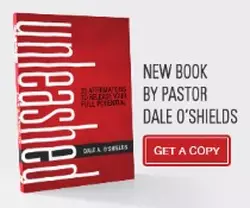
Positive changes happen in us when we know, believe, confess and obey God’s Word. When we agree with what God says about us, our minds are renewed, and our choices and habits improve. In this new book from Pastor Dale O'Shields, you will find 25 biblically-based affirmations that will help you think right about God, yourself, others and the world.
Past Episodes
- 10 Lessons for a Life of Significance
- 35th Anniversary
- 7 Things You Need To Know About Your House
- re:MIND
- think.thanks
- A Big Christmas
- A Life That Works
- A Timeless Christmas
- Amazing Grace How Sweet The Sound
- Are you ready ?
- Faith +
- Family Matters
- Fathers Day
- Fear Less
- Fear Not
- Forward
- Fresh
- Friend
- Friends
- From Me to We
- FruitFull
- Hallowed Be Your Name
- Heart Check
- Heaven HOPE Us!
- Heaven to Earth
- Help Is Here
- History Changers
- House Builders
- How to Stay Sane in a Crazy World
- How’s Your Love Life?
- I Have Decided
- I Want A Happy Family
- I Will Go Deeper
- I Will Grow Stronger
- I Will Not Settle
- I Will Overcome
- I Will Reset
- It’s Time to Change Your Mind
- Raising Resilient Kids (and Adults)!
- Real Deal Faith
- Reasons To Believe
- Recover
- Relate
- Renew
- Resolve
- Restored
- Rise
- Road Trip
- Rudders and Routes
- Runway
- Take Hold
- Talk To Me
- Teach Us To Pray
- The Best Christmas
- The Call of Christmas
- The Gifts of Christmas
- The God of Miracles
- The Heart Of Christmas
- The Life of Worship
- The Pathway to Joy
- The Power of Personal Choices
- The Way Of Worship
- The Way To Pray
- Tides, Winds and Currents
- Turning Point
- Waymaker
- What If?
- What To Do When...
- When God Comes Down
- When Prayer Changes Things
- Who is Jesus?
- Whose Friend Are You ?
- Wise Up
- Wiser
- Worship 101

Video from Dale O'Shields
Featured Offer
Positive changes happen in us when we know, believe, confess and obey God’s Word. When we agree with what God says about us, our minds are renewed, and our choices and habits improve. In this new book from Pastor Dale O'Shields, you will find 25 biblically-based affirmations that will help you think right about God, yourself, others and the world.
About Practical Living
About Dale O'Shields
Dale O’Shields is the founding and Senior Pastor of Church of the Redeemer, a multi-cultural church that operates four campuses in Maryland, just north of the greater Washington, DC area.
Dale O’Shields is known for his relevant teaching style focused on practical application in people’s lives. His messages are regularly broadcast on radio and television. He is also the author of several books, devotionals and group study guides.
Dale O’Shields is a frequent conference speaker with a passion for leadership development and church growth. He has served as the Senior Pastor of a thriving local church for over 25 years. His heart to equip and encourage pastors and church leaders has led him to be a key founder of United Pastors Network.
Dale O’Shields has been involved in pastoral ministry since 1978, serving previously as Director of Campus Ministries and as an adjunct instructor at Regent University in Virginia Beach, VA. He and his wife Terry have two married daughters and seven grandchildren.Contact Practical Living with Dale O'Shields
Info@church-redeemer.org
Church Of The Redeemer
19425 Woodfield Road
(301) 926-0967