

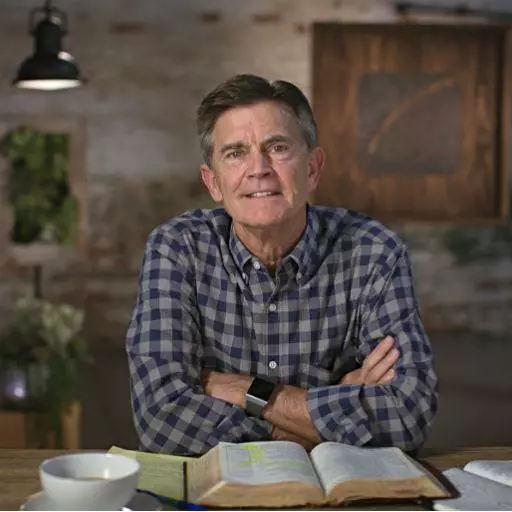
Understanding the Secular Culture, Part 2


Are you struggling to keep up with the trending worldviews and pop culture beliefs shaping our culture? Guest teacher Aaron Pierce offers a roadmap to understanding the primary influences and philosophies of young people today. Learn how seeing the world through their eyes can help you build deeper, more authentic connections.
Resources
Connect
- 888-333-6003
- Website
- Chip Ingram App
- YouTube
Partner With Us
- Donate Online
- 888-333-6003
Resources Mentioned in Teaching
- Nancy Pearcey - "Love Thy Body"
Guest Speaker Bio
Aaron Pierce is the International Mission Director of Steiger International, a rapidly-growing, worldwide mission organization that is called to reach and disciple the Global Youth Culture for Jesus. Steiger is active in over 100 cities around the world within the regions of Europe, Eurasia, Central Asia, the Middle East, East Asia, South America, Australasia, and North America.
Chip Ingram: Are you struggling to keep up with all the trending worldviews and pop culture beliefs that are out there? Do you want to have a meaningful conversation with a friend, or a child, or even a grandchild, but you don't know where to begin? Well, today we're going to help you connect with your kids and grandkids by seeing the world through their eyes and then knowing how to start the conversation. Stay with me.
Dave Druey: I'm Dave Druey, and this is Living on the Edge with Chip Ingram. In our last program, guest teacher Aaron Pierce began helping us understand just how much our culture has shifted. Today he's picking back up, showing us exactly what the next generation believes when it comes to where we came from, right and wrong, our purpose, and what happens when we die. It's eye-opening, and it's exactly what we need to understand if we're going to reach them in the ways that matter. So let's join Aaron Pierce with today's message titled Understanding the Secular Culture.
Aaron Pierce: First of all, in order to effectively communicate the gospel to a post-Christian culture, we need to understand three key realities. The first is that secular people have become suspicious of religious institutions and are far less likely to walk into a church. Trust and confidence in organized religion has plummeted in the last few decades.
The second key reality that we need to understand is secular people today do not have the same assumptions as previous generations. They don't have the same assumptions about morality, truth, the authority of the Bible, or the existence and nature of God. The third key reality we need to understand is that despite all of this, secular people are open to spirituality.
So these key realities are important because if we're going to be good missionaries to our culture, we need to understand the context that we're in and what's shaping and influencing the culture as well. What are the philosophical pillars? The first one is secularism. The idea here is that people are not necessarily atheist; they just believe that faith is private. You can believe whatever you want to believe as long as you don't push that on other people.
That naturally leads to relativism, that there is no absolute moral truth, and that morality is about preference. You have your favorites, I have mine; it's like an ice cream flavor. That leads to the idea and the value of acceptance. But then, actually, tolerance is not enough; you must affirm. It's based on the idea of being open-minded and this kind of authenticity and inclusion.
It's a paradox because basically, it's inclusion for all except the exclusive. That's the paradox that we find ourselves in where to tolerate someone and to love someone is not enough; we must actually affirm the way that they live their life. That is the message that you're going to hear in the global youth culture. What's interesting is all of these things in some way are just a twist on biblical truth. A lot of these things find their grounding in truth and then they're twisted.
It's interesting because in the post-Christian culture that we live in, we're still very much influenced by a biblical worldview, even if we've divorced ourselves from that. The fight for justice, even if it's twisted—like even those that are pro-choice—it's based on a framework of morality for them of protecting women. It's a moral framework that they're drawing on. That moral framework ultimately comes from a biblical worldview, which is there is a transcendent moral framework.
To give you an example of this post-Christian divorcing of the biblical worldview, a while back I was at a Caribou Coffee, and the barista had a pin on her shirt that said "Be human-centered." I asked her what that pin meant. She looked at me and said, "Oh, well, it means treat other people like you want to be treated and consider other people's needs above your own."
I listened to her say that and I was like, "Wow, that's awesome. Where did those ideas come from?" She looked at me kind of confused and she pointed at the pin. "This is where these ideas are coming from." It's so crazy because here she is literally quoting scripture, but she's completely divorced herself from that. That perfectly illustrates that post-Christian shift where we still hold to a biblical framework, but we've divorced ourselves from that.
By the way, it is an incredible opportunity because people connect with biblical truth even if they no longer hold that as an authority in their life. What I want to do now is show you a video of some people being interviewed on the streets of the University of Minnesota. We basically asked them four big worldview questions.
The first is origin: where did life come from, how did life begin? The second is morality: what is right and wrong and who decides? The third is purpose: what is the purpose of life? And the last is destiny: what happens after we die? The way that you answer those four questions essentially is your worldview. Let's take a look at how these young people answer those questions.
Guest (Male): How do you think we all got here? How did life begin?
Guest (Female): It started with the Big Bang. I don't really know much more than that.
Guest (Female): I believe in evolution and that we evolved from primates. I mean, there's proof that our DNA is 98% the same as chimpanzees.
Guest (Male): Probably just like a meteorite with some microbes on it that landed on Earth from a different planet and they eventually evolved to become humans.
Guest (Male): What is the purpose of life?
Guest (Female): Let me know when you figure it out.
Guest (Male): I'm still working on that one. Make your own. I don't think there's no grand purpose for anybody. There is no purpose; make up your own purpose and run with it.
Guest (Male): Help continue the evolution of human beings as a species.
Guest (Male): How do you think that right and wrong are decided?
Guest (Female): I think it's different for everyone depending on what they think is right and wrong because people believe in different things, so it can't be the same for everyone.
Guest (Male): That goes back to your morals. Your right can be someone else's wrong, so it's all based on your morality.
Guest (Female): I think that it depends on yourself and what you think is right and wrong and what you believe in. As long as you stick to your beliefs and carry out what the Bible says or what the Quran says or whatever, then you're living your life to the fullest and that's all that matters.
Guest (Male): What do you think happens after we die?
Guest (Female): I don't know. Isn't that kind of the beauty of it? There's a lot of people who are spiritual and have things in which they believe in, and so it's kind of a manifest of what you believe. I also feel like that is subjective because no one knows.
Guest (Male): Nothing happens and hopefully you lived your best life and if there is an afterlife, hopefully I lived within the boundaries to make it there.
Guest (Female): I believe in heaven. I don't know if I believe in hell. I think that if you want to believe in hell, then you'll probably go to hell.
Guest (Male): Rather than being showered with gold and jewels or living in some place where you have to have wings and a harp, hopefully we just get reabsorbed into that consciousness that allows the oceans to move and the tides and the rivers and the trees to grow. Maybe there's nothing. Either way, it doesn't matter.
Aaron Pierce: Pretty interesting, right? Here's my first challenge to you: when you see that, there's a tendency to want to laugh, when really we should cry. This isn't just some fringe group of people that see the world in a weird way; this is the predominant way that people see the world.
I just want to summarize essentially what it is that the global youth culture believes. When it comes to the origin of Earth, you're going to hear scientific answers for how the Earth came to be, but then we're also drawing in Eastern religious energy and this idea. So it's a combination of a naturalistic worldview combined with this vague spirituality that we talked about.
When it comes to morality, if you ask the average person, they're going to say that morality is essentially a social construct. But then, social injustice must be fought with passion. So you've got this weird combination of a social construct morality, but yet a sense of obligation to fight injustice.
Purpose? There is no purpose other than to seek personal happiness. That is the ultimate expression of purpose. Then destiny? The answer is essentially, "I don't know and I try not to think about it," because it's a scary, deep implication. The cold-hearted atheistic answers aren't very satisfying, so what I do mostly is not think about it. When it's late at night and I'm sitting in bed and I can't fall asleep and these dark thoughts come to my mind, I just pull out my phone and I start to scroll TikTok because I don't want to think about the big, deep, scary thoughts.
So this tends to be the worldview of this global youth culture. It all comes down to this idea of secular humanism, which is the religion of self. The idea of secular humanism is that God has been replaced, man is at the center, and there's no outside authority that can tell me how to live my life. The key to happiness is found within. Just follow your dreams and don't let anyone tell you who you are or what you want. Take care of yourself above all else.
It's the era of "my truth." In the era of my truth, identity, purpose, and morality is personally constructed. We define those things; you make your own meaning. If you pay attention, you see this messaging everywhere. This was at a Starbucks, and it's a poster that says, "Don't you ever let a soul in the world tell you that you can't be exactly who you are," and it's quoting Lady Gaga.
This perfectly illustrates the secular humanistic worldview. It's really appealing and it sounds so good. The reality is that the consequences of this worldview are heartbreaking. It's like poison wrapped in bubble gum. That's the secular humanistic worldview and if you pay attention to it, you see that the consequences are so heartbreaking.
Nancy Pearcey, who has written a number of good books on apologetics including *Love Thy Body*, which is about Christian sexuality, says once a society accepts a worldview, it tends to work out the logical consequences. Let me give you an example of this. A while back, a non-Christian friend of mine from high school posted on social media that his son, who is about the same age as my oldest son, had been diagnosed with brain cancer.
When I saw that post, it broke my heart because I couldn't imagine the fear and the pain that he was going through with his little boy being diagnosed with brain cancer. I began to read the comments on his post, and he was getting things like, "Positive vibes," "Sending healing vibes his way," "Sending you all positive vibrations and much love." Eventually, he responded, "Thank you, everyone, for the supportive words of concern and positive energy you have expressed for my son, Peter."
I couldn't help but think about how hopeless that all sounded because in the secular humanistic worldview, there is no transcendent hope, just positive vibrations. It's devastating. We live in a culture and in a generation that is incredibly confused, sexually broken, lonely, anxious, and depressed. I mean, these are universally felt in this culture and in this generation.
In a world where you define truth, what you get is confusion. In a world in which you do whatever makes you feel good, you get sexual brokenness. When it's all about you, you get loneliness. When there's nothing to hold onto besides yourself, you get anxiety.
The saddest thing of all is that we as followers of Jesus have the ultimate answers to these things. Jesus brings truth to the confused. He brings healing to the sexually broken. He brings the ultimate relationship with our Creator and with the church, and He brings peace that transcends understanding. We have the answer to the cry of a generation, and the sad thing is they are not looking to the church for answers. They're not walking into the church.
Our response is that we need to go to them and our hearts need to break because this isn't a distant problem. This isn't "out there." This is personal. These aren't just trends and statistics; these are our friends, sons, daughters, and grandkids. When we hear this, our response should be like that of Nehemiah. After he found out that the city of Jerusalem was ruined, in Nehemiah chapter 1, verse 4, he said, "When I heard these things, I sat down and wept."
That should be our response because until our hearts are broken, we're not going to do anything about it. To the extent to which our hearts are broken is the extent to which we will sacrifice, that we will get uncomfortable, that we will lay down our needs and our preferences for the sake of the lost. We need our hearts to be broken.
But we can't change our hearts. That's only something God can do. So what we can do is we can repent and we can say, "God, my heart is cold. I don't care for people like I should and it's not right. I've even gotten apathetic about people in my own family. I'm sorry. Would you forgive me and would you give me Your heart?"
When you start to pray that prayer, it's a dangerous prayer because all of a sudden, you're going to start to see the world through God's eyes and you're going to start to see people, maybe for the very first time. When He gives you that broken heart, then you're going to be willing to get uncomfortable, to be awkward, to take a step of faith and risk because your heart is so broken and God has awakened us from our apathy.
Once our hearts are broken, then we need to pray like never before. We need to go on like Nehemiah, which says that for some days, he mourned and fasted and prayed before the God of heaven. Biblical scholars estimate that Nehemiah actually prayed and fasted for four months before he eventually approached the king. The question is why would Nehemiah pray and fast so long and with such intensity? It's because when God opened his eyes to the problem, he knew that he couldn't fix it on his own.
Like Nehemiah, we need to recognize that the mission that we're called to, to bring the love of Jesus to people that are far from Him, is not hard; it's impossible. Which means that no human strategy, no evangelism script, no approach is ever going to be enough. I can't even solve the problems in my own family. But we need to understand: while the mission may be impossible, we serve the God of the impossible.
When we get on our knees in desperate prayer and cry out, "God, have mercy," that's when we're going to see the breakthrough. That's where this all starts. The foundation for reaching secular culture, for reaching young people in our families and in this world who will not walk into a church, is desperate prayer and a broken heart. That's where it all starts.
Not using the right words or having the right script; it starts with a broken heart. I don't know about you, but I look around the world and all its brokenness and I can be overwhelmed. We need God to move. Our human efforts and wisdom are so woefully inadequate. We need God's supernatural power.
First Corinthians 4:20 says the kingdom of God is not a matter of talk but of power. The amazing thing is that God loves to move through ordinary people. But to experience God's power like that, we've got to give Him everything because Jesus is not calling us to give a lot; He is calling us to give everything.
First Thessalonians 2:8 says, "We loved you so much we were delighted to share with you not only the gospel of God but our lives as well." That's what it's going to take. We've got to change our lifestyle. It's a radical shift in lifestyle where we give everything that we have. The paradox of Jesus is that when you give your life, you find it. That's the paradox of Jesus. When you give all that you have, your five loaves and your two fish, which is not enough, He can take that and He can do the supernatural. He can see that hardened heart, that person in your life that wants nothing to do with God; He can see their heart softened and awakened to the reality of Jesus. He can do the supernatural. All we have to do is give Him everything that we have.
Dave Druey: Aaron Pierce has been our guest teacher today here on Living on the Edge with a message titled Understanding the Secular Culture. It's part of a larger series we've begun called Caring Enough to Connect: Building Bridges to Those We Love. Now, if you missed any part so far, be sure to catch up anytime at livingontheedge.org.
What Aaron shared with us today is just a taste of what you can explore for yourself in the "Not Beyond Reach" participant's guide. It's a 10-week video-based study that will help you and your small group understand this generation's worldview, start real spiritual conversations, and carry the hope of the gospel into homes that feel far from church. Each week includes a viewing guide, discussion questions, a practical application, and interactive group exercises. You can get the Not Beyond Reach participant's guide at a discounted price right now by going to livingontheedge.org/offers.
Every single day, somebody out there is asking the same hard questions we explored in today's program. And that's exactly why this ministry exists: to share biblical truth with those who need it. This ministry's work only continues because of listeners like you who choose to help keep it going with their financial support. Wherever you're listening from today, we've made it easy for you to donate online. Simply go to livingontheedge.org or call 888-333-6003. You can also send your gift by mail to Living on the Edge, P.O. Box 3007, Savannah, Georgia 30025.
Now let me hand things over to our regular Bible teacher, Chip Ingram.
Chip Ingram: Thanks, Dave. Today I've asked Aaron to join me in studio. Today you referenced the man-on-the-street type interviews, and you did these with college students and you asked them questions like, "What's your purpose?", "How did life begin?", and "What happens after we die?" These are some pretty deep philosophical questions. But afterwards, you made this really interesting statement: our natural instinct is to laugh at some of those answers when, in reality, we should cry. Let me ask you this: what do you say to that parent or grandparent that's just befuddled by their adult child or grandchild that believes some things that they just think, "This is nuts, this is crazy"? Talk to that person about why they need to build a bridge rather than laugh.
Aaron Pierce: Chip, this is such an important question because I think we need to remind ourselves that the problem that we're dealing with is not first and foremost an issue of logic or rationality, but in fact we're dealing with a spiritual blindness issue. So if I were to point at a wall but you're blind, it doesn't matter how clearly I point at it; you can't see it. In the same way, we need to remind ourselves that we are in a spiritual battle, that the fundamental problem is spiritual blindness, and that should break our hearts.
Then it should remind us that we can't fight a spiritual battle with words alone, with persuasive arguments; we need God to move in a supernatural way for Him to reveal the truth in a way that our words alone can't do. So that's why I say we should respond not with laughter, but with crying, because this is a generation that is spiritually blinded and has been deceived.
Dave Druey: Next time, Aaron Pierce shows us how to build real friendships with the secular people in our own lives. Listen next time to Living on the Edge. Today's program is produced and sponsored by Living on the Edge.
Featured Offer

Build Lasting Connection
Love is a decision, not a feeling. Get practical tools to love your family, friends, and neighbors well.
Past Episodes

Featured Offer
Build Lasting Connection
Love is a decision, not a feeling. Get practical tools to love your family, friends, and neighbors well.
About Living on the Edge
About Chip Ingram
Chip Ingram's passion is to help Christians really live like Christians. As a pastor, author, coach and teacher for more than twenty-five years, Chip has helped people around the world break out of spiritual ruts and live out God's purpose for their lives.
Chip is the author of eleven books and reaches more than one million people each week through online, radio and television outlets worldwide. Chip serves as CEO and Teaching Pastor of Living on the Edge, an international teaching and discipleship ministry. Chip and his wife, Theresa, have four children and twelve grandchildren.
Contact Living on the Edge with Chip Ingram
info@lote.org
http://livingontheedge.org/
Mailing Address
Living on the Edge
PO Box 3007
Suwanee, GA 30024
(888) 333-6003