

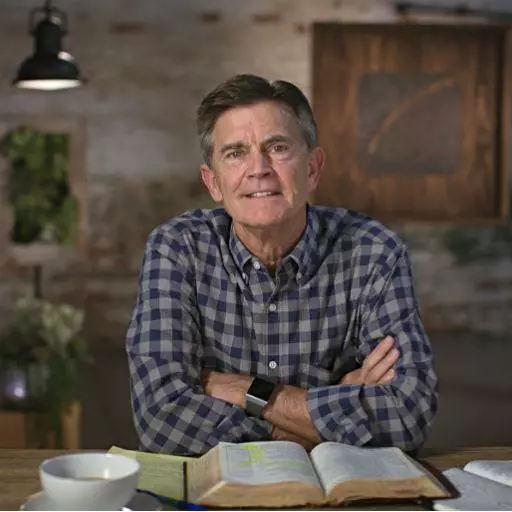
Managing Your Finances Together, Part 1


One of the biggest sources of conflict in marriage revolves around money. It’s really hard to get on the same page, especially when one person’s a spender and the other’s a saver. In this program, Chip tackles the most universal habit we all need to learn: how to manage money. Don’t miss how you and your spouse can biblically handle your finances together.
Chip Ingram: One of the biggest problems and sources of our biggest arguments in our marriage was about our finances. We just couldn't get on the same page when it came to money and budget and where it went. Do you have some financial struggles with your mate and want some help? Well, if that's you, stay with us. That's today.
Dave Druey: Welcome to Living on the Edge. I'm Dave Druey. And today, Chip Ingram tackles the number one source of conflict and divorce in America: money. But here's what most couples miss: financial problems are rarely about the money itself. They're symptoms of deeper issues: different values, different priorities, different backgrounds.
In our series "Choosing Love," Chip returns to Colossians chapter 3 to show how biblical principles transform not just how we handle conflict, but how we steward everything God has entrusted to us. Here's Chip Ingram with today's teaching, "Managing Your Finances Together."
Chip Ingram: If you'll pull out your notes, skill number four is how to biblically manage your finances together. The number one source of conflict and divorce in America is issues and problems around money. And really, it's the symptom as we learned. It's different values, different priorities, different styles.
Almost every marriage has a spender and a saver. Different family backgrounds. Your whole view of money, wealth, spending, saving, investing, risk. You grew up in a family and it's in your thinking, it's in your nerves, and you just have preconceived ideas about those things. And then some of you, because of circumstance or situations, entered your marriage with debt or challenges or have had huge hardships that have created financial problems.
All I'm saying is all that does is this: it creates incredible pressure. Just incredible pressure. And incredible pressure brings things to the surface where, because we're human, we figure out primarily how to blame the other person. Okay, you still have your passage? We're still in Colossians 3:12 through 17.
So in context here, it says as those who have been chosen of God, holy and beloved, put on a heart of compassion, kindness, humility, patience, bearing with one another and forgiving each other, whoever has a complaint against anyone, just as the Lord forgave you, so also should you. Beyond all these things, put on love, which is the perfect bond of unity, and let the peace of Christ rule in your hearts, to which indeed you were called into one body, and be thankful.
The very first line says this is how God sees you, this is who you are. What I just read after that is this is what we're to do in our relationships. And then notice verse 16 is a resource: "Let the word of Christ richly dwell within you." How? With all wisdom. That means at the right time, at the right way, sharing it for the right purposes, teaching and admonishing one another.
Well, how? With truth, psalms, hymns, spiritual songs. And then this idea of regardless of our circumstance, singing with thankfulness in your hearts to God. And then in verse 17, he's going to say this is how I want you to behave: "Whatever you do in word or deed..."
Now just pause for a moment. Can you think of anything that's outside of word or deed? Thought. That's good. "Whatever you do in word or deed, do all in the name of the Lord Jesus, giving thanks through Him to God the Father."
The command here is that all of our words and all of our actions are to be done in Jesus' name. And in Jesus' name simply means two things: it means you do it as a representative of Him. So I'm speaking or I'm behaving or I'm acting as His representative. And it also has the idea of being empowered by Him to speak whatever He wants you to speak or to do whatever He wants you to do.
The two most accurate mirrors of our heart and our lives are our words and our money. "The good man out of the good treasure of his heart," Jesus said in Luke 6:45, "brings forth what is good; and the evil man, or the evil woman, out of the evil treasure brings forth what is evil; for the mouth speaks from that which fills the heart."
If you ever want to know where you're at, the MRI of your soul—I mean, I can intend, I can think, I can lift my hands, I can sing, I can say I love God, but my words... my words reveal what's really in my heart. And that's why our speech is so important. And so anytime that's true, the other thing is your words—you can go into training so that you deal with issues so that what comes out of your mouth reveals what you want to be in your heart.
The second greatest revealer is our money. Jesus said, "Do not store up for yourself"—underline in your notes if you would, "for yourself"—"treasures on earth, where moth and rust destroy and where thieves break in and steal." Why? Why would He say that? He doesn't want you to have nice things? He wants to keep something from you? What's true about moth, rust, and thieves? They can take it away. In other words, it's vulnerable.
But store up—now underline again, will you? "For yourself." This is for your benefit. "Treasures in heaven, where neither moth nor rust can destroy and where thieves do not break in." And then here's the purpose clause: "Why? For where your treasure is, there your heart will be also."
Wherever—if you want to know—I mean, if you really wanted to know, Lord, how am I really doing from heaven? All pretense, what anyone else thinks, in my own denial, in the deceitfulness of my own heart, if I really wanted to know, where am I really at? If I took a tape recorder and listened to my words for a week and then sat down and listened to it—the tone of voice, the anger, the sarcasm, the hurt, the swearing, the thanks, the praise—I would get a really good idea of what's in my heart.
That would be a pretty challenging thing to do. A little bit easier way—if you would take all your financial statements, all your credit cards, and see where all your money was spent in the last year or two years or three years or four years, what you saved and why you saved it, and where you gave money, both formally and informally, it would tell you more about your life than almost anything you could imagine. Because wherever your treasure is, that's where your heart really is.
That's why Jesus talked more about money than heaven and hell combined. He doesn't need or want our money. In fact, I bet I was a pastor for ten years and I thought life was like this: there's Jesus, right? There's the Godhead, and then there's the enemy, Satan. That's not what the Bible teaches.
Jesus says there's two gods: there's God and there's Mammon. Wealth, greed. Money promises to do everything. Money promises to protect, provide, make you a someone. Jesus said, "This is one god, this is the other god." Satan is just the enemy to get you to believe that that will deliver.
And the world system is created to tell you your possessions, your power, your fame, what you can buy, what people think—that makes you a somebody. So Jesus says money isn't neutral. He says it's powerful, it's deceptive. It's not bad in and of itself, but it's the other god. And so if you want to know what's going on in your life, or if you want to direct your life, money is a revealer.
Let me give you a very brief overview of biblical finances. And I mean, I'm going to go really quick. And I'm only giving this because this is the context in which I'm speaking, and it's the context in my experience most Christians don't have. Money is sort of like a side thing over here. It's a problem to deal with. It's like we know we need some money.
Or the matter of giving is sort of like maybe there's some law and I'm supposed to give 10% and either begrudgingly or semi-begrudgingly. It's like paying a bill and I should do that because I was taught to. And the whole teaching of generosity in your heart and the purpose and how money fits into the development of your spiritual life in my experience is often missed.
So what the Bible teaches in a quick overview is that God owns it all. "The earth is mine," Psalm 50, "and the fullness thereof." Every good and perfect gift, James, comes from God. Second, we're stewards, managers, and trustees, Luke 16. You don't own anything. You don't have a car, you don't have a home, you don't have any investments. You don't own anything. It's 100% Him.
"What do you have," the Apostle said, "except what you have received?" And so my money, my house, my investments, my wife, my children—I'm a steward. And a steward or a manager is someone who is entrusted with certain things to make good use of them for their master.
That changes your whole world. That means, okay, the market goes up or the market goes down, Lord, you're losing a lot of your money right now. We laugh. People have been jumping off of buildings and off of bridges. Anxiety, depression, fear, overwhelmed.
The American view of money... we are living the last 50 years, 70 years, we're living in America with a level of affluence that only the greatest kings in all the world ever experienced historically. And yet in this affluent world, we have more anxiety, more suicides, and more problems than I could take you to multiple third-world countries where they have very little and the people are very happy and no one's taking drugs.
The most recent research... now by the way, when you're in abject poverty or you're really poor, there's financial issues. Does money solve all your problems? No, but it sure helps. And what the secular researchers say is that basically right up to about $75,000 to $85,000—if you're below that in the current economy, if you get in about that area and without debt, money really helps. And all the dollars after that is sort of diminishing returns in terms of quality of life.
The saddest, most miserable, most problems in families in all my life have been the wealthiest people that I know. Why? Because money can't solve the problems. In fact, it creates incredible entitlement, lack of responsibility. We'll give an account for our stewardship.
God, according to how He's made you and purposes, has given us all different talents, different resources. And I'll give an account of what I do with His money, what I do with His time. I added a card for years that I wrote down. I do this thing a lot with my thinking. I mean, I really believe as a man thinks in his heart, so he becomes. The mind set on the flesh, death; the mind set on the Spirit, life and peace. Set your mind on the things above.
I'm absolutely, I mean, I'm like over the top on, boy, what comes into my mind, there's a huge filter and what I put into my mind, because life change happens not by behavior or emotions or trying hard. Life change happens first and foremost, you renew your mind. And as you think differently, all of a sudden that's not a temptation because it doesn't look very good. You think differently and emotionally things change.
Because the news is like poison. And the more and more I watch of news and people being blown up and these people hate these people and those people hate... then what it does is it creates all kind of things inside. And so I keep aware of what's going on, but I've got to be real careful about what I let in my mind.
And then what I know is that when I struggle with areas, I've got to change my thinking. So coming from my background, giving away money and being generous did not come naturally. And so I had a card that I wrote: "Lord, I desire to be more generous with my time and my money this year." And I would just read it over, and just read it over, read it over, read it over, read it over.
And I just found there were opportunities, they were probably always there, but I noticed them. And I'd be a little bit more generous and then a little bit more generous. And then I reviewed that card for like five years. And then I was studying and I just realized that's not accurate. That's wrong, Chip.
So I put an X through the card in certain places: "God, I desire to be more generous with your money and your time this year." And that's what I just realized is whatever I've got in my pocket, whatever I've got in the bank account, whatever kind of car I drive, whatever I have, it's yours and I'm going to give an account for it.
Money is powerful and deceptive. Mark 4, you know the parable of the seed and the sower? The seed is God's word, it goes into the earth. The hard soil, Satan takes it away. The shallow soil, it grows up but persecution and difficulty fades away. The thorny soil, it grows up and then the desires of this world and the deceitfulness of riches choke out God's word.
By the way, the deceitfulness of riches. You do understand the word deceit means this: when you're deceived, you don't know it. And the subtlety in deception of money is it takes you down a path. It's like being in water where you go out, if you've ever been at the beach, and you're having fun and you've got the sand.
And if you have a family, you've got a couple kids here and you've got the blankets and you're going to have lunch and stuff. And they go out and play, and you're playing, and you're playing, and you're playing. And nothing happened but the current's doing this and you look up and you realize, "My lands, how did we get down? Where's Mom and Dad?" That's what happens to us with regard to money.
Money is the other god according to Jesus. We can't serve both. Matthew 6. Giving is God's antidote to greed and the dangers of idol worship. We're commanded: "Instruct those who are rich in this present world"—and biblically that's all of us—"not to be conceited or fix their hope on the uncertainty of money or wealth."
Notice that's the reason. Because it's uncertain, He wants to protect us. "But fix their hope on God who richly supplies us with all things to enjoy." In other words, when your priorities are right, when it comes from God, He's gracious and kind and loving. So you're not overwhelmed in the debt. You're not compensating by buying things or going places you really can't afford.
Your priorities are right, and He says don't fix your hope here on the one hand so you want to be generous and be wise. And then when He blesses, you don't have to say, "Well, the reason we have a swimming pool is we're doing baptisms for the youth group." Or, you know, that mission trip that we're taking to New Zealand and Hawaii... you know what? If you want to go to Hawaii and the Lord has blessed your life and your priorities are in order, here's what you ought to do: enjoy it.
If God gives you a swimming pool and your priorities are in order and He's led you in that way, and maybe it's especially great for the season of your kids, why don't you enjoy it? But what we do is we play lots of games. God wants us to richly enjoy all that He's given us and at the same time realize that thing, that wealth, that idol wants to take over your soul.
Debt is dangerous and to be avoided. I think the best counselors I know say it's not wrong to have some debt, appreciable items. It's way better not to have any. And we're to be accurately aware of our financial condition. Now this would be interesting... I will not do this because I would not want to embarrass anyone. But if I could, if you all lined up and I could meet with couples, couples, couples, couples, and then I would just, okay, separate, earphones so she couldn't hear, he couldn't hear.
And I would ask the man: in general, how much debt do you have? How much money do you have in savings? How much is on your credit cards? How much short-term, long-term, or any investments that you have? I mean, just a ballpark, I don't want the exact numbers, but you are aware of basically your finances.
What I would find in most couples, one person would have a vague idea and the other would be like, "He takes care of all that" or "She takes care of all that." Or they would both fumble around a lot and not have a very accurate... the Bible says know well the condition of your flock.
You need to know: this is our level of debt; currently right now, this is how much we've set aside for an emergency; this is a fund that we've developed for we're saving for the next car that we're going to buy because we want to pay cash; this is what we're doing in terms of long-term and investment or retirement. And you kind of know where you're at.
And by the way, your body language... I'm talking really fast. I'm going to pause for a minute. The reason you're feeling the way you're feeling is because of the deceitfulness of riches. Do you realize 50% of all the people that graduate from college—I read a statistic—file bankruptcy? You go to college, they give you a t-shirt, here's a credit card.
But by the time they're out, there's literally, we have a whole generation, some Christian, some non-Christian, that they think this is money. I remember one of my grandkids, we were taking him out for something and we're having a pizza or something like that. They were six, seven, eight, nine, ten at the time. And we were here and, "Oh, do you want to get something like that?" I said, "Oh, I don't have my wallet," and I said I don't know what to do.
And one of my grandkids says, "Oh, just use one of those cards!" In other words, it wasn't... you don't need money. There was no connection between money and a card. But here's... okay, now I'm going to be really gentle here. If you want to get hold of your life, if you want to get hold of your values, if you want to get hold of your future, you have to get hold of your money and your time and your thought life.
Dave Druey: You're listening to Living on the Edge with Chip Ingram, and we'll continue in just a moment. Today's teaching is available for listening anytime over on our website, livingontheedge.org. Whether you want to listen again or share it with someone who needs encouragement, you'll find this message and hundreds more online. Plus discover small group resources and practical relationship tools designed to help you choose love daily. Check it all out at livingontheedge.org.
Now let's get back to Chip's message. Want to go deeper into what biblical love really means? Chip's newest book, *I Choose Love*, is your next step. Here's the core truth: love isn't something you stumble into, it's something you choose. Drawing from Philippians chapter 2, Chip unpacks agape love, the kind God has for us.
This love isn't based on feelings that come and go, it's rooted in sacrifice, in deliberately choosing another person's best interest above your own. *I Choose Love* shows you how this transformative love operates: how it gives without counting the cost, serves without resentment, and cares beyond what's convenient. When you understand and practice agape love, it revolutionizes your marriage and every other relationship you have. Get your copy today at livingontheedge.org.
And friend, this teaching exists because listeners like you believe God's Word changes lives. When you support Living on the Edge, you're helping couples move from financial chaos to biblical stewardship, from constant arguments to united purpose. Your partnership makes that possible. Will you give today? Visit livingontheedge.org to give, or call us at 888-333-6003. Even easier, use our mobile app. Just click on the heart icon and follow the instructions. And don't miss the Chip Ingram Sermon Podcast, a new feature where you can hear Chip's complete unedited messages. Just subscribe to the Living on the Edge podcast on your favorite podcast app. Well, now here's Chip.
Chip Ingram: For years as a pastor, I have to tell you, I thought that it was God against Satan. Jesus didn't teach that. He says that there's two gods: there's Him and there's money. And Satan is evil and he uses money and multiple other things to try and lure or seduce us away from our relationship with Jesus Christ.
Now money isn't necessarily evil in and of itself, but the desire for to become rich... money promises security and significance and that's why it's the other god. And so it's not neutral. It's powerful because money reveals your values. Money reveals who is really the Lord of your life. You want to know what's really going on inside your heart, in your soul? It's not about the words that I say or lifting my hands when I sing a song or having a warm feeling towards God.
My money reveals where my real treasure is, who my real Lord is. And so that's why it's so critical as a couple to get on the same page. Lesson number one—and this is hard—God owns it all. "I am the Lord, that is my name," right? "The earth is mine, and the fullness thereof. All things are by me and for me and through me."
So the question is not what do I do with my money or even my time or my house. It's "Lord, what do you want me to do with the money that you've entrusted to me, with the time entrusted to me, with the resources or house entrusted to me?" There's these open hands. And that's why giving is the antidote to greed.
God doesn't want us to give because He needs it. He wants us to give because we have to constantly attack this god of money. And so this is why it's so critical as a couple to say, "Let's study what the Bible says about money. Let's not allow any idols to get into our lives." And you know what? It's so easy too to blame your mate.
"Well, she does too much shopping," or "He plays too much golf," or "All he wants to do is put money into cars and hobbies and this and that," "All she wants to do is fix up the house." Ask yourself: how much is coming in, what is our level of debt? And in our next broadcast, I'm going to walk through—I mean, a nuts-and-bolts approach to help you get a handle on your money so you can get a handle on your life.
Dave Druey: God or money. You can't serve both. Tomorrow, Chip Ingram explains why getting control of your finances is really about getting control of your heart. I'm Dave Druey, and we'll continue "Choosing Love" tomorrow on Living on the Edge. Today's program is produced and sponsored by Living on the Edge.
Featured Offer

Uncover Your God-Given Gifts
The Real You functions like a "spiritual DNA test," designed to help you uncover your gifts, talents, and unique purpose in the world.

Featured Offer
Uncover Your God-Given Gifts
The Real You functions like a "spiritual DNA test," designed to help you uncover your gifts, talents, and unique purpose in the world.
About Living on the Edge
About Chip Ingram
Chip Ingram's passion is to help Christians really live like Christians. As a pastor, author, coach and teacher for more than twenty-five years, Chip has helped people around the world break out of spiritual ruts and live out God's purpose for their lives.
Chip is the author of eleven books and reaches more than one million people each week through online, radio and television outlets worldwide. Chip serves as CEO and Teaching Pastor of Living on the Edge, an international teaching and discipleship ministry. Chip and his wife, Theresa, have four children and twelve grandchildren.
Contact Living on the Edge with Chip Ingram
info@lote.org
http://livingontheedge.org/
Mailing Address
Living on the Edge
PO Box 3007
Suwanee, GA 30024
(888) 333-6003