

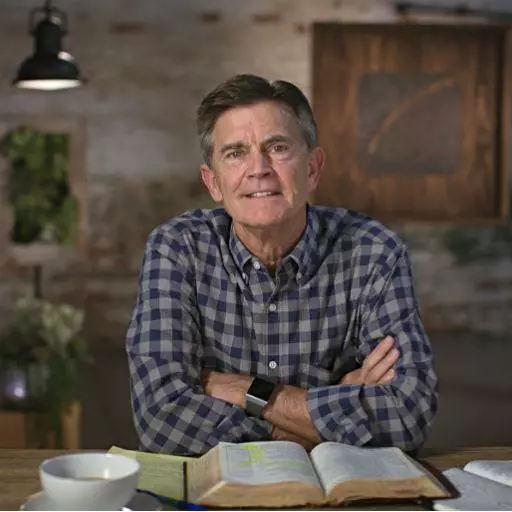
Connecting Their Story to the Gospel, Part 2


God’s Word is clear that believing in Jesus is the only path to genuine salvation. Guest teacher Aaron Pierce, from Steiger International, shares practical ways to discuss the Bible with those who don’t recognize it as absolute truth. Learn how to bridge the gap and share the message of the Gospel with clarity and compassion.
Resources
Connect
- 888-333-6003
- Website
- Chip Ingram App
- YouTube
Partner With Us
- Donate Online
- 888-333-6003
Resources Mentioned in Teaching
- Tom Holland - "Domnion"
Guest Speaker Bio
Aaron Pierce is the International Mission Director of Steiger International, a rapidly-growing, worldwide mission organization that is called to reach and disciple the Global Youth Culture for Jesus. Steiger is active in over 100 cities around the world within the regions of Europe, Eurasia, Central Asia, the Middle East, East Asia, South America, Australasia, and North America.
Dave Drury: Today on Living on the Edge with Chip Ingram.
Guest (Male): The gospel is absolutely clear. It is the power of God to salvation. But how do you share Jesus in a post-Christian society? Actually, in an anti-Christian society. What are some ways that we can talk about the truth of the Bible with someone that doesn't believe the Bible is the truth or even relevant? We're going to tackle these tough questions today. Don't go away.
Dave Drury: I'm Dave Drury, and this is Living on the Edge. Today, Chip Ingram invites us to hear from guest teacher Aaron Pierce, who's spent decades reaching secular, unchurched communities around the world through his ministry, Steiger International.
In today's message, he walks us through how the Apostle Paul modeled contextualized evangelism in the city of Athens, found in the book of Acts. Winning over a whole crowd of skeptics without ever leaning on scripture as proof.
Through this powerful example, we'll see why our own story might be the most powerful tool we have. Well, now here's Aaron with today's message titled, Connecting Their Story to the Gospel.
Guest (Male): This session we're going to be talking about how do we introduce Jesus and the message of the cross to non-religious people and then start a discipleship relationship.
The first point in all of this is that we need to remember that our only hope for this world is Jesus and the message of the cross. Now, in all of this, we're communicating the message, but that doesn't mean we don't want to do it in a contextual way, in a way that connects. How do I communicate Jesus and the message of the cross that will connect with people I'm talking to? Goes back to understanding what are the false assumptions that they have about it? How do I challenge those? How do I remove those things so they can really see who Jesus is?
And the thing about contextualization is it's not about popularity or compromise. It's not about being loved, it's about clarity, right? When I communicate in a relevant way, in a contextual way, then I'm understood.
And as we know from reading the Bible, reading the book of Acts, that doesn't mean you're going to be loved. I mean, Paul experienced riots, Jesus was crucified. You know, the message is not always going to be loved, but it's going to be understood.
And that's what we want because there's nothing worse than communicating but no one's reacting because they don't even get it. Like what's the use in that? And frankly, a lot of our gospel scripts are based on scripture that we share as if that is going to say, ah, okay, because the Bible says it, therefore. And the the reality is we have to understand that for a lot of secular people, the Bible is not an authority. Many of them question it. They they question, you know, how it came to be and also what it says. I can't assume that when I use scripture, somehow that's an argumentative proof, right? It's not. And so part of that is we need to understand how culture sees the Bible. So take a look at these guys.
Guest (Male): So when they say the word Bible, what does it mean to you? What comes to your mind?
Guest (Male): I don't know, it's something that I feel like gets talked about a lot and people reference it a lot without reading it.
Guest (Male): When I think of Bible, I think there's a lot of things that are really outdated now in the Bible. So I, I think I tend to have more of a negative view that way just because of the way they like talk about slavery or like gays or women in the Bible. I think a lot of it's pretty outdated and it doesn't really apply now, but
Guest (Male): I'd say a moral base that you can, you could build your life around and for some people that's good. But like, it's not something to be taken literally or anything.
Guest (Male): Stop there. Good communication is about knowing people's assumptions. And so if I'm talking to someone that takes the Bible seriously, then I can use it as an authority, but if I'm talking to someone who doesn't, I can't. And so here's the challenge or the principle or the way to go after it, is that we can leverage the truth of the Bible that is experientially verifiable, right?
So we can even say, hey, the Bible says this, but we can connect that to something that they experientially feel to be true. And so often that means using scripture in a in a different way. So I'm going to show you a video. This is another one of our Is There More spiritual conversations videos in which we basically begin to draw on scripture, but not doing it in an authoritative way, but in an experientially verifiable way. So take a look to to give you the example I'm talking about.
Guest (Male): It seems like the most self-destructive, suicidal people in our culture are celebrities. Does anyone actually get to the point where they finally have enough? It seems cruel to have a hunger this world cannot satisfy. But maybe this is trying to tell us something. Thousands of years ago, there was a king named Solomon. He was the richest, the most powerful person in the world. And yet when it was all said and done, he said this. I have seen all things that are done under the sun. All of them are meaningless, chasing after the wind. Maybe that's our problem. We are stuck looking under the sun. Could it be that we aren't finding satisfaction in this world because we were made for more? Our science teachers tell us that we are the result of the Big Bang and evolution. We live in a purely material world, and all of us one day will be gone. But what if that's not true? Consider whether God made you and I and everything around us, and that our deepest desires are satisfied only by knowing him. Now, I can't tell you what to believe. But from what I've seen, until we look beyond the sun, we are left with what's under it. And like Solomon, sooner or later, we'll realize that no matter what we get, it will never be enough.
Guest (Male): So you see how scripture was used there in a way that it's experientially true, right? Like I know that's true. And so it's drawing on on the the authority of the truth of the Bible without saying, hey, the Bible says it, therefore it is. And there's a lot of biblical uh basis for having this approach. The Apostle Paul was an a brilliant example of this, right?
In Acts 17, he's in Athens. And he's speaking to these these sophisticated Athenians who have all these different gods and they're very intellectual, and he uses, he he communicates the gospel without once referencing scripture. And you contrast that to Acts 13 when he's speaking to these to these Jews in a synagogue and he uses scripture to defend and make the case for the gospel. So he knew his audience. He knew what connected.
So if you read Acts 17:23, 24, what you find is first thing he does is he compliments. Remember we talked about affirming truth that people have, even if they don't know that that truth is biblical. So we look for ways to affirm truth that people have. So he compliments the Athenians on their interest in the gods. That's a that's a good thing because they desire something beyond themselves. They desire the supernatural. And in and in fact, often you can find that today where people desire spiritual things and you can affirm that in them. So that's what Apostle Paul does.
The second thing he does is that he begins to reference their culture and their context. And he begins to speak truth from their context. And he references an unknown God, right? And he quotes one of their poets. Like today that's like taking a pop song and taking lyrics and using that as a way to connect with someone. Right? So he was he was very intimately aware of their culture, their context, and he drew on that to speak the truth, right? And then he summarizes the whole biblical account of creation without referencing Genesis. He doesn't say, well, in Genesis 1 it said, he he summarizes the truth, right? Which by the way, was in contradiction to their view of creation. But he summarizes it.
And then he calls his audience to repent. So it's not like a soft message in which he kind of like is all happy and everything. He calls them to repentance. And then he and he preaches, as we've talked about, he preaches Jesus, he doesn't actually say the name Jesus, but he absolutely preaches Jesus and the death and resurrection. And then and then he invites people to respond. And what happens? Some rejected, some wanted to know more and some believed. Basically the options we've got, right? You know, and so it's a perfect example, a biblical example of how Paul contextualized the gospel for his audience.
And so this is the culture we are in. And this is the model that we need to follow.
Dave Drury: You're listening to Living on the Edge with Chip Ingram, and we'll continue this lesson from guest teacher Aaron Pierce in a moment. But before we continue, did you know there's a free app that puts years of Bible teaching right in your pocket, searchable by topic, so you can find scriptural wisdom the moment you actually need it? It's all available for you on the Chip Ingram app. Look up Chip Ingram in your app store and download it today. Now, let's continue today's lesson.
Guest (Male): And so I'm going to show you a video of someone in in our mission that was doing this. So I'm going to show you a video of a guy called Luke Greene. He's our European director, and he was at a club in Madrid. Very very secular, sophisticated club, a lot like being in Athens in this time. They you know, they're they're so sophisticated, they didn't want him to translate because they could all understand English, very intellectual people. And he they did a show and then afterwards in this club, filled with people, non-Christian, secular people, he shares the gospel.
And I want you to see how he does it. The language that he uses, the, remember we talked about not getting stuck in boxes like religious box or political box or the personal box. See how he avoids in a post-Catholic country, how he avoids the religious box, right? Or how he, how he communicates the the cross, using these principles in a modern context. So take a look at this.
Guest (Male): We're all the same. We're all imperfect, we die. We don't get it all right, right? We're human. That's how we are. But I think that we have this deep sense of dissatisfaction because that we were made for something more. I believe with all my heart that every single one of you are precious, like precious beyond everything in this club, in this world, in this city. You are amazing because you were made with design, you were created, and you have a purpose. You have something you're supposed to live for, something I'm supposed to live for, and we're not satisfied until we find it. And I don't think it's something that any book or philosopher or scientist or politician can give us. I think this is something beyond all of that. In fact, I think it's a deep sense that we need to make peace with our origins, with our roots. And the problem is there has been a number of lies that has kept us away from that. Religion has kept us away from finding truth in one sense, because it's controlled it, it's made a system that you have to follow, and if you don't follow it, you're not good enough. And so most of us don't feel good enough. And most of us feel like, okay, it's not for me, whatever. That's one lie. There's another lie that the system of the world tells us that you just have to keep living and just trying to make it on your own, and maybe one day you'll manage, and we just keep trying and trying and we never get there. And so again we're we're falling this lie. But I think there is truth. I believe there is absolute truth. There is something we can find, and I think it is beyond ourselves. I think it is in the one that made us. And I think that what we're looking for is to make peace with that one who made us. And the only way we can make peace with him is by knowing him. And he came to this earth so we could know him. And here's a crazy statement. I'm going to say this and you're thinking I'm talking about religion, and I'm not. But there was a man called Jesus who walked on this earth and said that he was God himself, bringing peace to all people. And he died a horrible death, and he rose from the dead. And this story has got trapped in a box called religion, and we've forgotten it and left it aside. I believe there is so much to that story, so much beyond everything else. And I believe that because of his death and resurrection, I can have peace with God right here, right now, and I can be full, I can be satisfied, I can have true joy. And I think it's for everyone. I don't think it's for good people, religious people, people that wear certain types of clothes. I think it's for everyone, every one of us right here, right now. So, I want to do something kind of crazy that you don't usually do in a club, or maybe you don't do it at the end of a rock concert, but I'm going to talk to God, and I'm going to ask that he speaks to us. And maybe you're here and you're thinking, I don't believe that, and I respect you for that. But maybe you're here and you're going, there's something in what he's saying that makes sense, and I want to know more. And if that's you, then I just want to ask that God would show himself to us. So God, thank you that you're here. And Jesus, thank you that you died for us. And I ask that you would reveal yourself to us, and that you would give us peace. I give my life to you, and I ask you to give me that peace. To forgive me for the mistakes I make, for the failings that I make, but that I might be able to know you. So come into my life. In your name I pray. Amen.
Guest (Male): Pretty cool, right? Luke is someone that is really knows the culture. But the principle here, you can apply as well. And remember the context of all of this, this isn't coming out of nowhere. You are developing friendships and relationships with people so you're beginning to understand them. Luke spoke that way because he was speaking to a particular audience, a sophisticated, intellectual, post-Catholic, European context. He knew his audience and he he he challenged their their misconceptions and their lies before they even had a chance to respond. He he challenged those. He also used words that wouldn't trigger the wrong response, where he could speak the language without adding baggage that certain words have.
The way you get to know the culture is you're with people, you know people, you understand them, and then the spirit gives you the wisdom to do it right. The good thing also is when you have relationships, there's also the grace that you're not going to say things right, but you've built up enough credibility to work around that anyway. The four spiritual laws would not have worked in that context. It brought all sorts of baggage and assumptions to the table that would not have connected.
And he is using an Acts 17 approach to preaching the gospel clearly, inviting response, showing them what that looks like, and we can do that as well. And let me be clear, this is something you learn, you practice, and the spirit works in your life and you and and so don't feel overwhelmed that you're not going to be as good as Luke because you probably won't ever be, but the point is you can grow in in your ability to communicate in the context that God has called you to. And it's going to look different if you work in a corporate culture. There's different things that you're going to be able to draw on and challenge as you speak the truth in your context or with your kids or at school. There's different context, it's not all the same. It's about knowing your audience and knowing how to communicate the gospel effectively where you're at.
Alright. So last last point is that there's power in your own story. And this is probably the biggest thing that you should be prepared to do. It's interesting, even the word testimony is a very religious word. And so we tend to communicate our stories in very religious ways. And so the challenge is, can you practice sharing your story using the relevant language of the context you're in?
Because and and what's so cool about this is as you're engaging relationships and asking people, tell me your story. Inevitably, they're going to ask you, what's yours? Or as you go through stuff, we talked about this. As they ask, where do you get the hope that you have? And, you know, you just heard that you have cancer, how is it that you're peaceful? Can you tell your story short, non-religious, that includes Jesus and the message of the cross? And I would say you need to practice this, write it down, talk to, go with a friend or a spouse, share your story because it can be awkward, but if you're not ready to tell your story, and but not in the kind of churchy testimony way, but in a natural, non-religious way, then then there's a problem. You need to be ready. So this is a great opportunity and it also plays into the culture today where people are open to your story, right? It's kind of the relativistic, you believe what you believe, but so you're able to draw on that.
So, be prepared to tell your story, and then the last key point is that you have to take a risk and invite a response. This is this is often where we fall short. And this is often why we're not seeing the fruit, is because we're actually falling short at the last moment. Anyone that's in sales would tell you, you got to give people the chance to say yes or no. And by the way, if they say no, that doesn't that's not the end of the relationship. So, at some point, and at various points probably, you need to give people the chance to say yes or no to Jesus. I've been in moments where I kind of like at the last resort, said, well, do you want to receive Jesus? And they say, yes, and you're like, oh, okay then. You know, and so you're kind of surprised, but I don't think we offer people the chance to say yes or no to Jesus enough. And it's another one of those cliff jumping risk moments. But I would encourage you, give people the chance. Give people the chance to say yes or no, and then when when you give people that chance, then then you need to walk with them.
Now, discipleship relationship is critical. And we talked about this in the beginning, the whole idea of of 1 Thessalonians 2:8, which says, we loved you so much that not only do we share the gospel of God, but our lives as well. And what's really cool about a discipleship relationship is that it doesn't start the day someone commits to a local church. It starts the moment they meet a follower of Jesus. And this is about an accurate definition of what is the church. Because the church is not just a group of people that meets together once a week on Sunday, it's a group of people out in the world. And so when they meet you in the world, they are meeting the church. And that's when discipleship relationship starts. And it doesn't even start necessarily after they made a commitment to follow Jesus. Often it starts before they make a commitment because the idea is that you are intentionally walking in relationship with them, moving them closer to Jesus. That is what a discipleship relationship is. And so you can do that with people even before they've made a commitment to follow Jesus.
We we bring discipleship, which often means exposure to the word of God and to prayer and to Christian community in their context, so that they can continue to be an influence in their world. The whole kind of context of this training is adopting a missionary mindset, and the missionary mindset is about being intentional about what we do and how we live. So we guide people purposely to see spiritual growth, make the most of every opportunity and it should lead to multiplication. That you're teaching people how to be disciples and to make more disciples. And then that's the context that we're in. And what's beautiful about that is that you might have three discipleship relationships, but the impact that that can have is exponential as they in turn have impact with others. And so the liberating thing is that I don't have to worry about reaching everyone. I can just reach those one, two, three people that God has put in front of me and I can actively build that discipleship relationship with them, starting with a friendship, engaging in spiritual conversations and introducing Jesus and the message of the cross. That's the process.
Dave Drury: You're listening to Living on the Edge with Chip Ingram and a message from our guest teacher Aaron Pierce called Connecting Their Story to the Gospel. It's part of our larger series called Caring Enough to Connect. And if you'd like to revisit any part of this series later or pass it along to a friend, don't forget you can find every lesson on the Living on the Edge podcast, and then be sure to also subscribe to the Chip Ingram Sermon podcast to hear original messages in full. And you'll find a deeper dive into everything Aaron shared today inside a special resource called The Not Beyond Reach Participant's Guide. It's a 10-session video-based study built for families and small groups alike to help you practice exactly what we talked about. Each session includes a short teaching video, thoughtful discussion questions and simple practical exercises, so your group doesn't just discuss these ideas, but actually starts living them out in their own relationships. It's designed to move you from information to real practiced conversation. It's available today at a reduced price over at livingontheedge.org/offers.
Somebody in your world is waiting to hear your story, and to hear it told well and building that kind of confidence in ordinary everyday believers is exactly what this ministry exists to do, day in and day out. Today, we invite you to help this ministry continue with a donation of any amount. You can give a gift online at livingontheedge.org or by calling 888-333-6003 or mail your donation to Living on the Edge, PO Box 3007, Suwanee, Georgia, 30024. Well, now here's Chip and Aaron wrapping up today's conversation.
Chip Ingram: Well, thanks, Dave, and Aaron, great to have you back in the program. We're putting you to work here, but it's so good just to have some time to you and I talk about things directly after the message to help pastors, moms, dads, grandparents, you know, put into practice what we're talking about. And today you said something, I want to make sure people are clear on what we're saying and what we're not. You said we can leverage the truth of the Bible that is experientially verifiable, but not its authority. I want you to unpack that. Help us out with that.
Guest (Male): Yeah, this is really important. Let me start by saying that I believe 100% that the Bible is the authoritative, infallible and inerrant word of God. But when I'm communicating to a non-religious person, they don't believe that. And so I can't use the Bible as an argumentative proof. By that I mean, I can't say, well, the Bible says this, therefore you must believe that. That's not a compelling argument to someone that doesn't believe that the Bible is the word of God.
So instead, we need to follow Paul's example, who shared the gospel in different ways with different audiences. You know, in Acts 13, Paul is speaking to a Jewish synagogue, and he references scripture throughout his message to speak to an audience that believed the Bible had an authority and that connected and he proved that Jesus was the Messiah. But then in Acts 17, Paul is speaking to a group of sophisticated pagan philosophers in Athens. And in this case, he doesn't reference scripture, but he communicates the gospel message clearly without compromise and he communicates in a way that connected with his audience. And I believe Acts 17 is a great model for us in how we can communicate the gospel in a secular post-Christian culture.
The Bible is true, and the Bible explains our reality and the deepest longing of our hearts in a way that other worldviews cannot. And so when I talk to people, for example, who have achieved so much in this world, they've seen all sorts of career success and have accumulated so much wealth, and yet they find that satisfaction and happiness is so elusive. They have all of this and they're depressed. Things don't satisfy, status doesn't satisfy. There's got to be something more and the Bible speaks to that. And so that is what I mean when I say that we should leverage the truth of scripture and connect that to people's lived experience and that it proves in a sense that scripture is true, that is reliable, and that I can trust it.
Dave Drury: Join us next time when Aaron steps into one of the most divisive topics of all, politics, and shows us how to turn an argument into an open door. That's coming up right here on Living on the Edge. Today's program is produced and sponsored by Living on the Edge.
Featured Offer

Build Lasting Connection
Love is a decision, not a feeling. Get practical tools to love your family, friends, and neighbors well.
Past Episodes

Featured Offer
Build Lasting Connection
Love is a decision, not a feeling. Get practical tools to love your family, friends, and neighbors well.
About Living on the Edge
About Chip Ingram
Chip Ingram's passion is to help Christians really live like Christians. As a pastor, author, coach and teacher for more than twenty-five years, Chip has helped people around the world break out of spiritual ruts and live out God's purpose for their lives.
Chip is the author of eleven books and reaches more than one million people each week through online, radio and television outlets worldwide. Chip serves as CEO and Teaching Pastor of Living on the Edge, an international teaching and discipleship ministry. Chip and his wife, Theresa, have four children and twelve grandchildren.
Contact Living on the Edge with Chip Ingram
info@lote.org
http://livingontheedge.org/
Mailing Address
Living on the Edge
PO Box 3007
Suwanee, GA 30024
(888) 333-6003