

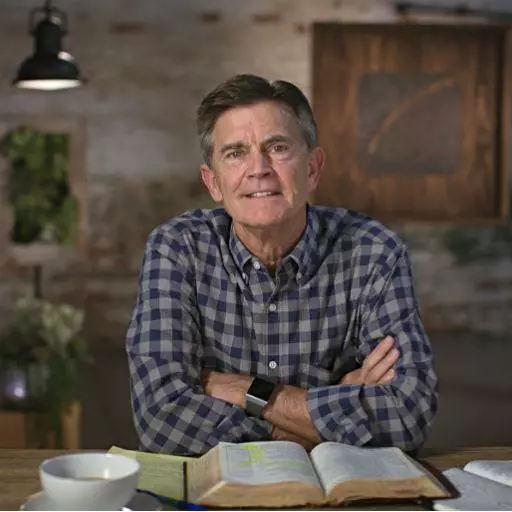
You Gotta Die, Part 2


The world’s chaos and dysfunction can be pretty overwhelming. But when we see chaos and dysfunction in our own lives, we can feel paralyzed - like there’s no hope. In this program, Chip tells us God’s shouting from the rooftops, “There’s hope! I sent you hope!” Where’s God’s hope? How do you get it? That’s where Chip’s headed - don’t miss it!
Dave Druey: Today on Living on the Edge with Chip Ingram.
Chip Ingram: When we look around and see all the dysfunction and chaos, it’s overwhelming. But when we look closer to home and see the dysfunction and the chaos in our own lives, it sometimes can paralyze us and make us feel like there’s no hope. I want you to know that God is shouting from the rooftops: there’s hope, I sent you hope. Where’s God’s hope? How do you get it? That’s what we’re going to talk about in the next 20 minutes. Stay with me.
Dave Druey: What if the life you’ve been working so hard to build is the very thing standing between you and the life God has for you? I’m Dave Druey, and today on Living on the Edge, Chip Ingram reveals how real change doesn’t start with personal growth or trying harder. It starts with dying to yourself.
As Paul says in Galatians 2, verse 20: "I have been crucified with Christ and I no longer live, but Christ lives in me." To unpack more of this revolutionary truth, here’s Chip with today’s message titled, "You Gotta Die."
Chip Ingram: I want to talk today about how do you really find life and hope and peace in a world that’s really messed up. And so we're going to ask four very basic questions. Question number one is: how did we get here? How did the world get this messed up? There’s chaos out there and there’s chaos in here.
And what I want to tell you is the world, this world that we live in now, is not the world God created. The world that God created, the eternal creator of all that is, who spoke the world into existence, created an absolutely perfect world. The world that you live in is messed up. God didn’t mess it up, we did. But he cares.
And so the question number two is: where is God in the chaos? Here’s the message of Easter, get this down. Easter is about a divine intervention. Anybody here know what an intervention is? Anybody had a friend or a relative? I have. And you get all the family and usually find a pro who’s done this before because you need to know what you’re doing. And you all create this place and then usually have to trick them to get them there. And he walks in and he goes, "Oh, what’s going on?" And they say, "We love you and you have a big problem."
You know what Easter is? God looking down from heaven—the Father, the Son, and the Holy Spirit. And the Son saying, "Let’s do an intervention. Let’s help them see that they are messed up and they are selfish and they need to die and receive life so they can be resurrected." And so Jesus came and he did the intervention to rescue us. His life mission, he said, was "I came to seek and to save those which were lost." And so the first thing he offered was life, because we’re on death patterns.
For God so loved the world that he gave his only begotten Son that whoever—underline the word believe—in him should not perish but have everlasting life. Circle the word have, present tense, the moment you believe. And then the very next verse was probably as life-changing for me as the first one. For God did not send his Son into the world to judge the world, but he sent his Son to save us. God’s not down on you. God’s not down on me.
He’s not this angry God whose arms are crossed with a big club, who has a lot of rules and is just waiting for you to mess up to bang over your head or knock you on the knuckles. His invitation is not: get religious, get more moral, try harder, pull up your bootstraps. That’s not it. It’s an intervention where you say: how you’re living your life doesn’t work. It’s bringing death to you and death to others. I want to give you life.
There’s a gift. And what we’re going to learn is he went to the cross and he died on the cross for you. He intervened and said, "What you can’t do for yourself, I’m going to do." And he literally paid—that’s what the word redemption means. He paid for your sin and paid for mine. And then he rose from the grave and says, "Look, free gift." That’s the message of Easter.
And the question you ought to be asking is: if that’s the message of Easter, what gives this Jesus the right to make that outlandish offer? Don’t other religions have offers about peace and life and hope? I mean, what makes you think this one’s real, right? That was my question.
Jesus makes this offer based on four things. First, his life. Sinless, revealing God’s character. If we could have found, if his enemies could have found one sin, the message of Jesus and all of his claims go out the window. But instead, Jesus said, "Look, here’s the deal. I’ve come to do an intervention and you have death. Life—you want to see what life looks like? See the poor, I feed them. See the hungry, I feed them. See the people that have lost close ones, I raise them from the dead.
If you have seen me, you’ve seen the Father. You want to know what God is like? You see this prostitute and the messed up life she’s had and the four partners: go and sin no more. You see this lady whose heart’s broken and this guy that’s just lost his daughter: I raise her from the dead. You see people who have purpose and these religious people and all their pious stuff? I shoot it straight with them and say, "Quit pretending. Quit posturing. Quit being a hypocrite."
His life—it marks AD, BC. All of life is around this single solitary life that’s changed the world. And second, his death. Colossians chapter 2 makes it clear that when he died, he didn’t just physically die. Because he was fully God and fully man, being man he could die, being God it could be a perfect sacrifice. And he covered sin. He broke the penalty of sin. He conquered death and destroyed the works of the evil one.
His life, his death, and finally he proved it all with his resurrection. Read the book of Acts, chapters 1 and 2. This isn’t some weird religious philosopher that had dreams and told people there’s a new way to God. This was someone who was outrageous. He said, "I’m the Savior of the world. I’m truth incarnate. There’s no other way but me." He’s either right, wrong, or a lunatic. But you can't even admire Jesus as a teacher. What kind of teacher would lie to you?
The resurrection proves that what he said was true. God visited the planet. You talk about an intervention? He visited the planet and suffered and lived a perfect life for you, for you personally, for me. 500 eyewitnesses for over 40 days that could touch his hands, they had meals with him. There’s a reason we’re sitting in this room. It’s not because we’re on the salad bar of the philosophical religious views of our day.
We’re sitting in this room because a real God visited a real planet and died on a real cross and came back to life and walked around for 40 days with eyewitnesses and their lives have been completely transformed. The tragedy is we’ve taken that and made it religion. Because the final point is it’s our union with him, what God has always wanted. The reason he did the intervention.
You don’t do an intervention so that people end up in a treatment center and their message is, "Hey, I go to treatment centers. I go on Mondays and Wednesdays and Fridays. I go through the 12 steps. It’s a great treatment center. Have you ever been to a treatment center? I love treatment centers. Let’s be treatment center people." What you want them to do is have an intervention and get whole and come back and love you and be connected to you.
The tragedy of our day and the reason that I opted out of Christianity as a young person—all they wanted to do was talk about their religion and telling me that I wasn’t moral enough. I knew I wasn’t moral enough, okay? Give me a break. God’s not trying to improve your morality. God is not trying to get you to be more religious. He wants you to be in union in relationship with him.
And when that happens, life—I am crucified. See, you’ve got to die. I’m crucified with Christ. Nevertheless, Paul would say, "I live." How? Christ lives inside of me. Well, how does that work? I put the verse in it, 2 Corinthians 5 verses 14 and 15. The Apostle Paul, the same one who gave us the secret counterintuitive means to life and hope and peace, says this: "The love of Christ controls us. Having concluded this, that one died for all—that one, Jesus. Notice the result: therefore, all died."
Dave Druey: You’re listening to Living on the Edge and today’s teaching from Chip Ingram continues in just a minute. His message is available anytime at livingontheedge.org. Listen again, share it with a friend, or explore hundreds of additional programs, all free, all online.
You can even search for specific topics like parenting, personal growth, and unshakeable truths, plus find small group resources and practical tools to help you live the Christian life every day. It’s all waiting for you at livingontheedge.org. Now let’s get back to today’s message.
Chip Ingram: Let me give you a picture. This has helped me so much. Imagine if you will, this is a bolt. Got that? Imagine this bolt is you or me. And there’s certain properties, there’s a nature to a bolt, correct? It’s made out of metal. And let’s imagine that this little fish tank, I think is what we’ve got here, and this water is staying on top of the water is being a good person, a righteous person, a loving person, a person that cares about others, a person that’s pleasing to God.
Left to yourself and your power and your effort, when you try and do that, does anybody have any predictions about where this bolt’s going? Okay, let’s check this out to make sure. Yep, it’s down there. Well, wait a minute. Oh, no. Well, maybe we should paint it. Or maybe we could put a little cross on it. And maybe the bolt could go to church now and then, or it could really try, maybe give away a little money, do a little something.
You can do all kind of little things with the bolt, but okay, let’s pretend it’s painted and it’s really pretty and it’s even religious. Oops, still got a problem. Because the nature of the bolt in and of itself is powerless. Here’s the intervention. The intervention is the very life of Jesus, fully man, fully God, who died. And says when he died, when a person by faith trusts in him, you died with him, you’re buried with him so you can be resurrected with him.
Now what’s the nature of wood when I put it in the water? Predictions? It’s the fundamental property of the wood. It will always float. Now get this. This is the Gospel. This is the good news. The good news is not that you can try hard, become religious, read the Bible, go on a missions trip, give some money, and try and earn your way to God. The Gospel is none of that can ever work.
But by faith, you can turn from your sin and you can be united with him. See this rubber band, this blue one here? It’s faith. It’s that moment in specific space-time history when you hear and understand that God, in the person of Jesus Christ, died for your sin, rose from the dead, and offers you new life, free of charge, that you could never do. And you turn from your sin and you say, "I can’t live this life, but I want to be connected to you." And you said whoever believes in you could be connected to you. I want to be in union with you.
See, the scripture says very clearly, "He that has the Son has life. He that does not have the Son of God does not have life." These things I've written to you, the Apostle John would say, that you might know that you have eternal life. And so when you have relationship with him, all the properties now and what’s true of Christ becomes true of you.
When you turn from your sin, ask Christ to come into your life, you’re atoned or forgiven. The Spirit of God enters your life. He begins to form the life of Christ in you. He seals you with his Spirit. He takes you from the kingdom of darkness to the kingdom of light. He breaks the power of sin. Death forever never can reign over you again. The moment you die, you will be ushered into the very presence of God forever and ever.
But you are crucified with Christ. Nevertheless, look, you’re living. But it’s not you, it’s Christ in you. That’s the message and the offer. And so the question I have for you is: do you have the Son? Do you have the Son of God living in you? If you do, you have eternal life. If you do not, you do not have life. Notice, I didn’t say do you go to church? I didn’t say are you moral? I didn’t say did you read the Bible? I didn’t say if you give to the United Way? All those things may be very, very good. But none of them have the power to give you eternal life.
And just like when you make a major union with another person, it’s not just for a certain day or a point in time, it’s for a new life. There’s a new path. It’s not about coming to some service and realizing, "Oh, I need to be united with Christ. Oh, Father, please forgive me," and then go off and live the same way. No, no, no. I died to my old way of life.
And I said to a cute little blonde-haired girl, "I would like to be united with you all the rest of my days and be on a new path with you." I did not say, "Honey, I want you to know for this day that I’m giving up my old girlfriends and I want to be married to you and be united to you. And thank you, I’m glad we’re married. Now I think I’m going to go do..." She would have not been happy with that, nor me her doing that. What I committed to was a new life that gave me new power to be on a new path.
And that’s our final question: what’s the path? What’s the counterintuitive path that brings life and hope and peace? And it’s summarized in Romans chapter 12, the first two verses. The same author, he says, "I urge you therefore, my brethren," or brothers and sisters is the idea, "in light of God’s mercy." In other words, in light of what he’s done for you, here’s the path that you’re on so that you receive life: offer your body or present your body as a living sacrifice, holy, acceptable to God. Then get the last line: this is your spiritual service of worship. Translation: this is what God really wants.
Once you turn from your sin and receive the gift on a certain day at a certain time, are you ready for this? You’ve got to die. The reason there’s so many Christians who say I love God and they pray a prayer and done this and done that and they live their own life and their lives don’t resemble Christ: they never died. You’ve got to die. You’ve got to say, "God, not my will but yours."
Jesus died before he could be resurrected. In nature, if it doesn’t die, it doesn’t produce fruit. Unless a grain of wheat fall into the earth and die, it remains by itself alone. If it dies, brings forth much fruit. Are you ready to die? You know what, God may be very gracious, but are you ready to die to some things that you think will make your life work?
See, any person or anything that your life revolves around, you know what that’s called? It’s called an idol. Anything that you orbit around, that holds you up, that’s what you worship. Some people, they worship their job. Some people worship their mate. Some people worship the fantasy of the success—the when-then syndrome. "When I get the big job, when I get the house on the hill, when we get the kitchen remodeled, when we finally have children, when I finally get married, when I finally make a lot of money."
You know, "if I keep working out, if I can look like this, then..." And we spend our whole days answering emails and responding to voicemails on this busy-busy-busy, go-go-go-go for what? So I can own, control, pose, pretend, and try in my own energy be good enough to get people to love me.
And all the while, the one who came to do the intervention is standing back, Jesus, saying, "I’ve watched this movie a lot of times. There’s not a happy ending coming. There’s not a happy ending in this life and there’s a tragic ending in the next. Will you allow me to forgive you and do for you what you can never do for yourself? And will you allow me to come into your life?
And after I do, would you slide over and let me drive? And I will tell you this: if I loved you enough to die for you, where I’m going to drive this car is better than you could ever dream. The roads will not always be smooth and they will not always take the turns that you always like. But if you’ll listen to what I have to say, you’ll do some counterintuitive things like give and you’ll receive.
You’ll love in your marriage and forgive even when it doesn’t come back and this bizarre thing happens: you get love back. You’ll live the kind of life that your kids will say, 'Wow, that’s the kind of person, that’s the kind of dad, that’s the kind of mom I want to be.'" Guess what? You can’t do this. Christ in you is the hope of glory.
Dave Druey: This is Living on the Edge with Chip Ingram and a powerful Easter message. Chip gave us a lot to sit with today. The bolt that sinks no matter how many times you paint it, the wood that floats—not because of anything it does, but because of its nature. That’s the Gospel in a fish tank.
And the invitation couldn't be more direct: stop performing, stop posturing, stop trying to drive. Slide over, let Christ take the wheel. If he loves you enough to die for you, where he’s going to take you is better than anything you could map out on your own.
For over 30 years, Living on the Edge has existed to bring that message to people who need it: in their cars, in their homes, in the quiet moments when they know something has to change. And it reaches them because partners like you believe this mission matters.
Now, if you already give to support this ministry, thank you. Every program, every moment of teaching that lands at just the right time, it happens because you said yes. And if you’ve never given before, today is the perfect day to start. Join a community of believers investing in something that outlasts all of us: the transformation of lives through God’s word.
To give, visit livingontheedge.org or call us at 888-333-6003. You can also mail your gift to Living on the Edge, P.O. Box 3007, Atlanta, Georgia, 30304. And one more thing: make sure you’ve subscribed to the Living on the Edge podcast where you can check out full-length messages from Chip and take them with you wherever you go. Subscribe today. Now here’s Chip.
Chip Ingram: So let me ask you today: which road will you take? Option A or option B? You know, we all face these windows of spiritual decision. It’s not an accident that you’re hearing my voice right now. The God of the universe made you, created you, loves you. He sent his Son to die in your place for your sin. He rose from the dead. It’s historical, it’s factual, it’s true.
But all that is got to move from your head to your heart. And today is the day, as what the Bible says, of salvation. So what will you do? Will you receive his offer? And if so, do it right now with me. In our church, I prayed a prayer with a number of people whose entire eternity changed because their trust shifted from themselves to Christ. And that’s what you need to do right now.
You can pray if this is the desire of your heart: Dear God, I admit today before you that I fall short, that I’ve sinned, that I’m not the man, the woman, the parent, the person that I know I need to be. I want to ask you right now to forgive me for all of my sins. I ask you to come into my life right now. And I believe and trust that your Son, the Lord Jesus, died to pay for my sin.
I believe he rose from the dead to give me eternal life. Please make me your son, make me your daughter. I trust you right now in Jesus’ name. And Father, thank you for your forgiveness. Grant me power and strength to walk with you all the days of my life.
If you just prayed that with me, you can go to our website and there’s a portion there where you can click for new believers where we can give you some help. And secondly, tell someone today what you’ve done. The person you think is the greatest Christian that you know, tell them: "I prayed to receive Christ today." And then this Easter weekend, find a good Bible-teaching church and celebrate your new life.
Dave Druey: Just go to livingontheedge.org/celebration to connect. I’m Dave Druey, and we’ll see you next time for more practical Bible teaching here on Living on the Edge with Chip Ingram.
Featured Offer

Experience Jesus's mission and love in this 16-day devotional.
Imagine walking with Jesus to the cross: from town to town, witnessing miracles, and soaking in His wisdom. This series explores the Gospel of Mark, offering a glimpse into Jesus’ journey. You will better understand His divine nature and the monumental impact of His death and resurrection. As you get to know who Jesus really is, you will be transformed from a casual observer to a devoted follower of Christ with a vibrant faith.

Featured Offer
Experience Jesus's mission and love in this 16-day devotional.
Imagine walking with Jesus to the cross: from town to town, witnessing miracles, and soaking in His wisdom. This series explores the Gospel of Mark, offering a glimpse into Jesus’ journey. You will better understand His divine nature and the monumental impact of His death and resurrection. As you get to know who Jesus really is, you will be transformed from a casual observer to a devoted follower of Christ with a vibrant faith.
About Living on the Edge
About Chip Ingram
Chip Ingram's passion is to help Christians really live like Christians. As a pastor, author, coach and teacher for more than twenty-five years, Chip has helped people around the world break out of spiritual ruts and live out God's purpose for their lives.
Chip is the author of eleven books and reaches more than one million people each week through online, radio and television outlets worldwide. Chip serves as CEO and Teaching Pastor of Living on the Edge, an international teaching and discipleship ministry. Chip and his wife, Theresa, have four children and twelve grandchildren.
Contact Living on the Edge with Chip Ingram
info@lote.org
http://livingontheedge.org/
Mailing Address
Living on the Edge
PO Box 3007
Suwanee, GA 30024
(888) 333-6003