
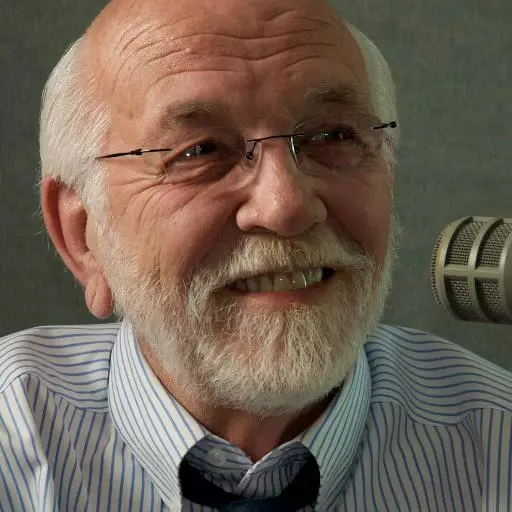
“Everybody who believes thinks in believing and believes in thinking.”


Matt Hurd: Everybody who believes thinks in believing and believes in thinking. Let's talk about it on Key Life.
Announcer: Welcome to Key Life. If you've been trying to earn God's approval, we invite you to hang out with us. Steve invited our friend Matt Hurd to teach us all this week. Matt is a speaker, teacher, writer, pastor, coach, and the author of *Life with a Capital L*.
Matt Hurd: Thank you, Matthew! And it has been a great week with you guys unpacking two words that belong together but aren't often put together: thinking and believing. And we're referring to this week as Thinking About Believing. A lot of people don't think that their believing has anything to do with their thinking. And that statement I made to you a moment ago, that everybody who believes thinks, both thinks in believing and believes in thinking, is not original to me. A gentleman named Augustine said it centuries ago.
He also said, "For who cannot see that thinking is prior to believing? For no one believes anything unless he has first thought that it is to be believed." Then he says, "For it is not everyone who thinks that believes, since many think in order that they may not believe. But everybody who believes thinks: both thinks in believing and believes in thinking." I'm hoping that right now your head is not spinning, but you're saying, "I need to start thinking more about believing and I need to do more thinking that will fuel my belief."
Remember where we started the beginning of the week is the relevance of believing, the importance of it. Everyone knows that believing is so vital to us coming to faith in Christ. John 20:31, he says, "I've written these things that you may believe that Jesus is the Christ, the Son of God." But then he says, "And that by believing you may have life in His name." So believing is not just a past tense thing that we do, saying, "Yeah, I believed back on July 22nd such-and-such a year and that's when I became a Christian, and therefore I'm done believing until the day that I head home and go to heaven."
What John is saying is that believing is not just a one-time scenario; it is a continual posture. And it's a continual posture that results in our actions being different. Believing the gospel on a daily basis so that we might have *Zoe*, the life of God, *Zoe* in His name. Us trusting Jesus is not just a matter of some emotional response; an engaging with the love of the Lord that Jesus exhorts us to involve all of our hearts and all of our soul and all of our minds. And so what we're looking at is unpacking: what does that belief involve?
And we've been bringing up a three-word, three-stage formula. Formula would be way too sterile of a way to put it, but the Reformers were trying to synthesize, "Okay, what does saving faith involve?" And their three Latin words—*notitia*, *assensus*, and *fiducia*—were the three stages. *Notitia* saying I first have to appraise the credibility of something and to evaluate it. And so I encourage you, if you're struggling from a faith standpoint, dig into some apologetics books, dig into the Word of God, just let the Word saturate you as you continually appraise: is this truth credible? Is it cogent? Is it historical? Are the claims of Christ to be trusted?
But that does not by itself result in this believing, this saving faith, this believing that gives me life in His name. That appraisal needs to be companioned with agreement where I'm agreeing to the relevance of who Jesus is and what He says. Yesterday, I started just briefly mentioning some different longings that we have. One of the things that fuels me in my engagement with the gospel is not only knowing the trustworthiness of the gospel, and at the core of that is the resurrection, but also the relevance. It's not just looking at is the gospel credible, but is it relevant to my need?
Every one of us has a longing for significance. Is there any other way for me to get the significance that I can gain from being restored in the original relationship that I was intended for, and that is a child of God? We long for intimacy. Does the gospel address that yearning for intimacy when Jesus says, "This is eternal life" in John 17:3, that they may know You? And yes, we can have intimacy on a horizontal level with other humans, but that intimacy that comes from God fuels the intimacy of those other relationships.
We long for love, we long for a sense of identity, we long for dignity, security. We long to be involved in a greater story. Is there any other story that's more significant than the narrative of the gospel that started in creation? And then there was a fall, and He has redeemed us from that fall and is restoring us back to what was intended. That's a story with a capital S. Our yearning for meaning, our yearning for wholeness and acceptance and purpose and Shalom. Our yearning for connection, our thirst and hunger for making an impact and having influence, being a person of destiny for goodness, truth, beauty. Our longing for belonging and for joy and for justice and triumph and freedom and resolution and home.
All of those longings are relevant to what the gospel promises. And so when I'm evaluating whether to sit in the chair, going back to our analogy of seeing faith as the process of where I evaluate is the chair sturdy enough to hold me, that's step one. But then I need to evaluate: is it relevant to my need right now? Am I tired? Do I need to sit down? Is the gospel relevant to my longings, my need? And then we come to actual saving faith being completed.
It's not just where I do the appraisal and the agreement. There are plenty of people that would appraise, "Hey, I think Christianity makes a lot of sense, but it's not for me." There are others who say, "I think Christianity makes a lot of sense and I can see that it's relevant probably to a lot of stuff that I'm longing for," but they still are not believers. Why? Because they've not taken that final step of acceptance, the *fiducia*. It's not just the *notitia* and the *assensus*; it's the *fiducia*, the acceptance, the submission to the truth.
I haven't actually exercised biblical faith in sitting in that chair until I sit down. I haven't exercised biblical faith in that airplane until not only do I evaluate its credibility and its relevancy, but I get in it. I strap on the seatbelt. James chapter 2 verse 19 says, "You believe that there is one God. Good. But even the demons believe that and they shudder." So it's not just believing that God exists and that the Bible exists and that Jesus exists and that the gospel promises what it does; it's actually submitting to those realities.
I could use the word believe in a couple of ways. I could say I believe in UFOs, and then I could also tell you I believe in ibuprofen. Well, I've used the word believe in both contexts, but they mean something very different. When I say I believe in UFOs, it might be, "Okay, I believe they exist," and you can move into my mental stability or whatever. But when I say I believe in ibuprofen, the way I'm using believing, I'm saying I use it. In John 17:8, Jesus in His prayer the night before He gave His life says, "I gave them the words You gave me," He's praying to the Father, "and they accepted them. They knew with certainty that I came from You and they believed that You sent me."
So there is a difference between sitting in the chair and not sitting in the chair. But there's also a difference between sitting on the edge of the chair and sitting relaxed in the chair. That's where the amount of belief makes a difference. Once I've believed, I'm in the chair. Once I've believed in Christ, I am saved. But the degree to which I experience that salvation, the degree to which I dance to the music of the gospel, the degree to which I engage with that *Zoe* life of God has everything to do with how much I'm going to believe.
And there are things that will happen in our lives that will throw us sideways. And it's a matter of in the midst of those things that disrupt us, that we go back to the core of saying, "Though the fig tree doesn't bud and there are no grapes on the vines, though the olive crop fails and the fields produce no food, though there are no sheep in the pen and no cattle in the stalls, yet I will rejoice in the Lord. I'll choose to believe," in other words, "and be joyful in God my Savior." That's Habakkuk chapter 3 verse 17.
It's where we're saying that mystery at times is a part of life. It's not a matter of me... a lot of us want to worship answers more than we worship God. So having faith does not mean I have no unanswered questions. Having faith doesn't mean that I don't acknowledge mystery. Having faith doesn't mean that I know all of the answers. Having faith is a matter of me saying there are things, as Dr. Francis Schaeffer one time said (I heard him tell another student in a session that I was in in L'Abri, Switzerland).
They asked him a question and he said, "I don't know." And that humble response from a brilliant man was pivotal towards this student from Scandinavia, who was an atheist, coming to Christ. And he said a big reason why was Dr. Schaeffer said there was something he didn't know, that his God is bigger than having all the answers. You and I don't have all the answers, but we have the core truth of the gospel. And it's bedrock to enable us to be catapulted into a restoration of what we were intended to do and live as human beings. And I'm praying that you will believe the gospel and believe in such a way that you will experience life in His name.
Announcer: Thank you, Matt Hurd. That wraps our special week-long series called "Thinking About Believing", and it's available to stream for free right now on our website. Just go to KeyLife.org. And tomorrow, another of our voices of Key Life will be here, Pete Alwinson. He'll join Steve for Friday Q&A when they'll talk about the differences between the God of the Old Testament and the God of the New Testament. Don't miss that.
Well, like I said, we just listened to some powerful teaching from Matt Hurd. And if you enjoyed that, then I think you're going to like a thought-provoking book that Matt wrote called *Life with a Capital L*. If you ever feel limited or stuck, guess what? That is not the way it was meant to be. God intends the humanity in each of us to be deeply experienced, lavishly enjoyed, and exuberantly celebrated. And for a minimum donation of $15 to Key Life, that book is our gift to you.
Just call us right now at 1-800-KEY-LIFE. That's 1-800-539-5433. You can also email Steve at Steve@KeyLife.org to order that book, or go to KeyLife.org/contact to find our mailing address. Again, the book is *Life with a Capital L*.
Finally, will you support Key Life financially? You can charge a gift on your credit card or include a gift in your envelope, or just take out your phone and text KEY LIFE to 28950. Again, that's KEY LIFE, one word or two, it doesn't matter, just text that to 28950 then follow the instructions. Key Life is a member of ECFA in the states and CCCC in Canada, and Key Life is a listener-supported production of Key Life Network.
Featured Offer

A recently-reprinted booklet taken from Steve’s classic book on radical grace, A Scandalous Freedom. Three freedom-stifling tendencies: The freedom we surrender…and the heritage that sets us free. The perfection we desire…and the forgiveness that sets us free. The Gospel we forget…and the joy that sets us free. We are free—no ifs, ands or buts. Jesus said we would know the truth and would be free indeed. Let’s see if he was right.
Past Episodes
- A Fresh Word from God (Steve Brown)
- Acts
- Acts (Steve Brown)
- Acts Overview (Steve Brown/Justin Holcomb)
- Adam and Noah (Steve Brown/Jerry Parries)
- All You Wanted to Know About the Bible but Didn't Ask (Steve Brown/Pete Alwinson)
- Amazed by Grace (Steve Brown/Matt Heard)
- Among Friends
- Anger and Forgiveness (Justin Holcomb)
- Babette and the Lavishness of Grace (Steve Brown/Matt Heard)
- Big Message, Little Place
- Big Message, Little Place (Steve Brown)
- Calibrate: Sitting at the Feet of Jesus (Matt Heard)
- Christmas Day (Steve Brown)
- Christmas Eve: A Grace Gift Exchange (Steve Brown/Matt Heard)
- Christmas Gifts: The Four Mondays of Advent - Part 1 (Steve Brown/Matt Heard)
- Christmas Gifts: The Four Mondays of Advent - Part 2 (Steve Brown/Matt Heard)
- Christmas Gifts: The Four Mondays of Advent - Part 3 (Steve Brown/Matt Heard)
- Christmas Gifts: The Four Mondays of Advent - Part 4 (Steve Brown/Matt Heard)
- Christmas Special (Steve Brown/Pete Alwinson)
- Comfortable Words (Justin Holcomb)
- Coming Alive (Matt Heard)
- Embracing the Story of the Gospel (Matt Heard)
- Engaging Your Story (Matt Heard)
- Epiphany: Light for the Nations (Steve Brown/Justin Holcomb)
- Experiencing Awesome (Pete Alwinson)
- Galatians
- Getting Saved (Steve Brown)
- God's Grace is Enough (Steve Brown/Jerry Parries)
- Grace Through the Centuries (Steve Brown/Justin Holcomb)
- Gratuitous Grace (Justin Holcomb)
- Harmony in the Band (Steve Brown)
- Heart Matters (Matt Heard)
- How to Handle Hallway Experiences (Steve Brown/Jerry Parries)
- How to Trust God in Difficult Times (Steve Brown/Jerry Parries)
- Humility and How We Achieved It (Steve Brown/Pete Alwinson)
- Is Pentecost Reproducible? (Steve Brown)
- It's about Forgiveness (Steve Brown)
- It's All About Grace (Jerry Parries)
- It's All About Worship (Steve Brown/Pete Alwinson)
- Jesus Saves Sinners for God's Glory (Steve Brown/Pete Alwinson/Justin Holcomb)
- Journey to the Cross (Steve Brown/Matt Heard)
- Joy is Plural (Matt Heard)
- Laughter and Lament (Steve Brown)
- Lent: God's Kindness Leads to Repentance (Steve Brown/Justin Holcomb)
- Lies from the Enemy (Steve Brown/Jerry Parries)
- Living Your Best Life (Jerry Parries)
- Love (Pete Alwinson)
- Loving Like Jesus (Matt Heard)
- Peter: The Patron Saint of Failures (Justin Holcomb)
- Philippians (Steve Brown)
- Psalms of Lament (Justin Holcomb)
- Real Power (Pete Alwinson)
- Resurrection: It Really Happened and It Changed Everything! (Steve Brown/Pete Alwinson)
- Thankful for the Gospel (Steve Brown/Matt Heard)
- Thanksgiving in Troubled Times (Steve Brown/Pete Alwinson)
- The Covenants: Abraham (Steve Brown/Jerry Parries)
- The Covenants: Adam and Noah (Steve Brown/Jerry Parries)
- The First Episode of Key Life (1986) (Steve Brown)
- The Gift of Forgiveness (Steve Brown/Jerry Parries)
- The Gifts Christmas Brings (Steve Brown/Jerry Parries)
- The Good Things God Has Done For You (Jerry Parries)
- The Graced Church (Pete Alwinson)
- The Grammar of Gratitude (Matt Heard)
- The Kingdom Manifesto
- The Kingdom Manifesto (Pete Alwinson)
- The Kingdom Manifesto: The Poor in Spirit, Those Who Mourn, & The Meek (Pete Alwinson)
- The Kingdom of God (Steve Brown/Pete Alwinson)
- The Last Week (Steve Brown/Justin Holcomb)
- The Liberating Power of Truth (Steve Brown)
- The Life We Long For (Matt Heard)
- The Life You've Always Wanted (Steve Brown/Matt Heard)
- The Power of Confession (Steve Brown/Jerry Parries)
- The Power of Pentecost (Steve Brown/Jerry Parries)
- The Purpose of Christmas (Steve Brown/Jerry Parries)
- The Spirit Who Gives Life (Steve Brown/Justin Holcomb)
- The Voice of Jesus (Justin Holcomb)
- The Weird Ways of God (Steve Brown)
- Thinking About Believing (Matt Heard)

Featured Offer
A recently-reprinted booklet taken from Steve’s classic book on radical grace, A Scandalous Freedom. Three freedom-stifling tendencies: The freedom we surrender…and the heritage that sets us free. The perfection we desire…and the forgiveness that sets us free. The Gospel we forget…and the joy that sets us free. We are free—no ifs, ands or buts. Jesus said we would know the truth and would be free indeed. Let’s see if he was right.
About Key Life Network
Because life is hard for everyone, grace is for all of us. And grace means that because of what Jesus has done, when you run to him, God’s not mad at you.
All of the radio shows, sermons, books, and videos we produce work together toward one mission: to get you and those you love Home with radical freedom, infectious joy and surprising faithfulness to Christ as your crowning achievement.
Learn more: http://www.keylife.org
About Steve Brown
He’s not your mother and he’s not your guru. He’s Steve Brown - a speaker, author, former pastor and seminary professor, and founder of Key Life Network, Inc.
At Key Life, Steve serves as Bible teacher on the radio program Key Life and the host of the talk show Steve Brown, Etc. Prior to Key Life, Steve served as a pastor for more than thirty years and continues speaking extensively.
Steve has also authored numerous books, including How to Talk So People Will Listen, Three Free Sins, Hidden Agendas and his latest release, Talk the Walk: How to Be Right Without Being Insufferable (now available as an audiobook).
Contact Key Life Network with Steve Brown
steve@keylife.org
http://www.keylife.org/
P.O. Box 5000
Maitland, FL 32794
In Canada, send requests to:
Key Life Canada
P.O. Box 28060
Waterloo, Ontario N2L 6J8
1-800-KEY-LIFE