

“Why does God use story?”


Steve Brown: Why does God use story? The answer will surprise you. Let's talk on Key Life.
Guest (Male): God's grace changes everything, how we love, work, live, lead, marry, parent, evangelize, purchase, and worship. This is Key Life with practical Bible teaching to get you home with radical freedom, infectious joy, and surprising faithfulness.
Steve Brown: You know, I always say at the beginning of these broadcast, thank you, Matthew.
Guest (Male): Yes.
Steve Brown: But you're still here.
Guest (Male): I'm still here. What's going on?
Steve Brown: It's been a great week as you've taught us about story. I've thought about things I haven't thought about in a long time.
So, Matthew, thank you for your introduction. And hi, Matthew.
Guest (Male): Hello, Steve.
Steve Brown: Talk about story and how God, how does God use a story?
Guest (Male): You know, we've talked about story this week about how he's a storyteller and that tells us certain unique things about him in how we're a small part of a story, a part of a larger story that we're all a part of.
Steve Brown: By the way, I don't want to interrupt you, but I got something just came to mind.
Guest (Male): Yes.
Steve Brown: I just thought of why you love this subject and teach it so well.
Guest (Male): Oh my.
Steve Brown: Because you're a film director.
Guest (Male): Yes.
Steve Brown: And you've won awards from your documentaries and your films.
Guest (Male): Yeah.
Steve Brown: And you know, a lot of people don't know that about you.
Guest (Male): Well, that's what's so interesting is for as different as our callings are, you're a Bible teacher and a preacher and all that, and I'm writer, director, producer.
Steve Brown: You're a storyteller.
Guest (Male): It's stories. That's an important part of what we both do.
Steve Brown: It really is.
Guest (Male): And it begs the question, why? Why is story such a powerful part of being human? And why does God use story? And following that question takes us to some interesting places. That's what we're going to dive into today.
So I want to look at Philippians 4:8 and I'm going to read the whole thing for us. Finally, brothers and sisters, whatever is true, whatever is noble, whatever is right, whatever is pure, whatever is lovely, whatever is admirable. If anything is excellent or praiseworthy, think about such things.
One of those words stands out to me from another one. You got noble, right, true, pure. Okay, that vaguely speaks to kind of a moral quality. Excellent, praiseworthy, admirable. Okay, that sounds like something that's done well.
Then there's lovely. In the Greek, it's prophiles. I'm sure I just murdered that Greek word. Apologies, everybody. That stands out from the other ones. And I wonder if that is the common thread of what moves us in stories. And if that's what is the common thread of what moves us in life. You know, just apart from a story, a child is born or you're looking at this amazing sunset or you have a just a meal with dear friends, it's just transcendent. What is it?
It might be beauty. Dostoevski, I know you know, said beauty will save the world. Your buddy Albert Camus had a great quote, "Man cannot do without beauty, and this is what our era pretends to want to disregard."
I wonder, Steve, if beauty is the breadcrumb trail leading us back to the source. And I wonder, isn't that what Paul meant in Romans 1? "Since the world was created, people have seen the earth and the sky through everything God has made. They can clearly see his invisible qualities, his eternal power and divine nature, so they have no excuse for not knowing God."
That makes me think that like everything else in the universe, story was an intentional creation, thoughtfully designed by God. It's like story, as we talked about a couple days ago, it's not an external phenomenon. It's more like our operating system. It's deep and it's by design.
Steve Brown: Man.
Guest (Male): There's there's something in the world of information management called discoverability. It refers to the degree to which something, especially a piece of content or information, can be found in a file or database or other information system.
So in other words, if you want to find it, can you find it? That's the discoverability. And Jeremiah 29, "You will search for me when you search for me with all your heart, you will find me. I will let you find me." Story as an operating system, beauty as breadcrumbs, everything we see in the world as metadata, linking to the world that we can't see.
If all of that is true, then God is trying to tell us something. But beyond that, he's inviting us to something. There was a guy named Andrew Stanton. He's still around, Pixar, big guy there. He calls this the unifying theory of 2+2. He says, don't give the audience four, give them 2+2. Let them put the pieces together.
And I wonder if that's what God has been doing with us. He creates us with a need for story as real and undeniable as our need for air and for water. He creates a capacity for learning, a thirst for discovery, and throws in some liberal dashes of curiosity and resourcefulness.
Guest (Male): Man.
Steve Brown: That's a brand new thought to me. And when you're as old as I am, that doesn't happen very often. That is so cool, the operating system of how we are created has to do with story.
Guest (Male): Yeah. And then once I read that, you're like, well, why? Why would you not just tell me now? Just everything.
Steve Brown: Just give me the Just give me the stuff.
Guest (Male): You know, when my wife was growing up, she had a phase where, I don't know what her problem was. She would just choke on food all the time. So like, she grew out of that. But that evolved into a story of where she would be leaving and her parents would go, "Bye, have fun, take small bites."
Steve Brown: Oh.
Guest (Male): God can't feed a baby steak. He cuts it, he brings it through story to the part that we can learn about him and understand about him at any given time.
Somebody has defined an artist as somebody who tells the same story over and over and over and over in different ways.
Steve Brown: Yeah.
Guest (Male): That's what God has been doing. He's been telling a million stories about one story, which is his love and and grace. It's like, you know, you put a leaf underneath a piece of paper and trace a little crayon over it.
Every line brings into relief one more additional detail about the reality that is so close, you just you just can't see it. And through stories, I think God is making those connections, bringing the infinite and incomprehensible down to a level where we can engage it.
All of it reminds me of, I don't know if you've seen the, you probably haven't. I watch a lot of Pixar movies because I have four kids. There's a film called Finding Dory and it's about this little blue fish who's forgetful.
Steve Brown: I've seen it.
Guest (Male): Yes.
Steve Brown: Believe it or not.
Guest (Male): Okay, good. That makes us better. So in the beginning of the movie and early in her life, she gets separated from her parents and she's forgetful. And so, you know, how are she ever going to reconnect with her parents who she loves so much?
Well, towards the end of the film, she hasn't just lost her parents, she's lost hope and she's just swimming around aimlessly. But then she spots a shell and it grabs her attention. She goes, "I like shells." And she goes closer, she sees another shell. Oh. And then she looks, it's not just shells, it's a path of shells. And some of them are very old.
Steve Brown: Yeah.
Guest (Male): And she keeps following the path of shells and now she sees other paths of shells. And they're all in a line too and what she realizes is these where she follows these converging paths, where they converge, there's her mom and dad.
Steve Brown: Yeah. Oh.
Guest (Male): Knowing their daughter loved shells so much, for years and years and years, day after day, they put these paths of shells out there, knowing that if their daughter came across this path and she loved shells, it's going to lead her back home. It's going to lead her back to what she loves and needs more than anything else. And that's exactly what our Father has been doing.
Steve Brown: That is so good.
Guest (Male): Yes, because of God. Yes, right.
Steve Brown: Right.
Guest (Male): Just patiently, the symbols, the metaphors, the layers, the the festivals, all of these things. He knows how we operate. We're that dumb little fish.
Steve Brown: Yeah.
Guest (Male): And we're even once we find him, we're going to still wander from time to time. And he laid out all these stories so that following these stories, it would lead back to him. It would lead us back home.
Steve Brown: That is so good. You know, you know, I've been doing that and didn't know it or think of it this way my whole life. I've been following the stories that God has allowed me to see. You know, the way one puts into practice what you've been teaching us this week that's so good about stories is to go to him and say make me sensitive.
Guest (Male): Yes.
Steve Brown: Don't let me miss the stories.
Guest (Male): Right.
Steve Brown: Don't let me miss your story because it's a story of love and grace and mercy. And it goes from beginning to end when we finally celebrate.
Guest (Male): Yeah, so true. When I was in college, I had a theater professor who, you know, used to have, he goes, "I don't like people to do auditions from Neil Simon plays because, you know, it this whole theory that there's a joke and it doesn't connect to the earlier thing." I'm like, context? And he's like, "Oh. Yeah."
Steve Brown: Yeah.
Guest (Male): And when we lose context,
Steve Brown: Yeah.
Guest (Male): everything seems meaningless and unconnected, but it's not. We just have to remember.
Steve Brown: Oh man. I want you to know, Matthew, I'm going to think about what you have taught us this week a lot. Context.
Guest (Male): Yeah.
Steve Brown: Don't forget context.
Guest (Male): That's it.
Steve Brown: Because the pieces won't save you. The context will bring you home every time. Good stuff about story. He really did give us stories. Matthew, thanks.
Guest (Male): Thank you, Steve.
Steve Brown: For this time. Hey, you think about that. I'm in.
Guest (Male): And that's it, friends. Thanks for hanging out with us this week as Steve and I explored the idea of God as the master storyteller. Tomorrow, Steve will be back joined by our good friend Pete Allenson for a little something we call Friday Q&A. Tomorrow they'll tackle questions you've sent in, including this one: Is the 1611 King James Version the only legitimate translation of the Bible? We do most earnestly entreat thee to return unto us on the morrow.
Hey, I have something for you. A very special booklet called Through the Eyes of Grace, The Gospels. This is taken from Steve's classic overview of the New Testament. It includes highlights of the gospels including introductory comments, major themes, and important teaching. We're going to start a new series here in Key Life later this month, a survey of The Gospels. I think you'll find having this booklet handy will be invaluable. So, get your free copy right now by calling us at 1-800 Key Life. That's 1-800-539-5433. You can also email Steve at Keylife.org to order that booklet or go to Keylife.org/contact to find our mailing addresses. Again, ask for the booklet called Through the Eyes of Grace, The Gospels.
And before you go, would you consider giving to Key Life to help the work of our ministry? You can charge a gift on your credit card or include a gift in your envelope, or you could give safely and securely by text. Just take out your phone and text Key Life to 28950. That's Key Life, in that, to 28950. Key Life is a member of ECFA in the States and 4C in Canada, and Key Life is a listener supported production of Key Life Network.
Featured Offer
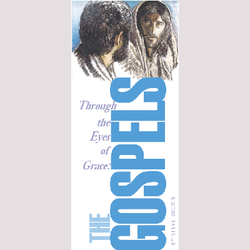
A companion booklet taken from Steve’s classic overview study of the New Testament. Highlights of the Gospels—Matthew, Mark, Luke, and John—including introductory comments, major themes, and important teaching. This is great preparation for Key Life’s Gospels broadcast series this year that begins this month.
Past Episodes
- A Fresh Word from God (Steve Brown)
- Acts
- Acts (Steve Brown)
- Acts Overview (Steve Brown/Justin Holcomb)
- Adam and Noah (Steve Brown/Jerry Parries)
- All You Wanted to Know About the Bible but Didn't Ask (Steve Brown/Pete Alwinson)
- Amazed by Grace (Steve Brown/Matt Heard)
- Among Friends
- Anger and Forgiveness (Justin Holcomb)
- Babette and the Lavishness of Grace (Steve Brown/Matt Heard)
- Big Message, Little Place
- Big Message, Little Place (Steve Brown)
- Calibrate: Sitting at the Feet of Jesus (Matt Heard)
- Christmas Day (Steve Brown)
- Christmas Eve: A Grace Gift Exchange (Steve Brown/Matt Heard)
- Christmas Gifts: The Four Mondays of Advent - Part 1 (Steve Brown/Matt Heard)
- Christmas Gifts: The Four Mondays of Advent - Part 2 (Steve Brown/Matt Heard)
- Christmas Gifts: The Four Mondays of Advent - Part 3 (Steve Brown/Matt Heard)
- Christmas Gifts: The Four Mondays of Advent - Part 4 (Steve Brown/Matt Heard)
- Christmas Special (Steve Brown/Pete Alwinson)
- Comfortable Words (Justin Holcomb)
- Coming Alive (Matt Heard)
- Embracing the Story of the Gospel (Matt Heard)
- Engaging Your Story (Matt Heard)
- Epiphany: Light for the Nations (Steve Brown/Justin Holcomb)
- Experiencing Awesome (Pete Alwinson)
- Galatians
- Getting Saved (Steve Brown)
- God, The Master Storyteller (Steve Brown/Matthew Porter)
- God's Grace is Enough (Steve Brown/Jerry Parries)
- Grace Through the Centuries (Steve Brown/Justin Holcomb)
- Gratuitous Grace (Justin Holcomb)
- Harmony in the Band (Steve Brown)
- Heart Matters (Matt Heard)
- How to Handle Hallway Experiences (Steve Brown/Jerry Parries)
- How to Trust God in Difficult Times (Steve Brown/Jerry Parries)
- Humility and How We Achieved It (Steve Brown/Pete Alwinson)
- Is Pentecost Reproducible? (Steve Brown)
- It's about Forgiveness (Steve Brown)
- It's All About Grace (Jerry Parries)
- It's All About Worship (Steve Brown/Pete Alwinson)
- Jesus Saves Sinners for God's Glory (Steve Brown/Pete Alwinson/Justin Holcomb)
- Journey to the Cross (Steve Brown/Matt Heard)
- Joy is Plural (Matt Heard)
- Laughter and Lament (Steve Brown)
- Lent: God's Kindness Leads to Repentance (Steve Brown/Justin Holcomb)
- Lies from the Enemy (Steve Brown/Jerry Parries)
- Living Your Best Life (Jerry Parries)
- Love (Pete Alwinson)
- Loving Like Jesus (Matt Heard)
- Peter: The Patron Saint of Failures (Justin Holcomb)
- Philippians (Steve Brown)
- Psalms of Lament (Justin Holcomb)
- Real Power (Pete Alwinson)
- Resurrection: It Really Happened and It Changed Everything! (Steve Brown/Pete Alwinson)
- Thankful for the Gospel (Steve Brown/Matt Heard)
- Thanksgiving in Troubled Times (Steve Brown/Pete Alwinson)
- The Covenants: Abraham (Steve Brown/Jerry Parries)
- The Covenants: Adam and Noah (Steve Brown/Jerry Parries)
- The First Episode of Key Life (1986) (Steve Brown)
- The Gift of Forgiveness (Steve Brown/Jerry Parries)
- The Gifts Christmas Brings (Steve Brown/Jerry Parries)
- The Good Things God Has Done For You (Jerry Parries)
- The Graced Church (Pete Alwinson)
- The Grammar of Gratitude (Matt Heard)
- The Kingdom Manifesto
- The Kingdom Manifesto (Pete Alwinson)
- The Kingdom Manifesto: The Poor in Spirit, Those Who Mourn, & The Meek (Pete Alwinson)
- The Kingdom of God (Steve Brown/Pete Alwinson)
- The Last Week (Steve Brown/Justin Holcomb)
- The Liberating Power of Truth (Steve Brown)
- The Life We Long For (Matt Heard)
- The Life You've Always Wanted (Steve Brown/Matt Heard)
- The Power of Confession (Steve Brown/Jerry Parries)
- The Power of Pentecost (Steve Brown/Jerry Parries)
- The Purpose of Christmas (Steve Brown/Jerry Parries)
- The Spirit Who Gives Life (Steve Brown/Justin Holcomb)
- The Voice of Jesus (Justin Holcomb)
- The Weird Ways of God (Steve Brown)
- Thinking About Believing (Matt Heard)

Featured Offer
A companion booklet taken from Steve’s classic overview study of the New Testament. Highlights of the Gospels—Matthew, Mark, Luke, and John—including introductory comments, major themes, and important teaching. This is great preparation for Key Life’s Gospels broadcast series this year that begins this month.
About Key Life Network
Because life is hard for everyone, grace is for all of us. And grace means that because of what Jesus has done, when you run to him, God’s not mad at you.
All of the radio shows, sermons, books, and videos we produce work together toward one mission: to get you and those you love Home with radical freedom, infectious joy and surprising faithfulness to Christ as your crowning achievement.
Learn more: http://www.keylife.org
About Steve Brown
He’s not your mother and he’s not your guru. He’s Steve Brown - a speaker, author, former pastor and seminary professor, and founder of Key Life Network, Inc.
At Key Life, Steve serves as Bible teacher on the radio program Key Life and the host of the talk show Steve Brown, Etc. Prior to Key Life, Steve served as a pastor for more than thirty years and continues speaking extensively.
Steve has also authored numerous books, including How to Talk So People Will Listen, Three Free Sins, Hidden Agendas and his latest release, Talk the Walk: How to Be Right Without Being Insufferable (now available as an audiobook).
Contact Key Life Network with Steve Brown
steve@keylife.org
http://www.keylife.org/
P.O. Box 5000
Maitland, FL 32794
In Canada, send requests to:
Key Life Canada
P.O. Box 28060
Waterloo, Ontario N2L 6J8
1-800-KEY-LIFE