
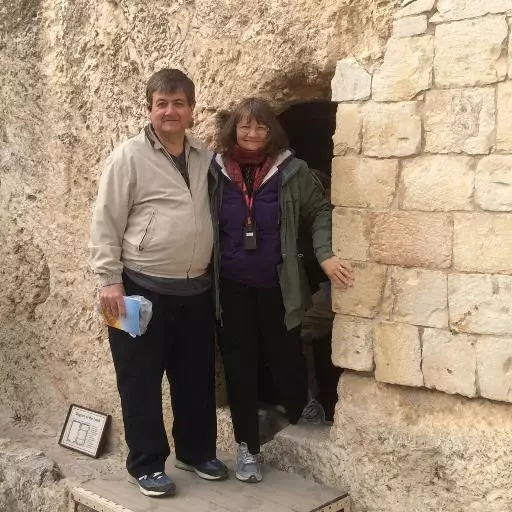
Easter Series #1


If you knew that you were about to die, what do you suppose you'd say to those you love? No doubt you'd try to convey something important, something that you'd really want them to remember. This is Hope From the Word with Pastor Bill Luebkemann, a ministry of Calvary Chapel of Marlton. With Easter just days away, Pastor Bill will take some time to discuss the last seven sayings of Jesus on the Cross. You can be sure they're worthy of our time and attention. With today's Hope From the Word, here's Pastor Bill.
Bill Luebkemann: One of the first things he said: "Father, forgive them, for they do not know what they are doing." Praying he was here, praying for those people that were nailing him to the cross. They were doing the worst possible things. If there's anything about praying for your enemies, this is it.
In Matthew 5:44 Jesus said, "But I tell you, love your enemies and pray for those who persecute you." That's what he said in the Beatitudes, and now here he is putting it into practice. He said love your enemies, and here he is loving them.
Guest (Male): If you knew you were about to die, what do you suppose you'd say to those you loved? No doubt you'd try to convey something important, something that you'd really want them to remember.
This is Hope From the Word with Pastor Bill Luebkemann, a ministry of Calvary Chapel of Marlton. With Easter just days away, Pastor Bill will take some time to discuss the seven last sayings of Christ on the cross. You can be sure they're worthy of our time and attention. With today's Hope From the Word, here's Pastor Bill.
Bill Luebkemann: We're going to do something a little different today. We're going to be looking at the seven last sayings of Jesus. Of course, these are not really the seven last sayings of Jesus since he's still alive today and speaking to our hearts. He's still talking. They're not even the seven last sayings from his time on the earth, because after he rose, he was walking around for 40 more days and he said a lot more things.
But these are the seven last sayings before he died or, to put it another way, the seven things that he had to say when he was hanging on the cross. That might even not be true itself, because it's quite possible and maybe even likely that he spoke other things while he hung on the cross. So, these are the seven last things that he said on the cross that are written down that we know that he said.
I think in my mind that means they're pretty important. It goes without saying anything he said was important, but when it's recorded in the Scriptures, then it tells me that it's even more so. At the very least, when it's recorded in the Scriptures, it's for all of us to know. This is the part he wants everyone to know about. What he spoke on the cross represents the last gasps of a dying man.
What would you say if you were on your deathbed and you only had seven more sentences that you could utter? What would they be? What would you tell your loved ones around you? What would be important enough that you'd have to get it out when you knew your time was so short? You would think these would be perhaps among the more important things that he ever had to say.
Certainly, very revealing of his character. Talk comes cheap, but actions are a lot harder. Talk while you're nailed to a cross is more like actions in my mind. I would put that in the actions category. It would have been easy for someone nailed to a cross to be calling down curses on the people who nailed him to the cross and to be mean and spewing out vindictive, nasty things.
It's harder to do something than talk about it. When you're suffering on a cross, that's kind of when the pedal hits the metal. You're going to say what you really mean, and those people listening are going to find out a lot about who you are, what you believe, and what really matters to you. You can distill a lot of Jesus's ministry down, and that is certainly not to say nothing else that Jesus said was important or that this was more important because everything he said was probably equally important.
I just think it's interesting to look at those things that he said on the cross. I tried to put them in order here. Chris Simber gave me a book this week, *The Seven Things Jesus Said on the Cross* by Greg Laurie. It's a nice little book and I read it and I thought there's a lot of good material in here. This is something good to be thinking about on Easter. I thought I'm going to put them in order.
I'm going to read all the Gospel accounts, put them all in order, and then I'm going to compare it to the order Greg Laurie had in the book to see if he was right. We came up with the same order, actually, except two of them. Numbers two and three you really can't tell. I put them differently than he did, but you really can't tell. Everything else we agreed on.
They're all in the different Gospel accounts, so you have to read them all, try to pull them together, and look at what was happening around those events and try to see how it all fits together. The first thing that he said when they were perhaps in the process of putting him up there, it's recorded in Luke. Jesus said, "Father, forgive them, for they do not know what they are doing."
I get the impression this was done early on. He may have said this while he was laying on the ground there and they were driving those nails through his hands and his feet. Maybe he said it right after they stood that cross upright. It was somewhere near the beginning of the time when they were putting him up there. One of the first things he said: "Father, forgive them, for they do not know what they are doing."
Praying he was here, praying for those people that were nailing him to the cross. They were doing the worst possible things. If there's anything about praying for your enemies, this is it. In Matthew 5:44 Jesus said, "But I tell you, love your enemies and pray for those who persecute you." That's what he said in the Beatitudes, and now here he is putting it into practice.
He said love your enemies, and here he is loving them. He said pray for those who persecute you, and here he is praying for them as they nail him to the cross. Anyone here ever been nailed to a cross? I didn't think so. Whatever anybody did to you to persecute you, it's not as bad as what they did to him. It was worse for him.
We've all experienced all different things in our lives, some of them pretty painful I'm sure, but nothing like being nailed to a cross. Certainly, if you're going to have an enemy in your life, it would be the guy who's nailing you to the cross. I don't think any of us can say we have an enemy who did anything that bad. Yet, Jesus said pray for them that persecute you, and here he is actually doing it, proving that nobody is beyond God's forgiveness.
Not you, not anyone you know, not someone you love, not someone you hate, not your best friend, not your worst enemy. Whoever offended you, shocked you, hurt you, whatever they did to you, whatever it was in your life, they are not beyond God's grace either. They don't need him any more than you do, not even one little bit.
Greg Laurie in that little booklet, he contrasted this event with Samson. I thought that was a great little contrast because here Samson, at the end of his life, his eyes had been gouged out because he compromised his faith. He was a prisoner and they brought him out to show him off to all the Philistines. They were gawking at him and making fun of him.
He was blind and he had no eyes, and he was chained to a pillar. He said to a little boy, "Is this pillar here, is this what's holding up the whole building?" It was. He prayed that the God would just honor one more time and give him the strength to pull that pillar down. In the process, the whole building collapsed like an earthquake and thousands of people died. That's what he did to his enemies in the end, and by the way, God blessed it.
But now here's Jesus. What a contrast. He's praying for these guys. These are the mockers and the haters. It says in verse 35 of Luke 23: "The people stood watching, and the rulers even sneered at him. They said, 'He saved others; let him save himself if he is the Christ of God, the Chosen One.'" Mocking him and making fun of him.
The soldiers also came up and mocked him. They offered him wine vinegar and said, "If you are the king of the Jews, save yourself." Then they nailed the notice above his head written in three languages: "This is the King of the Jews." They wrote the notice, don't make any mistake, Pilate put the notice there to mock him. It wasn't a factual obituary; it was a mocking kind of a thing.
One of the criminals who hung there hurled insults at him. We know from the other Gospels that in the beginning both criminals were hurling insults at him. Here he is nailed up there. He's getting the insults from both sides. From the ground, people are spitting on him and making fun of him, and no one, we see here, is beyond the power of prayer. He's willing to forgive every last one of them. "Father, forgive them, they do not know what they are doing."
How often we do things in our lives that we don't know what we're doing, or someone does something to us and they don't know what they're doing? Our first response is so often to condemn and call down judgment on them, when the response of Jesus is: "Forgive them." Forgive them, forgive my enemies, forgive those that are persecuting me.
He said to do it, he told us to do it, and then he did it himself in the worst, arguably, the worst possible circumstances one could ever be in. We can learn from this. We're not beyond his forgiveness, none of us are, no matter who we are, no matter what we've done. I know there are people out there that think it's too late for me, I could never get in on this, I've done too much, I've gone too far, I've strayed too far.
The Lord would never forgive me for what I've done. That's just not true. He was praying for the forgiveness of these people who nailed him to the cross. We know from the book of Acts some of the people involved in crucifying him got saved, maybe even a lot of them. This prayer was answered. He's sitting at the right hand of the Father now, praying for each of us. We're not beyond his reach. You are not, I am not, no one is.
We need to put this into practice in our own lives with those around us who may have offended us, shocked us, or done something to us. After he prayed that prayer and he was up there and they were calling him names and making fun of him, the next thing it seems he said—these next two things are the two that we're not really sure of the order—but one of them was in addressing Mary, his earthly mother.
That's recorded over in John 19:26. When Jesus saw his mother there and the disciple whom he loved standing nearby, he said to his mother, "Dear woman, here is your son," and to the disciple, "Here is your mother." From that time on, this disciple took her into his home. He was nailed to the cross roughly about 9:00 in the morning, the third hour they count the hours from 6:00 a.m. here.
Around 9:00 a.m. he's nailed to the cross. He prays that the Father forgive them, they don't know what they're doing. Now, sometime in the morning now before noontime, because we know from 12:00 to 3:00 darkness came upon the land. Sometime in the morning, he said these other two things kind of near the beginning, looking out for his mother. We can see there a picture of someone who provides for our needs, even our earthly needs.
She had earthly needs and he took care of them. One of the last things he did. I guess he didn't have a will and write all this stuff up ahead of time, but he arranged a place for her to stay and to live and for someone to look after her. "You're adopting him as your son, and he's adopting you as his mother." Over in Luke chapter 2:34, when Jesus was just a baby, they presented him in the temple. You know that story.
Simeon spoke a prophecy over him. "Sovereign Lord, as you have promised, you now dismiss your servant in peace." This was a guy that had been promised by God he would see the Lord before he passed away from the earth. "For my eyes have seen your salvation, which you have prepared in the sight of all people, a light for revelation to the Gentiles and for glory to your people Israel."
He understood who this baby was, even though he was an old man at this point, never lived to see Jesus grow up. The child's father and mother marveled at what was said about him. Then Simeon blessed them and said to Mary, his mother, "This child is destined to cause the falling and rising of many in Israel and to be a sign that will be spoken against, so that the thoughts of many hearts will be revealed. And a sword will pierce your own soul too."
I just think Mary, as she was standing there at this cross looking upon her son up there, that sword must have felt awful deep and must have been awful painful. As much pain as he was feeling being nailed to that cross, her pain had to be second, maybe. Certainly more than any of his friends, more than his brother, siblings. His brothers didn't believe in him until he rose again.
His cousins, family, his disciples, they believed in them. They were shocked and terrified at what had happened. But this was his mother, for crying out loud. That sword had to pierce her, and she had to be thinking about those comments. She had to be thinking about them her whole life. She had to be wondering and pondering what's that all about as he was growing up. What's that mean? A sword's going to pierce my own heart.
As he got into ministry, how's that going to play out? Is he really the king? Is he going to drive out the Romans and set up a kingdom here on the earth? Now she knew as she was standing there, this is what that guy was talking about some 30-some years ago. A sword piercing her own heart. Yet, Jesus taking the time while he was hanging on that cross to make her living arrangements, if you will, for a time after that.
Over in Matthew chapter 12:46, some people overplay the role of Mary. Mary's not the mother of God. She is the mother of Jesus, God incarnate, God in the flesh. She was his earthly mother. A blessed woman, no doubt about it. The most blessed ever that lived, perhaps. But not God herself. She didn't have a part in redeeming mankind except to bear him. She didn't die for our sins.
Chapter 12 of Matthew, verse 46, while Jesus was still talking to the crowd, his mother and brothers stood outside wanting to speak to him. Someone told him, "Your mother and brothers are standing outside wanting to speak to you." He replied to him, "Who is my mother and who are my brothers?" Pointing to his disciples, he said, "Here are my mother and my brothers, for whoever does the will of my Father in heaven is my brother and sister and mother."
That means no disrespect to Mary. She was his earthly mother. He loved her, he looked up to her, he respected her. She raised him. There was a bond of love there. I'm sure it was very deep and very strong. At the same time, the relationship that each of us has with him can be just as good as the relationship that she has with him. He died for her sins as well as for ours.
He paid the price for her sins just like he paid the price for our sins. Don't let anybody tell you she was without sin. The Bible says for all have sinned and fall short of the glory of God. Doesn't say all minus one. All means all. Means everyone, including her. A special, blessed woman, but Jesus dying for her as well and saying everybody here is just as important to me as my mother is. Every one of you are just as important. I love you just as much. I came for you just as much as I came for her.
The next thing that Jesus said, over in Luke 23:43, "I tell you the truth, today you will be with me in paradise." Let's back up a little bit. A couple of the other Gospels tell us that they all were hurling insults at Jesus. Not just those on the ground, but the robbers on the cross and not just one robber, but all the robbers. In Matthew and/or Mark, it says that they were all hurling insults at him, including both of these robbers.
Called robbers in one place, criminals in another place. You can call them thieves if you want, bandits. The point is they were both provoking him. This was some time also in the morning, some time before the noon hour. But in Luke here, some time after they were both insulting him, one of the robbers must have come to the realization, "What am I doing up here insulting this guy?" Some little light bulb must have gone on his head. "Ding!"
I'm crazy. And then he must have been, maybe he was silent for a while because in Luke here, Luke records one of the criminals who hung there hurled insults at him. "Aren't you the Christ? Save yourself and save us, too." But the other criminal rebuked him. "Don't you fear God?" he said, "since you are under the same sentence? We are punished justly, for we're getting what our deeds deserve, but this man has done nothing wrong."
Then he said, "Jesus, remember me when you come into your kingdom." Jesus answered him, "I tell you the truth, today you will be with me in paradise." Today. Not, purgatory. You'll be there for a while while they whip you into shape. No, today you'll be with me in paradise. We're just as guilty as the robbers. We need to make the same request that they did. They're nailed to the cross for what they did.
What they did was just maybe more noticeable to society than what any of us may have done. They got caught. Maybe we didn't get caught. But we're in the same exact position, every one of us. And this guy comes to his senses here, and all he says to the Lord, all that's recorded is, "Jesus, remember me when you come into your kingdom." Remember me.
He doesn't say remember me *if* you come into your kingdom. "Hey, if you happen to ever find that kingdom, remember me." My dad always tells me if he wins the lottery, he's going to give me a nice piece of it, which is good because I don't play the lottery, so that's the only chance I ever have of winning it. But I'm not really thinking that's going to happen. He doesn't say, "When I win it." He just says, "Hey, it's 100 million if I win it, I'm going to give you and your brother 30 million."
Well, that's great. I'll take it. But I didn't stake my life on it or anything. This guy doesn't say, "Hey, if you're ever successful in what you're doing, give me a call." When I left college in 1980, we all were shaking each other's hands, joking about who's going to work for who in 10 years or, "Hey, if you're successful, be sure you give me a call," or, "If I'm successful, let's hook up in 10 years. Maybe I'll hire you or you'll hire me." We never kept in touch.
And we all agreed we're never going to donate money to the university, though I've seen some of those guys' names in that stuff they send me. I would like to talk to them about that. There's no if, ands, or buts here. He says, "Remember me *when* you come into your kingdom." You know what this is? This is an example of faith. This guy has faith. He's just as guilty as the next guy. We're just as guilty as him.
He's just as guilty as all of us. But look, he has faith. "Remember me when you come into your kingdom." And Jesus answering him, "I tell you the truth, today, today you'll be with me in paradise." Not maybe, "Well, we'll have to check out your deeds, buddy, and see how they stack up on that heavenly scale there, the good deeds, the bad deeds. Uh oh, it's going the wrong way, better get some more good deeds on there." No. Today.
Why? Because he asked Jesus into his heart. He sought Jesus for the forgiveness of sins. He didn't pray some long, complicated prayer here. This was his heart attitude, and the Lord could see his heart and knew what was going on in his heart. And you know what else? This guy began defending the faith at this point. He's defending the faith. He's witnessing to the other robber.
He says, "Don't you fear God? We're under the same sentence. We are punished justly. We're getting what our deeds deserve, but this man has done nothing wrong." Here he is, saved and sharing his faith already while he's nailed up there to that cross. We're called to defend the faith, and here he's doing it. And we're called to share the faith and always be ready to give an accounting for the hope that's within you.
Here's the guy doing that. He didn't even hear that Scripture. It wasn't even written yet. Always be ready. And he was ready, and he was sharing his faith and he was defending it. Paul said we're in a race and don't you know you have to run like you want to win the prize? And this guy here, we have to finish the race well. If you start the race and you get halfway down and then you say, "Well, I'm going to take a break and stop at this roadside restaurant for a little while and I'll do some other things, and maybe I'll get back on the track later."
Other people are doing more laps, they're ahead of you, you're out dilly-dallying around. If you begin the race but don't finish it, that's no good. Not recommended. Bad advice. You can get in the race late in the game and still finish well. What matters is how you finish. This guy got into the race as late as you can get, just hours before he died. He got into this race, and he finished well. I want to suggest to you this guy is an example of finishing the race well.
If you're in the race today, you need to be asking yourself, "What am I going to do to finish this race well? I want to win the prize. I want to be as close to the Lord as I can. I want to know as much of him as I can. I want him to impact my life as much as possible. I'm just not going to come to church on Sunday. I'm going to get into his Word every day and I'm going to find out what he wants me to do that day and I'm going to live my life for him that day."
Every day, from when we get up to when we lie down. If you're just coming to hang out for an hour on Sunday, you're wasting your time; you might as well stay home. We're in the race. You're not going to win the race. The nice thing about this race is there's more than one winner. And I want to suggest to you, if maybe you're not walking with the Lord, maybe you don't know the Lord, maybe you just accepted him recently, maybe you've been in the race but you haven't really been doing much lately, you can get back in it.
Guest (Male): We're studying the events surrounding the empty tomb right now on Hope From the Word with Pastor Bill Luebkemann. You can join us at Calvary Chapel of Marlton either in person or online. Our Sunday service begins at 10:00 a.m., and there's a Wednesday evening service at 7:00.
You can subscribe to our YouTube channel at Calvary Chapel of Marlton, or just go to our website for the link at ccmarlton.org. And if you'd take a moment to write to Pastor Bill, it would be such a blessing to us. We're thankful each and every time we hear what God is doing in our listeners' lives, and we want to pray for you, too.
Either email us through the website at ccmarlton.org or call 856-983-1662. Once again, we'll be reviewing the seven last sayings of Christ tomorrow. Join us then as Pastor Bill Luebkemann returns with more Hope From the Word.
Featured Offer

The Hope FM radio station app provides access to live radio and program archives. Listen live or on your own schedule with access to programs on the Hope FM radio network.
Past Episodes

Featured Offer
The Hope FM radio station app provides access to live radio and program archives. Listen live or on your own schedule with access to programs on the Hope FM radio network.
About Hope From the Word
Hope From the Word with Pastor Bill Luebkemann is the daily teaching ministry of Calvary Chapel of Marlton, NJ. Pastor Bill leads clear, uncompromising verse by verse Bible studies through the whole counsel of God. His passion for the Lord and desire for all to answer the call to salvation is evident as he delivers Hope From the Word.
About Bill Luebkemann
Calvary Chapel of Marlton is also home to the Hope FM radio network. In 1995, Pastor Chuck Smith exhorted pastors to prayerfully consider radio as an effective tool for spreading the gospel of Jesus Christ. Pastor Bill Luebkemann heard that message and caught the vision. Hope FM went on the air in November of 2005 and has continued to grow into a network of stations and translators reaching across South Jersey, Eastern and Central Pennsylvania and south into Baltimore, Maryland.
Bill and his wife Lynn have been married for over 40 years and have three adult children and two grandbunnies.
Contact Hope From the Word with Bill Luebkemann
https://hopefromtheword.org/
Hope From the Word
Calvary Chapel of Marlton
55 East Main Street
Marlton, NJ 08053
856-983-1662