
1 Kings 5-6


Giving God our best! That's what Solomon did in the building of the temple. We'll learn all about it today on Hope from the Word with Bill Luebkemann, pastor of Calvary Chapel of Marlton. We are in the historical book of First Kings that recounts among other things the immense cost, effort, and planning involved in building the temple. In the building of life, we must make critical decisions. Who do we listen to for advice? Do we listen to our friends who tell us what we want to hear? Or do we listen to the wisdom of those with life experience? Pastor Bill begins today's teaching with Solomon's son facing this issue and making a bad decision. From First Kings, chapter five, and verse thirteen, here's Pastor Bill…
Guest (Male): God is worthy of our best. Here's Pastor Bill Luebkemann.
Bill Luebkemann: Are we giving the Lord the best part of our day in our quiet time as we read His word and seek Him when we're fresh and when we have enough energy to really hear what He's saying to us? Or are we giving Him the leftovers when we can just barely keep our eyes open with toothpicks? If He tried to speak to us, He would need a megaphone, and we still wouldn't hear Him. Here's a guy that spent seven years and a whole lot of effort to do something for the Lord that was really first class.
Guest (Male): Giving God our best. That's what Solomon did in the building of the temple. We'll learn all about it today on Hope from the Word with Bill Luebkemann, pastor of Calvary Chapel of Marlton. We are in the historical book of 1 Kings that recounts, among other things, the immense cost, effort, and planning involved in building the temple.
In the building of life, we must make critical decisions. Who do we listen to for advice? Do we listen to our friends who tell us what we want to hear, or do we listen to the wisdom of those with life experience? Pastor Bill begins today's teaching with Solomon's son facing this issue and making a bad decision. From 1 Kings chapter 5 and verse 13, here's Pastor Bill.
Bill Luebkemann: Rehoboam didn't listen to his father's advisors. He went to the young kids that he grew up with, the whipper-snappers. He asked what they thought he should do. They all said that he should tell the people he was even stronger than his father, that his pinky was even bigger than his father's waist.
In chapter 12, he told the people that while his father put a heavy yoke on them, he would make it even heavier. His father scourged them with whips, but he would scourge them with scorpions. Rehoboam put an even heavier load on them, and that's what caused the kingdom to divide. He lost a big chunk of the kingdom and it split because he was foolish. That was what the Lord wanted to happen at that point.
From chapter 12, we can see that Solomon had put a heavy load on the people. Looking forward to that, I'm tempted to think that this raising up of laborers might have been some form of conscription or forced labor. They did the work and had 10,000 each month on a rotating basis. They also had carriers, stone cutters in the hill, and foremen. They had this whole organization, this huge organization working by hand. Nowadays, it would be done a lot easier with the machinery that we have today.
They removed these large blocks of quality stone from the quarry to make a foundation of dressed stone for the temple. It's interesting that they're making the foundation of high-quality stone. Some people would be tempted to make the foundation out of something low quality because you can't see it. It's the foundation and it's going to be invisible and covered over. We wouldn't want to make it too pretty because no one's going to see it, so let's just use junk.
But Solomon was concerned about what was unseen as well as what was seen. He wanted to make the whole project well, and he wanted what the whole temple was resting on to be of the highest quality. He was building this thing for the Lord and he wanted the whole thing to be of very high quality.
In the 480th year after the Israelites had come out of Egypt, in the fourth year of Solomon's reign over Israel, in the month of Ziv, the second month, he began to build the temple of the Lord. He probably spent the first three years getting ready. It doesn't say he was sitting around doing nothing. He spent some time organizing his kingdom and getting things ready. He was consolidating his reign, but it's also quite possible that he was organizing his materials and supplies and looking over the stuff that his father had gotten ready for him.
If you look over in 1 Chronicles chapter 22, beginning in verse five, David said, "My son Solomon is young and inexperienced, and the house to be built for the Lord should be of great magnificence and fame and splendor in the sight of all the nations. Therefore I will make preparations for it." David made extensive preparations before his death.
Then he called for his son Solomon and charged him to build a house for the Lord, the God of Israel. David said to Solomon, "My son, I had it in my heart to build a house for the name of the Lord my God. But this word of the Lord came to me: 'You have shed much blood and have fought many wars. You are not to build a house for my name because you have shed much blood on the earth in my sight. You will have a son who will be a man of peace and rest, and I will give him rest from all his enemies on every side. His name will be Solomon, and I will grant Israel peace and quiet during his reign. He will be the one.'"
1 Chronicles 28:11 and 12 says that David gave his son Solomon the plans for the portico of the temple, its buildings, its storerooms, its upper parts, its inner rooms, and the place of atonement. He gave him the plans for all that the Spirit had put in his mind for the courts of the temple of the Lord and all the surrounding rooms, for the treasuries of the temple of the Lord, and for the treasuries of the dedicated things. David gave Solomon the plans and also gave him a lot of materials with which to work.
David was well-prepared for this. When Solomon began to build in the fourth year of his reign, you know that he already had the plans and a lot of stuff his father had given him. I don't think he was sitting around doing nothing for those first few years.
The temple that King Solomon built for the Lord was 60 cubits long, 20 wide, and 30 high. A cubit was most likely about 18 inches, roughly half a meter. This temple was not really huge. Its magnificence was not in its size. 60 cubits would have been about 90 feet. That's not much bigger than this building. It was about 90 feet long, 30 feet wide, and 45 feet high.
The portico at the front of the main hall of the temple extended the width of the temple, which is 20 cubits, and projected 10 cubits from the front of the temple. It had a vestibule on the front that was the same width and extended another 15 feet. Imagine this rectangular building, 90 feet long and 30 feet wide. He made narrow clerestory windows in the temple.
Against the walls of the main hall and inner sanctuary, he built a structure around the building in which there were side rooms. The lowest floor was five cubits wide, the middle floor six cubits, and the third floor seven. He made offset ledges around the outside of the temple so that nothing would be inserted into the temple walls.
In building the temple, only blocks dressed at the quarry were used, and no hammer, chisel, or any other iron tool was heard at the temple site while it was being built. All the measurements were transmitted down to the quarry and they chiseled out the blocks. They measured them, chopped them down, and got them all exactly perfect.
They must have numbered them and known exactly where each one went at the quarry. Then they sent them back to Jerusalem and they all fit together, a build-it-by-the-numbers approach. No hammer, no chisel, and no iron tool was to be heard there at the temple site. This was Solomon's rule out of respect for the temple or for the Lord. All the noisy work was done at the quarry a long ways away. It would be hard to do such an engineering job today, yet they did it 3,000 years ago, and it was magnificent.
The entrance to the lowest floor was on the south side of the temple. A stairway led up to the middle level and from there to the third. So he built the temple and completed it, roofing it with beams and cedar planks. He built the side rooms all along the temple. The height of each was five cubits, and they were attached to the temple by beams of cedar. The side rooms were each seven and a half feet high, about the same height as your kitchen at home.
The word of the Lord came to Solomon: "As for this temple you are building, if you follow my decrees, carry out my regulations, and keep all my commands and obey them, I will fulfill through you the promise I gave to David your father. And I will live among the Israelites and will not abandon my people Israel."
Unfortunately, Solomon didn't quite do this. One of the commands was to keep yourself away from other gods. Solomon was a guy that never met a woman he couldn't marry or at least sleep with or take as a concubine. He had 700 wives and 300 concubines. This was a guy that just couldn't keep his hands to himself. In the later years, he was distracted by all these many wives and concubines to follow after other gods.
He did not follow the Lord's decrees, keep His regulations, follow His commands, and obey Him. The Lord says here that if he did these things, He would fulfill the promise He gave to David his father. The Lord allowed Solomon to retain the kingdom for his entire lifespan as a result of the promise the Lord had made to David. But as soon as Solomon passed away, the kingdom was torn asunder and divided when Solomon's son Rehoboam took over.
Solomon built the temple and completed it. He lined its interior walls with cedar boards, paneling them from the floor of the temple to the ceiling, and covered the floor of the temple with planks of pine. Hardwood floors and paneling originated in the Bible.
He partitioned off 20 cubits at the rear of the temple with cedar boards from floor to ceiling to form within the temple an inner sanctuary, the Most Holy Place. The temple was 60 cubits long, which was 90 feet. He partitioned off 20 cubits, which is one-third of it, or 30 feet. He used cedar boards from floor to ceiling to make a room, and we're calling that the Most Holy Place.
The main hall in front of this room was 40 cubits long, which is 60 feet. The inside of the temple was cedar carved with gourds and open flowers. Everything was cedar and no stone was to be seen. When you were inside the temple, you didn't see a stone anywhere. All you saw was gold and boards.
He prepared the inner sanctuary within the temple to set the Ark of the Covenant of the Lord there. The Ark has been in the tabernacle for 480 years. It's going to be moved here to the temple once the temple is completed. The inner sanctuary, the Holy of Holies, was 20 cubits long, 20 wide, and 20 high, so 30 by 30 by 30 feet.
He overlaid the inside with pure gold, and he also overlaid the altar of cedar. All the wood in there was overlaid with gold. Solomon covered the inside of the temple with pure gold, and he extended gold chains across the front of the inner sanctuary, which was overlaid with gold. He overlaid the whole interior with gold. He also overlaid with gold the altar that belonged to the inner sanctuary. The walls, floor, and ceiling were overlaid with gold. He wanted this to look like a real important place. Even though the only person allowed to go in there was the high priest, when he went in there, he was going to be reminded that this was a real important place.
In the inner sanctuary, he made a pair of cherubim, giant winged angels, out of olive wood. Each was 10 cubits high, or 15 feet high, half as high as the ceiling. One wing of the first cherub was five cubits long and the other wing five cubits long, 10 cubits from wingtip to wingtip. The second cherub also measured 10 cubits, as the two cherubim were identical in size and shape.
He placed the cherubim inside the innermost room of the temple with their wings spread out. The wing of one cherub touched one wall, while the wing of the other touched the other wall, and their wings touched each other in the middle of the room. He overlaid the cherubim with gold.
On the walls all around the temple, in both the inner and outer rooms, he carved cherubim, palm trees, and open flowers. He also covered the floors of both the inner and outer rooms of the temple with gold. This guy had a lot of gold.
For the entrance of the inner sanctuary, he made doors of olive wood with five-sided jambs. On the two olive wood doors, he carved cherubim, palm trees, and open flowers and overlaid the cherubim and palm trees with beaten gold. In the same way, he made four-sided jambs of olive wood for the entrance to the main hall. He also made two pine doors, each having two leaves that turned in sockets. He carved cherubim, palm trees, and open flowers on them and overlaid them with gold hammered evenly over the carvings.
That could have been a one-year project just doing that. He built the inner courtyard of three courses of dressed stone and one course of trimmed cedar beams. The foundation of the temple of the Lord was laid in the fourth year in the month of Ziv. In the 11th year in the month of Bul, the eighth month, the temple was finished in all its details according to its specifications. He had spent seven years building it.
Solomon began to build the temple of the Lord in Jerusalem on Mount Moriah, which is the same place where Abraham went to sacrifice Isaac so many years before. It also is a different part of the hill where Jesus was sacrificed. You have this Holy of Holies, the inner court, and outside of that is the great court. Then there's another courtyard outside of that.
Seven-year project, lots of attention to detail, lots of painstaking detail. He wanted this thing to be absolutely perfect. He was doing this for the Lord. It just seems like today we say we're going to do this for the Lord or that for the Lord, and then we give the Lord our leftovers. We'll give the Lord five minutes and then we'll get on with our work for the day.
We're saved by grace, not by works. We're not going to go to heaven based on our works. But when you compare the attention to detail that was put into this project with how we sometimes look at giving our leftovers to God, it sometimes puts us in a very bad light. I think we should be encouraged by this. Whatever we're doing and in whatever way any of us are called to serve the Lord in our own lives, starting with our own quiet time, are we giving the Lord the best part of our day in our quiet time as we read His word and seek Him when we're fresh and when we have enough energy to really hear what He's saying to us?
Or are we giving Him the leftovers when we can just barely keep our eyes open with toothpicks? Are we really giving Him the cream of the crop or are we giving Him our leftovers? Here's a guy that's spent seven years and a whole lot of effort to do something for the Lord that was really first class.
The Lord called him to do it, and we're going to see that this was dedicated to God. He prayed a prayer of dedication, and the Lord really visited him through that and really blessed the king and the nation. The Lord honored what they did for them, and I think the Lord honors us even more so when we put Him first in all that we're doing. Maybe that's a lesson that we can get out of this today. When we put Him first, He honors that so much more.
Guest (Male): Challenging words from Pastor Bill Luebkemann raising an important issue. Are we giving God our leftovers or our best? You've been listening to Hope From the Word. We're currently in Pastor Bill's study of 1 Kings.
If you'd like to hear this message again, you have several options. Visit our website at ccmarlton.org, download the Hope FM app to your smartphone or tablet, or look for us wherever you find your podcasts. If you've been thinking about visiting Calvary Chapel of Marlton where Bill serves as pastor, we'd love to have you. Our service times are on Sunday mornings at 10:00 AM. We also meet midweek on Wednesdays at 7:00 PM. You can also livestream from home when you visit our YouTube channel at Calvary Chapel of Marlton. For more information, go to ccmarlton.org. We hope to see you soon.
Before the day is done, we'd like to connect with you. Share a praise report, prayer request, or what you're learning from this series. You can easily email us at our website, ccmarlton.org, or just call us at 856-983-1662. There's more to come from Bill's study of 1 Kings and we'll have that for you next time on Hope From the Word with Pastor Bill Luebkemann. This program is brought to you by Calvary Chapel of Marlton.
Featured Offer

The Hope FM radio station app provides access to live radio and program archives. Listen live or on your own schedule with access to programs on the Hope FM radio network.
Past Episodes

Featured Offer
The Hope FM radio station app provides access to live radio and program archives. Listen live or on your own schedule with access to programs on the Hope FM radio network.
About Hope From the Word
Hope From the Word with Pastor Bill Luebkemann is the daily teaching ministry of Calvary Chapel of Marlton, NJ. Pastor Bill leads clear, uncompromising verse by verse Bible studies through the whole counsel of God. His passion for the Lord and desire for all to answer the call to salvation is evident as he delivers Hope From the Word.
About Bill Luebkemann
Calvary Chapel of Marlton is also home to the Hope FM radio network. In 1995, Pastor Chuck Smith exhorted pastors to prayerfully consider radio as an effective tool for spreading the gospel of Jesus Christ. Pastor Bill Luebkemann heard that message and caught the vision. Hope FM went on the air in November of 2005 and has continued to grow into a network of stations and translators reaching across South Jersey, Eastern and Central Pennsylvania and south into Baltimore, Maryland.
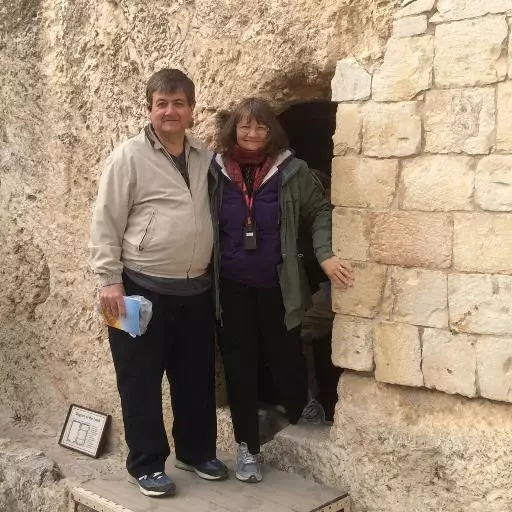
Bill and his wife Lynn have been married for over 40 years and have three adult children and two grandbunnies.
Contact Hope From the Word with Bill Luebkemann
https://hopefromtheword.org/
Hope From the Word
Calvary Chapel of Marlton
55 East Main Street
Marlton, NJ 08053
856-983-1662