
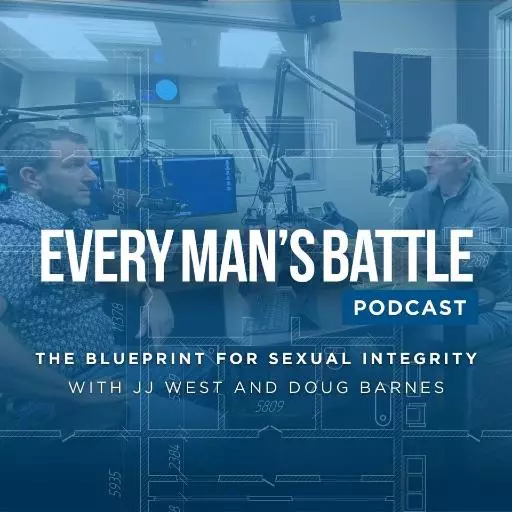
When the Temple Breaks: Eric Thomas's Journey from NFL Dreams to Sexual Integrity


📻 𝙀𝙫𝙚𝙧𝙮 𝙈𝙖𝙣'𝙨 𝘽𝙖𝙩𝙩𝙡𝙚 𝙋𝙤𝙙𝙘𝙖𝙨𝙩 – 𝐄𝐩𝐢𝐬𝐨𝐝𝐞 𝟖 Show Notes
Licensed counselors JJ West and Doug Barnes kick off a Season 3 mini‑series introducing Every Man's Battle facilitators by sitting down with Eric Thomas, LMFT. Eric shares his powerful story: early exposure to his father's porn stash, NFL dreams shattered by a shooting at 20, years of shame over his scarred body, transactional relationships, and deep isolation—until God met him in an RV in the Eastern Sierras and showed him he was becoming his father: a man who would die alone.
You'll hear:
- How trauma and resentment fueled years of acting out, self‑soothing with porn, and using women to avoid vulnerability.
- The moment Eric realized he'd "booked his yearly vacation with his dog" because he refused to let a woman close enough to reject him.
- How God's patient grace brought Eric from brokenness to becoming a facilitator who helps other men find freedom and wholeness.
🎟 Use code 𝐄𝐌𝐁𝐏𝐎𝐃 to save $100 on the Every Man's Battle Intensive—the 3‑day workshop where men like Eric lead you out of isolation and shame into brotherhood, healing, and lasting sexual integrity.
📧 𝐁𝐎𝐍𝐔𝐒 𝐂𝐎𝐍𝐓𝐄𝐍𝐓 & 𝐋𝐈𝐒𝐓𝐄𝐍𝐄𝐑 𝐐𝐔𝐄𝐒𝐓𝐈𝐎𝐍𝐒
Want extra tools and follow‑up content for Season 3?
EMBpodcast@newlife.com
with "Bonus Content" in the subject line to receive exclusive Every Man's Battle Podcast resources.
Have a question, topic suggestion, or your own story to share?
EMBpodcast@newlife.com
with "Podcast Question" in the subject line. JJ and Doug read and respond to listener emails, and your feedback shapes future episodes.
☎️ Need prayer, a counselor, or more info on workshops and groups?
👉 Call 800‑NEW‑LIFE or visit NewLife.com for counseling, groups, and faith‑based sexual integrity resources.
🎟 𝐒𝐏𝐄𝐂𝐈𝐀𝐋 𝐎𝐅𝐅𝐄𝐑 – 𝐄𝐕𝐄𝐑𝐘 𝐌𝐀𝐍'𝐒 𝐁𝐀𝐓𝐓𝐋𝐄 𝐈𝐍𝐓𝐄𝐍𝐒𝐈𝐕𝐄
If Eric's story resonates—if you see your own trauma, resentment, isolation, or transactional relationships—the Every Man's Battle Intensive is where healing begins. This 3‑day, in‑person workshop, led by licensed Christian counselors like Eric, creates a no‑shame zone where men bring hidden struggles into the light, find brotherhood, and receive practical tools for lasting sexual integrity.
📅 Upcoming Dates:
January 23–25, 2026: Orange County, CA
April 24–26, 2026: Washington, DC (Early Bird discount ends April 10)
February 28, 2026: 1‑Day Online Intensive (Early Bird discount ends Feb 13)
Use code 𝐄𝐌𝐁𝐏𝐎𝐃 when you register to save $100 on your tuition. If cost is a concern, ask about scholarships and financial assistance when you call 800‑NEW‑LIFE—New Life does not want money to be the reason you stay stuck.
🎧 𝐂𝐎𝐍𝐓𝐈𝐍𝐔𝐄𝐃 𝐒𝐔𝐏𝐏𝐎𝐑𝐓: 𝐒𝐔𝐒𝐓𝐀𝐈𝐍𝐄𝐃 𝐕𝐈𝐂𝐓𝐎𝐑𝐘 𝐆𝐑𝐎𝐔𝐏𝐒
After the Every Man's Battle Intensive, ongoing Sustained Victory groups provide weekly virtual coaching, accountability, and deeper healing with other men on the same path. These small groups, led by trained counselors, reinforce biblical truth and help you maintain momentum so you don't go back to isolation, shame, or acting out.
🎧 Discover more ways to listen & watch:
👉 Every Man's Battle Podcast hub:
https://newlife.com/podcasts/every-mans-battle/
👉 New Life LIVE & other podcasts:
#EveryMansBattle #SexualIntegrity #EricThomas #FacilitatorStories #ChristianMen #Trauma #Resentment #Grace #RecoveryJourney #NFLDreams #BrothersInChrist #EveryMansBattleWorkshop #NewLifeMinistries
Announcer: Welcome to the Every Man's Battle podcast, brought to you by New Life Ministries. In this podcast, you'll hear honest conversations and encouragement for living a life of sexual integrity. In every episode, licensed marriage and family therapist JJ West and licensed professional counselor Doug Barnes break the silence around sexual integrity struggles that millions of men face but rarely discuss openly. Each episode offers practical strategies and genuine hope to dissolve the shame and isolation that keeps men trapped in destructive cycles. Let's get to today's episode.
JJ West: Hey everyone, welcome back to the Every Man's Battle podcast. Thanks so much for tuning in. We are excited about today's episode. If you're watching online, you can already see that we have a special guest in our studio. We have Eric Thomas, who is one of our facilitators at the Every Man's Battle Intensive. We're going to get to know Eric a little bit better. Of course, you can see Doug, who's joining us via Texas. We're so thrilled, Eric, for you to join us today on what we term as Happy Podcast Day. We wish each other a happy podcast day and welcome to season three.
The reason why we have Eric in the studio today is we're starting a new mini-series. It's part of season three and it might even stretch into season four, where we want to introduce you, the audience, to several of the men who serve as facilitators at Every Man's Battle so that you can get to know them and get to know their story. In the same way that Doug and I in season one shared our stories, it really was born out of a conversation that I had with one of our listeners, Joe, who's also an EMB alum.
He reminded us the other day of how helpful it is to hear the stories of other men because there's always something that I connect with in somebody else's story. It's going to be different. I'm going to connect to something different in Eric's story than I connect to in Doug's story, and it's going to be different than what you might connect to in my story. So it's really important that we hear all these different stories because we go, "Oh yeah, that relates to my story and I feel seen and heard and I feel like there's a path forward for me toward healing and toward hope." So Eric, thank you for being on with us today.
Eric Thomas: It is my pleasure. Thank you. It's great to be here with both of you.
JJ West: Without further ado, we can't wait to learn more about Eric. I've got a few questions that I'm going to ask. Of course, Doug's going to chime in and ask his questions and wax eloquently as we do so. What we hope is that this will be an encouragement to you as you may be feeling like, "Oh gosh, I don't know if there's a way out of my brokenness. I don't know if there's a way toward healing and hope and sanctification."
So let's start though with some of the specifics. Eric, how long have you been a facilitator for the Every Man's Battle Intensive? How did that connection come about? How did you find it?
Eric Thomas: I'm on my third year of being a facilitator at the Every Man's Battle, and the connection was through my friend Sam Fraser, who is a facilitator. I've been friends with Sam Fraser for about 20 years.
JJ West: You've been friends with Sam for 20 years?
Eric Thomas: 20 years.
JJ West: Okay, so now I've just got to ask the question. How did you and Sam become friends 20 years ago?
Eric Thomas: We had a link from Fuller Seminary. I was studying for my marriage and family therapy license and Sam was an alum. I needed someone to help me out with a few things and to give me some guidance. Sam was able to do that and we stayed friends.
JJ West: So you're a licensed marriage and family therapist. You work in private practice or you work in a group practice? What's your setup?
Eric Thomas: I work in private practice.
JJ West: You work in private practice and of course, you get to serve as a facilitator at the Every Man's Battle Intensive, which we are the incredible beneficiaries of. So thank you for serving in that way. At the Intensive, we share our stories with the guys as an invitation for them to share their stories. So why don't you share with the audience your story? How did sexual integrity weave its way through your story?
Eric Thomas: I can recall probably my first encounter. Let's just say 1982. I started taking particular interest in those magazines that came in those little slips that were around my house. My parents were both Christians, churchgoing people. There wasn't a romantic connection with my parents and I could tell that from an early age, meaning they slept in separate bedrooms. I'm aware that there are some couples that sleep in separate bedrooms that do have intimacy, but it was very clear that that wasn't the case for my parents. Ultimately, I shared a bedroom with my dad who worked nights. It wasn't too long before when he was at work that I would get out of my bed and search the room, and then I found the stash. I found the stash.
JJ West: You found the stash. Okay. And you were about how old?
Eric Thomas: I was about 12.
JJ West: About 12 years old. You find Dad's stash and when you first discovered the stash, when you first found those magazines, what did you feel?
Eric Thomas: Both exhilaration and shame.
JJ West: Exhilaration. What did that feel like as a 12-year-old?
Eric Thomas: It felt like goosebumps. It felt like shortness of breath. It felt like I had discovered the hidden treasure.
JJ West: Yeah, so there's that exhilaration, that excitement, that electricity of finding this hidden treasure. But then there was the shame. At 12 you probably wouldn't have used the word shame, but you felt something. Do you remember what it felt like to feel shame there?
Eric Thomas: It felt like I'm doing something wrong.
JJ West: So even though I have this exhilaration, this desire is awakened in me for something—and by the way, that desire is supposed to be there, sexual desire, God intended it for us—so there's this good thing that's happening, but I feel bad about it. I'm not supposed to be feeling this. I'm not supposed to be experiencing this. I'm doing something wrong, to use your words. So then at 12 years old, what did you do with those feelings?
Eric Thomas: I just ran with it. I suppressed the bad feelings and let the good feelings roll for a little while.
JJ West: So from 12 until what age would you say was this period where you're just continuing to go with these magazines, with these good feelings that you get from them?
Eric Thomas: I would say probably about two years because when I was 14, we got a bigger house and then I got a bigger room to share with my brother. So my access to the treasure had been cut off.
JJ West: Access had been cut off. Gotcha. In a good way, in a good way. Okay. All right. So then did it just evaporate? Did it go dormant? Did it find other expressions?
Eric Thomas: I would say that it went partially dormant because I was also an athlete and I was looking to play college football and in the NFL. Our coaches were already telling us to avoid sexual activity because it's going to make you weak, it's going to make you soft. So there were real conversations about—of course, they were said like, "Don't play with yourself. It's going to make you weak." And so there was that voice. I'm very goal-oriented. So I would say for the most part, my goals kept me from trying to find them in the house.
But there were times where I would just be walking home from school and the trash would be out in front of someone's house and I could see just what was hanging out was enough to let me know that that was a magazine. So I would open up that trash bin and grab it and then take it to one of my friend's houses and we would take a look at it together. Interestingly enough, this is just coming to my awareness, there wasn't any co-masturbation or anything like that. We were just looking at it and enjoying it and then I would leave it and go back home. I'd leave it with him.
JJ West: And was that because of that goal orientation? Not because of the threat of being found out at home that you're looking at stuff you're not supposed to.
Eric Thomas: No, it was more being goal-oriented. I think that my parents were probably busy enough trying to figure their marriage out to be worrying about little things like that. If Dad's looking at it, it would be pretty hard for him to have this stance of, "You shouldn't be looking at my magazines." Absolutely. So how long did that phase—from about 14 when you started to really take your athletic career seriously, how long did that phase of "I just look at it every once in a while if I happen to come across a magazine with a friend but I don't engage in say masturbation, self-stimulation," how long would you say that phase was?
Eric Thomas: I think that the phase of trying to not engage in masturbation was probably maybe a year or two until I got into high school. I started playing high school football and then my football career became real and my goals really seemed attainable. So then the focus shifted away at that time from trying to avoid pornography and to trying to avoid cheerleaders.
JJ West: So now instead of the magazines, now you're trying to avoid actual sexual relationships with other people.
Eric Thomas: Correct.
JJ West: And I don't know what it was like in your school, but in my school, the guys who were on the football team, they were the top pick. They were the ones that the cheerleaders actually wanted to be with. So there was opportunity.
Eric Thomas: Absolutely, there was opportunity.
JJ West: And did you have the same admonition or scare tactic from the coaches in high school that you had in middle school of "Don't do this, don't let yourself get sucked into a relationship with a cheerleader"?
Eric Thomas: We had some coaches that were speaking that and then we had other coaches who were actually sleeping with teachers and bragging about it in the locker room. So there was a mixed message there. But I, at that time, was really locked in and so I paid attention to the people that were giving the message that I wanted to follow, and that was to abstain. I was able to make it out of high school still maintaining my abstinence.
JJ West: So then what happened in the next chapter after you got out of high school?
Eric Thomas: I ended up going to community college because I missed a couple of classes, meaning I didn't do well in those classes. I didn't get straight to the four-year school. So I went to community college with the understanding that after two years playing there, I would finish my career at a four-year school with a scholarship. I started my freshman year and a lot of Pac-10 schools were looking at me. I was still maintaining my abstinence and really taking on the persona of the person like I'm not going to cut my hair, that's my strength, and I'm not going to sleep with girls because that's my strength.
And then before my sophomore year—I grew up in South LA and I still lived there—so before my sophomore year, it was the summer, July 14, 1989. I can tell you the date. I went to get something to eat and the restaurant was robbed and people came in shooting and I got shot in the back. That's where the story took a turn.
JJ West: So what was the turn?
Eric Thomas: Well, basically I had to learn how to walk again. The doctors told me that I would never play football again, that I would be lucky if I could just walk. When I woke up from surgery, there was a zipper from my chest here all the way down to the bottom of my stomach and other scars on the right side and a cut on the right side where my lung had collapsed. So there were a lot of scars on what was once a very beautiful body.
A body that I hadn't brought in my theology from my church—my church was also reinforcing that your body is a temple of God. And so I just remember waking up, looking at my body and saying, "What happened to my temple?" And then I immediately felt regret for saving myself, for waiting all this time because I just said, "Well, who's going to want me now?" I passed on these sexual experiences but I'm not going to have them because I look like Frankenstein. The temple has been destroyed.
So now I'm filled with all this regret, maybe resentment, a lot of resentment. And possibly even resentment toward God, right? Because I was—my theology was telling me to save myself for marriage because that's what God wanted me to do, and I'm also taking care of my body, my temple, for my career. All of that just got snatched away.
JJ West: And as we all know as fellow addicts, resentment is a key driver in our acting out. So talk about that. What did that look like in the coming weeks, months, and years after you woke up in that hospital bed?
Eric Thomas: I immediately started questioning God and challenging God and letting my parents and my pastor know that I was very upset with God and that I was disappointed. Why did I follow all of these rules only to have these things happen to me? Because I grew up in South LA and I would say that a significant portion—I grew up right where all those 80s movies are filmed, Boys n the Hood, Menace II Society, you could see my house probably in one of those movies. I successfully navigated through that, through those temptations and things that were offered to me.
I felt like I did everything right. So I went into victim mode. While I did work very hard to get back to football shape, I still decided—I made a decision that I would like to use my body sexually. At the same time, I had so much shame around how my body looked. So I got into pornography. I would say that at that time, I felt like I was—the language I would use now is I was self-soothing because there was so much pain and emotional turmoil.
And that was it for a while because I was focused on getting back into football. As my career continued because I did make it back to football and I did get half a scholarship to a smaller Division I college, I did use my body sexually with—I took the offers that were given to me. But there was no intimacy or any connection. I had a lot of shame. I kept my shirt on. I didn't feel like I was even worth looking at. And that was how it was all the way through college. I had come to believe that I was damaged goods.
The lure of pornography and self-stimulation, masturbation, is so strong because I have the belief that it's anonymous, right? There's low risk. There's no one there looking at me, potentially rejecting me, judging my body unfavorably. And yet I'm still a sexual being that longs for sexual desire to be met. So I go looking for it in ways that are low risk and I don't have to be vulnerable and take my shirt off.
JJ West: I want to run back to Eric at 20 years old, 21 years old, 22 years old, and put my arms around him and say, "Oh man, you're so loved. You're perfect as God—you're exactly what God designed you to be." And yet it's very—you know, we can't do that. I know, and I wish someone had done that. I don't know if it would have made a difference, but yes.
So the dream of D1, playing in the Pac-10, that's gone. After the shooting, after the surgery, that's gone. I still get back to football and I'm playing—I've now managed to get to a D2, D3 school, something. I'm in the Big West Conference, not the Pac-10. This was not the dream. But it's a sample of the dream. Am I more aware of I'm getting some of the dream, or am I more aware of this is not what I wanted?
Eric Thomas: I'm more aware of how my body isn't moving how it used to move and I'm more aware of how men that I think would have driven five yards down the field are either defeating me or having me at a standstill.
JJ West: So again, I'm reinforcing I'm damaged goods. The temple has been destroyed. Does that take me further into that self-soothing addictive behavior to self-medicate that feeling?
Eric Thomas: Yes, because what's also happening is that my church community is telling me that I'm blessed and that I am doing more and doing better than most people in my community. So I'm getting messages that are telling me to be grateful. Those messages don't sit with me. They're not resonating with me and that's leading to more self-soothing. And I would tell you that there was a lot of hope that I would even still make it to the NFL out of the Big West.
And so there's this theology that's still running that even though I'm not doing treating my body as the temple because I think the temple is destroyed—to use your language, that's great language—I still have this hope that I'm going to make it out of the Big West and somehow get discovered and have a great pro career and I'm going to have this testimony and I'm going to minister to people that have experienced trauma and I'm going to get my hope back and things are going to line back up.
JJ West: My hope is in my ability to fulfill that dream, right? But then with each passing season and I'm not able to drive these guys five, ten yards down the field, I'm losing more and more hope that that dream is going to be fulfilled. And if that dream's not fulfilled, where is my hope now?
Eric Thomas: So then I graduate with a degree and begin work and because I did not become an NFL player, slowly I start to accept the fact that I'm not going to be an NFL player and then I start thinking that I need a wife because I'm still active in my church. I do realize and understand that there still was a blessing on my life because I did get a college degree out of that and I had a good job.
So I'm trying to move forward. There are still trauma symptoms that nightmares and things that haven't gone away from getting shot and things like that. But I'm now ready to try and find a wife.
JJ West: And how'd that go?
Eric Thomas: Found one, but I can definitely say now that I was not whole enough to be the husband that I should have been and that I was not well enough psychologically and maybe even spiritually to accept that maybe her boundaries or her limitations on intimacy wasn't an outright rejection of me based on the fact that my body and everything was scarred up. So I heard every—what I would now say at this age probably a normal discourse conversation limit boundary that happens in marriages—those things were all looked at through for me through the lens of, "Oh, it's because I'm destroyed. I'm not worthy of having someone who really wants to be intimate with me and connected with me." That filter was filtering all those messages.
JJ West: Was that what caused the relationship to deteriorate?
Eric Thomas: Absolutely. And so, man, I mean we're just piling up the disappointments.
Eric Thomas: Absolutely piling them up, sir.
JJ West: And so what's happening to your heart?
Eric Thomas: I would say that my heart is getting more and more like stone than like flesh. I'm hardening my heart more and more so that I don't feel the weight of all these disappointments that are piling up. For me, when I was doing that, it was, "Okay, so I go to my sexual acting out as the way to feel something and to avoid the disappointment."
Eric Thomas: And I did that. I did that exact thing. And this time I just decided to just go no holds barred because I am now a viable adult with a really good job and I decide that if I'm going to interact with women, then I need to make sure that I get my needs met. So I find myself involved in quid pro quo relationships that guarantee that if I do this for you, then I get what I want. Before I met you, JJ, I would have said I get what I need, as would I.
I was consumed with getting my needs met. Everything that I didn't get from high school all the way up through marriage, I've got to make up for lost time. All that energy. So I just go through relationship after relationship after relationship, and I'm using these people. In my incorrect thinking—and I even knew better at the time—it was just like, "Yep, okay, but what did she get out of that? Oh yeah, she got a trip to a place that she would probably never go to or she got a bracelet or she got something." And that was how I was justifying in my mind that I wasn't using someone, that it was this for that and I had that exact language. Quid pro quo. Absolutely. So I'm not a monster who's just using women. It's a trade. But eventually, eventually those justifications start to wear thin.
Eric Thomas: Well, that happened for me. My dad passed—and my dad never remarried after divorcing my mom—and my dad was a lady's man and a sex addict since we're talking about it clearly. He passed away and he died alone. And God met me. I was up in the Sierras in an RV for a fishing trip and I went up there a little too high. I went up in May and I took my dog, who was then nine years old. His name was Patch.
I'd taken off for a week and rented a camp space and that first night it snowed. My dog did not enjoy the snow and I can remember him not wanting to get out of the RV because it was just too cold for him. And that night, after two nights of being there kind of stuck in the RV, not really getting what I want, not doing the fishing, my dog not having a good time—and there was alcohol involved in this also—I can remember looking at my dog in the eye and I said, "Patch, you've got to learn to enjoy this snow because this is our vacation. I took off a whole week for us to come up here and go fishing and have a good time." And as I'm saying that, I just start breaking down crying because I really felt like God was amplifying every word that I said and I said to myself, I said, "I'm going to be like my dad. I took my yearly vacation with my dog because I refuse to let a woman get close enough to me to judge me, reject me, or hurt me. And I'm trying to convince my dog that this is why we're here and he needs to just not be old and cold and get out here and enjoy this fishing trip."
And God wouldn't leave me alone that night. Those words kept coming back into my head and then I kept having images and flashbacks of my dad, of my dad's final time, and I thought I could soothe that with alcohol and so I drank more and more. And the more that I drank, the more I kept seeing my dad and I kept seeing my dog and I kept hearing my words. And I just said, "This isn't how I wanted life to go." That was the wake-up call.
JJ West: So if that was the wake-up call, what did it wake you up to?
Eric Thomas: It woke me up to realizing that if I wanted a happy life, if I wanted to really be the person that God wants me to be, that I've got to essentially get my life together and heal. Most of my healing, the therapy that I did, was about nightmares from getting shot and the violence and things that I haven't talked about in this podcast because I know we're talking about another subject.
So I did a lot of therapy, but there was so much that I didn't get to talk about—sexual integrity or trusting or love or anything like that. And so all of my love I was pouring into my dog and women were just company. I wasn't taking one on a vacation, not on my vacation, because I would probably only just get rejected and hurt anyway. The dog is safe. A dog is loyal. A dog doesn't care what you look like, what you smell like—they are loyal and want to be with you no matter what.
JJ West: So when did you come to a place where you said, "Okay, I've got to be serious about my sexual integrity. I've got to do something different"?
Eric Thomas: Oh, it was that morning when God allowed me to wake up again. I packed everything up and drove home and came home and just really got on my knees and said, "God, I thank you for the awakening and I thank you for the vision that you came to visit me all the way up in the Eastern Sierras and I heard you. I heard you say that this isn't the life that you have for me, that you want more for me." It might sound cliché, but I made some phone calls that day that I got back and said I'm done with the situationship and I need to do things differently. And then the first thing I did was learn how to be with God and with myself and start healing that way.
JJ West: You started the process of connecting with God and with self so that you could then have authentic connection with others. Tell me one thing you've learned along the way that's made a big impact in your recovery.
Eric Thomas: For most of my life, my early life, I was responding to what happened to me. I didn't really understand grace because I was always in recovery mindset, recovering from what this person did to me, what that person did to me, how that person made me feel. And what happened when God met me up in the Eastern Sierras and showed me my present self and possibly my future self if I didn't change, and then when I started my sexual recovery and I became aware of the people that I hurt and the pain that I caused due to my acting out behaviors, I learned what grace is because I was just like, "Wow, God was really patient with me. God was really patient with me while I went out there and I did those things." And so I'm continuing in awe by God's grace and the fact that I get to come and help facilitate Every Man's Battle. I was just like, "Me? Are you kidding? I don't deserve that. I do not deserve to sit with any men and tell them or help them understand anything. I have been horrible." But I have had to accept God's grace in order to do the work that he's called me to.
JJ West: Wow. And I know we got the tip of the iceberg when it comes to your story, Eric, but can I just say thank you so much for your willingness to be vulnerable, thank you for letting us into your world a little bit. And I know if you're in the audience, I know you're sitting there going, "Wow, that is a powerful story of brokenness." And every single one of us can connect to that feeling of being broken. Every single one of us can connect to that feeling of "I'm going to be rejected." It may be for different reasons. For some, it's going to be "My body has been broken because of the scars." For some of us, it's going to be "I don't measure up to what other people are looking for." For some of us, it's going to be the "I've been beaten down by others." There's all kinds of different ways that we've interpreted that I'm broken, but we all have brokenness and it invites us into resentment. It invites us into hiding. It invites us into self-medicating through whatever our escape is. And we have to come to the place, just like Eric, we have to come to a place of recognizing this isn't life. This isn't what God has for me.
So if you're out there and you've heard Eric's story and you've connected the dots in your own story and you've said, "I've been living in a place that God doesn't have for me. I am isolating. I'm going on vacation with my dog. I'm withdrawing from people but I want to have life," call. Call 1-800-NEW-LIFE. Go to the website, go to newlife.com. Sign up for the Every Man's Battle Intensive because that can be your turning point. That can be your wake-up call to say, "I'm not going to live this half-life, this shell of a life, this shadow anymore. I'm going to live life to the full the way God designed for me."
So please make that call. Again, I feel like a broken record, but don't forget, use the code EMBPOD, EMBPOD in the coupon code, you'll get $100 off the registration fee because we want you to go. We want you to be there. We want you to experience what it looks like to go from not living to living, to go from isolation to community, to go from brokenness to wholeness. And we can't do it alone. So guys, together, let's keep walking in integrity. Next time we meet, we are going to talk about what should be included in a check-in call. We're going to give you some examples of what that looks like because we know you're in community, you're doing Sustained Victory, and you need some help. You need some practical tools for what does a check-in call look like. So join us next time for that, and thank you again for listening.
Announcer: Thanks for listening. This podcast is one of many ways we can encourage and help you. If you're looking for more help, visit us at newlife.com or call 1-800-NEW-LIFE. To receive bonus content exclusive to EMB podcast email subscribers, send an email to embpodcast@newlife.com with the words "bonus content" in the subject line. If you have a comment about this podcast, we'd love to hear from you too. Drop us a line at embpodcast@newlife.com. And please remember to review, like, and share the podcast as it helps others find us. See you next week.
Featured Offer

Use discount code EMBPOD to save $100 when you register for the Every Man's Battle Intensive. The Every Man’s Battle Workshop is the place where men engage in the battle to get back their sexual integrity. In this intensive three-day workshop you’ll work with licensed Christian counselors who will arm you with the weapons you need for victory. The enemy may have wounded you, but the battle is not over. Register today. Too much is at stake not to take action.

Featured Offer
Use discount code EMBPOD to save $100 when you register for the Every Man's Battle Intensive. The Every Man’s Battle Workshop is the place where men engage in the battle to get back their sexual integrity. In this intensive three-day workshop you’ll work with licensed Christian counselors who will arm you with the weapons you need for victory. The enemy may have wounded you, but the battle is not over. Register today. Too much is at stake not to take action.
About Every Man’s Battle Podcast
New Life has been helping thousands of men with their sexual integrity for over 3 decades. Every Man's Battle podcast discusses the topics that will help men understand their challenges, the pathway to Christlike character, and hope for recovery. Becoming a man of sexual integrity is an ongoing process, and we can help you on the journey. New Life's EVERY MAN’S BATTLE PODCAST can assist you on the pathway to becoming the man you hope to be. As all things sexual integrity, EVERY MAN’S BATTLE PODCAST is for EVERY MAN!
Use discount code EMBPOD to save $100 when you register for the Every Man's Battle Intensive.
About New Life
JJ WEST
JJ is a Licensed Marriage and Family Therapist in private practice in Orlando. With a Master’s and Specialist degrees in Counselor Education, JJ began private practice after years of working with children, adolescents and families in outpatient settings. In 2009, he became an Every Man’s Battle Workshop facilitator, taking over as the main presenter in 2022. Before becoming a therapist, he worked for several years with college students in both Christian ministry and church settings. JJ is married with 2 adult children; and enjoys outdoor adventures, traveling to other cultures, good movies, and Florida State sports.
DOUG BARNES
Doug is a LifeCoach and Licensed Professional Counselor with Supervisor status working in private practice in the Dallas Ft. Worth Metroplex; working primarily with men and couples in finding restoration and redemption from sexual brokenness. His journey into becoming a clinician began in his teens and cultivated into a road to healing in his early twenties after the death of his father. He has worked with Every Man’s Battle Intensive Workshops as a facilitator since 2006. His passion is to give other men what God has given him—freedom. Doug has been married for 31 years and has 2 sons. He is a rollercoaster junkie, runner, all around fitness gym rat, and sometimes even breaks out his guitars to play.
Contact Every Man’s Battle Podcast with New Life
EMBpodcast@newlife.com
http://everymansbattle.com/
New Life Ministries
PO Box 852347
Richardson, TX 75085-2347
Phone Number
(800) NEW-LIFE (639-5433)