

A Nation That Prays Together Stays Together Nehemiah 9 Part 2


Today on Connect with Skip Heitzig, Pastor Skip explains why confession is one of the most important parts of a healthy relationship with God.
Guest (Female): Welcome to Connect with Skip Heitzig. We're so glad you've tuned in today. At Connect with Skip, we're passionate about helping you grow in your relationship with Jesus. That's why we share verse-by-verse Bible teaching that's both clear and practical, so you can live out God's truth wherever He's placed you.
And you can stay connected beyond the broadcast when you sign up for Pastor Skip's free weekly devotional. You'll receive biblical encouragement, exclusive content, and helpful resources to guide you deeper into God's Word, delivered straight to your inbox. Signing up is quick, easy, and completely free. Sign up today at connectwithskip.com. That's connectwithskip.com. Now, here's today's message from Pastor Skip Heitzig.
Skip Heitzig: I've always thought that manna was one of the coolest inventions of God because manna was like the multivitamin of the Old Testament. Everything you needed was in this little bread that came from heaven. And not only a multivitamin, but a vitamin that tasted good. It tasted like Krispy Kreme donuts. Now, you think I'm stretching it a little bit, but let me give you the biblical description. It tasted like wafers made with honey. You heat that baby up and that's a Krispy Kreme donut right there.
Verse 21, "Forty years You sustained them in the wilderness; they lacked nothing; their clothes did not wear out"—he's just rehearsing God's faithfulness—"their clothes did not wear out and their feet did not swell." Can you imagine having a wardrobe that never wore out for 40 years? Every man in this room would love that. I don't think the gals would like that that much. "Honey, I need a new dress." "Actually, you know, I got that for you 35 years ago and it looks brand new. Boom."
I do want to just touch on that last little phrase, "their feet did not swell." That's a very telling phrase you might just want to brush over, but I had a missionary explain that people that have the same diet—there's no variety in what they eat—the sameness of diet will prohibit a person from getting vitamins, especially Vitamin B1, thiamin. And the person can manifest a disease called Beriberi, and one of the symptoms of that is the swelling of the feet.
So the fact that God, by just giving them water miraculously and bread from heaven—the multivitamin manna—all that they needed was cared for for 40 years. So, back to the prayer. After adoration, looking up, they looked back. That's reflection. Do you ever do that? Do you ever in prayer rehearse before the Lord your spiritual journey? For some people, this is why they keep a journal and they write down the things that God has been showing them and then look back over it in days to come.
Reflection in prayer helps you do two things. It helps you track God's goodness and it helps you evaluate your progress. Track God's goodness, evaluate your progress. My history professor loved quoting that historian who said, "Those who fail to learn from history are doomed to relive it." So memory can be a powerful tool. In your prayer life, after telling God He's awesome because He is and giving Him adoration and adjusting your perspective, I think it's good to rehearse, even in short form, all the faithfulness of God.
Just highlight that. Lord, You've done this and You did that. I remember when I was single and I prayed for a wife or I prayed for a husband, and then I needed a job, then when I was in the hospital how You came through. In Deuteronomy chapter 8, God gives the command to do that. He says to the people of Israel, "And thou shalt remember all the way the Lord thy God led thee these 40 years." It's a command. I want you to rehearse what I've done. To the church of Ephesus, Jesus said, "Remember from where you have fallen; repent and do your first works."
So begin by adoration, continue with reflection, recalling your spiritual journey. Third element: they looked within. They looked within. This is confession. They looked up, adoration; they looked back, reflection; now they look within and they make confession of their sin. We're told in the verses we began with in this chapter that they stood up and confessed their sins and the iniquity of their fathers. Now I want you to notice something. Look down at verse 16. Let's just get the thought of this.
Ezra recalls God's blessings to His people in the past. But then in verse 16, "But they and our fathers acted proudly, hardened their necks, and did not heed Your commandments. They refused to obey." Go down to verse 26. After telling them that God still blessed them, verse 26, "Nevertheless they were disobedient and rebelled against You, cast Your law behind their backs, and killed Your prophets who testified against them to turn them to Yourself; and they worked great provocations. Therefore You delivered them into the hand of their enemies."
But then he says You delivered them from their enemies. Go down to verse 34. After God delivered them, "Neither our kings nor our princes, our priests nor our fathers, have kept Your law, nor heeded Your commandments and Your testimonies, with which You testified against them." Okay, so far he's looking back and he's saying they blew it, they were out of line, they sinned, pointing the finger. But now in verse 37, talking about the land they're in, it yields much increase to the kings You have set over us because of—watch this—our sins.
Now he's including himself. He's including the present generation. "Because of our sins. They also have dominion over our bodies and our cattle at their pleasure, and we are in great distress." It's been said that the six most important words in any relationship are: "I admit that I was wrong." Six most important words: "I admit that I was wrong." Confession. "I admit that I was wrong." That's what they're doing. They blew it, they were wrong. I admit that I was wrong.
Likewise, Jesus, when He taught His disciples to pray, said, "When you pray, just don't say Our Father who art in heaven, hallowed be Your name, but also make confession. Forgive us our sins, our debts, our trespasses, as we forgive our debtors." You remember that little story that's tucked away in the Gospel of Luke? It's around chapter 18. In fact, it is chapter 18. Jesus told a story about two men who prayed. He said, "Two men went up to the temple to pray. One was a Pharisee and the other was a tax collector."
And this is what Jesus said: "The Pharisee stood"—listen, listen—"the Pharisee stood and prayed thus with himself." Very interesting. He's offering a prayer, Jesus said, but he's not really praying. He's actually praying to himself. He's listening to himself going, "I'm so awesome. Listen to how cool my prayer is. That is so good." So he's not really doing it to talk to God. He's doing it to impress himself and probably anybody else who could hear him because he was praying it publicly.
He said, "The man stood and prayed thus with himself. Here's his prayer: God, I thank You that I am not like other men—extortioners, unjust, adulterers, or even like this tax collector. I fast twice a week; I give tithes of all that I possess." He's bragging about himself and he's pointing fingers at other people who have failed. Ezra does not do that. Sometimes we can be finger-pointers in our prayers. Ever been in a prayer meeting where somebody goes, "Lord, I just pray that You will forgive us of pride that some people have struggles with."
It's like they're not praying, they're just preaching. In this prayer, Ezra is not superior, he is not condescending, he is not self-righteous. Instead of pointing the finger at other sinners, he's grabbing the hands of those sinners and saying, "I am along with you in this. You have sinned, they have sinned, I have sinned." Leonard Ravenhill said, "The self-sufficient do not pray, the self-satisfied will not pray, and the self-righteous cannot pray." Ezra was none of those.
Now notice that this confession of sin followed adoration and reflection. That's a healthy pattern. That's a good pattern. If you're looking for ways to improve your prayer life, add this element: adoration, then reflection, then confession. Why is it a healthy pattern? Simply this: the closer you get to God and the clearer you see God by adoration, then the clearer you also see your own sin and failure and that drives you to repentance. That's confession.
This happened to Isaiah the prophet. Isaiah. He was a prophet, a heavyweight, and he had a vision of God. I don't know when's the last time you got a vision like Isaiah got a vision, but I haven't had one. He saw the Lord high and lifted up and the train of His robe filled the temple. And in seeing the majesty of God, he said, "Woe is me! I am undone. I am a man of unclean lips, I dwell in a generation of unclean lips." In seeing God clearly, he also saw himself clearly and he made confession.
Guest (Male): This is Connect with Skip Heitzig. Your support helps reach people every day with biblical truth that brings clarity, hope, and direction in difficult times. And this month, we'd like to thank you with a timely resource centered on God's power to restore what's broken. When you give today, you'll receive City in Shambles, Pastor Skip's complete 18-message study through Nehemiah on CD plus digital download.
These messages will help you understand how God works in times of confusion and instability, how revival begins in the hearts of His people, and how to move from passive concern to courageous faith in action. Your gift helps extend the reach of Connect with Skip Heitzig, connecting more people to God's Word. Request your resource when you give $50 or more at connectwithskip.com/offer or by calling 800-922-1888. Now, if you're looking for a way to go deeper in your Bible study, here's a great way to do just that.
Skip Heitzig: Learning your Bible matters. I'm committed to teaching God's Word and I want you to understand the depth of Scripture for yourself. That's why I want to invite you to join me in a 90-day through the entire Bible reading challenge using the YouVersion Bible app. We call it Jesus People Grow. So for 90 days, we're going to read together God's Word. We're going to learn it, receive it, and we're going to let it shape us so that we can also be faithful in sharing good teaching with others. So join me. Let's learn our Bibles and grow in the Word of God. Now, here's more from Pastor Skip.
You say, "Why do I need to make confession? Why do I need to confess my sin? Isn't God all-knowing? Doesn't He know that I have blown it?" Yes, He does. Why does He want you to confess it? God knows who you are. God wants you to admit who you are. He wants to hear you admit who you are. That's confession. I admit it. I admit that I was wrong.
Fourth step: they looked around. They looked around. This is petition. They're looking around at where they're at, they know they're in need, they're looking at their situation. Look at verse 32 with me. "Now therefore, our God"—see the prayer pivots—"now therefore, our God, the great, the mighty, and awesome God, who keeps covenant and mercy: do not let all the trouble"—that's the trouble we are in—"do not let all the trouble seem small before You that has come upon us, our kings, our princes, our priests, our prophets, our fathers, and on all Your people, from the days of the kings of Assyria until this day.
However You are just in all that has befallen us; You have dealt faithfully, but we have done wickedly. Neither our kings nor our princes, our priests, our fathers, have kept Your law, nor heeded Your commandments and testimonies, which You have testified against them. For they have not served You in their kingdom, or in the many good things that You gave them, or in the large and rich land which You have set before them; nor did they turn from their wicked works.
Here we are, servants today! And the land that You gave to our fathers, to eat its fruit and its bounty, here we are, servants in it." Now don't misunderstand that. He's not saying, "Here we are Your servants in it." He's saying, "We're in the land You gave us, but we're slaves in it. Here we are servants in it, and it yields much increase to the kings You have set over us because of our sins. Also they have dominion over our bodies, over our cattle at their pleasure, and we are in great distress."
Here's the prayer. They're saying, "Look, we're in the land You gave us, but we're still somebody else's slaves. We're in distress. We're servants to somebody else." The King of Persia let us come back here, but we are under his command and under his control and under his taxation. "We are in great distress." So what he is praying is, "Look, You have been merciful to us in the past. Would You be merciful to us once again?"
This is his petition. That's his petition. In verse 32 he says, "Do not let this trouble seem small to You." Look at our trouble. Please do something about our trouble. Now listen, I mentioned that he didn't begin with petition with "I want, I need," but there's nothing selfish or unspiritual about making personal petitions, asking God, telling Him what you need or what you want.
In fact, it honors God when you do that because God happens to love dependence. When you say, "Lord, I am in trouble. I need, I want," at the appropriate time in your communication with God, that honors God's role as your provider. He loves when you depend on Him. Let me just say when you make your petitions, be as specific as you can. The more specific you are, the better.
I remember a guy that I knew who used to pray this: "Lord, You know every need, spoken and unspoken. Would You just work in those areas? Amen." What? What do you mean unspoken needs? Why don't you speak them? Would you go into a restaurant and say, "I have an unspoken food need. Just bless me." You might not get what you want. In fact, I had a friend a couple months ago I was with overseas and he went into a restaurant he knew, and he didn't even order. He just knew the guy, said, "Bring me what you think I need. You know what I like." And so he just let the guy order for him. At the end of the meal, he said, "I shouldn't have done that. It's not what I was looking for."
So you would go in and you would be very specific about what you want. The more specific you are, the more obvious it will be when the prayer is answered. If you say, "Lord, I have a general financial need," okay. But if you say, "Lord, I need $350 by Wednesday," when it comes, you'll go, "I prayed for that. It got answered." So they looked up, adoration. They looked back, reflection. They looked within, confession. They looked around, they made petition.
Fifth and finally, they looked ahead and they submitted themselves to God. This is submission. Verse 38, this is how it closes: "And because of all this, we make a sure covenant and write it; our leaders, our Levites, and our priests seal it." We're going to write a document. We're going to put our names on the dotted line. That is a pledge of submission to You. We've blown it, we've gone into captivity, we don't want that happening again. Lord, forgive us. Thank You for Your goodness in the past. Hear our petition and we're going to sign a pledge.
And chapter 10 is a list of all the people that put their names on the dotted line. This is sort of like Joshua. Joshua, when he brought the people into the land of Israel, he reaffirmed the covenant. Remember he said, "Choose this day whom you will serve. As for me and my house, we're going to serve the Lord." He made people step up and reaffirm the covenant.
Samuel did the same thing, Hezekiah did the same thing, so now Ezra does the same thing. This is the equivalent of Romans chapter 12: "I beseech you therefore, by the mercies of God, that you present your bodies before God as a living sacrifice, holy and acceptable, which is your reasonable service." So they step up and they say, "Oh Lord, here we are. We are Your servants. We are signing this pledge in writing." So the prayer doesn't end with a plea, it ends with a pledge.
Their remorse led to their repentance. Their repentance led to their reformation. They decided we're going to change our behavior. You know, people often confuse remorse with repentance. One is a feeling, the other is an action. You can feel remorseful about something but not do anything about what you're feeling. That's just remorse. Repentance is a decision to change that brings reformation.
So I've told you the story in the past, but I've always loved this little story. I heard it's a true story. I read about it. A guy sent a letter to the IRS because in the 1970s he had cheated on his income tax and he's felt guilty all this time. And he wrote a letter to the IRS and said, "I cheated on my income tax in the '70s, so I didn't pay all that I should, and I've not gotten good sleep since then." So he sent cash in an envelope, five $100 bills. The letter was wrapped around it. And then the man concluded the letter by saying, "If I still can't sleep, I'll send you the rest."
That's remorse. That's not repentance and reformation. You might feel bad about some things you do. Where's the rest? The rest is repentance and restoration and reformation. You remember Star Trek? Any Star Trek fans? Okay, so in the original Star Trek, you remember the engineer of the USS Enterprise? What was his name? Scotty. Right, he had that Scottish accent and by the way, people in Scotland say that was a horrible Scottish accent. But anyway, Scotty always, that I remember, was worried about the power aboard the Enterprise. And he would say things like this in a lot of the episodes: "Captain! I've given it all I can! I've given it all she's got! We just don't have the power!"
Do these things and you will have the power. You'll have the power. You say, "Oh, I pray all the time." So we have these things called popcorn prayers. I'm going to call them popcorn prayers. Here's a popcorn prayer: you hear about somebody who is dealing with an issue, "Oh, I'll pray for that," and you're walking away and you go, "Lord, help that person." You just popped one up. You're at a prayer meeting or a Bible study or a Connect Group and somebody says, "I have a financial issue," and you say, "Lord, help that person. Give them whatever they need financially. Amen." So you walk away from these things and you say, "I pray."
Most Christians don't pray like this. We pray, we talk about prayer, we sing, but we don't pray in a biblical way, faithfully, that includes these things. My challenge—I'm not asking you to go three hours in prayer every day—but just broaden out from "I pray before meals" and "I shoot up a popcorn prayer" to a little bit of adoration and reflection and confession and petition and submission. Do that, and I challenge you with that, and I believe you're going to see results and power.
Guest (Male): We're so glad you joined us today on Connect with Skip Heitzig. Before you go, here's a reminder. When you give $50 or more this month, we'll send you City in Shambles, Pastor Skip's complete study through Nehemiah on CD and digital download, as our thanks. These messages offer practical biblical insight for anyone burdened by the brokenness they see in the world around them, helping you respond with faith, prayer, and hope instead of fear or despair. Your support helps keep this Bible teaching ministry on the air, connecting more people to God's Word. You can give today at connectwithskip.com/offer or call 800-922-1888. See you next time.
Announcer: Make a connection. Make a connection at the foot of the cross. Cast your burdens on His Word. Make a connection. A connection. Connect with Skip Heitzig is a presentation of Connection Communications, connecting you to God's never-changing truth in ever-changing times.
Ready to go deeper in your faith and discover your calling? The School of Ministry at Calvary Church in Albuquerque is designed to equip you with practical Bible teaching, hands-on ministry training, and real-world experience. Whether you're called to lead, serve, or grow, this is your next step. Classes are forming now. Visit calvarysom.org to learn more and apply today. That's calvarysom.org. The School of Ministry at Calvary Church: your calling starts here.
Featured Offer
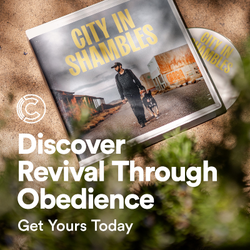
As followers of Christ, we recognize the brokenness around us and may be tempted to give in to feelings of hopelessness and despair. Yet we are called to faithfully seek God regardless of our surroundings and circumstances. This month, take your thoughts and actions captive and continue developing your own resolute faith that will carry you through this life’s difficulties and trials with Pastor Skip Heitzig's City in Shambles, on CD plus digital download.
Past Episodes
- A Red Christmas
- A Time to Build
- Adulting (A Study Through the Book of James)
- Against All Odds
- Alert Prophecy Update
- Always Only Jesus
- Believe
- Best of 2008
- Best of First Friday
- Bloodline: Tracing God's Rescue Mission From Eden to Eternity
- Can God Be Known?
- Celebrations of the Gospel
- Christians in the Crucible of Pain
- Christmas
- Church: A Place...
- Church? Who Needs It
- City in Shambles
- Crash & Burn
- Easter Series
- Expound
- Expound: Acts
- Expound: Exodus
- Expound: First Corinthians
- Expound: Genesis
- Expound: Holy Spirit
- Expound: John
- Expound: Philippians
- Expound: Romans
- Expound: Ruth
- Expound: Second Corinthians
- Expound-Ephesians
- Expound-Galatians
- Fact-Check
- Fight for the House
- First Friday
- Five Decades of Top Teachings by Skip Heitzig
- From the Edge of Eternity
- Hashtag
- Heart and Soul
- Heaven Below
- Help!
- History's Last Chapter
- Homeland Security
- Hunting Giants
- Hustle and Grind
- Rediscovering Our Foundations
- Rock Solid
- Rumblings of War and the Prince of Peace
- Running with Champions
- Technicolor Joy: A Study Through Philippians
- The Bible Doesn't Say
- The Bible from 30,000 Feet
- The Biography of God
- The End is Near?
- The House That God Builds
- The Light has Come
- The Passion of Christ
- The Royal Road of Love
- The War Is Over

Featured Offer
As followers of Christ, we recognize the brokenness around us and may be tempted to give in to feelings of hopelessness and despair. Yet we are called to faithfully seek God regardless of our surroundings and circumstances. This month, take your thoughts and actions captive and continue developing your own resolute faith that will carry you through this life’s difficulties and trials with Pastor Skip Heitzig's City in Shambles, on CD plus digital download.
About Connect
About Skip Heitzig
Skip Heitzig ministers to over 15,000 people as senior pastor of Calvary Albuquerque. He reaches out to thousands across the nation and throughout the world through his multimedia ministry. He is the author of several books including The Bible from 30,000 Feet, Defying Normal, You Can Understand the Book of Revelation, and How to Study the Bible and Enjoy It. He has also published over two dozen booklets in the Lifestyle series, covering aspects of Christian living. He serves on several boards, including Samaritan's Purse and Harvest.
Skip and his wife, Lenya, and son and daughter-in-law, Nathan and Janaé, live in Albuquerque, New Mexico. Skip and Lenya are the proud grandparents of Seth Nathaniel and Kaydence Joy.
Contact Connect with Skip Heitzig
Connect
PO Box 95707
1-800-922-1888