

Until He Comes


It’s hard to fathom that something as solemn and moving as the Lord’s Supper could draw controversy, and yet, in Paul’s day, it did just that...and in our day, through differing interpretations of its meaning and purpose, the table still draws dissension. Join Dr. James Boice next time on The Bible Study Hour as he takes a deeper look into the reasons we celebrate this foundational institution of our faith.
Alliance of Confessing Evangelicals, Inc: In the early church, the Lord's Supper was meant, among other things, to promote unity, bringing believers of different backgrounds and circumstances together as brothers and sisters in Christ. Yet the table often brought further division. Welcome to the Bible Study Hour, a radio and internet broadcast with Dr. James Boice, preparing you to think and act biblically.
As hard as it is to believe, some church members became drunk on the wine, and others refused to participate in the Lord's Supper. The wealthy came with plenty, and the poor came in want, yet the abundance was not shared. Even today, believers are divided over the true meaning and purpose of both the host and the practice. Join Dr. Boice as he takes a deeper look into the abuses of the Lord's Supper and the true meaning and purpose of this fundamental Christian institution.
James Boice: Most of the ceremonies of this world take great care to distinguish between people, so that those who are important get the first place and those who are less important get a somewhat lesser place, and so on down the line until you get to people that aren't even welcome. I've taken part in a number of graduation ceremonies, and it is the essence of graduation ceremonies to bestow honor and to distinguish between people.
If you've had the opportunity to acquire a doctorate degree, you get to wear a robe that has bands on the sleeve and you have a hood that goes a long way down your back, about three-quarters of the way to the floor. If you only have a master's degree, you only get a hood that goes halfway down. If you have a bachelor's degree, it's shorter than that and it's made of thinner material, and so on. These are the ceremonies of the world.
But it's not like that in the Christian church. There's the ceremony or ordinance of marriage, for example. Where the wedding service is properly conducted, it is a testimony to the fact that the high and the low, the mighty and those who are not mighty, are all united in wedlock in the same way with the same vows and with the same opportunities in the sight of God. It is true that sometimes people do strange things to try to make their weddings unique.
I read recently about a couple that were married while skydiving. It was a very short service. Another couple was married in a burning house. The reason for that is the woman was a firefighter, and so she thought it would be appropriate to be married in a house that was burning down around her. They were burning it for a training session of different firefighters, and they set it on fire and the ceremony began. They had just a few minutes to conduct it before the rest of the team came and put it out.
She wore an asbestos dress. Instead of a bouquet of flowers, she carried a fire extinguisher, and then she left for her honeymoon on a fire engine. In this particular case, the groom's family were not entirely pleased with the arrangement. We have all kinds of differences humanly speaking, but where in the Christian church a man and a woman come and are married before a minister in the sight of God, it is the same vows they take and the same words that are spoken, whether they are wealthy, poor, famous, or utterly unknown.
I suppose of all the places in the world that is most evident is in England, where on the one hand you have the most splendid weddings that ever take place—the wedding of a king or a queen of England in Westminster Abbey with all of the trappings—and yet the words that are used in that service are the same words that the most humble person anywhere else in the British Isles, if they are married in a Church of England, say and participate in. Now that is true of the Lord's Supper.
This passage that we are about to study from 1 Corinthians 11 speaks of the Lord's Supper, and what it has chiefly in mind are abuses of the Lord's Supper that had taken place in Corinth. There were a number of them. One was the fact that when the Corinthians came together to observe the Lord's Supper, that observance had degenerated into what was essentially a banquet with very little, if any, spiritual overtones.
Perhaps in some measure because so many of the early Christians were slaves and didn't have a great deal of free time, when they did have free time, they tried to make the most of it in their Christian fellowship and not waste time going off to have a meal somewhere. They would bring their food together and they would eat it while they were observing whatever was happening in the service at that time.
Perhaps also because it had been a custom in the Christian church in the early days to observe the Lord's Supper in connection with what was described as an agape or love feast—sort of a big Christian fellowship dinner—where as part of the dinner they would also observe the Lord's Supper. There wasn't anything wrong with that except that the way this was practiced at Corinth, it happened that the Christians were coming together more for the food than either the fellowship or the spiritual blessing.
And so some would come with their dinners, and because they had a lot of money, they would eat and have a great big repast. Others, because they had very little money, would come with very little or perhaps with nothing at all. So the whole thing was getting distorted that way. Some were indulging themselves—Paul says some were even getting drunk at the communion service—and others were sitting over there and they really weren't participating in it at all. That was one thing that was wrong with it.
But the other thing, which is closely wrapped up with it and which as I read this actually seems to be the major concern of the apostle Paul, is that by conducting themselves in that manner, they were actually producing divisions among themselves in the very midst of the observance of that which should have indicated that the church, instead of being divided into all sorts of diverse parts, was actually one. You only have to go back a chapter to 1 Corinthians 10 where Paul is speaking of the Lord's Supper also in verse 17 and find him there stressing the unity.
Paul says there, "Because there is one loaf from which they participate, we who are many are one body, because we all participate in the one loaf." He said the very way in which they were in the habit of observing the Lord's Supper—taking one loaf of bread, breaking it, and distributing it among the many who were there—indicates that the church of Jesus Christ is one. And yet here they were in their particular observance of this, denying the unity of the body by creating the very kind of schisms that he had been deploring earlier in this book.
Apparently they had sects at Corinth. There was a sect that centered around the name of Apollos because Apollos was such a wise and eloquent preacher. There were others who centered around the name of Peter; they said, "Oh, we're of Peter's party." Then there were people who were of Paul, and people who thought they were more spiritual than anybody else and said, "Oh, but we are of Christ's party." In addition to all of that, there were the wealthy and those who weren't wealthy, and it was just a terrible big mess.
This bothered Calvin. Calvin wrote about it in one place; he said, "It is wonderful and well-nigh portentous that Satan could have accomplished so much in so short a time. We may learn from this example what is the worth of mere antiquity; that is, what authority is due to custom unsustained by the word of God." Paul of course was bothered by this, too. And so as he begins to write about it, he is not disguising in any measure his displeasure.
Earlier in this chapter, as he began to talk about worship and whether women were to be coming to worship with their heads covered or not, he begins with a word of praise. He said, "I praise you" and so forth. But when he comes to this point—this disruption, this disunion, this schism in the Lord's Supper—he says instead, "I do not praise you about this," and he begins to talk about all the things that they have done.
The way Paul counters it is to go back and remind them of that which they certainly knew, which was the words of the institution of the Lord's Supper. As Paul says here very clearly, this was not something he had invented. It was not something that was practiced in some unique way by the church of Corinth as if they could have one kind of communion service while people somewhere else had something different. Oh no, said Paul, what I delivered to you is exactly that which was delivered to me, that which came from the Lord himself.
Namely, he goes on to explain how when the Lord was betrayed on that very night, gathered together with his disciples, he took bread and he broke it. As he broke it, he said, "This is my body, which is given for you." He told them to do that in remembrance of him. Then he said, "In the same way," when he had finished that, he took the cup. He said, "This cup is the cup of the new covenant in my blood, and as often as you drink this, do it in remembrance of me."
Paul says as he gets to the end of this summation, "So whenever you eat of this bread and drink this cup, you proclaim the Lord's death till he come." I've sometimes said, and I think it's a very helpful way to look at these verses, that they contain three time elements. There is first of all a reference to the past, because Paul says, quoting the Lord Jesus Christ, that we're to do this in remembrance of him. That is, we're to look back.
Then there's the future element, because as Paul says, "As often as you do this, you show forth the Lord's death till he come." And so we're looking for Christ's second coming, which is future. Then because of that, because we're here in the middle between that which Jesus did at his first coming and what he's going to do at his second coming, we're to live for him. That means that there is a present element to the communion service.
Chiefly in the fact that we're to examine our hearts in order that we might not eat or drink unworthily, but might begin to grow in grace, which is the reason for which the Lord Jesus Christ instituted this sacrament. Now when we look to the past, we look to Christ's death. And when we look to his death, we look to that death not simply as a tragedy or the execution of an innocent man and therefore a miscarriage of justice, but rather we look to the past as that sacrifice which Jesus made for our sins.
This was no accident, because it had been planned from before the foundation of the world. This is what it says: it says that Jesus was the Lamb slain from before the foundation of the world. And that means, as far back as we can think and farther than that, in the mind of God before this world began, God set Jesus Christ aside to be our Savior by his death on the cross. It was necessary that he die, the innocent for the guilty, the Son of God for creatures who had besmirched themselves with sin.
We look to that which is the focal point of all history, namely the cross of Jesus Christ. It is a pity that the Lord's Supper and our interpretation of it and the words that our Lord used should have become, as they have become, such a cause of division within the Christian church. The chief cause of trouble here is the Lord's saying when he referred to the bread and said, "This is my body." This has been a cause of at least four major interpretations.
The Roman Catholic Church, at the time of the Reformation, took these words in the most literal of all ways. They said if Jesus said, "This is my body," then that is his body. And that means that in some way, which we may not fully understand, the bread and the wine are in the sacrament changed into the literal body and the literal blood of the Lord Jesus Christ. The word in theology is "transubstantiation." It meant that there is a literal change.
In Roman Catholic theology, that happens at that moment in the Mass where the priest lifts up the Host and pronounces the words, "This is my body, which is broken for you." At that moment, a bell rings and it is understood that the transformation literally takes place. When the bell rings, the worshippers kneel because now they are adoring the Host, which has now been changed into Jesus Christ. In worshipping the elements, they worship him.
The Reformers didn't like that. They said that was patently wrong, and I believe it is wrong, though I want to say by way of qualification that I believe there are strong Christians in the Roman Catholic Church who recognize that Jesus Christ did die once for all for their sin and they trust him. But as theology, that is wrong. I would say that even as an interpretation of the historical circumstances of the Lord's Supper, it's obviously wrong.
When our Lord first pronounced those words, saying "This is my body which is broken for you," his body was right there. None of the disciples would understand being seated before him around the very table where they were gathered that he was saying now a great miracle is taking place here and though you can't see it, my body which you see is not really here but is being changed into the bread.
None of them would have understood it that way; they would have understood it at least in a mystic sense and perhaps in a symbolic sense. The Reformers said really that is what's involved. We're not pretending that there is some kind of miracle that's going on here, so that the body of Christ actually enters into the elements or the elements actually change into the body and blood of Christ, but rather something else is involved.
Moreover, they said it is never the case that the sacrifice of Christ is repeated again and again as it is claimed that it is repeated in the Roman Catholic Mass, but rather Jesus Christ died on the cross once for all for our salvation. Our salvation comes from faith in what he has done, not in some continuing arrangement which is maintained in the church continuously by priestcraft. Well, so far so good, but the difficulty is that the Reformers themselves couldn't quite agree.
The view that was most antithetical to that of the Roman Catholic Church was that of Zwingli from Zurich. Zwingli said, "You make a big mistake when you begin to talk of any kind of presence of Jesus there in the communion service in the bread or in the wine." Zwingli said, "Don't you know that Jesus ascended to heaven? His body's not here on earth, and it's certainly not in the communion elements. The body of Jesus Christ is in heaven at the right hand of God."
So when we observe the communion service, all we're doing is remembering what he has done, and those things are symbols of what was done, and they're there simply to help us remember. So the Lord's Supper is essentially, in the view of Zwingli, a memorial. Luther didn't like that. Luther was a literalist where scripture was concerned, in the best sense. Furthermore, Luther had a hearty distrust of human reason.
He was well aware that in our sinful state, our reason can often lead us astray. So when Luther came to these words and read "This is my body," Luther certainly wanted to take them in some literal sense. Now Luther didn't believe that the sacrifice of Christ was repeated; Luther rejected the Mass. But, said Luther, there's some way in which those elements actually become the body and blood of Christ.
There was a meeting at the time of the Reformation where people tried to get Luther and Zwingli together and they discussed these things, and it broke down because Luther refused to be anything but literal at this point. The story goes that he spilled salt on the table, and then he wrote in the salt by scraping it aside with his fingers the Latin words "Hoc est corpus meum"—this is my body. Luther said, "This is where I stand," and because Zwingli was unwilling to accept that interpretation, the meeting broke up.
And then there was Calvin. Calvin of course was right, though the Roman Catholics, Lutherans, and Zwinglians don't think so. Calvin's view goes like this: "Is the Lord Jesus Christ present in the communion service?" "Oh yes," said Calvin, "he most certainly is." "Is the Lord Jesus Christ present in a special way when the bread and the wine are distributed?" "Oh yes," said Calvin, "he most certainly is." But how is he present?
Is the Lord Jesus Christ present physically? No. In that respect, said Calvin, Zwingli is right. The body of Jesus is in heaven; he has ascended up on high from where he gave gifts to men and women, and one of the gifts is the communion service. But, he said, is that the only way in which Christ can be present? As a matter of fact, is that the most important way in which Christ can be present? Oh no, said Calvin.
The most important presence of Christ is a spiritual presence. That's far more important than a material thing. So just as the Lord Jesus Christ is with us in a spiritual way by the Holy Spirit day by day, so he can say in a very real sense, "Lo, I am with you always, even unto the end of the world." So, said Calvin, in a very special way, the Lord Jesus Christ is with his people in the communion service, and the spiritual presence of Christ is imparted to them.
I know there are many important differences between the various branches of the Protestant church, but the Protestants are at least united in this: that the Lord Jesus Christ gave the communion service as a point at which all who call upon the name of the Lord Jesus Christ can come and confess their sin and be assured of forgiveness. As a matter of fact, say the Reformers, there is even a sense in which the communion service illustrates what it really is to be a Christian.
Being a Christian is not merely an intellectual assent to certain doctrines. That's important, it's basic, it's fundamental to Christian theology, but that alone does not make one a Christian. What makes one a Christian is participating in that one whom we so profess. So we do not say merely, "Yes, Jesus is God," we say, "He is my God." We do not say merely, "Jesus died upon the cross for sin," we say, "He died for my sin."
We don't merely say, "He rose from the dead," we say, "He rose from the dead for my justification." And we receive that by faith, just the way we receive the elements. You see the gospel in a certain sense is proclaimed in the elements, and as that gospel is proclaimed, we receive it. We take it in our hands spiritually, and we feed upon it so it becomes part of us, just as the Lord Jesus Christ becomes part of us through saving faith.
Communion service has great power to do that. I was reading Harry Ironside's commentary on 1 Corinthians, and he told about an experience that he had had when he was in Japan. There was a Japanese businessman who had difficulty coming to Christ because he understood that if he did that, he'd have to put Christ first. He feared that if he did that, he would have to stop making as much money as he was making.
Ironside was there once; a year later he came back. The man was still there; he was listening but he hadn't made a commitment. "When are you going to do that?" he said. "Well," the man said, "it's a real struggle for me." "Well," said Ironside, "we're having a service next week, I'd like you to come." And the man did, and part of the service was the communion service.
This man sat off in the side while the communion service was going on, and as he observed that, as he saw the Christians share in that which represented the broken body and the shed blood of the Lord Jesus Christ, big tears began to roll down his cheeks. There was something in it that reached his heart and changed him. He came up afterwards and said, "I've held out against Jesus Christ for so long. But as I sat there and watched the Christians partake in that holy sacrament, I recognized that Jesus Christ loved me and gave himself for me, and so I want to become his disciple."
A number of years ago, there was a man sitting in the back corner of the church in one of the communion services. He was not a Christian, and he understood that the communion service was for Christians only. So during the communion service when the bread was passed, this man refused to take it; the bread went by. But as the bread passed by, he was aware of what he was rejecting: the body of Jesus Christ broken on the cross for him.
In the moments after that, this man gave his heart to the Lord. Then the service went on, and the wine representing the shed blood of Christ was passed. This time, when the second element came by, he took it, because in the meantime he had given his heart to Jesus Christ and was a Christian. This man went on to become dean of Moody Bible Institute. You see, that's the spiritual presence of Christ in the supper.
You say well, is he not present at other times? Yes, he is. But there's a special promise of the blessing of Jesus Christ where we gather together in that way in his name. There are two more time elements in this: there's the future element. We don't just look to a Christ who died on the cross and rose again and that's the end of it. Rather that same Jesus ascended to heaven, and he's coming again.
He said, "I go to prepare a place for you, and if I go, I will come again and receive you unto myself, that where I am, there ye may be also." That is the same Jesus. The Jesus whom we look to in the past is the Jesus we look to in the future. Because of that, you see, there is the present element as well. The apostle John in his first letter is talking about the return of Christ, and he says one day we're going to see him.
When we see him, we're going to be like him, because we can't see Jesus in his glory while we're in our sin; we have to be changed. We have to be holy as he is holy; we have to be filled with love, wisdom, and mercy. John says the day is coming when we will see him, and then he makes this conclusion: he says, "Therefore everyone who has this hope in him purifies himself, even as he is pure."
That's what Paul is talking about in verse 27 and following. He says there is a way in which a believer can participate in the Lord's Supper unworthily. It's not an adjective; it's an adverb. It's not that we come unworthy; if that was the problem, none of us could come. But he's talking about the manner in which we come. What he means is we can come treating the Lord's Supper flippantly.
We can come taking it as just another thing that fills up a little extra time on a Sunday morning, and without any real thought about the state of our souls. He said some have been so wrong in the way they've approached the Lord's Supper that the Lord has actually judged them with sickness—not with a loss of their salvation, but with sickness—and some have actually died. God has taken that so seriously.
But of course the contrary is the way we should come. We should recognize the Lord's Supper for what it is: a great gift of God to his people, a privilege of meeting with Jesus Christ in a special spiritual way. If we understand that, then as we come, we search our hearts, we ask the Spirit of God to reveal to us that which is displeasing in his sight. By his grace, we come confessing that sin and receiving the forgiveness which we certainly need.
Paul says, "Whenever you eat this bread and drink this cup, you proclaim the Lord's death until he comes." That is one way of saying that Jesus is most certainly coming. And the question is how are we going to meet him when he comes? Are we going to meet him having treated spiritual things lightly? Are we going to meet him as those who have been faithful, who have profited from his gifts, who have fellowshipped with him at this table, and who are therefore ready to participate with him in that great marriage supper of the Lamb? Let us pray.
Our Father, forgive us for taking your gifts lightly. We confess that we often do. We treat the sacraments lightly, we treat the Word lightly, we treat Christian worship lightly, and we recognize to our own spiritual hurt. Father, forgive us for that and grant that in conviction of our sin in this area, we might be turned around and so go in a way which values what you have done and in a way which is honoring to Jesus Christ with whom we fellowship. We pray in his name. Amen.
Alliance of Confessing Evangelicals, Inc: You're listening to the Bible Study Hour featuring the teaching of Dr. James Boice. Christ's last supper was the apostle's first communion, a practice that is still relevant and precious to us today. What is it about the bread and wine that plays a vital role in Christianity? Find out more in this week's CD offer entitled "The First Supper" by Dr. Phil Ryken.
This free CD is our gift to you. To receive it, call 1-800-488-1888 and we'll be happy to send you a copy of "The First Supper". That number again is 1-800-488-1888. Here at the Bible Study Hour, we depend on loyal listeners like you to enable us to continue to air Dr. Boice's powerful and insightful biblical messages to strengthen believers and draw others to our Savior.
You can make a donation to the ministry online at thebiblestudyhour.org. You may choose to call instead; that number is 1-800-488-1888. And our mailing address: 600 Eden Road, Lancaster, Pennsylvania, 17601. In Canada, you can reach the Bible Study Hour at PO Box 24087, RPO Josephine, North Bay, Ontario, P1B 0C7.
We all love how Dr. Boice's sermons always put life in a biblical perspective. It's often impossible, though, to include every biblical reference in detail in a 26-minute broadcast. You can purchase complete preached messages at reformedresources.org. That's reformedresources.org. I'm Mark Daniels.
While the apostle Paul had a lot to say on the subject of tongues, he had a lot more to say on the much broader subject of spiritual gifts in general. Join Dr. James Boice as he emphasizes the important topic of believers exercising their spiritual gifts for the benefit of the church. That's next time on the Bible Study Hour, preparing you to think and act biblically.
Featured Offer
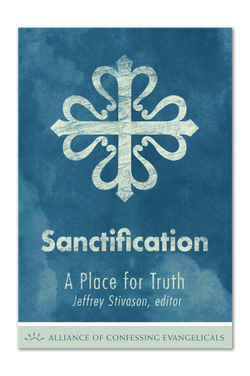
Those who are in Christ have been justified before God. But salvation means much more; it means that we are sanctified, that God actually leads us into holiness. As Michael Allen and company explain, our holiness is carried out in the present work of our sovereign, loving God. In Christ we are given life, not simply in name, but in fact. Praise the Lord, who delivers His children through every weakness. Though you struggle with sin, do not be discouraged; it is God who works in you, "both to will and to work for his good pleasure" (Phil. 2:13).
Past Episodes

Featured Offer
Those who are in Christ have been justified before God. But salvation means much more; it means that we are sanctified, that God actually leads us into holiness. As Michael Allen and company explain, our holiness is carried out in the present work of our sovereign, loving God. In Christ we are given life, not simply in name, but in fact. Praise the Lord, who delivers His children through every weakness. Though you struggle with sin, do not be discouraged; it is God who works in you, "both to will and to work for his good pleasure" (Phil. 2:13).
About Alliance of Confessing Evangelicals
The Alliance of Confessing Evangelicals exists to call the twenty-first century church to a modern reformation that recovers clarity and conviction about the great evangelical truths of the gospel and that then seeks to proclaim these truths powerfully in our contemporary context.
About Alliance of Confessing Evangelicals, Inc
The Alliance of Confessing Evangelicals is a broadcasting, events, and publishing ministry that exists to call the twenty-first century church to a modern reformation. Our broadcasts/podcasts include
The Bible Study Hour
with James Boice,
Every Last Word
featuring Philip Ryken,
Mortification of Spin
with Carl Trueman and Todd Pruitt,
Theology on the Go
with Jonathan Master and James Dolezal,
and Dr. Barnhouse & the Bible
with Donald Barnhouse.
These broadcasts air daily and weekly on stations in the United States and Canada and on the Internet. Event audio includes the Philadelphia Conference on Reformed Theology, the Reformed Bible Conference, and many others.
Contact Alliance of Confessing Evangelicals with Alliance of Confessing Evangelicals, Inc
Alliance@AllianceNet.org
http://www.alliancenet.org/
Alliance Of Confessing Evangelicals
600 Eden Road
Lancaster, PA 17601
1-800-956-2644