
The Church and the Churches


Imagine a new believer looking for a church in the yellow pages. He will see names like Presbyterian, Baptist, Roman Catholic, Methodist, Pentecostal, Lutheran. Episcopal, and perhaps a few others. He ,might wonder, which is the right church? Much confusion has arisen because people fail to distinguish between the organized, institutional churches and the Church founded by the Lord Jesus Christ made up of His genuine followers. Do you know the difference between the churches and the Church?
Narrator: The Alliance of Confessing Evangelicals presents the timeless teaching of Dr. Donald Grey Barnhouse.
Dr. Donald Grey Barnhouse: Many years ago, some friends did me what I thought was a great wrong. About that time, I found the verse in Job, “The Lord turned the captivity of Job, when he prayed for his friends. Also, the Lord gave him twice as much as he had before.” I fought the leading of the Holy Spirit in this matter. And then came the day when I began praying for these people and asking him to bless them in his sovereign grace. The effect on my own ministry was startling.
I was obeying Christ. I was praying for those who had despitefully used me. In almost no time, the circulation of our magazine doubled, and the Lord gave me twice as much as I had before, and then it tripled. And this happened again and again as I reached out in love to all who belong to Christ. I saw our radio coverage leap from two stations to 100 and across the nation.
As I met men, I asked but one question: Were they members of the body of Christ? I discovered that the circle of those whom I could love in Christ was continually enlarging.
Music: God's worthy words for us He came to teach, to build, correct, and train. He quits finding, we can pursue the work God has for us to do. God's Word is all the Christian needs to grow in grace and to do good deeds.
Narrator: Over a half a century ago, the late Dr. Donald Grey Barnhouse, then pastor of 10th Presbyterian Church in Philadelphia, saw the need to spread God's word beyond the hearing of his local congregation. He started the radio ministry which has become known as Dr. Barnhouse and the Bible. The application of God's word as taught by Dr. Barnhouse is as relevant today as when he first taught over the radio airwaves decades ago.
The message we will be featuring on today's edition of Dr. Barnhouse and the Bible is entitled “The Church and the Churches.” Imagine a new believer looking for a church in the yellow pages. He will see names like Presbyterian, Baptist, Roman Catholic, Methodist, Pentecostal, Lutheran, Episcopal, and perhaps a few others. He might wonder, which is the right church?
Much confusion has arisen because people fail to distinguish between the organized institutional churches and the church founded by the Lord Jesus Christ, made up of his genuine followers. Do you know the difference between the churches and the church? The scripture text for this edition of Dr. Barnhouse and the Bible, Romans chapter 12 and verse 5. Here again is Dr. Donald Grey Barnhouse with a message entitled, “The Church and the Churches.”
Dr. Donald Grey Barnhouse: Through the Lord Jesus Christ, we come unto thee our Father and our God and in the Holy Spirit. We thank you that we can come directly to thee, as a child comes to his father, through the new and living way which thou hast opened to us, even our Savior. Bless the word to each listening heart in this hour. We ask it in the name and for the sake of our Lord Jesus Christ. Amen.
In our study of the Epistle to the Romans, we come today to the 12th chapter and the fifth verse, where we read, “So we, being many, are one body in Christ, and everyone members one of another.” The problem of the oneness of believers is the greatest problem in Christendom today. Beyond question, the church is divided. And our text teaches that such a condition is scandalous.
There are many who believe that the difficulty arises from the confusion of the original church, founded by Christ, with the institutional churches, which have grown up historically. Our text tells us that all believers, taken together, are a body, the body of Christ, and members one of another. This body is supernatural, and it is to all believers that the divine word is addressed.
Do you not know that you are the temple of God, and that the Spirit of God dwells in you? Now, while it is true that each individual believer can say that the Holy Spirit is dwelling in him, and I can say therefore that the Holy Spirit is dwelling in me, the primary reference is to the fact that the Holy Spirit is dwelling fully in all the collective body of believers, and that it takes all of us to make up this mystic body.
And that every true member of the body of Christ needs every other member, and that we should recognize our oneness and seek to manifest and maintain that oneness. In the Apostle's Creed, we recite, “I believe in the Holy Ghost, the Holy Catholic Church, the communion of the saints.” Now, these three clauses are bound up in what we are teaching here.
When we say that we believe in the Holy Spirit, we should mean that we believe that the Holy Spirit is a member of the Godhead, the third person of the Trinity. The Bible teaches that the Holy Spirit does not dwell in every member of the human race, but only in those who have been redeemed by the blood of Christ. And by his indwelling, the true church is formed.
The Holy Spirit reaches across denominational lines and gathers to himself all in whom he dwells. This spiritual body has been counterfeited in an attempt to draw all professing believers into the same earthly organization. The very names of organizations illustrate this. Take, for example, the meaning of the word “Catholic.”
The term is the Greek “katholikos,” which was taken into the Latin tongue and thence into many modern tongues. Originally, the word “katholikos” meant general, universal, broad, diverse. Now when used in an ecclesiastical sense, this word is a groping after often hidden truth of the oneness of all members in the true body of Christ.
Those who accept the rule of the Vatican would be much more accurate if they always spoke of themselves as Roman Catholics. An Episcopalian sees himself as an Anglo-Catholic. In a very true sense, I am a Presbyterian Catholic. There are Baptist Catholics, Methodist Catholics, Lutheran Catholics, Pentecostal Catholics, and a host of others.
To fail to recognize this is to fail to grasp an important spiritual truth. What we are saying is that we belong to the spiritual body of Christ, and that we are welded together by the indwelling of the Holy Spirit. True modesty and spiritual perception should keep any one group from monopolistic use of the title, since it is so evident that not all true believers are in any one organization.
And that no man or group of men can claim to have a patent or a copyright on God, on the Holy Spirit, and on the divine truth of the body of Christ. Some Protestants have taken a kindred word, ecumenical, to stress the life of the whole church. This is another illustration of the same groping after the oneness of all members in the true body of Christ.
The word ecumenical is also a Greek word, “oikoumene,” which refers to the inhabited world, and was used somewhat as we use the word “world” when we say, “Everybody in the world knows this or that.” Although even in using it, we are aware that perhaps a billion of the emerging peoples do not know what we're talking about. We mean that most people in the cultural world or the intellectual world, in every nation, have opportunity to be aware or should be aware of what we're talking about.
When Protestant leaders speak of the ecumenical church, they mean the spread of faith to every kingdom, tongue, tribe, and nation. Certain evangelicals have misread modern literature on this subject, and are obsessed with the idea that an attempt is being made toward an ecumenical organization, a world church. Oh, there may be those who have dreamed of this, but they are not taken seriously in high places in Protestant organizations.
Almost everyone whom I know in a high place in any Protestant organization, when speaking of the ecumenical church, means a council, those who come together for oneness in some matters, but who are divided in other matters, and who recognize the rights of each minority group to have their specific emphasis while recognizing the oneness on the upper, the higher, the spiritual level.
Now, thoughtful men know that there will not be organic union of the churches during this present age. There are points on which masses of men have such firm convictions that they would be willing to die as martyrs before they would abandon their convictions. Now, it is possible for such people to work together in great spiritual causes, and to be united in many efforts.
But there is no indication that organic union, governmental union, will be achieved until Christ comes again. But in spite of these differences, the inner working of the Holy Spirit will ever bring each true believer into closer fellowship with every other true believer. In his first epistle, after presenting the Lord Jesus Christ as the eternal word of life, John writes, “That which we have seen and heard, declare we unto you, that you also may have fellowship with us.”
That's horizontal fellowship between men. And truly our fellowship, vertical fellowship between the individual and God, our fellowship is with the Father and with his Son, Jesus Christ. In the light of this truth, it's necessary for me to make the very serious charge that many professing Christians are not in true fellowship with God because they refuse fellowship on the human level to others who are also believers in Christ.
We cannot escape the plain teaching of scripture. Quote: “If we say that we have fellowship with him, and walk in darkness, we lie and do not the truth. But if we walk in the light, as he is in the light, we have fellowship one with another, and the blood of Jesus Christ, God's Son, cleanses us from all sin.” Now examine this closely. What does it teach?
God is light. Each and every true believer must walk in fellowship with each and every other true believer. That is to say, we must be willing to stretch out our arms to him and acknowledge him as a brother in Christ, no matter what organization he belongs to. If we do not do so, we're walking in darkness and we are not doing the truth.
But if we are walking in the light of God as Christ is in the light of God, we have fellowship one with another. Now let us look at some specific examples. Sometime ago, a Bible teacher preached in a large church in a denomination other than his own. The pastor, in introducing him, stated that although he had learned Hebrew, Greek, and other theological subjects in his denominational seminary, that he had learned his Bible from the guest teacher.
He said that this teacher's influence had been the real cause of his spiritual growth and power. He publicly invited the teacher to come back the following year, and told him to count on the appointment when preparing his schedule. But when the time approached, the pastor found himself in trouble with his deacons. These laymen wanted to know why a denominational program was not being followed, why a teacher from their own denomination had not been invited to hold the special meetings.
So the pastor cancelled the meetings. Now I make bold to say that this action was sin. It was the equivalent of saying that the Holy Spirit must work on denominational lines, and that he could not do what he pleased in giving gifts to men, and in giving these men to the whole body of Christ. It was the sin of quenching the Holy Spirit.
We can grieve the Holy Spirit by sin within our own hearts, but we can quench the Holy Spirit by denying his ministry through a variety of instruments in the organizational form of the church. The hand may not say, “I have no need of the foot.” Such a declaration is sin. Now where does this lead us practically?
This means that the Episcopalian needs the Pentecostalist Christian. And the Pentecostalist needs the Episcopalian Christian. Each, confessing that the other is a member of the body of Christ, must acknowledge that every member and organ in the body needs every other member and organ in the body. The Southern Baptist needs the Presbyterian, and the Presbyterian needs the Methodist, and the Methodist needs the Baptist, and the Lutherans need the Presbyterian and, so we all need each other.
And the church in America needs the ministry of the missionary churches, as they need the ministry of the American missionaries. Sometime ago, the noted president of the Union Theological Seminary of New York City took a trip to the West Indies and published the story of his journey in The Christian Century. It was entitled Caribbean Cruise. The point of the story was in this churchman's discovery of the churches that are generally known as Holiness Churches.
He was astonished at the vigor and the life which he saw in their churches in Cuba and in other islands of the West Indies. The old line denominations had been in the West Indies for 60 years and had built churches that totaled 10 or 15,000 members. The Holiness Churches had come in after the Second World War and already had 50,000 members.
He wondered why he had never run across these denominations in America. He said that the denominations which are usually looked upon as being the center of Christianity, needed to discover these so-called fringe movements and seek further union with them. It was a nice suggestion, but I doubt if anything came of it. Because leaders in many denominations have closed minds as to what really constitutes the body of Christ.
The old line denominations with their offices in New York and their control of the great endowments of the past century, often want all other organizations to do just as they say. This is a substitution of the human will for the leadership of the Holy Spirit. At this point, spokesmen for the smaller, newer denominations may object that they do not want to have fellowship with those who are guiding the destinies of the great denominations.
They hold that such leaders are not faithful to, quote, “the doctrine,” unquote, and so there can be no fellowship. Now I'm qualified to speak on this point because I drew such lines for many years until the Lord taught me better. When I faced the problem squarely in the light of the word of God, I recognized that I had been wrong, and that I must allow the Holy Spirit to give me a biblical attitude, which is nothing more nor less than love of the brethren.
The appropriation of this truth has brought a transformation in my ministry. Many years ago, some friends did me what I thought was a great wrong. About that time, I found the verse in Job, “The Lord turned the captivity of Job, when he prayed for his friends. Also, the Lord gave him twice as much as he had before.” I fought the leading of the Holy Spirit in this matter like an animal wanting to be free from the leash.
And then came the day when I began praying for these people, telling the Lord that I had nothing against them and asking him to bless them in his sovereign grace. The effect on my own ministry was startling. I was obeying Christ. I was praying for those who had despitefully used me. In almost no time, the circulation of our magazine doubled, and the Lord gave me twice as much as I had before, and then it tripled.
And this happened again and again as I reached out in love to all who belong to Christ. I saw our radio coverage leap from two stations to 10, to 50, to 100, and across the nation. As I met men, I asked but one question: Were they members of the body of Christ? If they were, I wanted to learn something from them, and to see how the Holy Spirit was working in and through them.
I discovered that the circle of those whom I could love in Christ was continually enlarging. About the beginning of this experience, I wrote an article in which I described a certain well-known minister in terms of apostasy. In my new circle of friends was a man who was a close friend of the minister about whom I'd written. My friend arranged that we should have lunch together.
After discussing various subjects, I told him that I was the author of the article that had been written against him, and which he had read without knowing its source. He was incensed. Asked me if I would print a retraction if he wrote it. I answered that I would, but that I must surround it with many safeguards for the sake of my readers, because I was not sure that he truly believed the essential minimum of Christian truth.
He said, “What is the essential minimum?” Then he sat back and listened for more than an hour, while I explained the simple doctrines of original sin and redemption through the shedding of the blood of the Savior, who is none other than the Lord Jesus Christ, God Almighty made flesh. When I finished, there was a long pause, and then he said, “Doc Barnhouse, I wish we'd had this talk years ago.”
“I confess that I don't know anything about theology. I may even have expressed things differently in the past than I would today, but I do know that my father led me to Christ when I was a boy. I do know that I am a sinner and that Jesus Christ died for me. I have no hope apart from him.” He then told me of great experiences in his life that had formed his whole character.
During schooldays, there was a prolonged strike, and he was the only boy in his classes who had shoes one winter. Each day he took lunch enough for six to school, and ate only an apple while his hungry friends devoured the food. Then when he went to college in the city, he discovered the slums. I shall never forget his face as he said, “I was almost wild with desire to do something for these poor people. I believed that I had to take the love of Christ to them.”
“And everything else was put aside for this one purpose. I studied just enough to pass my examinations so that I could get out and do something about it. I admit that I don't know about theology, but I did and I do want to take the love of Jesus Christ to those who were in such desperate need.” Yes, he had spent his life in social service. Better milk for better babies, and better conditions for the common man.
I left that table with deep gratitude to the Lord for showing me the earnest heart of this minister. At that table, there was formed in my heart a deep love for him. On essentials, there was no disagreement. We both knew that we were sinners. We both knew that God came in Christ to die for us. We both looked to the cross of Christ for salvation.
We are confident that both will be in heaven together because of the sovereign grace of the Savior. And whatever he may have learned from me, I know that I learned that I must love him here on earth. And in spite of our disagreements, it is not hard for me to love him. Through this experience, Christ had drawn me a little closer to himself. And I had learned the wonderful truth of our oneness in Christ.
And our Father, we pray you to bless to every heart that which is spoken in this hour. We ask it in the name and for the sake of our Lord Jesus. Amen.
Music: All creatures of our God and King, lift up your voice and let us sing. Alleluia, Alleluia! Thou burning sun with golden beam, thou silver moon with softer gleam, oh praise Him. Oh praise Him. Alleluia, Alleluia, Alleluia. Thou rushing wind that works so strong. He comes to hill and them among. Our rising morn in praise rejoice. In light of evening find our voice. Oh praise Him. Oh praise Him. Alleluia, Alleluia, Alleluia.
Narrator: The Holy Spirit dwells in his fullness in the collective body of true believers throughout the world. We all need one another and we must seek to manifest our oneness and unity in the Lord. You have been listening to Dr. Barnhouse and the Bible. We hope you've benefited from today's message, “The Church and the Churches.”
To listen to additional teaching by Dr. Barnhouse, visit us online at alliancenet.org. An audio copy of today's teaching is available by calling us toll-free, 1-800-488-1888. Today's message again is entitled “The Church and the Churches” or simply request message number R12-11. We would also like to make available to you a free copy of our booklet entitled “All Things Work Together.”
Romans 8:28 declares, “We know that all things work together for good to them who love the Lord, even to them who are called according to his purposes.” Yet, many times we may feel that nothing good could ever come out of our problems and circumstances. This free booklet shows how this precious and powerful promise applies to any situation you may be facing, and can fill you with hope and encouragement when you need it the most.
Ask for your free copy of “All Things Work Together” when you call or write. Dr. Barnhouse and the Bible is a radio ministry of the Alliance of Confessing Evangelicals headquartered in Philadelphia, Pennsylvania. We exist to promote a biblical understanding and worldview. Drawing upon the insight and wisdom of Reformation theologians from decades and even centuries gone by, we seek to provide contemporary Christian teaching which will equip believers to understand and meet the challenges and opportunities of our time and place.
The Alliance also produces the radio broadcast The Bible Study Hour, featuring the teachings of the late Dr. James Montgomery Boice, and Every Last Word, featuring the Bible teaching of Dr. Philip Graham Ryken. For a full list of radio stations carrying our programs, visit us online at alliancenet.org. Dr. Barnhouse and the Bible comes to you through the generous gifts of listeners like you. If you have benefited from this broadcast and would like it to continue, prayerfully consider a donation to help us keep this ministry on the air.
For more information or to make a contribution to help further our work, contact us by calling toll-free 1-800-488-1888. Again, that's 1-800-488-1888. Write to us at Alliance of Confessing Evangelicals, Box 2000, Philadelphia, Pennsylvania 19103. Visit us online at alliancenet.org. Be sure to ask for a free resource catalog featuring books, audio teachings, commentaries, booklets, videos, and a wealth of other materials from outstanding reformed teachers and theologians, including Donald Grey Barnhouse, Dr. James Montgomery Boice, Dr. Martyn Lloyd-Jones, and Dr. Philip Graham Ryken.
Thank you for listening. Join us again next time for more classic teaching on Dr. Barnhouse and the Bible.
Music: The Bible has come and here to do God's saving work for us, this cross our souls from death to life, and rescues us from deepest night. Amazing grace, our heart, the life in God's great word of God.
Featured Offer
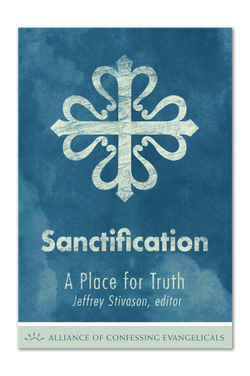
Those who are in Christ have been justified before God. But salvation means much more; it means that we are sanctified, that God actually leads us into holiness. As Michael Allen and company explain, our holiness is carried out in the present work of our sovereign, loving God. In Christ we are given life, not simply in name, but in fact. Praise the Lord, who delivers His children through every weakness. Though you struggle with sin, do not be discouraged; it is God who works in you, "both to will and to work for his good pleasure" (Phil. 2:13).

Featured Offer
Those who are in Christ have been justified before God. But salvation means much more; it means that we are sanctified, that God actually leads us into holiness. As Michael Allen and company explain, our holiness is carried out in the present work of our sovereign, loving God. In Christ we are given life, not simply in name, but in fact. Praise the Lord, who delivers His children through every weakness. Though you struggle with sin, do not be discouraged; it is God who works in you, "both to will and to work for his good pleasure" (Phil. 2:13).
About Alliance of Confessing Evangelicals
The Alliance of Confessing Evangelicals exists to call the twenty-first century church to a modern reformation that recovers clarity and conviction about the great evangelical truths of the gospel and that then seeks to proclaim these truths powerfully in our contemporary context.
About Alliance of Confessing Evangelicals, Inc
The Alliance of Confessing Evangelicals is a broadcasting, events, and publishing ministry that exists to call the twenty-first century church to a modern reformation. Our broadcasts/podcasts include
The Bible Study Hour
with James Boice,
Every Last Word
featuring Philip Ryken,
Mortification of Spin
with Carl Trueman and Todd Pruitt,
Theology on the Go
with Jonathan Master and James Dolezal,
and Dr. Barnhouse & the Bible
with Donald Barnhouse.
These broadcasts air daily and weekly on stations in the United States and Canada and on the Internet. Event audio includes the Philadelphia Conference on Reformed Theology, the Reformed Bible Conference, and many others.
Contact Alliance of Confessing Evangelicals with Alliance of Confessing Evangelicals, Inc
Alliance@AllianceNet.org
http://www.alliancenet.org/
Alliance Of Confessing Evangelicals
600 Eden Road
Lancaster, PA 17601
1-800-956-2644