

Sufficiency and Necessity of Scripture


Chad Van Dixhoorn brings the first of four messages from The Philadelphia Conference on Reformed Theology 2026.
Alliance of Confessing Evangelicals: The Alliance of Confessing Evangelicals is pleased to bring you the following message from the Philadelphia Conference on Reformed Theology. Since its start in 1974, this conference has attracted audiences to its biblical expository approach to Christian doctrine. The Alliance is a listener-supported ministry. Our purpose is to promote a biblical understanding and worldview.
Guest (Male): Turn with me to 2nd Timothy, chapter 3. I'll be reading with you this morning verses 10 to 17, but focusing really on verses 14 to 17. About 1600 years ago, a theologian named Theodore of Mopsuestia packaged the passage we're about to read in four points. He says Paul here lays out four reasons why Timothy ought to be steadfast if he will recall them. First, because of the teacher from whom he learned. Second, the time when he learned it. Third, the source from which the teaching came. And finally, the sublime purpose for which he learned it.
This morning, I'm going to pinch Theodore's outline, but I add a point in the middle about the gospel and a point at the end about the necessity and sufficiency of Scripture. Hear God's word as I read it with you this morning. "You, however, have followed my teaching, my conduct, my aim in life, my faith, my patience, my love, my steadfastness, my persecutions and sufferings that have happened to me at Antioch, at Iconium, and at Lystra, which persecutions I endured. Yet from them all, the Lord rescued me.
Indeed, all who desire to live a godly life in Christ Jesus will be persecuted, while evil people and impostors will go on from bad to worse, deceiving and being deceived. But as for you, continue in what you have learned and have firmly believed, knowing from whom you learned it and how from childhood you have been acquainted with the sacred writings, which are able to make you wise for salvation through faith in Christ Jesus.
All Scripture is breathed out by God and profitable for teaching, for reproof, for correction, and for training in righteousness, that the man of God may be complete, equipped for every good work." This is God's word. Let's pray together and ask one more time for the Lord's blessing on the preaching of the word this morning.
Father, we thank you that we can begin this day with your word. There's no book like this book, no word like your word. Help us, Father, as we begin a conference that focuses on the benefits of creeds and confessions, the history of their use in the church. Help us to begin by a reminder from your word about why no other document competes with your word, why any other standard is subordinate to your word. Father, help us to fall in love afresh with the wonder of your word this morning. Help us to hear your voice. Help us by your Holy Spirit, and we ask that you would do this because we come to you in Jesus' name. Amen.
The first feature that I want to flag in these verses comes at the end of verse 14. For in learning how to continue on faithfully, Timothy is charged to remember from whom he learned his lessons about the Lord. When I was a student, I became conscious of a small army of Athenians, always itching to hear something new in the classroom, kind of bored when they were hearing things that they had already heard from their childhood. Some were willing to give up anything that their pastors or parents might have taught them, so long as someone could present a new idea in a shiny way.
Well, in calling Timothy to remember his teachers, Paul is making a case for vintage doctrine over freshly brewed ideas. He was also indirectly calling Timothy, who was himself to be a teacher, to be faithful in his own teaching. For what it's worth, I've been helped by remembering the pastor from whom I learned the Christian faith, from whom I learned my doctrine. I won't share all the details, but he lost his home, actually, lost his whole church, for defending me as a young Christian. It was an astonishing stand, and he only got heavenly treasure out of it. I remember the one from whom I learned my doctrine, and it is that much more precious to me.
Every pastor shows faithfulness in different ways. But how thankful we can be this morning that so many of us can recall in our lifetime pastors who were faithful. How many of us can say to friends and to family, "Remember your pastor, remember your teacher," and expect that when we say that, they will be encouraged, they will be strengthened just as Timothy would be in hearing these words from Paul.
Well, if we're to remember from whom we learned, then secondly, as verse 15 teaches us, we should remember when we learned. For Paul is saying something important when he tells Timothy that he's to follow what he learned from childhood. By mentioning childhood, Scripture teaches us that truths held tightly over time become more dear to us and more useful to others. Provided that it was good to begin with—an important qualification—provided it was good to begin with, we are to firmly believe what we have long believed.
I like reading Matthew Henry's commentary. I love reading J.C. Ryle's expository thoughts. When I'm discouraged and feeling down, I turn to these old books that I read when the Lord first awakened me. I go to J.C. Ryle's expository thoughts because my father, who never felt able to do family devotions in any depth, discovered J.C. Ryle's expository thoughts. A paragraph of Scripture, two and a half pages of explanation, and he was just so grateful to be able to read that on a Sunday afternoon to our family.
He went through it, and having gone through all four volumes, or seven volumes as they were packaged back then, he didn't know what else to do, so he went through it again. The fact that I had this instruction from childhood makes it more dear to me. I don't want to outgrow the doctrine I've learned there. Of course, in mentioning childhood, Paul's not only thinking of his influence on a young Timothy. He's also thinking of Timothy's home life. For we hear elsewhere about Timothy's mother, Timothy's godly grandmother.
Timothy's father doesn't seem to have been a Christian, or he wasn't much of a Christian leader in the home, or something like that. And so mom and grandmother were the principal influences. One of the great shaping influences on Timothy were these two dear Christian women. I hope that verse 15 encourages single parents who are trying to raise their children, or uneven families where one parent is more committed to the teaching and to the praying in the household.
I hope it's an encouragement to consider how the teaching given to Timothy in his youth could bear so much additional fruit with additional instruction later in life. Surely there's encouragement here for all parents. While children's attention is often poor, their retention is surprising and sometimes astounding. Truth learned in childhood is not more true, but it can become more dear. It ought to help us to continue in what we've learned. It ought to help us to be firm in what we have believed when we remember when we learned it.
So we're to remember from whom we've learned and when we've learned. Third, as Theodore of Mopsuestia puts it, we are to remember the source from which the teaching came. It was obvious to Theodore, as I hope it's going to be or already is obvious to all of us, that even if pastors or parents impress truth upon us, they're not the source of that truth. Okay, the Apostle Paul is a kind of a unique case. He was given words directly from God, inspired.
But setting the Apostle Paul apart, the point is even the Apostle Paul, who is used by God to write inspired Scripture, even he directs Timothy in verse 15 to the sacred writings. Now almost every New Testament scholar has a theory of what is meant by the sacred writings. This is the kind of thing that gives New Testament professors job security, developing their own theory, but surely the Apostle Paul has in mind at least the Old Testament. After all, the Old Testament can make us wise for salvation, which is how these sacred writings are described.
And probably the Apostle Paul means more than that. After all, in his earlier letter to Timothy, Paul refers to the Old Testament and to a saying of Jesus found in the Gospels with one simple "Scripture says." The Apostle Paul is referring to the developing New Testament as well as to the Old Testament as Scripture. And so it seems likely to me that the Old Testament and the developing New Testament are both in view here. Either way, what Paul says in these verses applies to every part of the Scriptures.
However much of the sacred writings we have in our possession, whether it be a whole Bible as you have in your hands and we find in our pews, whether it's one part of the Bible translated for a remote tribe, whether it's just the verses we've hidden in our hearts if we're imprisoned for the gospel, however much of the Bible we have, we ought to seek to be acquainted with it and to hold it dearly. Many of you have children or grandchildren who are going to need some form of education or are already being educated.
And the questions come up in Christian circles: should they be public schooled, private schooled, homeschooled, Christian schooled, or some kind of arrangement that I haven't thought of yet schooled? And the answer is that however they're schooled, the Bible must play a critical part in the development of a Christian child. The sacred writings ought to be part of the ethos and fabric and structure of their lives, however they're schooled. If not at their desks, then at the kitchen table and at their bedside and so on. We all must be, young and old, acquainted with these sacred writings.
The learning of the world is useful. We need to get a lot of it to be useful in this world. But we must not live like the Israelites at the mercy of their enemies, always going over to the Philistines to get our tools sharpened. Let's make use of all kinds of learnings, but let our minds be principally sharpened by the Bible. This is the most important tool we have. This is easier said than done, and we all know that.
How many read-the-Bible-in-a-year plans became a forget-the-Bible-in-a-month plan? Even when we read with purpose, we are sometimes galloping through a chapter of the Bible in order in a sort of race to get to something that's more important in our day. This is not how we become very well acquainted with the sacred Scriptures. What's more, learning requires repetition. We need to revisit this material. We need to go over Scripture again and again. We need to repeat what we've learned or we'll forget it.
That goes for learning from sermons and teaching on the Bible as well. Thomas Watson, an old Puritan, was surely right in saying that one reason why some people get no more good by what they hear is that they never speak to one another about what they have heard. As if sermons, he says, were such secrets that they must not be spoken of again, or as if it were a shame to speak of matters of salvation. You have long breaks today. Perhaps there'll be something you hear today that'll be worth talking about, and if you do talk about it, it'll stick with you better.
The Van Dixhoorns' attempt to remind ourselves about what was read and preached on a Sunday morning by talking about it over Sunday lunch. On occasion, that's been a flop. Often it's been edifying, but it was always worth the try to retain more of what we're reading and hearing by talking about it. Watson mentions matters of salvation, and I suppose that's the gospel point that I want—wanted Theodore to accent more than he did in his writings on these verses.
What are the Scriptures, after all? What are the sacred writings, if not a window through which to gaze on the person and the work of Jesus Christ? By the Holy Spirit's help, we can be awakened to a wisdom that sees in the sacred writings where salvation is to be found. What are we after in our Bible study if it's not a kind of wisdom that helps us see Christ as he is given for us in the gospel? What are we seeking but a knowledge of God, and self, and of the savior, and a discovery that all that Christ did is in our place and for our sakes?
Is this not the highest prize to take away from a study of the sacred writings? When we become wise for salvation, as our passage puts it here, when we become wise for salvation through faith in Jesus Christ, the gospel becomes personal. We can say that Jesus came for us, that Jesus lived for us, that Jesus died for us, that Jesus rose for us, reigns for us, he'll return for us. As an old Puritan once explained, our relationship to Christ and his gospel—as he explained it—when you hear a promise spoken, apply it.
This is to suck the flower of the promise and to turn it into honey. That's what we're doing when we read the sacred Scriptures, seeking to be wise for salvation through faith in Christ. When we trust in the Jesus of the Bible, he's not a flower to be viewed; he's honey to be tasted. Once we see Christ in the Scriptures, it enriches all of our Bible reading. It turns all our water into wine.
The fourth point is that the Scriptures present to us Christ, and this fourth point is so inspiring that one can almost forget that the Holy Scriptures talk about anything else. But they do. There's more that we need to teach, more that we need to see and to learn in the Scriptures. There's more that's profitable, and that's my fifth point. The message of verse 16 is that all Scripture is profitable for all kinds of purposes. I do think that we need to especially emphasize this in today's evangelical and reformed subculture.
It seems to me that more and more evangelical and reformed churches are increasingly avoiding the sticky bits of the Bible, the hard conversations that come from a careful study of God's word. Sometimes churches and Christian people are making real compromises about many of the truths in the Bible with the hope that we'll be able to keep the focus on the gospel at the expense of everything else. As though we only had the confidence that some Scripture is useful for some things, rather than all Scripture is useful for all kinds of things.
Maybe you've yourself felt that temptation in a difficult conversation. You want to dodge an uncomfortable truth or passage in order to just keep a sense of focus on the gospel, in order to make the gospel seem more credible to someone by ignoring the things that seem less credible. Well, that is to give up the city walls in order to hold the citadel, and that kind of defense only works for so long. I understand that if given only a limited time and opportunity, we're going to want to focus as Christians on that which is more likely to lead someone to salvation.
That's a no-brainer. If I'm given one breakfast with a friend who does not know Christ, I'm going to talk about Jesus rather than just war theory. But we need to be clear in our own minds that the glory of God is found in the perfection of his design for us and his rule over us, and not only in his saving rescue of us. There's a wide expanse of what gives God glory: worship designed for his praise, government that reflects his gracious rule, government of the church, and many doctrines that all give him glory.
We cannot put all that aside to just focus on one point, however wonderful that one main point is. Maybe I'm saying that we must be careful that our love for people who are without hope and happiness—important as that is or should be to us—we need to be careful that our love for such people does not become the thing that runs everything that the church does. Let us always preach the gospel. Let's do it more. But let us not reduce our message to the gospel of Christ as if there were nothing else to say, as if the Bible had no other topic to discuss, or as if the gospel can actually make sense apart from everything else that the Bible has to say.
Of course, to say all this about the Bible is to bring us in a roundabout and inefficient way to a key concept in verse 16, captured in the word that we usually translate as inspired. The word "inspired" is okay so long as we understand that the Apostle Paul is not saying that Scripture is inspirational or exciting. He means something thicker and bigger than that. Although, by the way, the Scripture is inspirational and exciting. The word inspired's okay so long as we understand that it is actually the Scriptures themselves and not the people who wrote it who are inspired.
The word "inspired" is okay so long as we realize that God does not breathe into existing pages and scrolls, but he breathes out Scripture. Truth be told, and technically, Scripture is not inspired but expired. Don't say that as a preacher without lots of explanation. Don't teach that in Sunday school without explaining exactly what you mean. It's breathed out by God. It's expired in that way. But again, the point here is that God did not take some human writings and breathe life into them to make it his own.
No, instead he spoke, he breathed out through holy men his words. The Scriptures are ancient, but they are inhabited by the Spirit of God, and they always have been. That's why John Calvin says we owe to the Scriptures—think about this extraordinary comment that he makes—we owe to the Scriptures the same reverence that we owe to God, because it has proceeded from him alone and has nothing belonging to man mixed with it. These are God's words.
And you cannot say to someone, "I don't respect your words, but I respect you." It doesn't work that way. Of course, anyone who's read the Bible knows that the experiences, and the thoughts, and the griefs, and the joys of the human writers suffuse the Psalms and inform the writings of the prophets and apostles. Anyone who knows that has wondered how, how did God speak through these men while using their personalities and perspectives as we see that God did?
This is one of the great mysteries of the Christian faith. We do not know how inspiration works, but we know that it did. We know that God did do this, that these are his words. How foolish we would be to believe nothing until we can understand everything. Let us believe what God's word says here about God's word. Only when we see that the Scriptures are the word of God will we also submit to what Theodore calls the sublime purposes of Scripture.
When we trust God speaking to us in Scripture, it becomes profitable for teaching us about God. It's through the Scriptures that we learn what to believe, what to hold dear. It's here that we learn about the triune God, his sovereign rule, his holy law, his perfect justice, our awful guilt, his amazing grace, our call to gratitude. When we take God at his word by taking all of his word, we also find material for reproof, not just for others, not for the world around us that seems to be going wonky, but also for ourselves.
When we see the Bible for what it is, we discover it profitable for putting us on the right path, for correcting, for redirecting and recalibrating. To sum it all up, when the Bible is trusted as God's word, it is profitable for training in righteousness. A single phrase that perhaps captures everything else that's promised in this verse and elsewhere. What's essential for us to see is that our encounters with the Bible do not get to be controlled by us. The Bible speaks to us.
It tells us what to think, what not to think, what to do, how we're to live. The Bible speaks as though its author were our master, as if we were the servants and God is our owner. Or to return to an earlier picture, the Scriptures are ancient but inhabited. Every passage is full, the whole of it's alive. Calvin always insisted that the Holy Scripture will be a dead thing to us and without force until we know that it is God who speaks in it and shows us his will in it.
He's right, he's right. And he was also right to add that we may judge hereby whether it be enough for a man when he would expound the Holy Scripture to devise and discourse upon it as though it were a bare history, as though it were just a record of men's words or thoughts, as though it were, to put it a different way, a testimony of people's religious experiences rather than God's word. We must accept the Scripture's direction. Surely all of that is clear in verse 16. We must sit under it, not stand over it.
As John Stott so helpfully puts it, we must let the word of God make you a man of God. Stott's mention of the man of God directs us to verse 17, to Paul's sixth and final point and therefore ours this morning. For the apostle ends by saying that all this instruction, and correction, and training is to make us complete, equipped for every good work. In fact, he actually says to make the man of God complete. The phrase "man of God" is used in the Bible—and those of you who read the Bible regularly will of course know this—it's a phrase used to describe prophets, apostles, ministers of the gospel.
But if the word of God is enough to make a prophet, an apostle, your pastor equipped for everything that God calls them to do, which are some of the most important things that would ever need to be done—if God's word is enough to equip a person to do that—well, it goes without saying it's going to equip the rest of us for everything else we need to do too. This is an argument, if you will, from the greater to the lesser, from the magnitude of such a task to our lives.
So why does Timothy need to treasure what he has learned from his teachers, from childhood, from the Scriptures? Because the Scriptures present Christ. Because the Scriptures are God's word to us. Because the Scriptures make us complete. I'll soon discuss the history and theology of creeds and confessions. This evening, I'm going to—you know, give it the old college try to persuade you that these are really good things to have for a Christian church. But such documents can never supplant the Scriptures described here in 2nd Timothy 3.
These texts are not, strictly speaking, in reformed and Presbyterian and reformed Baptist churches—they are not secondary standards. They are subordinate standards. They are under. They are only—they're only as true and as useful as they are biblical. They are not beside the word, they are below it. Reading and study of the creeds is useful. Crossway had me edit a version of the Bible that has creeds and confessions in the back because it can be useful devotionally, not to replace the reading of your word but to supplement the reading of the word.
Indeed, study of creeds cannot replace the reading, or the preaching, or the study, or the memorization of Scripture. It just doesn't replace it at all. For the truth is that we are only complete with the word, we're never complete without it. The Scriptures are necessary. They are essential for the establishment of the church. They are basic for our faith. They're vital for our life. They are compulsory for our church government. They are indispensable for our worship. The Scriptures are necessary.
And we are complete only with the word and with nothing more. The Scriptures are sufficient. They offer the church an abundance of instruction. They present to believers plenty of ground for faith. They are more than adequate as a guide for the Christian life. They tell us what is appropriate for good discipline, and they offer ample wisdom for worship. The Scriptures are not only necessary, they are also for Christians and for the work of the church and for the proclamation of the gospel, they're sufficient.
Of course, these necessary and sufficient Scriptures themselves teach us to listen to others, to not be so full of what the Holy Spirit has told me that I'm no longer interested in hearing what he's ever told anyone else. Now, in this very passage, Timothy's commended for listening to teachers and parents, for heeding the authorities in his life. But the point here is that the teachers, and the parents, and elders, and we ourselves all must acknowledge Scripture to be necessary and find Scripture to be sufficient.
Necessary and sufficient as guides to life in Christ, as guides for life in Christ. Necessary and sufficient as a guide to Christ's church and a guide for Christ's church. Anything that claims to have authority over us must be rooted in Scripture. We need to remember this because there are people in churches who do want to exercise an authority over us that they should not attempt to do. There are people who want to add to the word, and we can do that sort of subtly in a kind of evangelical-ish way.
There are people who insist on their own kind of spiritual disciplines, their 10-step program to your holiness or your happiness or your closer walk with God. And they insist that we need what they say for the body or the mind to be complete, even though many of their disciplines and five of their steps are actually prescriptive in ways that the Bible is not. There are churches such as the Roman Catholic Church and various Eastern Orthodox churches which say that we need their extra-biblical traditions for us to be complete.
I want to suggest to you this morning that it is much safer for us to vote with 2nd Timothy, chapter 3. Long, sad history has shown that the moment we say that something more than Scripture is needed, we plunge ourselves into a river of trouble without bottom or banks. This is important for us to realize. It's important for us to be committed to this, both in our doctrine and our worship. It's essential for us personally because we're not only saints but we're also sinners. We can be distracted from the truth of what's so clearly said here.
So do you come this morning as one who is sinful and weary and discouraged? Do you come as someone who sees afresh that you have sins that need to be forgiven, that you need to be made complete when right now there are ways in which you are broken? Well, return to the Scriptures. They will make you wise for salvation—and for sanctification too—through faith in Christ, through the help of the Spirit who works with and through the word.
Does your life require a little more training in righteousness? Well, then don't graze through the Scriptures, taking a nibble here or a bite there when you see something that strikes you as appetizing. Swallow it whole. Are you underused or overworked in the church? Would you like to be more profitable in spite of the difficulty of your circumstance? Would you like to be better equipped to bless others, to praise God, or be given a new lease on ministerial life?
Would you like a strength that you cannot seem to find in yourselves for the apparently overwhelming tasks that face you? Turn to the Scriptures. This is what we need. Listen to what God's word has to say to us. For we can trust the living word of God as it pulses through our passage this morning and assures us that all Scripture is breathed out by God and profitable for what? For teaching, for rebuke, for correction, for instruction or training in righteousness. The man of God, and therefore all of us here this morning, may be complete and equipped for every good work.
Alliance of Confessing Evangelicals: You've been listening to a message delivered at the Philadelphia Conference on Reformed Theology. This conference is a ministry of the Alliance of Confessing Evangelicals. For more messages from the PCRT, visit reformedresources.org, a trustworthy source of books, audio, video, and other resources to help you grow your Christian faith. That's reformedresources.org.
Featured Offer
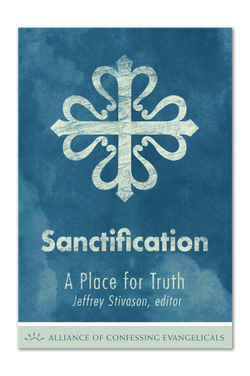
Those who are in Christ have been justified before God. But salvation means much more; it means that we are sanctified, that God actually leads us into holiness. As Michael Allen and company explain, our holiness is carried out in the present work of our sovereign, loving God. In Christ we are given life, not simply in name, but in fact. Praise the Lord, who delivers His children through every weakness. Though you struggle with sin, do not be discouraged; it is God who works in you, "both to will and to work for his good pleasure" (Phil. 2:13).
Past Episodes

Featured Offer
Those who are in Christ have been justified before God. But salvation means much more; it means that we are sanctified, that God actually leads us into holiness. As Michael Allen and company explain, our holiness is carried out in the present work of our sovereign, loving God. In Christ we are given life, not simply in name, but in fact. Praise the Lord, who delivers His children through every weakness. Though you struggle with sin, do not be discouraged; it is God who works in you, "both to will and to work for his good pleasure" (Phil. 2:13).
About Alliance of Confessing Evangelicals
The Alliance of Confessing Evangelicals exists to call the twenty-first century church to a modern reformation that recovers clarity and conviction about the great evangelical truths of the gospel and that then seeks to proclaim these truths powerfully in our contemporary context.
About Alliance of Confessing Evangelicals, Inc
The Alliance of Confessing Evangelicals is a broadcasting, events, and publishing ministry that exists to call the twenty-first century church to a modern reformation. Our broadcasts/podcasts include
The Bible Study Hour
with James Boice,
Every Last Word
featuring Philip Ryken,
Mortification of Spin
with Carl Trueman and Todd Pruitt,
Theology on the Go
with Jonathan Master and James Dolezal,
and Dr. Barnhouse & the Bible
with Donald Barnhouse.
These broadcasts air daily and weekly on stations in the United States and Canada and on the Internet. Event audio includes the Philadelphia Conference on Reformed Theology, the Reformed Bible Conference, and many others.
Contact Alliance of Confessing Evangelicals with Alliance of Confessing Evangelicals, Inc
Alliance@AllianceNet.org
http://www.alliancenet.org/
Alliance Of Confessing Evangelicals
600 Eden Road
Lancaster, PA 17601
1-800-956-2644