

Spiritual Warfare 5: The Sword


Our study brings us to the final piece of armor, the sword of the Spirit, identified as the Word of God. Drawing from John Bunyan’s Pilgrim’s Progress, Reverend Alexander describes the unique characteristics of this weapon and how we are to use it in our warfare. Find out how to boldly wield the sword of the Spirit against the powers of darkness on Hear the Word of God.
Guest (Male): Welcome to Hear the Word of God, the online and broadcast teaching ministry of the Reverend Eric Alexander.
Eric Alexander: The sixth chapter of the epistle to the Ephesians, as we have been studying the subject of Christian warfare and seeking to equip ourselves for the universal Christian experience of doing battle with what Paul calls the principalities and powers, the world rulers of this present darkness, the spiritual hosts of wickedness in the heavenly places, the wiles of the devil.
We are studying this Christian warfare and Christian armor in these Sunday evenings in order that we might be able to face this real experience of Christian warfare. We have seen that such spiritual warfare is normal Christian experience, not the abnormal experience of some who are failures, not the experience of some who have been drifting from God and becoming liable to satanic attack, but the normal Christian experience of every true believer.
The reason it is normal Christian experience is simply because of the nature of a true work of grace whereby we become Christians. For that work of grace takes us who were strangers and enemies to God, hostile to his love, and it reconciles us to him. It makes us his children, his friends, accepted in the beloved. It makes us members of his family and under the smile of his love.
The same grace which reconciles us to God antagonizes us to Satan. The very same work which draws us under the smile of God brings us under the wrath of Satan. So it is the work of God's grace in bringing us salvation that makes this warfare a reality. In other terms, the same work of grace delivers or redeems you from Satan's domain and bondage and brings you into the kingdom of God's grace and life.
Henceforth, Satan treats you as an escaped prisoner. When you have been delivered out of his bondage, he immediately sets about pursuing you to devour and destroy you like a roaring lion or a cunning serpent or a fiery dragon or an angel of light. The Scripture is full of these descriptions of him. This Christian warfare of which we have been reading, the reality of wrestling against the powers of darkness in the close conflict of which the Apostle is here speaking, this is normal Christian experience, and we need to be armed against it.
We have been studying the armor of God that he has provided for this warfare. No one outside of Scripture has ever described this warfare better than John Bunyan in his Pilgrim's Progress. He was a real physician of the soul. I want to begin this evening as an introduction to read you part of Pilgrim's Progress and of Bunyan's description of Pilgrim's encounter with Apollyon in the Valley of Humiliation.
He describes to us how Christian comes into this House Beautiful where he meets these three delightful young ladies called Prudence, Piety, and Charity. They equip him with the armor of God for the journey that lies before him. The next day they took him into the armory where they showed him all manner of furniture which their Lord had provided for pilgrims: a sword, shield, helmet, breastplate, and shoes that would not wear out. There was enough of this to harness out as many men for the service of their Lord as there be stars in the heaven for multitude.
Soon Pilgrim was in what Bunyan so picturesquely calls the Valley of Humiliation. He says, "Now in this Valley of Humiliation poor Christian was hard put to it, for he had gone but a little way before he espied a foul fiend coming over the field to meet him. His name is Apollyon." Then did Christian begin to be afraid and to cast in his mind whether to go back or to stand his ground. He considered again that he had no armor for his back. That's an important thought, isn't it? No armor for his back.
He therefore thought that to turn the back to him might give him greater advantage with ease to pierce him with his darts. Therefore he resolved to venture and stand his ground. "For," thought he, "had I no more in my eye than the saving of my own life, it would be the best way to stand." So he went on, and Apollyon met him. The monster was hideous to behold. He was clothed with scales like a fish. He had wings like a dragon, feet like a bear, his mouth was as the mouth of a lion. When he was come up to Christian, he beheld him with a disdainful countenance and thus began to question with him. "Whence came you and whither are you bound?"
Christian said, "I am come from the City of Destruction, which is the place of all evil, and I am going to the City of Zion." Apollyon replied, "By this I perceive that thou art one of my subjects, for all that country is mine and I am the prince and god of it. How is it then that thou hast run away from thy king? Were it not that I hope thou mayest do me more service, I would strike thee now at one blow to the ground." Christian replied, "I was indeed born in your dominions, but your service was hard and your wages such as a man could not live on. For the wages of sin is death."
Apollyon said, "There is no prince that will thus lightly lose his subjects, neither will I lose thee." He sets about seeking to destroy Christian and ends by seeking to bring him to the point of despair about himself. "Thou didst faint," he says, "at first setting out when thou wast almost choked in the Gulf of Despond. Thou didst attempt wrong ways to be rid of thy burden, didst thou not? Wherefore thou shouldst have stayed till thy prince had taken it off. Moreover, thou didst sinfully fall asleep and lose thy choice things. Thou wast also almost persuaded to go back at the sight of the lions. When thou talkest of thy journey and of what thou hast seen and heard, thou art inwardly desirous of vain glory in all that thou sayest or doest."
Christian says, "All this is true and much more which thou hast left out. But the prince whom I serve and honor is merciful and ready to forgive. And I have obtained pardon of him." Then Apollyon broke out into a grievous rage saying, "I am an enemy to this prince. I hate his person, his laws, and his people. I am come out on purpose to withstand thee." Then Apollyon straddled quite over the whole breadth of the way and said, "Prepare thyself to die, for I swear by my infernal den thou shalt go no further. Here I will spill thy soul."
With that he threw a flaming dart at Christian's breast, but he had a shield in his hand with which he caught it and so prevented the danger of it. Then did Christian draw his sword, for he saw it was time to bestir him. Apollyon as fast made at him, throwing darts as thick as hail, by the which notwithstanding all that Christian could do to avoid, Apollyon wounded him in his head and his hand and his foot. This made Christian give a little. Apollyon therefore following his work amain, and Christian took courage and resisted manfully as he could. This sore combat lasted for above half a day until Christian was almost quite spent.
Then Apollyon espying his opportunity began to gather up close to him, and wrestling with him gave him a dreadful fall. With that Christian's sword flew out of his hand. "Then," said Apollyon, "I am sure of thee now." With that he had almost pressed him to death so that Christian began to despair of life. As God would have it, while Apollyon was fetching his last blow, Christian nimbly reached out his hand for his sword and caught it saying, "Rejoice not against me, O my enemy. When I fall I shall rise again." With that he gave him a deadly thrust which made him give back as one that had received his mortal wound.
Christian perceiving that made at him again saying, "In all these things we are more than conquerors through him that loved us." With that Apollyon spread forth his dragon wings and sped him away so that Christian saw him no more. There is a man who understood something of what we have been thinking about in these Sunday evenings. It is this final piece of armor which Christian here wields so valiantly, the sword of the spirit, that we are to think this evening.
Bunyan rightly sees and notices that when it has gone out of Pilgrim's hand, Apollyon says, "I have thee now." For this is the crucial weapon. It's obviously a unique part of the armor from what the Apostle tells us in verse 17 of chapter 6 of Ephesians. It is unique for two reasons chiefly. First, it is the one piece of armor whose nature is immediately identified. We are given a definition of it. We are told immediately what it is: the sword of the spirit, which is the word of God.
The other thing that's unique about it is that it is the only piece of armor which is intended not only for defense but for attack. It is by this weapon that we not only hold the evil one back and stand our ground but actually make inroads into his territory. So you see, it has a dual uniqueness. It is defined for us and it is a special piece of armor in that not only does it act for defense like the rest of this armor, but it is also designed clearly for assault and attack.
What I want us to do this evening basically is two things. I want us first to try to understand the nature of this weapon of which the Apostle speaks, which is clearly such a vital part of the Christian's armor. I would say to you this evening that for Christian living and Christian warfare, there is probably nothing so vital as this matter that we are to touch upon this evening. The other thing I want us to do is to try to discover together the ways in which we are to use this sword. So the questions we will be asking are: what is the sword of the spirit and secondly, how do we use it?
What is it then, first of all? The sword of the spirit, which is the word of God. In two other places do you recollect in Scripture the word of God is likened to a sword? It is a picture that the Bible clearly uses in more than this place to describe the word of God. In Hebrews chapter 4 verse 12, for example, when the writer of the epistle is encouraging these weak, beleaguered and tending-to-backslide believers to go on, he urges them, "Let us strive to enter into that rest that no one fall by the same sort of disobedience as they have seen in some of the figures in the Old Testament."
In Hebrews 4, he says, "Because the word of God is living and active, sharper than any two-edged sword, piercing to the division of soul and spirit, of joints and marrow and discerning the thoughts and intentions of the heart." It is a two-edged sword, piercing and dividing and discerning. You also get a picture of this same metaphor in Revelation chapter 1, and in verse 16, in this picture of the exalted Christ in glory, this amazing picture of the one who is clothed with a long robe and the golden girdle round his breast, his head and his hair white as wool, white as snow, his eyes like a flame of fire, his feet like burnished bronze and so on. In verse 16 of Revelation 1, "In his right hand he held seven stars and from his mouth issued a sharp two-edged sword."
The most obvious significance of that picture, which is repeated twice more in Revelation, is that the sword refers to the words that come like a sword out of the mouth of God. That must refer to the one place where we have the word of God spoken, namely in Holy Scripture. Where do we find the word that comes out of the mouth of God today? We find it in the pages of Holy Scripture of which the Apostle Peter says, "Holy men of God spoke as they were moved by the Holy Spirit."
Paul speaks of Scripture as the sword of the spirit. He is implying something about its origin and its authority as well as about its use and its power. The sword of the spirit is really the sword which originates with the Holy Spirit. It is the spirit who has given us, as it were, the sword. As we shall be seeing later, what is also implied in that phrase is that it is the spirit who uses it. It's in this area of Scripture's origin and authority that we need first of all to be really clear because one of the great reasons that people are in spiritual defeat and that the church of Christ is in spiritual malaise is because we have not grasped the fullness of what the Apostle means by the sword of the spirit originating with God.
That is what he is saying to us about the origin of Holy Scripture. Perhaps the place where we get the fullest statement of the New Testament teaching on this is in 2 Timothy chapter 3 and at verse 16. I want to invite you to turn with me to that this evening. If we are to ask the question, what does the Apostle mean by the sword of the spirit, that is the sword which the spirit has given, it's here that we would turn for the Scripture's answer.
All Scripture, I'm reading from the RSV, is inspired by God and profitable. There is its origin, it is inspired by God. Here is its use: it is profitable for teaching, reproof, correction, training in righteousness, that the man of God may be complete, equipped for every good work. Paul is speaking here about precisely the same thing: the origin and the use of Holy Scripture. I want you to ask you to concentrate with me for a little on something that's really important in understanding what the Apostle is saying.
The New International Version translates verse 16 at the beginning, "All Scripture is God-breathed." You may possibly know that "inspired by God" as the RSV has it is really an attempt to translate one Greek word, which is really two words put together. Quite literally, if you were to translate them literally, they mean "God-breathed." There are one or two other words in the New Testament like this: the word that's translated "taught of God" or "God-taught." It's a construction which simply means "breathed out by God," "taught by God."
What the Apostle is saying about all Scripture is of immense importance for our understanding of this sword of the spirit. He is not saying, do you notice, that all Scripture is breathed into by God. What he is saying is that all Scripture is breathed out by God. The distinction is quite vital and it's this. Paul is not telling us that holy men of God wrote the Scriptures and when they had completed the Scriptures, God breathed into the Scriptures to inspire them in much the same way that we will say somebody has inspired this man to write.
We speak of Shakespeare being inspired to write English or Beethoven to write music. We say that was inspired when somebody speaks. Perhaps it may be true that God has breathed into them to inspire them. But what the Apostle is speaking of here is not God breathing into what men have written, but God breathing out what men then write down. That is a vital element in our understanding of the Scripture. If we were to be quite literal, we would speak of God exhaling Scripture. That's what Paul says. All Scripture is exhaled by God and breathed out by him.
Inspiration is probably not a very good word because it comes from two Latin words meaning "to breathe into." What the New Testament teaches is that God exhaled or out-breathed it. It came, in other words, from the very mouth of God. Paul does not give us any theory of how God did this. We recognize that God neither obliterated the personalities nor the cultures nor the personal gifts of those through whom he spoke, nor did he use them as typewriters, as some people have rather cynically said, although I recollect Alec Motyer once saying that if God had come to him and said to him, "Would you like to be my typewriter?" he would have said, "Lord, I will be delighted and privileged."
He used their individuality. He used their culture. He used their personality and so on. The vital thing is that Scripture originated in the mind of God and was spoken by the mouth of God. The mouth of the Lord has spoken it, and that is the key to understanding Scripture in its origin. It was written down in what we know as the word of God. This is exactly the position that our Lord Jesus Christ took. For him, the one word *gegraptai*, "it is written," was enough to settle any issue.
Again and again he uses that phrase, "it is written." At least from the age of twelve, Jesus felt the compulsion of Scripture on his soul. He was in the world to live under its total authority and to fulfill every atom of its prophecy. Scripture, he says in John 10:35, cannot be broken. Not an iota, in Matthew 5:18, not a dot will pass from the law until all is accomplished. For Jesus, what God said, Scripture said. What Scripture said, God said. He is able to say equally, "Moses said" and "God said" almost in the same breath.
It is from Jesus, therefore, that the New Testament authors had learned their conviction about the authority and the origin of Scripture. Men moved by the Holy Spirit, they say, spoke from God. All Scripture is breathed out by God. That is our Lord Jesus's position. I cannot personally see how any man can profess to acknowledge the lordship of Jesus Christ and not accept his view of Scripture. That seems to me a fundamental matter. It is part of living under the lordship of Christ that we receive this view of Scripture.
It is of great importance, my Christian friends, because you see, if you do not have full confidence in any part of your armor, you will never wage effective warfare. If you do not have full confidence in this most vital part of the armor, you will be discomfited and defeated again and again. That is precisely the story, not only of so many individuals, but of the church of God throughout generations. When she has lost confidence in the origin and authority of Holy Scripture, she has moved into a day of spiritual decline and sickness and of spiritual weakness and defeat.
Our Lord was able to put the devil to flight in his own personal wrestling with him because of this holy confidence that he had. "It is written," he said, and he confronts the evil one with this. This is sufficient testimony, "it is written," as his counteraction to the evil one. That is the bridge into the second question that we need to ask about this whole issue the Apostle raises in Ephesians 6. How are we to use this weapon? How are we to use the sword of the spirit?
The very phrase helps us not only with the origin of it but with the use of it. For example, it is the spirit's sword in the sense that only he can take it up and use it effectively. Now it's almost as important for us to grasp that as to grasp the truth of the origin of Scripture coming from the Holy Spirit, breathing it out. The use of Scripture depends upon the Holy Spirit taking it up and wielding it. When we were down in Ayrshire, one of the places to which many people came as tourists, some of them from overseas, were the covenanted areas of the county.
Chiefly, many of them came to a little place near Fenwick to a farm where Captain Paton, who was one of the great covenanters, had lived for some time and where his relics of a flag and a sword and so on were to be found. The minister of Fenwick once took me to see this sword, a monstrous thing. I've never seen anything quite so huge. There it was with all the inscriptions engraved on it and with all the details written out. There was no question about its authenticity. This was the genuine sword that Paton himself had used.
For someone like me going there, and I'm not sure it was because I was a weakling more than anybody else who was standing around the table, but to lift this thing up, far less to use it, would almost have been an impossibility. It was weighty, clumsy, monstrous. You could hardly hold it upright, far less take it on a horse and wield it in battle. But it seems that Paton was a man of extraordinary power. They used to call him the strong man of the covenant, and he had a mighty arm which was able to take up this sword and wield it powerfully.
We are not just interested in proving the authenticity of Scripture as a theory. The important thing is that this very sword should be taken up and wielded against the powers of darkness in our generation. That sword near Fenwick is a curio from the past. It has nothing to do with modern warfare. This sword, my dear Christian friends, is as up-to-date as tomorrow morning's newspaper. This is relevant to the battles that we are engaged in in our daily life provided we know that the sword is taken up by the Holy Spirit and wielded by him.
People often separate the word and the spirit in a way that God never does. They will sometimes emphasize the spirit to the exclusion of the word. That produces all kinds of heresy and moral chaos, as Christian history testifies. Others will emphasize the word to the exclusion of the spirit. That simply produces a dead orthodoxy or a mere head knowledge of Scripture. God never divides these two things. He marries them together: the word and the spirit. You get the right balance in Jesus's encounter with Satan.
Do you remember that he was anointed by the spirit just before he came into this encounter with the devil in the wilderness? That's of great significance because it was as one anointed and filled with the spirit of God that he went up into the wilderness and wielded the sword. The spirit of God was wielding it, in other words, and Satan was made to flee. In whatever place we are looking, whether we are looking at the individual level or whether we are looking at the church level or the national level or wherever, it is vital that we grasp that this sword is the sword of the spirit.
I am not interested in producing a company of men and women who are thrilled to a doctrine of the infallibility and inerrancy of Holy Scripture, and that's all. What we desperately need is a generation, especially God give it to us in the pulpits of Scotland, who are thrilled to that doctrine of Scripture and anointed by the Holy Spirit so that the spirit takes the word and drives the devil back. That's what we need.
I want us first to apply this use of the Scripture in two ways. First personally and then ecclesiastically. Personally first of all, we need, if we are going to become armed with the sword of the spirit, we need to take it. We need to take it from God. The Apostle is saying, "Take the helmet of salvation," and that verb also qualifies the next noun, "and take the sword of the spirit, which is the word of God." Take it, says Paul. Take it from God. That's who we have to take it from.
One of the things he is implying at least is that we are to take this sword from God as what he declares it to be: his written word. We are to take it from him. We are to take it from him believingly, accepting it as Jesus, our forerunner, gives it to us. It has often been the turning point in many a man's life. It has most certainly been the turning point in many a man's ministry when he has taken the sword of the spirit from God as God describes it and gives it to him in all its infallibility and authority and inerrancy.
I will never forget as a young divinity student at the time hearing Billy Graham addressing a company of ministers in the St. Andrew's Halls in Glasgow after the 1955 crusade was over. As he addressed us, he told us that the great turning point of his ministry had been when he was ready to stretch forth his hand and take the word of God from the hands of God as the infallible counsel of God. He said, "I went out and it transformed my ministry as well as my life."
I have found that to be true. Our relationship to the authority of Scripture is not simply an academic matter, my dear friends, not an academic matter at all. It first becomes a moral issue in fact in the wider sense of that word. When you have a mutilated Bible, you have a broken sword and you have no weapon against the evil one. You greatly need to get this matter settled in your own mind and spirit. You may not be able to understand it all. But here is an area where we need to put ourselves under the lordship of Christ.
We need to take it. Secondly we need to store it up in our minds and hearts. Not just little snippets of it or favorite verses from it, although I don't want to be thought to despise that, but great tracts of it. The whole counsel of God, as the psalmist says in Psalm 119 verse 11, "Thy word have I hid in my heart that I might not sin against thee." This is clearly what our Lord Jesus has been doing in Matthew 4. Have you ever traced these quotations that Jesus makes in Matthew 4 when he is saying to the devil, "It is written"? Every single one of them comes from the book of Deuteronomy.
Our Lord Jesus was probably meditating upon the book of Deuteronomy in the days immediately preceding this encounter with the evil one. Here he is, having hidden the word of God in his heart. Then when the evil day comes, it is brought out as the sword of the spirit. Consistent sitting under the word of God is of such vital importance. We are storing it up against the evil day. Do you recognize that?
It's this that makes me often say to people that you don't really need to feel blessed by the word of God to be blessed by it. There are times when you may be storing the word of God up in your heart and mind and you are being blessed in doing so, even although that at that moment you may be unaware of it. A friend of mine had something wrong with his hand some time ago and had to go to the hospital, consulted the doctor. He said, "Come back for ten weeks every Tuesday. Come back and we'll do something for you."
So back he went for ten weeks, put his hand into some kind of machine that seemed to have what looked like a lamp that wasn't on above it. As he sat there for a quarter of an hour or so, he was calling the lady on the first day and said, "You've forgotten to switch your lamp on." "No, no," she said, "it's all right, just you sit there." He felt an awful fool, nothing was happening. Went away home, came back the next week, did the same thing. Back the next week and he felt really stupid this time with his hand underneath here and apparently nothing was happening. But after the tenth week, he had got rid of the problem.
You don't need to feel blessed to be blessed, my dear friends. That's why there are periods in our lives when we may have little sense of God doing anything for us and may be tempted thereby to stay away from the ministry of the word or not to read it privately. But there is peril in doing that. You need all the time to be storing the word of God up in your heart. A friend of mine in his student days was going through a very dark and difficult time. He has since become a very fruitful servant of God in this land.
The devil was pressing upon him his own weakness, his own failures, the fact that perhaps this call was just something that had gone on in his own imagination and had nothing whatever to do with God. He sat on the banks of the River Ness up in Inverness and stared out over the river, wondering whether perhaps after all he ought to give it all up. Suddenly, as it seemed out of the blue, God spoke to him as clearly as though he had heard his voice in his own mind, "You have not chosen me, but I have chosen you and ordained you that you should go and bring forth fruit and that your fruit should remain."
Now he said it seemed as if it came out of the blue, but it didn't come out of the blue. It came out of his heart where he had been storing up the word of God. It was the sword of the spirit to send the devil fleeing. We need to sit under it, to take it in, to open our hearts to a constant exposure to the whole word of God. That's the personal application.
It is the Holy Spirit who will lead you into an understanding of it as you read it. I say this perhaps for those of you who are recently Christians. It is the Holy Spirit whose sword it is who will give you understanding of the word because these things are not revealed to the wise and prudent. They are revealed to those who are babes, ready to trust God for the illuminating work of his Holy Spirit in the word. The God who is pleased to make wise the simple will lead you into his truth and give you an understanding of it.
Let me say something before we close about the application of this not personally now but ecclesiastically and nationally. This is our great and crying need in the church in Scotland in our day. The word of God is God's appointed means for making inroads into the territory of Satan and dislodging his hold on people's lives. Our greatest need therefore is to cry to God that as a church he will make us clear about Holy Scripture. I believe that this is the watershed, the watershed in the evangelical world in our time.
Let me read you these words of Francis Schaeffer, a man whom God has in so many ways made a prophet to our generation. They are words he spoke at the Congress on World Evangelism in Lausanne. "We must say," he says, "if evangelicals are to be evangelicals, we must not compromise our view of Scripture. There is no use of evangelicalism seeming to get larger and larger if at the same time appreciable parts of evangelicalism are getting soft at that which is the central core, namely the Scriptures."
Then he goes on to quote Luther. "Martin Luther said if I profess with the loudest voice and clearest exposition every portion of the truth of God except precisely that little point which the world and the devil are at that moment attacking, I am not confessing Christ, however boldly I may be professing him. Where the battle rages, there the loyalty of the soldier is proved and to be steady on all battlefront beside is mere flight and disgrace if he flinches at that point." In our day, says Schaeffer, that point is the question of Scripture. Holding to a strong view of Scripture or not holding to it is the watershed of the evangelical world.
What does that mean practically? Well practically it means that we need to cry to God that he will raise up anointed, Bible-believing, Bible-teaching ministry in our land. How do you get that? The Apostle tells us before he finishes. Verse 18: "Pray at all times in the spirit, with all prayer and supplication. To that end, keep alert with all perseverance, making supplication for all the saints, and also pray for me that utterance may be given me in opening my mouth boldly to proclaim the mystery of the gospel." It is when men and women set about praying that we discover this kind of ministry produced in our church and in our land.
Mark Daniels: You're listening to Hear the Word of God with the Reverend Eric Alexander, a minister in the Church of Scotland for over 50 years. To access more Bible teaching from Reverend Alexander, visit hear-the-word-of-god.org, where your generous contribution will help us sustain and grow this ministry. That's hear-the-word-of-god.org.
You could choose instead to mail a check to this address: 600 Eden Road, Lancaster, Pennsylvania, 17601. Or call 1-800-488-1888. This program is a presentation of the Alliance of Confessing Evangelicals. I'm Mark Daniels, thank you for listening. Please join us again next time for Eric Alexander and Hear the Word of God.
Featured Offer
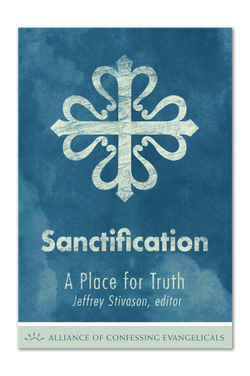
Those who are in Christ have been justified before God. But salvation means much more; it means that we are sanctified, that God actually leads us into holiness. As Michael Allen and company explain, our holiness is carried out in the present work of our sovereign, loving God. In Christ we are given life, not simply in name, but in fact. Praise the Lord, who delivers His children through every weakness. Though you struggle with sin, do not be discouraged; it is God who works in you, "both to will and to work for his good pleasure" (Phil. 2:13).
Past Episodes

Featured Offer
Those who are in Christ have been justified before God. But salvation means much more; it means that we are sanctified, that God actually leads us into holiness. As Michael Allen and company explain, our holiness is carried out in the present work of our sovereign, loving God. In Christ we are given life, not simply in name, but in fact. Praise the Lord, who delivers His children through every weakness. Though you struggle with sin, do not be discouraged; it is God who works in you, "both to will and to work for his good pleasure" (Phil. 2:13).
About Alliance of Confessing Evangelicals
The Alliance of Confessing Evangelicals exists to call the twenty-first century church to a modern reformation that recovers clarity and conviction about the great evangelical truths of the gospel and that then seeks to proclaim these truths powerfully in our contemporary context.
About Alliance of Confessing Evangelicals, Inc
The Alliance of Confessing Evangelicals is a broadcasting, events, and publishing ministry that exists to call the twenty-first century church to a modern reformation. Our broadcasts/podcasts include
The Bible Study Hour
with James Boice,
Every Last Word
featuring Philip Ryken,
Mortification of Spin
with Carl Trueman and Todd Pruitt,
Theology on the Go
with Jonathan Master and James Dolezal,
and Dr. Barnhouse & the Bible
with Donald Barnhouse.
These broadcasts air daily and weekly on stations in the United States and Canada and on the Internet. Event audio includes the Philadelphia Conference on Reformed Theology, the Reformed Bible Conference, and many others.
Contact Alliance of Confessing Evangelicals with Alliance of Confessing Evangelicals, Inc
Alliance@AllianceNet.org
http://www.alliancenet.org/
Alliance Of Confessing Evangelicals
600 Eden Road
Lancaster, PA 17601
1-800-956-2644