

Spiritual Warfare 4: The Helmet


We come now to the element in the armor of God that Paul describes as the helmet of salvation. Discover how the helmet offers the hope of salvation—protection to the mind against discouragement in battle. Eric Alexander calls us to equip ourselves with the hope that is found in Christ on Hear the Word of God.
Eric Alexander: It seemed to me especially fitting that we should be engaged in these Sunday evenings in studying together Christian warfare in Ephesians chapter 6. Whenever we send people out from this congregation, and we have had the privilege of doing it so often recently to serve God in the world, I am always conscious that we are sending them into a battlefield, and never more so than this evening.
But wherever the battlefield and whoever the soldier, when Christ sends a man to his post, the real battle that he will be fighting will always be a spiritual battle, and the real need that he is going to have will always be for spiritual armor. And so what I believe God is saying to us together is, take unto you the whole armor of God that you may be able to stand in the evil day, and having done all, to stand.
We have been considering this armor in recent Sunday evenings in its various parts: the belt of truth, which makes us ready to wage war at all; the breastplate of righteousness, which guards our very heart from the devil's assault; the shoes of the readiness of the gospel of peace, which give us stability in the fight and mobility to go wherever God will call us.
And that may not be an unimportant consideration if God is indeed to speak to many of us here this evening: the mobility that will permit us to go wherever God may call us. May I pause for a moment and ask you, have you the gospel shoes on your feet, young people who are here this evening? Have you the gospel shoes on, so that you are ready and mobile for wherever God may call you to?
We have been thinking about the shield of faith, by which God Himself, for He is the shield—I am thy shield—God Himself stands between the believer and the enemy. And we would have come in the normal course of our study this evening, Ian Murray having spoken, I know so helpfully, about Christian warfare from David and Goliath last Sunday evening, we would have come naturally to that element in the armor that Paul describes as the helmet of salvation this evening.
And I regard that as being of particular significance as we gather together in this way tonight. The helmet is, of course, for the head. And doubtless part of the significance of this metaphor is in the protection that the helmet of salvation gives to the mind. And I think the key to our understanding of it is in the apostle's other use of the phrase in that earlier epistle he wrote to the Thessalonians. In 1 Thessalonians 5:8, for a helmet, he says, speaking again about the armor we need for the warfare, for a helmet, take the hope of salvation.
What Paul is speaking about as he speaks of the armor we are going to need to protect our mind is the hope of salvation. Now, Dr. Lloyd-Jones points out in that book that I was recommending to you several times, he points out that this helmet, which is the Christian hope, is not so much a protection against a particular attack. It is rather a protection against what affects our whole attitude to the warfare.
And I think he is right. I'm sure he wouldn't be very interested to know that I thought he was right, but I think he is right. You see, there are times in warfare when the vital thing is not just some particular strategy in a particular area of the battle or some particular battle itself that we are engaged in, but the overall attitude that we have to this campaign into which God has called us.
When a certain weariness or tiredness, a spirit of discouragement creeps over us, a spirit of defeat, it's then that we greatly need to heed this word of the apostle: take the helmet of salvation and put it on your head. When we have this creeping sense that perhaps the whole battle ought to be given up, that perhaps it is not worthwhile giving and paying the cost and even bleeding and dying in the battle, when that spirit of discouragement comes upon us, whether personally or communally, then we greatly need to take the helmet of salvation.
Now, that was true on many occasions in the last war. When I was with the students in Wales last weekend, I was illustrating something in a different connection altogether from the last war, and one of them in the talkback they had afterwards asked me quite seriously, "Which war was this that you were remembering?" But during the last war, there were occasions when the real problem was not some particular defeat in a special area, but a spirit, a general attitude, a sense of a pall coming upon people, a sense of hopelessness perhaps.
And this is precisely what the apostle is speaking about. And the great need, and discerning men like Winston Churchill saw it, the great need was to inject a spirit of confidence, of hope into the nation. Now, in secular war, you do that by all kinds of devices, by protecting people from certain kinds of news, by seeking to give them certain kinds of encouragement, by perhaps even creating a spirit of triumphalism—Rule Britannia, Britannia rules the waves, you know.
But there is something altogether different that the apostle is speaking about when he says, take the helmet of salvation, the helmet which is the hope of salvation, and put it on your head to protect you. It is this condition that some of our great hymns have been addressed to. Have you noticed how some of them discern this? Men like Frederick William Faber, for instance, writing this hymn, "Workman of God, oh lose not heart, but learn what God is like, and in the darkest battlefield, thou shalt know where to strike."
Or Arthur Hugh Clough in the hymn, "Say not the struggle naught availeth, the labor and the wounds are vain, the enemy faints not nor faileth, and as things have been, they remain." That's the spirit, you see. It's a spirit of a sense of the hopelessness of the contest. Now, these men recognized this particular problem in spiritual warfare: the problem of discouragement. And it occurs at times when the warfare is particularly intense, or perhaps when success has not been very apparent, or when the majority appears to be the enemy rather than the Lord's people.
When you're a tiny minority in a certain place, that's when the spirit begins to appear and to cripple people, or when you're very tired, physically and mentally, and exhausted emotionally, and you wonder how long you can go on. It's very significant how often the Bible takes up this theme and meets it. The apostle Paul recognizes it when he speaks so often in his epistles about the danger of losing heart, of saying, what is the point in going on in the battle? So he writes to the Galatians, "Do not grow weary in well-doing." And to the Corinthians, "For this cause we do not lose heart, though our outward man perish, our inward man is being renewed day by day."
There is a sense in which the whole of the Epistle to the Hebrews, which we have been studying last winter, was written to deal with this condition. And the apostle writes about laying hold of the hope that is set before us like an anchor for our soul. You need an anchor in this situation, you see. What's the anchor? It's the hope that is set before us within the veil where Jesus is. It is this sense of glorious assurance about the future, glorious assurance about the present, because as Dr. Anderson was reminding us, God is a God on whose shoulders the government rests in the whole universe and in every corner of the world.
And we greatly need it, this confidence. So many of the Psalms touch upon it. And the psalmist finds himself in loneliness, in days of isolation, for example, in Psalm 42 and 43, and he turns upon himself and says, "Why art thou cast down, oh my soul? Hope thou in God, for I shall yet praise Him for the help of His countenance." And he is addressing himself, you see, because he sees he is in this situation. He is tending to the point of giving up. Now, that's an essential element in spiritual warfare that we need to grasp, and it goes on chiefly in the mind, does it not? You begin to discover yourself getting disconsolate, downhearted, discouraged, and a pall settles upon you. And everything you think about, you tend to begin to think in a negative rather than in a positive way.
So the apostle says, for a helmet, take the hope of salvation. Now you see it's of great significance that the distinctive mark of the godless world and of the godless man in Ephesians 2 is not only that he is without God and without Christ, but he is without hope. He is without hope in the world. And the apostle says, for a helmet, take the hope of salvation. Now, I have little doubt that in these coming months, both Murray and Ruth will need to be armed greatly with this weapon.
It's really the weapon, you see, which is wielded by keeping your eyes absolutely on God. That's what the man whose whole life is lived on this basis that he is saying to himself, "Hope thou in God, all my hope on God is founded." Now, that's the language of the Christian believer, and that's the language of Christian warfare. And the reason, of course, is not some kind of empty triumphalism. This is not some psychological trick to make you think positively—and some of you thought I was a bit hard on Norman Vincent Peale the other Sunday evening—but it's not the power of positive thinking.
It is the power of the gospel of God who has saved us in hope, as we were discovering this morning in Romans 8, and who has set before us a hope that is sure and steadfast. And that enables us to see that there is not an area of life, there is not a moment of time, there is not a corner of the world that is outside of the government of the King of Kings who has called us into His fellowship and summoned us into His service and sent us to the place of His appointing.
And I want to say to you that this is what I shall be praying for: for Murray as he labors there in Kabul, that day by day he may have this glorious sense of being borne along by this truth—the Lord God Omnipotent reigneth. So why art thou cast down, oh my soul? Hope thou in God. Now, that not only makes a world of difference to the way you do your work, it makes a world of difference to the state of your mind.
And that's why the doctrine of God's sovereignty and the truth of the hope that God has set before us is not merely some academic thing that you either take on or don't. It is the very stabilizer of a man's mind in days when the world is dark and there are wars and rumors of wars and evil men wax worse and worse, the very world that Jesus described. Now, He did not say these things will cease for My children, they will be insulated and protected from them. He says, when these things come to pass, lift up your eyes.
Now, that's what we've got to do: lift up our eyes to see the hope and to recognize that the living God is marching on. That's the great hymn we should really have been singing this evening: "Our God is marching on." And I tell you there is nothing in the whole world that is so altogether thrilling as to be taken into His service, to march with another drumbeat from the world's. Are you marching to that drumbeat this evening, my dear friends?
Has God taken you up into this glorious purpose so that your mind is protected as Isaiah tells us? "Thou wilt keep him in perfect peace whose mind is stayed on Thee." The helmet which is the hope of salvation. Take the helmet of salvation. And may the God of hope fill you with all joy and peace in believing. I want to say to my own soul that we need the same protection against the tendency to discouragement, and to give up, and to wonder whether it's all worthwhile in terms of the ministry of prayer that God has given to us.
It is a very easy thing, and I was greatly struck by what Dr. Anderson was saying to us about prayer as the greatest non-event of the evangelical world. It is such an easy thing on an occasion like this for us to stand as we shall be standing later to covenant with God concerning our brother and sister, and then to allow the devil to discourage us, and to weaken us, and to make us readily give up before we have really begun.
And if there is one place that the devil would want to do that, surely it's at the front line of the battle. Have you ever wondered where the front line of the battle is? The front line of this particular battle is in the place of prayer. That's where it is. And that's where the devil will do his discouraging work to his uttermost. And you and I will need to put on the helmet of salvation. Take it, my dear friends. Take it, my brother and sister. And may the God of hope give us joy together and peace together in serving Him. Let us pray.
Oh, Lord our God, we thank Thee that Thou art mighty in battle, great in Thy strength, and we bless Thee that more are they that be for us than they that be for them, for greater is He that is in us than he that is in the world. And we pray that for the sake of Thy glory, we may take the helmet which is the hope of salvation and place our hope in Thee afresh this evening, and go forth saying, we rest on Thee, and in Thy name we go. We rest on Thee, our shield and our defender. Hear us for Christ our Savior's sake. Amen.
Mark Daniels: You're listening to Hear the Word of God with the Reverend Eric Alexander, a minister in the Church of Scotland for over 50 years. To access more Bible teaching from Reverend Alexander, visit hear the word of God dot org where your generous contribution will help us sustain and grow this ministry. That's hearthewordofgod.org. You could choose instead to mail a check to this address: 600 Eden Road, Lancaster, Pennsylvania, 17601. Or call 1-800-488-1888. This program is a presentation of the Alliance of Confessing Evangelicals. I'm Mark Daniels. Thank you for listening. Please join us again next time for Eric Alexander and Hear the Word of God.
Featured Offer
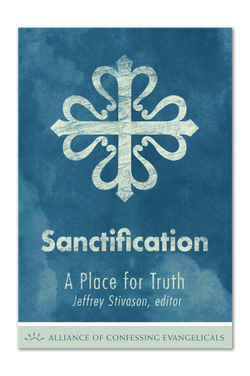
Those who are in Christ have been justified before God. But salvation means much more; it means that we are sanctified, that God actually leads us into holiness. As Michael Allen and company explain, our holiness is carried out in the present work of our sovereign, loving God. In Christ we are given life, not simply in name, but in fact. Praise the Lord, who delivers His children through every weakness. Though you struggle with sin, do not be discouraged; it is God who works in you, "both to will and to work for his good pleasure" (Phil. 2:13).

Featured Offer
Those who are in Christ have been justified before God. But salvation means much more; it means that we are sanctified, that God actually leads us into holiness. As Michael Allen and company explain, our holiness is carried out in the present work of our sovereign, loving God. In Christ we are given life, not simply in name, but in fact. Praise the Lord, who delivers His children through every weakness. Though you struggle with sin, do not be discouraged; it is God who works in you, "both to will and to work for his good pleasure" (Phil. 2:13).
About Alliance of Confessing Evangelicals
The Alliance of Confessing Evangelicals exists to call the twenty-first century church to a modern reformation that recovers clarity and conviction about the great evangelical truths of the gospel and that then seeks to proclaim these truths powerfully in our contemporary context.
About Alliance of Confessing Evangelicals, Inc
The Alliance of Confessing Evangelicals is a broadcasting, events, and publishing ministry that exists to call the twenty-first century church to a modern reformation. Our broadcasts/podcasts include
The Bible Study Hour
with James Boice,
Every Last Word
featuring Philip Ryken,
Mortification of Spin
with Carl Trueman and Todd Pruitt,
Theology on the Go
with Jonathan Master and James Dolezal,
and Dr. Barnhouse & the Bible
with Donald Barnhouse.
These broadcasts air daily and weekly on stations in the United States and Canada and on the Internet. Event audio includes the Philadelphia Conference on Reformed Theology, the Reformed Bible Conference, and many others.
Contact Alliance of Confessing Evangelicals with Alliance of Confessing Evangelicals, Inc
Alliance@AllianceNet.org
http://www.alliancenet.org/
Alliance Of Confessing Evangelicals
600 Eden Road
Lancaster, PA 17601
1-800-956-2644