
Creeds and Pastoral Ministry


Jonathan Master brings this message from The Philadelphia Conference on Reformed Theology 2026.
Alliance of Confessing Evangelicals: The Alliance of Confessing Evangelicals is pleased to bring you the following message from the Philadelphia Conference on Reformed Theology. Since its start in 1974, this conference has attracted audiences to its biblical expository approach to Christian doctrine. The Alliance is a listener-supported ministry. Our purpose is to promote a biblical understanding and worldview.
Guest (Male): The topic that we're going to look at today is the question of how confessions and creeds, and all the things we've been discussing this weekend, can be used particularly in pastoral ministry. I want to mention something that David mentioned right before. There's a sense in which many of these things that I'm going to say would apply to everyone. Some of them are going to be pastor-specific, such as how you can use it in preaching and that sort of thing.
Obviously, not everyone is called to preach, but some of them really apply very generally. Perhaps the title is a little narrower than what I'm actually going to do here. I've organized this around seven uses, seven major ways that we can apply and utilize creeds and confessions in pastoral ministry. I want to take each of these one by one, but they're not necessarily in any particular order.
In other words, it's not from the most important to the least important or vice-versa. These are really just seven ways that they have been used in the past, that I have found them personally useful in my own ministry experience, and that I think they might apply to any ministry context that you might find yourself in as well.
Number one: Creeds and confessions are useful in your personal devotional life. For instance, most of the examples I'll give will be from the Westminster Confession of Faith. I understand that not everyone is from a context that uses the Westminster standards, but if you utilize the London Baptist Confession, all of these examples will work because it's a very similar document.
The confessions that we have, and particularly the later Reformed confessions that we have, really instruct pastors and people and lead us to understand more fully the beauty and glory of the triune God. The purpose of doctrine is that we might live unto God in a way that he has commanded us—that our thoughts and our actions would be conformed to the Word of God.
Because in our standards we get such a full-orbed, scriptural view of who God is, that can help us not only live rightly but also aid us in our own love for the Lord. Let me give an example of this, of a way in which it could be used in personal devotion. Perhaps you're going to lead in prayer, or maybe not even lead in prayer but just go to the Lord in prayer.
One of the very useful ways that we can utilize our confessional documents is by asking the question: what have other people said in the past about who God is? For instance, as you go before the Lord in prayer, you might recall to mind what it says in the Westminster Confession of Faith, Chapter Two, Paragraph Two.
"God hath all life, glory, goodness, blessedness, in and of himself; and is alone in and unto himself all-sufficient, not standing in need of any creatures which he hath made, nor deriving any glory from them, but only manifesting his own glory in, by, unto, and upon them." That really fleshes out what we mean when we come before the Lord and when we address God.
Who is this God that we're addressing? We're addressing the God who is all-glorious, who has all blessing in and of himself. We do not add anything to him. No one adds anything to him. He has all of these things in full measure in and of himself. Even just thinking in those theological terms drives us toward greater and deeper personal devotion.
When you come to God in prayer, you're not merely thinking in categories that are at arm's length. You're really thinking: this is the God whom I am going to. I'm going to the God who has all blessedness in and of himself. That will also shape the language of your prayers because oftentimes we can get into a pastoral rut or a rut as Christians and not stop to think, "God, I'm coming to you as the all-wise one, the one who has all wisdom in and of himself. You're the God who needs nothing from me."
That changes your approach to prayer, and it comes out of this very significant confessional language. Or you might meditate on the doctrine of God's providence: "God, the great creator of all things, doth uphold, direct, dispose, and govern all creatures, actions, and things, from the greatest even to the least."
A little later on in the chapter on providence, this is worth reflecting on, particularly as you face challenges and temptations in ministry: "The most wise, righteous, and gracious God doth oftentimes leave for a season his own children to manifold temptations, to chastise them for their former sins, that they may be humbled."
That is language that speaks directly to our own Christian experience and to the Christian experience of many people that we'll be ministering to. It is systematic theology, but it's systematic theology that breathes doxology and draws our hearts to this God who has everything under his control and who is wise beyond our tracing out.
When you're praying, that's especially useful because oftentimes we want to ask God that he would do something or change something. The Bible tells us to bring those requests before God. But as we bring those requests, isn't it also important for us to say, "But Lord, your will be done. Your wisdom is far beyond my own"?
"I don't know exactly why you would choose not to heal this person. But Lord, I know you are the all-wise God, and in your glorious providence, you uphold all creatures and you direct and dispose and govern all things that come to pass." When we think about the use of confessions and creeds, it can be useful in enabling our own hearts to be drawn closer to who God actually is.
When you look at the history of the church, they consistently said that the pastor's duty is to be God's mouthpiece to the people in preaching. You're opening God's Word and proclaiming what God says. But they almost all say this as well: and the people's mouthpiece to God in prayer.
It's part of your job description as a pastor to pray for your people. If you have anyone under your care, you're commanded to pray for them. How do we pray? We want to pray informed prayers that are drawing our hearts and the hearts of our people to who God actually is. Creeds and confessional statements can aid us in that kind of personal devotion.
Number two: Creeds and confessions can aid us in understanding God’s Word. God’s Word, of course, in all the major facets of our salvation and all the major truths about who God is, is very clear. But there are parts of the Bible that are somewhat less clear than others. The Westminster Confession puts it this way:
"The supreme judge by which all controversies of religion are to be determined, and all decrees and councils and opinions of ancient writers, doctrines of men, and private spirits are to be examined, and in whose sentence we are to rest, can be no other but the Holy Spirit speaking in the scripture."
The Bible is our final authority, but the question is: how do we interpret the Bible? For instance, in 1 Samuel 15, the text says the Lord regretted making Saul the king. You read that in isolation and that could send you off in a direction that the Bible doesn't go in. You could go in a direction that says God is a God who changes his mind and doesn't know what's going to happen in the future.
But what do creeds and confessions do? The best ones are taking the whole sweep of what the Bible teaches and compressing it into statements that make it clear what the whole teaches in light of its parts. Our Reformed confessions uniformly teach that God’s decree is immutable and that God does not change.
You read these isolated verses through the lens of the whole of scripture. One way you can do that is by reading more of your Bible, but the reality is that sometimes when we come to isolated passages, we need help. We need help from people who have carefully digested all of scripture and put it together in such a way that it can be a guide for us.
When we come to the scriptures, we know that everything set down in them is true. We need to test everything by the scriptures, and our confessions teach us that. But by doing that work of pulling all these threads together, they also give us a helpful guide when we come to difficult passages.
The Bible has to be your guide, but we want to be careful that we don't take biblical verses in isolation from the others. My wife and I are getting some digging done to add to our driveway, and we have to have the utility companies come out and make sure that where we're digging is not going to cut through a gas or water line.
There's something similar to that dynamic that happens when we have a good confessional standard. We can read the scriptures and see lines that we need to be very cautious about crossing. If we were to read that verse about God regretting making Saul king and immediately jump to the conclusion that God changes his mind, a confession will help us there.
It helps us when we come to the scriptures to come to them with the right frame of mind and to make sure that the parts fit in with the whole. That leads us to the third thing: good creeds and confessions help act as a check on the proportionality of our ministry.
All of us have certain doctrines or passages that are very meaningful to us. We can find ourselves, if we're not careful, only teaching those things. Even if those things are true and biblical, they're not giving people the whole diet of what the Bible teaches. The best creeds and confessions do a good job of showing us the proportions of different theological topics.
Ministers are commanded to proclaim the whole counsel of God. We can't always test ourselves by asking people their opinions, but we can test ourselves by looking at good summaries of biblical truth. I think it's useful for pastors to ask themselves, "Have I ever taught people this? I know I've taught them this, but have I taught them that great truth?"
In Acts 20, the apostle Paul says, "I did not shrink from declaring to you the whole counsel of God." Sometimes we have to confess it can happen that there are certain topics that we want to avoid. I don't want to actually preach on what the Bible says regarding eternal punishment.
But when I look at these great confessions, I realize that's a significant portion of biblical teaching that I have to be faithful in proclaiming to my people. We want to come to the end of our ministries and be able to say, "I am innocent of the blood of all men." Why is it not on my hands? Because every part of the scripture, I've taught you.
Even if you're not a pastor, it's still important because there may be aspects of biblical teaching that you simply don't give a lot of attention to in your own life. That means you're out of proportion in some way. Regular Bible reading can do that for you, but also coming to a confession that has pulled all these things together can help.
Look back, if you're a pastor, at the sermons you've preached over the last two years and say, "Have I really been proclaiming the whole counsel of God?" Number four is this: creeds and confessions promote the unity of the church. At first, that might seem counterintuitive because they're very specific on certain issues.
But those who are united around these core truths can genuinely serve in unity with one another. This is why denominations can be so beneficial. They're a kind of visible statement of the unity that we have. We can say to these other brothers, "You're a fellow minister who believes the same things I believe."
They also make clear the areas on which we are united and the areas in which we're going to go in separate directions. This came up today in the Q&A when someone asked whether or not creeds and confessions hurt our ability to do evangelistic or mission work together.
Actually, they give greater clarity because it is clear there are so many things we can do together because we share this common confession. As a pastor, what you need are other ministers of the gospel with whom you can have close ties and fellowship. You also need to be able to delineate: on these things we probably can't cooperate, but on all these other things we can.
Our natural tendency is to draw lines just in terms of affinity and friendship, but that actually doesn't lead to fruitful, long-lasting ministry. What does lead to fruitful ministry is a cooperation based on a common commitment to theological truths. It enables us to cross lines that we otherwise wouldn't naturally cross.
Number five: creeds and confessions aid in our witness to the world. They do that because they offer a transparent statement of what it is that we believe. Why is that important? If you read your New Testament, you will find that the apostle Paul very frequently assesses his own ministry based on the fact that he has served in godly sincerity.
"The aim of our life is to serve with a clear conscience." Paul can say, "I have been totally transparent about everything that I believe and I have operated in full integrity." In that sense, he can evaluate his own ministry and say that it is faithful before God. This is why Paul says, "We're not like so many others, peddling the Word of God, but as from sincerity, as from God, we speak in Christ in the sight of God."
It is a great security to pastors to be able to say with total transparency, "This is what I believe. This is what I'm going to teach." We're not a secret society. We're not people trying to do a bait and switch. We want to be ministers of whom it is said he ministered in godly sincerity with total integrity.
We should all be able to say that what you're going to get here is from the Word of God. But particularly when people are coming in from the outside, they don't necessarily know everything the Word of God says or how it works out in practice. Very few people who walk into our churches are going to know that we follow the Bible, and that means that we have a certain form of church government or we're going to practice church discipline.
It's important for us to state those things up front. I remember reading an article written by a professional woman in New York City. She talked about going into a church and feeling like she'd been hoodwinked because the people avoided issues that were actually really significant in her life.
She was committed to a secular understanding, and they said, "Oh, that's not going to be a big deal." But then as she dug into the life of the church, she realized it was in conflict with what they actually believed. But their strategy had been: let's not be open about those things because it will drive people away.
In that case, it did much more harm than good. What she needed was a clear statement of what we believe. Robust confessions like the Westminster Confession of Faith are robust enough that we can say, "This is our understanding of the Word of God." That kind of sincerity and integrity is good both internally and externally.
There's a kind of respect and security that goes along with that. We weren't peddlers of the Word of God. We didn't try to sell you on something. We actually openly stated the truth to you. Note how many times the apostle Paul appeals to that when he describes his own ministry.
Number six: the confessions that we have are a great aid to us in personal counseling. Counseling should be a kind of exercise in systematic theology. Someone comes to you with a problem and they say, "Pastor, I need help. My marriage is falling apart," or "Pastor, I need help with this sin."
What they are asking for is: what does the whole Bible teach on this particular issue? It is essentially a systematic theology exercise. Our very best confessions give concise, clear, biblical answers to moral issues. I have lost count of the number of times that I've been able to point someone to a paragraph in a confessional document and get a proportional, whole-Bible answer.
One profound example is the question of assurance: how do I know that I'm actually in Christ? Our confessions have very concise paragraphs that deal with that issue. "Yet such as truly believe in the Lord Jesus, and love him in sincerity, endeavoring to walk in all good conscience before him, may, in this life, be certainly assured that they are in the state of grace."
They say this assurance is founded upon the divine truth of the promises of salvation, the inward evidences of those graces, and the testimony of the Spirit of adoption. How do we grow in assurance? We look to the promises that Jesus Christ made. Jesus said, "The one who comes to me I will not cast out."
Then we look at the inward evidences. One of the ways you can determine whether or not you're in Christ is you can look at the way the Spirit is working in your life. By God’s grace, I'm not the same person I was five years ago. I can see the Spirit's work in my life. Then we have the testimony of the Spirit of adoption as God the Holy Spirit works in our hearts to convince us that we are children of God.
That's a counseling issue. Someone comes to you with all kinds of stray thoughts and doubts, and you say, "Yes, you can know in this life." How can I grow in this? Look to the promises of Jesus Christ. For every one look at yourself, take ten looks at Christ. Look at your own life. By God’s grace, the Lord is working in your life.
That is the language of sitting across from someone in the coffee shop, yet it's systematic theology. We don't have to reinvent the wheel. We find so much of biblical teach encapsulated and summarized here in the Westminster standards.
My seventh and last point is this: confessions and creedal statements are very useful in the training of children. This certainly applies to parents, but it also applies to pastors. You're called to pastor a congregation of families. What a privilege that is to be able to shape them by the Word of God from a young age.
Our confessions and catechisms are made just for that purpose. It's essentially what the Westminster Shorter Catechism was made for. We all have a burden for the next generation. Children are designed by God so that they can absorb this information and memorize it much more easily than we can later in life.
I see men who come to train for the ministry in their twenties and men who come in their sixties. The guys in their twenties, generally speaking, have a much easier time learning their Greek paradigms. Children can retain information and memorize it very quickly. That's the kind of thing that sticks with them.
What better way to train up children than to use these wonderful catechism documents? Think about Question Seven in the Shorter Catechism: "What are the decrees of God?" "The decrees of God are his eternal purpose, according to the counsel of his will, whereby, for his own glory, he hath foreordained whatsoever comes to pass."
If you learn that as a four-year-old, you're not going to understand all the implications, but it sticks in your mind. Can you imagine the implications that has for the rest of your life? The decrees of God, for his own glory, foreordaining whatsoever comes to pass. You know how many questions that answers and how many false paths that keeps you from going down?
"How doth God execute his decrees?" "God executeth his decrees in the works of creation and providence." "What is the work of creation?" "God’s making all things of nothing, by the word of his power, in the space of six days, and all very good." "How did God create man?" "God created man male and female, after his own image."
"What are his works of providence?" "God’s works of providence are his most holy, wise, and powerful preserving and governing all his creatures and all their actions." You've addressed a myriad of issues that children are going to face: confusion about God’s creative work, confusion about male and female, or confusion about how God is at work in the world today.
That has massive implications and it comes from five questions in the Shorter Catechism. We want them to have a proportional faith that really addresses the perennial human issues.
I would suggest to you that confessions and creeds serve a number of purposes: they aid in your personal devotion; they help guide your approach to the Bible; they put a check on the proportions and balance of your ministry; they promote the unity of the church; they aid in your witness; they aid in your counseling; and they aid in the training of children.
Alliance of Confessing Evangelicals: You've been listening to a message delivered at the Philadelphia Conference on Reformed Theology. This conference is a ministry of the Alliance of Confessing Evangelicals. For more messages from the PCRT, visit ReformedResources.org, a trustworthy source of books, audio, video, and other resources to help you grow your Christian faith. That's ReformedResources.org.
Featured Offer
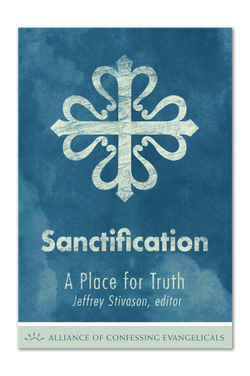
Those who are in Christ have been justified before God. But salvation means much more; it means that we are sanctified, that God actually leads us into holiness. As Michael Allen and company explain, our holiness is carried out in the present work of our sovereign, loving God. In Christ we are given life, not simply in name, but in fact. Praise the Lord, who delivers His children through every weakness. Though you struggle with sin, do not be discouraged; it is God who works in you, "both to will and to work for his good pleasure" (Phil. 2:13).

Featured Offer
Those who are in Christ have been justified before God. But salvation means much more; it means that we are sanctified, that God actually leads us into holiness. As Michael Allen and company explain, our holiness is carried out in the present work of our sovereign, loving God. In Christ we are given life, not simply in name, but in fact. Praise the Lord, who delivers His children through every weakness. Though you struggle with sin, do not be discouraged; it is God who works in you, "both to will and to work for his good pleasure" (Phil. 2:13).
About Alliance of Confessing Evangelicals
The Alliance of Confessing Evangelicals exists to call the twenty-first century church to a modern reformation that recovers clarity and conviction about the great evangelical truths of the gospel and that then seeks to proclaim these truths powerfully in our contemporary context.
About Alliance of Confessing Evangelicals, Inc
The Alliance of Confessing Evangelicals is a broadcasting, events, and publishing ministry that exists to call the twenty-first century church to a modern reformation. Our broadcasts/podcasts include
The Bible Study Hour
with James Boice,
Every Last Word
featuring Philip Ryken,
Mortification of Spin
with Carl Trueman and Todd Pruitt,
Theology on the Go
with Jonathan Master and James Dolezal,
and Dr. Barnhouse & the Bible
with Donald Barnhouse.
These broadcasts air daily and weekly on stations in the United States and Canada and on the Internet. Event audio includes the Philadelphia Conference on Reformed Theology, the Reformed Bible Conference, and many others.
Contact Alliance of Confessing Evangelicals with Alliance of Confessing Evangelicals, Inc
Alliance@AllianceNet.org
http://www.alliancenet.org/
Alliance Of Confessing Evangelicals
600 Eden Road
Lancaster, PA 17601
1-800-956-2644