

A Great Destiny - Part 1


Pastor Bryan shares a lesson from Luke 24. Dr. Chapell investigates the truth that Jesus chose to take on the form of a man to fulfill a purpose that had been prophesied.
Bryan Chapell: God is saying to us, I am taking every prayer, every moment, every act of kindness, everything that you endure, and I am making it infinitely and eternally significant because it's not just a material world. The world is not flat.
Host (Male): So glad you joined us for today's Unlimited Grace, the audio broadcast ministry of pastor and author Bryan Chapell. In today's episode, Pastor Bryan shares a lesson from Luke chapter 24. Dr. Chapell investigates the truth that Jesus chose to take on the form of a man to fulfill a purpose that had been prophesied.
You can find this lesson and many others when you visit unlimitedgrace.com. And while you're there, look for Pastor Bryan's book, The Multi-Generational Church Crisis. This compelling book asks the question of the church, what could be accomplished in the name of Christ if we could better understand each other? Let's hear now from Dr. Bryan Chapell as he shares the lesson, A Great Destiny.
Bryan Chapell: So with Easter passed, now what? I mean, it can't just be a letdown. It can't be all the adrenaline passed. Christian writer Paul Tripp honestly asks us the question, so now that Easter is over, what do you do with Easter?
When a particular area of sin looks attractive to you and you feel weak and vulnerable, what do you do with Easter? When you've been betrayed by someone and thoughts of vengeance enter your head, what do you do with Easter?
When you're struggling in your marriage and it seems impossible to love another person as God designed, what do you do with Easter? When you're facing another situation with a rebellious child and you feel there is no patience left, what do you do with Easter?
What do you do with Easter when you lay in bed tonight mulling over yesterday and today and tomorrow and wonder whether God is for you in any of those places? What do you do with Easter? Now that it's passed, what's your takeaway? I mean, we know there's supposed to be a message and we kind of get the essence of it: Jesus rose from the dead. But what's the purpose of that?
Apparently, there's some mission that the people of God understood and we wonder still, is it ours? And if so, what is the motivation to be on mission for Jesus who may simply seem to be that ancient guy long ago in those pages of Scripture? All of those things are apparent to us in this account of two disciples who for reasons we don't quite understand are honest enough to say, he arose and we didn't get it.
He actually appeared to us and it was so out of context, so beyond our expectation, so beyond whatever was supposed to be happening that we didn't even recognize it was him. What do you do with Easter when it's passed? They help us know. There is a message that they ultimately got, but it was the message first of a might that had been forsaken.
The message that we're supposed to understand is that Jesus forsook the might that was his. Verse 19, right at the middle, they explained to Jesus, who's just said, what things are you talking about that happened in Jerusalem? Like he doesn't know. So they explain it to him: Jesus of Nazareth, a man who was a prophet mighty in deed and word before God and all the people, and how our chief priests and rulers delivered him up to be condemned to death and crucified him.
He was a prophet. He knew what was coming and he kept on coming. And what he came to was a crucifixion and a death that he himself had prophesied. He, even as he was being taken away from the garden by the troops that would ultimately put him on trial before Pilate, even said to his own disciples, I could have called 12 legions of angels to stop all of this, but he did not stop it.
He had the foresight and he had the power and he forsook them both in order to fulfill the mission that he says was necessary. And the reason it was necessary was because he was not just forsaking power, he was fulfilling prophecy. The startling words of verse 27: beginning with Moses and all the prophets, he interpreted to them in all the Scriptures the things concerning himself.
As though this same Jesus, even as he is walking with disciples on the road to Emmaus, actually begins to say to them, this thing that happened was no surprise. In fact, beginning at the very beginning of the Scriptures, that which began to be written 1,500 years, 15 centuries before Jesus came, by as many as 40 different authors in many different nations, in many different settings, past war and famine and slavery and exile, past all of that, there is a message that the Creator is a Redeemer.
And he had this message from the beginning, says Jesus, going through Moses and all the prophets and all the Scriptures. There is no other holy book like it known among humanity. We talk about the uniqueness of Christianity being instead of somehow humanity reaching up to God, God reached down to us. But one of the great expressions of that grace that is unique about a God who would reach to us are the Scriptures themselves.
There's no other holy book written by so many people over so many centuries with one consistent message. It's not just Aesop's fables, it's not just a rulebook, it's not just a code of moral standards. Here is a message that humanity is in need, that a holy God establishes standards that humanity cannot keep and therefore requires an action by that same God in providential grace to make us his own.
And that is the message from the first page all the way through the end, and it is unique in the human experience that God would use so many over so much time. Think of it, a millennia and a half, people who do not know each other, different nations, different places, different times, on message.
And the message is that God would send his son. From the very dawn of humanity, that message that Moses wrote as he talked about the experience of Adam and Eve after the temptation, that God would even speak to the tempter and say, I am going to put enmity, antagonism, a war between your seed and my seed.
And what your seed is going to do is strike the heel of my son, but he is going to crush your head. And from that moment, it is game on. The rest of human history is the unfolding message of a Creator God who would send a Redeemer. And that consistency of message is ultimately not just our hope, it is astounding.
National news was made just a few months ago because of a young woman named Amanda Laman who, after 23 years, received letters from her mother who had died of bone cancer. As the mother was dying, she began to write the letters to her daughter. But the letters never made it. Instead, 23 years later after foster care and living in numerous states—Washington State, Texas, Louisiana, back to Texas—agency to agency, foster care to foster care, occasional relative to occasional relative, suddenly there is a packet in the mail from the executor of her mother's estate with a birth certificate and some photos and letters of love 23 years late.
Amanda, honey, you know I will really miss you and not being able to get up with you every day. Honey, try to keep smiling, try to be brave. It was only 23 years and it made national headlines. What would it mean for a parent to say to us, for thousands of years I have loved you and I have prepared for you and I have sent word to you of my great care?
In itself, it is astounding that such love letters would come to God through all the centuries and all the people that he has arranged. But there is something better even than the love of looking backwards at what he did. It is the love being expressed in the present.
Host (Male): You're listening to Unlimited Grace, the audio broadcast ministry of pastor and author Bryan Chapell. It may seem hard for younger Christians to believe, but people over 50 were raised during an era when 90% of Americans identified as Christian. These older believers were once part of a majority group that understood the mission of the church was to take control of our culture, to halt its evils.
At the same time, Christians under 50 have lived their entire lives perceiving themselves as a minority that needs to make credible their faith to a secular, pluralistic culture. These distinct experiences and perceptions have a profound impact on the priorities different generations have for church ministry. It's no wonder that younger and older believers don't always see eye to eye.
Guest (Male): In his new book, The Multi-Generational Church Crisis, Dr. Bryan Chapell asks the question, what could be accomplished in the name of Christ if we could better understand each other? This practical and hopeful book is backed by thorough research, revealing how to open the lines of communication, appreciate the experiences that shaped each generation in your church, and unite in one mission to impact your community and the world.
You can request your copy of The Multi-Generational Church Crisis when you donate online at unlimitedgrace.com or by calling 844-41-GRACE. That's 844-414-7223.
Host (Male): And now more from Bryan Chapell on today's Unlimited Grace.
Bryan Chapell: We're here on Earth Day weekend when our world is celebrating the accomplishments of science, which we applaud as we identify the gifts of God in the intelligence and the experience of those who understand the intricacies of our world and its science. But that's not all that's being understood in the present age.
One of the great contributions of a rising generation who has examined the modernist influences of our culture now is that it is discovering a new spirituality to say the answers of science, if it's presenting reality as if to say the only thing you can know is what is material and can be measured by human machines, that's the only reality there is, flattens out the world. So that even the human heart that begins to experience thought and emotion and love and the things of a spirit, no, that can't be the whole reality.
And the generation that's rising with a new spirituality that I will grant you is sometimes bizarre and off the biblical path, nonetheless is touching something deep in the human instinct and awareness to say it is not just about molecules and measurement. That is not the only reality. There is something far more complex and layered and rich in the human experience, and that is what the Scriptures are speaking of.
And what Easter is declaring is that spiritual reality is powerful and it is here. That this same Jesus works for his people not just long ago, but in the present reality because he is alive and he is here by his spirit. What difference does it make? I read recently an essay by Ken Shigematsu, who is a Christian writing for scientists.
And he writes these words, "If our life one day simply ends and we just rot in the ground like a carrot and we're no more, and if this world billions of years from now overheats and makes life no longer possible and then there's nothing, well then our careers which seem so important to us now and our romantic loves and our family loves and our friendships which seem so important to us now really mean nothing.
If this planet one day burns up and there's no more life, it's just over, period, full stop. The fact that you've made Vice President or partner in the company or that you were in love with somebody or have a family, it won't mean a thing. It's all over nothingness." The words simply remind me of the social media post where the mom says, "What is the use of all this? I clean the dishes and they're dirty again. I wash the diapers and they're messy again."
Or the businesswoman who says, "I commute and I compute and the next day I do it all over." Or the family who goes through unspeakable tragedy and wonders what is the use and why. And if it is only a material world, the answer is it all ultimately means nothing.
But if there is a spiritual reality, if we operate on one plane and God is at the same time opening up a spiritual reality that is eternal, a new heavens and a new earth that we are preparing for, that the children whose dishes are being cleaned and diapers who are being washed are eternal souls that we are investing in.
That they are learning by patience and tolerance and the care of a parent what it means to have a God who loves them not just for the moments of their childhood, but for eternity. That our relationships, whether they are romantic or whether they are career, are God putting us into the opportunity to say who he is for people who will be our eternal mansion-mates.
That God is saying to us, I am taking every prayer, every moment, every act of kindness, everything that you endure and I am making it infinitely and eternally significant because it's not just a material world. The world is not flat. God is saying there is texture and richness and complexity and spirituality beyond your fathoming.
And he's letting us into the material world and glimpsing the spiritual world by Easter itself to say that greater reality is what I am promising to you. So that you begin to recognize in that richness and infinite duration of God's care that you can trust me. Even when the world looks bleak, even when you don't have immediate answers, I have shown you myself.
I have pulled back the curtain. Here is the spiritual reality. Your world is not flat. It is a spiritual world into which God has not only shown himself strong, he is operating to our great advantage and from the beginning he was letting it be known. And even in the miracle of the Scriptures themselves, he is telling us that we can trust him.
What would it mean if the message now is: here is this God who is Creator and he's also Redeemer, he's yours, yours to know and yours to tell? You would begin to recognize there's a mission here. If this is really who this Jesus is and I see it now, really, there is mission for us to let others know.
I've mentioned to you before, in 1601, Michelangelo Caravaggio painted what became one of the world's most famous paintings known as the Supper at Emmaus. He's capturing this event that Luke describes. You know on that road to Emmaus after the resurrection, Jesus begins to walk with these disciples, and we don't even understand why they do not recognize him.
But finally they get to Emmaus, they have supper, and there is a moment at which they recognize it is Jesus. What does he do when they say it's him? He breaks the bread. And in that most Christ-like of actions where he is reminding them of his body broken in their behalf, they see him. And it's that moment of recognition that Caravaggio captures.
And the reason it's captured for such note is that he's breaking all the conventions of his era. Neither Jesus nor his disciples have aristocratic beards. They are shaven like working men would have been in that time so they can sweat and wash off the fish guts and the sawdust. They're just common men. And they don't have halos.
And when they see this is Jesus, they don't kind of sit back in glassy-eyed wonder. Instead, the moment that Caravaggio captures is the disciples rising from their seats. Their muscles are taut. They are ready to act. One reaches out toward you, the observer, and pulls you toward Jesus as if to say, if this is Jesus, the long-prophesied Messiah, the one predicted from the beginning of the world, the one who came to save, the one of whom all the prophets, all the Scriptures have written, he comes to save and he's alive and he's here, you know they must tell.
They are now on mission. And the Scriptures say that same hour they get up to go back and tell people. Already, remember, they were saying to Jesus, no don't go on to the other town, the day's already far spent. Have supper with us. But the same hour that they recognize it's Jesus, though the day is far spent, they go back to Jerusalem to say we have seen him.
There is this note of urgency and the reason there is urgency in their mission is they are telling of his victory. He's not in the grave anymore. He is here. And do you recognize that is our story too? To say he's not just in the grave, he is here. And they are able to say it with transparency even to those other believers that are back in Jerusalem.
What do they say? You know what, we were walking with him and we didn't even recognize him. He was appearing and we were blind to him. And we were leaving Jerusalem. We were trying to get out of there. We thought he had failed. We thought our hopes were dashed. We were in despair. And though we were fleeing from his work, he came into our journey. We had lost hope, and he gave us hope again.
Host (Male): That's Pastor Bryan Chapell, and you've been listening to Unlimited Grace. If this message has been an encouragement to you, you can find a collection of more valuable resources at unlimitedgrace.com. When you visit, you will find today's message and many others from Pastor Bryan.
Please be sure to join us next time as once again we endeavor to put Christ at the center of our efforts so that lives might be transformed by his unlimited grace. This ministry is brought to you by Unlimited Grace Media and continues to be made possible with your generous financial support.
Featured Offer
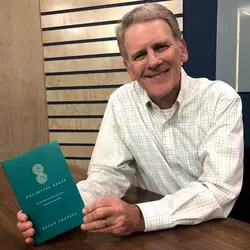
In Bryan Chapell's book, you will learn how God's unlimited grace leads us to heartfelt obedience and transforming joy. Explaining why grace is important and giving us tools to discover it in all of Scripture, Unlimited Grace helps us to see how gospel joy transforms our hearts and makes us passionate for Christ's purposes.
Past Episodes

Featured Offer
In Bryan Chapell's book, you will learn how God's unlimited grace leads us to heartfelt obedience and transforming joy. Explaining why grace is important and giving us tools to discover it in all of Scripture, Unlimited Grace helps us to see how gospel joy transforms our hearts and makes us passionate for Christ's purposes.
About Unlimited Grace
About Bryan Chapell
Bryan Chapell, Ph.D. is the Stated Clerk Pro Tempore of the Presbyterian Church in America (PCA), based in Lawrenceville, GA.
Dr. Chapell is an internationally renowned preacher, teacher, and speaker, and the author of many books, including Each for the Other, Holiness by Grace, Praying Backwards, The Gospel According to Daniel, The Hardest Sermons You’ll Ever Have to Preach, and Christ-Centered Preaching, a preaching textbook now in multiple editions and many languages that has established him as one of this generation’s foremost teachers of homiletics.
Dr. Chapell is passionate about sharing the truth of God's grace with others, because it provides the freedom and fuel for transformed lives of joy and peace.
He and his wife, Kathy, have four adult children, a growing number of grandchildren, and lives rich with friends, fishing and faith.
Contact Unlimited Grace with Bryan Chapell
info@unlimitedgrace.com