

Transformed By Grace, Part 2


God continually gives us the spirit to empower us to witness. To use our spiritual gifts. To accomplish Gods purposes. To worship Him in power and truth.
JP Jones: God continually gives us the spirit to empower us to witness, to use our spiritual gifts, to accomplish God's purposes, to worship him in power and truth.
Greg: Thank you for joining us on Truth That Changes Lives. Pastor JP Jones is the senior pastor of Crossline Community Church in Laguna Hills, California, and a professor in biblical studies at Biola University. Today on Truth That Changes Lives, Pastor JP will be giving us a message from a series entitled Galatians. Let's listen in as JP gives part two of Transformed by Grace.
JP Jones: Galatians 3:2. He says, "Did you receive the Spirit by observing the law or by believing what you heard?" It's a rhetorical question. The obvious answer is it was by believing what you heard; it wasn't by observing the law.
Verse three, "Are you so foolish?" He says it again. "After beginning with the Spirit, are you now trying to attain your goal by human effort?" It's almost like he's saying, "Dude, what's the deal?" You came into the Christian life by grace through faith. Do you think now you're going to do it on your own to continue to live the Christian life?
The goal of sanctification, the goal of transformation, the goal of fully experiencing all that God saved you for—since he got you there by grace through faith, do you think now all of a sudden, "Oh, I need to do it from here"? How foolish. But couldn't we just put our names there? Not just foolish, "Oh, foolish JP. Oh, foolish Crossline Church." It's kind of woven in our DNA to kind of want to do that.
But Paul is rebuking that under the inspiration of the Holy Spirit as he writes these words. Verse four, "Have you suffered so much for nothing, if it really was for nothing?" It's like he's bringing them back to their conversion experience and what it was to step out of darkness into the light in the first place, what it was to let go of the law and accept grace in the first place. Don't you remember what that cost you? Why are you going back to a system that held you in bondage?
And verse five, "Does God give you his spirit and work miracles among you because you observe the law or because you believe what you heard?" Again, two bridges: observing the law, believing what you heard in the gospel. Everybody's living on one of them. What Paul is saying to the Galatians is this is not only true for the person who's yet to make a commitment to Christ.
This isn't just written to the unbelieving world as a gospel offer. This is written to believers who are reverting back to a false belief system. Remember, everybody lives by faith. What he's saying is that it's really easy to step out of darkness into the light and really put your faith in Christ alone, but then in the process of living that out, step back into the old system that you got saved from in the first place.
That could be the Jewish law, the laws of the Baptist church, the laws of what you think it means to be a good person. Any principle of works, human effort, personal attainment is this bridge that's described as law-keeping. The alternative is grace through faith, accepting what God has done and what God does do, and living by faith in who God is and what God has promised.
When we walk on that bridge of law-keeping, it repudiates the work of Jesus Christ. Paul's logic is that if you could become righteous by your own efforts, then you wouldn't need Jesus. So then why did Jesus die? Well, it's pretty interesting because when you study the history of the church, there have been within the larger umbrella of Christendom movements and denominations that have really emphasized our effort, our work, as the way we get to God.
But then the Bible clearly speaks about Jesus's death, so then they have to come up and redefine why Jesus died. What they will tell us is that really Jesus died to give us an example of what it means to be totally committed to God. So his example should motivate us to really do the best we can to keep the rules. Now, is Jesus an example? Yes.
But is that why Jesus died? No. Jesus died to pay the penalty for our sin because we could not overcome the barrier of sin. Romans chapter eight, verses three and four says, "For what the law could not do, weak as it was through the flesh, God did: sending his own Son in the likeness of sinful flesh and as an offering for sin, He condemned sin in the flesh, in order that the requirement of the law might be fulfilled in us, who do not walk according to the flesh but according to the Spirit."
You see, we couldn't do it on our own, so God did it for us in Jesus Christ. But when we walk down this bridge of law-keeping, in effect, we're saying to God, "I can do it on my own. Let me try, and let me work really hard." But that repudiates what Christ has done for us. The continual keeping of laws, rules, spiritual convictions, disciplines, practices, with an attitude that when I do this, that either saves me or when I do this, that keeps me saved or when I do this, that makes me more spiritual, is basically a statement that what Christ did isn't enough. I have to add to it.
I remember as a very young Christian, I was 16 when I believed in Christ and was saved. Probably about a year after that, during that first year of my relationship with Christ, there'd be times when I had doubts. It is a developmental process of everybody going through doubts and developing convictions. But sometimes my doubts were related because I would fail God, I'd sin. I'd think, "Maybe I'm not a Christian because I sinned."
So I'd ask Jesus to come into my life all over again. I'd say the sinner's prayer all over again because I think maybe I wasn't saved or maybe I lost my salvation. I better get saved all over again, so I'd say the prayer of salvation and ask Jesus to come into my heart all over again. I did this several times. I remember one day I was watching on TV a Billy Graham crusade. Billy Graham was speaking and he was speaking to people out there in television land.
Billy said, "If you have given your life to Christ and trusted in Christ alone for your salvation, but you keep asking Jesus into your life, you're insulting Jesus. Because you're basically saying, 'I don't believe your promise.' You're testing Jesus." It was like, "Wow." That was speaking right to me. I remember Billy Graham said, "If you've trusted in Christ alone for your salvation, you may need to confess your sins, but you don't need to keep asking Jesus into your life all over again. Thank him that he is in your life and that he's never going to leave you."
I realized that in effect, what I was doing, though I didn't really understand it—because I think this is what we all do, though we don't always understand it—is that we think we've got to do something to add to what Jesus has done. We may even start doing that out of what we think our really sincere motives. We really want to please God, we want to get right with God, we want to do the right thing.
But we start thinking, "I've got to add to it." Paul says that attitude is trusting in human effort, he goes on to say in Galatians three, rather than in Christ alone. The point, the powerful point of what God is saying here, is we couldn't add anything to what Christ has done in order that we might be saved and be accepted by a holy God and be declared righteous.
You know what? We can't add anything to what Christ has done to grow in that salvation. Just as only Christ could save us, only Christ can make us holy. Only Christ can transform our lives. Only Christ can grow us up. Only Christ can sanctify us. When we revert to an approach of law-keeping, in effect, we're saying what Jesus did wasn't enough.
Now, here's the tricky part. It's very subtle. Think back to the greatest sermon ever preached by the greatest preacher who ever lived, for those of you who were with us in that series looking at the religion of Jesus and the Sermon on the Mount. In Matthew chapter six, Jesus talks about the practice of religion, the practice of our righteousness. He makes no bones about it. "My followers will practice their faith." Faith is active.
So in the course of living out the Christian life, we've come to Christ by grace through faith, we are new people in Christ, but we live that out. Jesus talks about three religious practices that are to be the part of the life of a really dedicated follower, a kingdom disciple. He talks about giving to the poor, he talks about prayer, and he talks about fasting. He legitimizes all three religious practices.
But what he says is you can do those practices two ways. One way is to be seen by men, and what you get is what you get. And the other way is to please God and honor God and you will be rewarded now and in eternity. Step away from that. There's a lot involved there. But one of the principles that is involved there is the religiousness of an act, or the righteousness of an act, is not in the act itself. It's in the heart of the person performing the act.
In other words, as a new person in Christ, I can practice certain spiritual disciplines, I can hold to personal convictions, I can practice my religion in a way that's trusting in my own efforts or in a way that pleases God and is energized by the Holy Spirit. You may not be able to know the difference because it might look the same. Two people might be doing the same two thing and they look the same, but one person has a heart that is fully trusting in Christ alone and the other person has a heart that says, "I'm adding something. I'm working for it."
You cannot reduce the Christian life down to rules and externals. It's about a transformation of the inside. Faith is expressed in action, but be careful not to measure your action or somebody else's action and put that as a spiritual litmus test of whether it's spiritual or not. The heart is the key. To be quite honest, I don't even know my own heart and you don't know your heart either.
So the last thing you could do is presume to know my heart and the last thing I could do would be to presume to know your heart. Jeremiah says the heart's deceitful and desperately sick; who can know it? "I alone judge the hearts. I alone test man's motives. I alone render to every man according to his work." Only God really knows our heart.
The best that we can do is come to God with a humble heart, a repentant heart, trusting in his grace, saying, "I'm not going to live on this bridge of law-keeping because I know that's death. I'm coming humbly, depending on who you are, believing who you are, trusting what you've said, and living as much as possible on this principle of grace through faith."
Even then, God's going to correct us sometimes because it's so easy to step off that bridge and to get over on the other bridge. That's what the Galatians had done. They started off well. That's the whole argument. You started off by the Spirit. You started off by grace through faith. And now somehow you think your effort is going to complete the task. Law-keeping in all of its forms repudiates the work of Jesus Christ.
When I was a growing Christian in college and I'd really gotten excited about reading God's word and sharing my faith and I'd gotten involved with Campus Crusade as a ministry, what started off as a very sincere expression of my faith was this: there were some issues in my life that I really wanted to be transformed, some sinful habits that I had gotten myself into that I wanted to be changed out of.
Whenever I sinned in those areas, I had a greater sense of guilt. All sin is sin, but there's some things that we may feel a greater sense of condemnation over, either because of some of our own stuff or because those are things we're really wanting God to change in us. Whenever I struggled in those areas, I would have a little ritual where I read Psalm 51, which is a Psalm about confession. I read Romans chapter seven where Paul talks about the struggle between the flesh and the spirit.
And I would read those scriptures and kind of recommit myself to not be a person who lived in the flesh, but to really be a person who lived in the spirit. It started off as a sincere effort to renew my mind and become a new person. But you know what it became without myself even realizing it? A ritual.
A little, "If I sin in these areas, I just have to say, 'God, please forgive me. Thank you for the work of Jesus Christ. I accept that Jesus died on the cross. I know that's true and I'm forgiven.'" But if I sin in this stuff, I have to practice my little ritual. It became a little legalistic habit. In effect, what I was saying, though I didn't fully understand it, what I was saying is, "Jesus, your blood completely forgives me for these sins, but these sins, you need a little help. You need my real active dedication to add to what you have done so that I can walk in forgiveness."
You see how subtle yet insidious that can become? Paul is saying to the Galatians, that's what's happened to you guys. You're now trying to add to what Jesus has done. The application, by the way, for the Galatians, just like it might be for us, is not to stop our spiritual disciplines or our religious expressions. It's to start living by faith. It's to renew our perspective that it's by grace alone through faith alone in Christ alone.
Some people have made the mistake that, "Well, then I'm not going to keep any rules. I'm not going to try to live any life of obedience. I'm not going to try to be a holy person at all. I'm just going to say it's God's grace that saves me and see, I'm proven by what a sinner I am." Paul addresses that in Romans chapter six. At the end of Romans five, he says that where the law increased, the transgression increased, but we experience grace in righteousness through Christ to eternal life.
And then he says in Romans 6:1, "What shall we say? Shall we continue to sin that grace might increase?" "Hey, let's really prove that it's all by grace by living full lives of sin and still boasting in our salvation because we could say, 'See, it's all by grace because I'm a total sinner, but grace covers me and my sin actually proves grace.'"
Paul says, "May it never be." Don't you know that if you've been baptized into Christ Jesus, you've been baptized into his death? You're dead to sin. That goes back to Galatians 2:20. "I've been crucified with Christ. It's no longer I who live, but it's Christ who lives in me." That's a total perversion. You're throwing the baby out with the bathwater when you take that approach.
No, Paul is saying there is a bridge that is the gospel bridge: by grace alone through faith alone in Christ alone. It's living by faith. It's having a new heart. It's trusting entirely on who Christ is and what Christ has done for us. We live out our new identity by faith. When we try to live by the law, we repudiate the work of Christ.
Last point here: faith is the means to experience the work of the Spirit. What Paul says is salvation and sanctification is entirely a work of God's Holy Spirit. At the moment of salvation, the Holy Spirit comes into your life and throughout your Christian experience, it's the Holy Spirit who energizes and empowers and works miracles in your life. That only is experienced in this principle of by grace through faith. That is a faith-accessed life.
Paul says, "I would like to learn just one thing from you: Did you receive the Spirit by observing the law or by believing what you heard?" It's a rhetorical question. The answer is implied in the question. In other words, we received the Spirit when we believed what we heard. When we believe what we heard about what? The gospel.
The whole book of Acts, the letters of the New Testament affirm this. This is the dynamic of the New Covenant. The Holy Spirit comes into our lives the very moment we believe in Jesus Christ. Ephesians 1:13 and 14 says, "You also, after listening to the message of the gospel, the message of truth, the message of your salvation, having also believed, you were sealed with the Holy Spirit of promise, who is given as a pledge of our eternal inheritance."
The moment we believed in Christ, we received the Holy Spirit. So Paul says you didn't receive the Holy Spirit by observing some laws; you received the Holy Spirit because you believed what you heard in the gospel. Verse three, "Are you so foolish? After beginning with the Spirit, are you now trying to attain your goal by human effort?"
In other words, we begin the Christian life by the Spirit and we attain the goal—and he's not clear specifically what that goal is, but I think by the context the goal is that full conformity to Christ, the full maturity in Christ, the full experience of all that salvation means. Paul says you don't get that by human effort; you get it the same way you began: by the Spirit.
Second Corinthians 3:17-18, "Where the Spirit of the Lord is, there's freedom. And we all, with unveiled faces, behold as in a mirror the glory of the Lord and are being transformed into that same image from glory to glory, even by the Lord the Spirit." It is only the Holy Spirit who can transform us. It is only the Holy Spirit who can make us holy. It is only the Holy Spirit who can fully make us like Jesus Christ.
Verse four, "Have you suffered so much for nothing, if it really was for nothing?" Verse five, "Does God give you his spirit and work miracles among you because you observe the law or because you believe what you heard?" It's another rhetorical question. The answer is God gives us the Holy Spirit and works miracles among us because we believe what we heard. Only here is something that you don't necessarily see in the English.
Those two verbs: give and work. Does God give you his spirit and does God work miracles among you? Now, when he was referring to the initial salvation experience, verse two, "Did you receive the Spirit by observing the law?" That was a past tense verb. He's talking about an experience in the past. Actually, it's what's known as a perfect tense in Greek, something that was completed in the past but has continuing results into the present.
So there was a point in the past when you received the Holy Spirit completely and he continues to work in your life. But in verse five, he shifts the verb tense. It's a present tense verb when he says, "Does God give you the Spirit?" In other words, does God presently give and continue to give the Spirit?
Work miracles. Does God presently work miracles and continue to work miracles? In other words, this is a dynamic statement of the fact that the Holy Spirit's work in our life was not something that just happened at salvation. It does happen at salvation. We wouldn't be saved without it. But it's something that continues to manifest itself in our lives.
He's real and present in our lives. God continually gives us the spirit to empower us to witness, to use our spiritual gifts, to accomplish God's purposes, to worship him in power and truth. And God works miracles in us. It's better translated not just among us, but actually in us. There is a miracle-working presence of the Holy Spirit. But the only way we experience it is by faith. That's the whole point.
Does God presently give you the Holy Spirit? Does God presently work in you through the Holy Spirit so that there's miracles? Does he do it because you observe the law? In other words, you follow the five steps to living the spirit-filled life and you make sure you've got to do all those steps. Or you jump through the five hoops of spiritual renewal. Or you follow the three keys of spiritual transformation.
Whenever we do that, we make it like, "If I do these things, then this will happen." Living that way is living by the law. Or, Paul says, and he's assuming the reality of his question, this is really the way: you believe what you hear. That is the key to living the spirit-filled life, to living the dynamic life empowered by the Holy Spirit: believing what we hear in the word of God.
When we believe what God says about the Spirit, when we believe what God says about living a spirit-filled life, when we believe what God says about following him, that's when the Spirit is released to do what only he can do within us. Every person lives by faith. It's either faith in law-keeping, which is really human effort, or it's faith in who God is and what God provides. What bridge are you walking on?
Greg: What a great message for all of us today. Pastor JP provides us with great insight. That is why we'd like to make it available to you on CD. Just get in touch with us and mention today's date. We'll send it your way for just five dollars. Or if you'd like to support this ministry, you can write us at Truth That Changes Lives, 23331 Moulton Parkway, Laguna Hills, California, 92653, or give us a call at 949-916-0250. That's 949-916-0250.
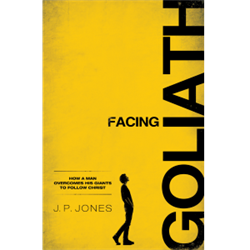
For your gift of 25 dollars or more, we will send you a signed copy of JP's new book, Facing Goliath. Please join us every Sunday at 9:00 or 11:00 AM at Crossline Church in Laguna Hills. The address is 23331 Moulton Parkway, Laguna Hills, California, 92653. Or check us out on the web at crosslinechurch.com. We're going to get to the address and phone number again in a moment, but before we do that, Pastor JP, do you have any insight from today's message?
JP Jones: Thanks, Greg. In Galatians chapter three, the apostle Paul tells us this: that this life of grace, the only way we can please God, the only way we can actually be saved, is energized by the Holy Spirit. It is the Holy Spirit who imparts God's grace to us. This happens initially at salvation when we're born again.
The Holy Spirit convicts us of our sin, the Holy Spirit shows us Jesus, the Holy Spirit draws us to Christ, the Holy Spirit indwells us and gives us a new nature. All of this is a work of God's grace. We're saved by grace alone through faith alone in Christ alone. But it's the Holy Spirit who energizes, who empowers, who reveals God's grace.
Paul says in Galatians chapter three that we begin the Christian life by grace and we are to continue the Christian life by grace. What that means is we begin the Christian life by the Holy Spirit who imparts grace, and we continue the Christian life by walking in the Spirit, the Holy Spirit who makes us strong in grace. There is no way to live the Christian life apart from the energizing work of the Holy Spirit.
Paul rebukes the Galatians because they were trying to work out on their own what could only be worked out through the power of the Holy Spirit. And yet that is true for every believer today. It's true with me. I seek to live the Christian life at times on my own, and it's a supernatural life; I can't do it.
And when I seek to live it on my own, I no longer live by grace; I live by law. The only way I can live by grace is by living in step with the Spirit. The only way any of us can please God is to live in the power of the Holy Spirit because he is the Spirit of grace. If that's what you want to experience today, then would you surrender your life to the Holy Spirit? Would you ask him to fill you up with God's grace? Let's pray.
Holy Spirit, thank you that you're the Spirit of grace. Thank you that you energize grace within us. Make us strong in the grace as we live in the power of the Holy Spirit. I pray for that in Jesus' name. Amen.
Greg: We want to help you in your relationship with Christ. Please get in touch with us at Truth That Changes Lives, 23331 Moulton Parkway, Laguna Hills, California, 92653, or call us at 949-916-0250. On the internet, you will find us at crosslinechurch.com. We hope to see you at one of our services every Sunday at our new campus in Laguna Hills. For more information and directions, please go to crosslinechurch.com. Please join us next time on Truth That Changes Lives.
Featured Offer
Past Episodes

Featured Offer
About Truth That Changes Lives
About JP Jones
JP Jones is the founding Senior Pastor of Crossline Church in Laguna Hills, CA. Beginning with 16 people, Crossline has grown to a congregation of over 2,000 in 10 years. This growth has come largely through people receiving Christ and joining the church. JP is a dynamic and articulate Bible teacher with a passion to see people come to Christ and grow into being multiplying disciples for Jesus. JP began his ministry career with Campus Crusade for Christ and continues to have a heart for the Great Commission. Traveling on mission trips all over the world, JP preaches the gospel and trains pastors to be reproducing spiritual leaders.
For the past 25 years, JP has been an Adjunct Professor of Theology and Biblical Studies at Biola University and Talbot School of Theology. A published author, JP has written Facing Goliath by Baker Books and the discipleship curriculums, Transformed and Livin’ Large by Life Together. JP is a popular speaker at Men’s Retreats and Couples Conferences. JP is married to his wife Donna and they have 3 children. JP loves family vacation, the beach, Ultimate Fighting and a good cup of coffee.
Contact Truth That Changes Lives with JP Jones
info@crosslinechurch.com
http://pastorjpjones.com/
23331 Moulton Parkway
Laguna Hills CA 92653
(949) 916-0250