

The Reconciler, Part 4


Is God building you up spiritually? Are you asking Him to? Are you cooperating with Him? Are you responding to His work within your life or are you resisting Him?
JP Jones: Is God building you up spiritually? Are you cooperating with him and asking him to and responding to his work within your life? Are you resisting him?
Greg: Thank you for joining us on Truth That Changes Lives. Pastor JP Jones is the senior pastor of Crossline Community Church in Laguna Hills, California, and a professor in biblical studies at Biola University. Today on Truth That Changes Lives, Pastor JP will be giving us another message from a series entitled All About Jesus. Let's listen in as JP gives us part four of The Reconciler.
JP Jones: If you have been a believer in Jesus Christ for three years or more, you should not be a baby anymore. You should be pressing on to maturity and adulthood spiritually. If you are a baby, God bless you. It's okay to be babies. We love babies. Everybody loves babies. We love babies in the body of Christ because we get to love them and encourage them and teach them and help them grow up spiritually. But that's the idea, isn't it? To help them grow up spiritually. If you're not growing up spiritually, something's wrong. You need to grow up. Just grow up. It's a call of scripture on every Christian to grow up spiritually.
Secondly, from this passage is the goal of spiritual growth. In verse 27, Paul says that he's writing about the mystery of the glorious riches of this mystery, which is Christ in you, the hope of glory. This word mystery we've looked at a little bit in the past couple of weeks. It's the Greek word mysterion. It literally is a mystery, but it's talking about something that would remain hidden unless God revealed it to us. So it's no longer a mystery because God has revealed the truth.
And Paul says here in Colossians 1 that the mystery is Christ. We wouldn't really know who Jesus Christ is apart from God revealing it to us. And if you don't believe that, just go to the spectrum after church and walk up to people and ask them what they think about Jesus. Everybody will have an opinion, but it won't necessarily be the truth. The truth that Jesus is the unique god-man, the very creator that holds everything together, the way, the truth, and the life, the resurrected one, the head of the church—that's a mystery that's revealed to us by God.
And he says in here that he's the hope of glory. Any hope that we have of experiencing glory, of knowing glory, of being glorified, is in Jesus Christ. He is the hope of glory. Jesus is the goal of the Christian life. We receive Christ, we grow up in Christ. The goal of spiritual growth is Christ: growing into Christ, experiencing Christ, knowing Christ, being transformed by Christ.
And that's why Paul amplifies this in verse 28. He says, "So we proclaim Christ, admonishing every man and teaching every man with all wisdom that we may present every man perfect in Christ." We're mature in Christ. We're complete in Christ. We're perfect in Christ. You see, Jesus is the ultimate goal of our spiritual growth. It's not to become busier in the church. It's not to have more theological knowledge. Those may be wonderful pursuits and what God calls you to engage in, but they're not the goal. The goal is Jesus Christ.
In chapter two, Paul clarifies this a little bit more for us, and he says, "My purpose is so that they may be encouraged in heart, united in love, so that they may have the full riches of complete understanding, in order that they may know the mystery of God, namely Christ, in whom are hidden all the treasures of wisdom and knowledge." Paul says in Christ are all the treasures of wisdom and knowledge, so if you want to get wiser and more knowledgeable, you need to experience more of your union in Christ, because in Christ are hidden all the treasures of wisdom and knowledge.
And if your wisdom and knowledge in your spiritual pursuit, in your growth in Christ, if the wisdom that you're gaining and the knowledge that you're gaining isn't from Christ and doesn't come back to Christ and doesn't glorify Christ, then it's not really true spiritual wisdom and knowledge. It's like I've said to my wife on many occasions: there are a lot of smart people who are really stupid. Wisdom and knowledge are found in Jesus Christ. And when we understand our union with Christ, and when we understand that Christ is the hope of glory, and we commit our lives to pursuing after Christ and knowing Christ, that's when we experience his wisdom and his knowledge. That's spiritual growth.
The goal of spiritual growth is to focus on Christ, to pursue after Christ, to get to know Christ, and even the way Paul describes it here as being encouraged in heart, united in love, and being complete in our understanding. But those are coordinate means towards an end. He says we're united in our love and we're encouraged in our hearts and we're complete in our understanding so that, Colossians 2:3, we may know God's mystery, namely Christ. Knowing Christ, that's the goal of spiritual growth.
And Paul describes this in the most intimate personal way. He could have said knowing about Christ. That would have been the Greek word oida. But he uses the Greek word, the verb ginōskō, which is off of the noun gnosis, which is what the Gnostics prided themselves in having this knowledge. So Paul actually takes their word and says, "Let me tell you what this word really means and how it ought to really be applied." And then he even intensifies it because he adds the Greek preposition epi. The whole goal of all of this—of being encouraged and being united and being complete—is so that we might have an epignosis kind of knowledge of Jesus: deep, intimate, personal knowledge of Christ.
It's what Paul describes over in Philippians 3 in his own personal biography. In Philippians 3:7, when he says, "Whatever things were gain to me, those things I've counted as loss for the sake of Christ. And more than that, I count all things to be loss in view of the surpassing value of knowing Christ Jesus my Lord, for whom I've suffered the loss of all things. I count them but rubbish in order that I may gain Christ and may be found in him, not having a righteousness of my own derived from the law, but that which is through faith in Christ, the righteousness which comes from God and is by faith. I want to know him and the power of his resurrection and the fellowship of his sufferings, being conformed to his death, that I too may attain to the resurrection from the dead."
And he says, "Not that I've already obtained it yet, but forgetting what lies behind and reaching forward what lies ahead, I press on towards the mark of the goal of God's calling on my life in Christ Jesus." Paul says, "I'm consumed with knowing Christ, intimate, deep, personal knowledge of Christ." When you learn to drive, they do it different now with kids. You have to pay for it through some kind of outside agency. It's not just provided by school. When I was in school, it was part of our curriculum. So you took a course driver education and then you took a course driver training.
In driver education, you learned about driving. You learned the rules of driving. In my high school, they had a little driving simulator where you sat behind this wheel and you watched these movies, and then they had these safe driving movies. I remember there was this Disney movie with Goofy. Okay, keep your eyes moving. Make sure they see you. Leave yourself an out. Be a safe driver. And then they showed you those movies with all the accidents—kids who weren't safe drivers. Wheels of tragedy, Red Asphalt. I don't want to do that. You learned about driving.
Driver training, you got in a car. The guy sat next to you and he says, "Okay, start it up and take it out of the parking lot." You're actually driving. And at first, you're so conscious of everything that you're doing. You're conscious of how you're sitting, the feel of the seat, your hands on the wheel, you're thinking of all the checklists of all the things you have to do to drive. But once you learn to drive, you don't just know about driving. You just drive.
In the seeking process of being a follower of Jesus, there's a legitimacy of learning about Jesus. But at some point, what we talk around here with respect to crossing the line, you move from just learning about Jesus, from knowing about Jesus, to actually stepping into actually knowing Jesus. You ask Jesus to come into your life, you receive Jesus. Now you just begin to know him, but guess what? Now you continue to grow in really knowing him. That's spiritual growth. That's what Paul's talking about here. It's about Christ and really knowing Christ.
And then he says in a command in Colossians 2:6, "As you've received Christ Jesus the Lord"—hello McFly, you did that, come on—what's the obvious next step? You live in Christ. You grow in Christ. You walk in Christ. You keep on knowing Christ. The goal of the Christian life is knowing Christ, growing in Christ. That means every one of us here has something to get out of this message. Because if you haven't received Christ, it's a beautiful day outside. It's gorgeous. We're here. What a great day to say, "This is when I receive Christ. I move from just knowing about him to really knowing him. I cross the line and I gave my life to the Lord and I asked Jesus to come into my life."
As John 1:12 says, "But to as many as received him, to them he gave the right to become the children of God, even to those who believe in his name." You could do that today. You could do it right now, even in your heart, just say, "Lord Jesus, I'm not going to struggle anymore. I'm just giving you my life. Come into my life right now, Jesus. I receive you as my savior and Lord." Now, whether you just did that even just now, or you did it years ago, as you've received Christ Jesus the Lord, live in him, walk in him, grow in him. That's God's command on our life.
There's a third observation: the steps to spiritual growth. And when I say steps, I don't mean like they are linear, chronological steps. You do this, you do this, you do this, and ipso facto, you have grown up spiritually. No, life is far more complicated than that. These are the experiences, actions, disciplines of growing spiritually that ought to be part of our lives and part of what we are pursuing and experiencing. The first one is receive Christ. So then just as you received Christ Jesus the Lord, continue to live in him. That's how you begin. You've got to receive him.
Secondly, live in Christ. Walk about in Christ. Paul uses this word peripateō in Colossians 1:10 when he says, "So that you will walk in a manner worthy of the Lord." In Colossians 4:2, "Walk with wisdom towards outsiders." In Ephesians 2:10, "Walk in the good works that God has prepared beforehand for you." In Ephesians 4:1, "Walk in a manner worthy of the calling with which you've been called." In Ephesians 5:1, "Walk in love just as Christ loved you." In Ephesians 5:8, "Walk as children of light." In Ephesians 5:15, "Walk as a wise person."
Those are all commands for how we ought to live the Christian life. If you're in this kind of phase of trying to understand your spiritual walk, read Ephesians 4 and 5, because that's where five of those walk statements come out of, and it's unpacked for you what that really looks like. There is a Christian lifestyle that we're called to. We're called to live as followers of Jesus Christ, to walk about. And so part of our spiritual growth is a proactive commitment to that.
In fact, in this passage in Colossians 2:6 and 7, there's God's part and there's our part. So this is part of our part: our part receive Christ, our part live out in Christ. They are active verbs, so the call is on us to be intentional in pursuing and living out. Now he shifts from the active to the passive, and from the present tense to what's called the perfect tense in Greek, because he says "be rooted in Christ." That's the way it's phrased in the NIV, but it's literally "having been rooted."
Perfect tense is describing a completed action in the past that has continual abiding results into the present. Paul shifts from the metaphor of walking to a metaphor of a plant that's been rooted. I talked to you last week a little bit about tearing up all those bushes and transplanting some of those. All day yesterday, I planted flowers where those bushes used to be. Now I planted them, but whether or not they're going to thrive depends on whether those roots are going to really attach into the soil that I've put them in outside of just the root ball that they are in that came out of the basket. Are they going to attach? Are the roots really going to go into the soil?
Well, Paul says the way he describes our Christian life here is there's an assumption if you've received Christ that you have been rooted and that rooting bears impact upon everything else that flows from that. So you'll never find a plant that is thriving and bearing fruit that hasn't first been rooted. If I was Jesse Jackson, I might say, "If there ain't no fruit, there ain't no root." Is there fruit in your life? It's because you've been rooted. If you haven't been rooted, then that has to happen. Now that's a passive tense verb, though. So what that means is only God can root us. Only God can root us in Christ.
But we get to determine what kind of soil that seed gets planted in. Go back to the parable of the soil. Remember, the farmer sows the seed and it lands on four different kinds of soil: the hard soil, the rocky soil, the weed-filled soil, and the good soil. When the seed landed in the good soil, it got rooted and then it grew up and it produced fruit. So is your heart, is your life, good soil so that the gospel that you've received is actually being rooted in you by God so that it's producing in you a growing Christian life?
So there's walking and there's being rooted, and now he shifts the metaphor again and says "being built up in Christ." Now this is talking about building a building. It's a construction term to build a house or to build a building or to build a temple. In fact, Paul uses it over in 1 Corinthians 3 to talk about how we build our Christian lives on the foundation of Christ. He says, "By the grace of God that's given to me, I laid a foundation as an expert builder and someone else is building on it. But each one should be careful how he builds. For no one can lay any foundation other than the one that is laid, which is Jesus Christ. If any man builds on this foundation using gold, silver, costly stones, wood, hay, straw, his work will be shown for what it is because the day will bring it to light."
Paul there is talking about the ultimate judgment seat of Christ where Christians will give an account of their lives and God will evaluate our lives and we'll receive a reward or we won't receive a reward based upon the faithful spiritual lives that we lived. But the analogy that he uses is to be a Christian, you've got to have the foundation of Christ, but then you build a building on that foundation of Christ. That is the life that you live. Now in 1 Corinthians 3, it's an active sense of that verb: we build the building. In Colossians 2, it's a passive sense of that verb: it's God who builds us. But are you letting him do it?
Is God building you up spiritually? Are you cooperating with him and asking him to and responding to his work within your life? Are you resisting him? See, part of that growing up in Christ is walking, it's being rooted, it's being built up. Is God building you up? Are you asking God to build you up? Are you pursuing the things that will allow God to build you up? Are you putting yourself in places where God will build you up?
So there's walking, there's being rooted, there's being built up, and now he shifts the idea again and says "being strengthened in the faith as you were taught." Again, this is a passive verb, being strengthened. So God making you strong. Is God making you strong in the seasons of your life? Is God making you strong in the circumstances of your life? Is God making you strong in the relationships of your life? And again, it's only God who can make us strong, but we either put ourselves in a position to be made strong or not.
If an athlete never went to the gym and worked out, he wouldn't be made strong. If a swimmer never swam laps, they wouldn't be improving in their athletic performance in swimming. So it's a passive idea, in other words God's the one acting upon us, but we need to be the ones who are in a prime position that experiences what God not only can do but he wants to do and is eager to do in our lives. God wants to strengthen us. And in this passage, it's strengthened in our faith according to what we've been taught.
So the idea is that the way God strengthens us is based upon what we've been taught. The old adage: garbage in, garbage out. So if you have been hearing and seeing and receiving garbage, then that's going to do a work within you and that's going to come out. On the other hand, if you've been receiving the truth and reading the truth and studying the truth and memorizing the truth, then based upon that truth, God will make you strong.
And then Paul shifts back to the active. So there's God's part and our part. The active part on our part was the receiving—as you've received Christ—the living in Christ. The passive part in terms of what we allow God to do is to root us, to build us up, and to strengthen us. And now he comes back to what we need to do, which is overflowing with thankfulness. A step, a season, an aspect of spiritual growth is giving thanks. And that's a choice. We either intentionally give thanks or we don't. We choose to be thankful people or we choose to be grumblers. We choose to be positive or we choose to be critical. We choose to find fault or we choose to be those who bless and speak praise.
It really does come down to that. Did you know that? I don't know about you, but I don't want to be known as a critical person, a negative person, a grumbling person. I don't want to be the guy who comes into a room and just takes it into the toilet because I'm grumbling. I don't want to be a person in my own mental attitude focusing on all the stuff that I don't like and don't appreciate and don't want and feel like God's let me down.
It's very easy to become a Christian narcissist, to think it's all about you and anything that doesn't fit what you want you have a divine right to complain about. When an aspect of spiritual growth, a dynamic of becoming more and more like Christ, is overflowing with thankfulness. Is that the characteristic of our spiritual growth? Are we overflowing with thankfulness?
In fact, this is a pretty big idea to Paul because over in Colossians chapter three, he picks it up again and says this in Colossians 3:15, "Let the peace of Christ rule in your hearts since as members of one body you were called to peace and be thankful. And let the word of Christ dwell in you richly as you teach and admonish one another with all wisdom and as you sing psalms, hymns and spiritual songs with thankfulness in your hearts to God. And whatever you do, whether in word or deed, do it all in the name of the Lord Jesus, giving thanks to God the Father through him."
In the space of three verses, three times he talks about giving thanks and being thankful. So here's the paradigm: the steps to spiritual growth. What's involved in growing? Well, I've got to receive Christ, and then I need to be living in Christ and walking that Christian life, and I need to make sure that I've been rooted. Because if I haven't been rooted, there's not going to be the growth and the fruitfulness. And I need to be experiencing God building me up, and I need to have the truth taught to me so that my faith is strengthened.
And then I need to choose to just overflow. Because Paul makes up a word here. It's the word to abound and then he puts the hyper preface which means to super abound. Paul is known for this in the New Testament: making up words because he's describing how the Christian life is really different than just life apart from Christ. So we ought to be super thankful, abounding in giving thanks. And those are all pictures, descriptions, steps of growing up spiritually.
So wherever we all might be in our spiritual journey, there is a next step. If we're here and we are outside the faith, we need to receive Christ today. We need to receive Christ. If we have received Christ, then we need to live in him, walk in him, and commit ourselves to growing up in him. Because that's God's call on our church.
Greg: What a great message for all of us today. Pastor JP provides us with great insight. That is why we'd like to make it available to you on CD. Just get in touch and mention today's date. We'll send it your way for just five dollars. Or if you'd like to support this ministry, you can write us at Truth That Changes Lives: 23331 Moulton Parkway, Laguna Hills, California 92653. Or give us a call at 949-916-0250. That's 949-916-0250.
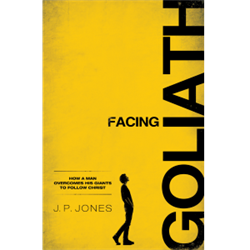
For your gift of twenty-five dollars or more, we will send you a signed copy of JP's new book, Facing Goliath. Please join us every Sunday at 9:00 or 11:00 AM at Crossline Church in Laguna Hills. The address is 23331 Moulton Parkway, Laguna Hills, California 92653. Or check us out on the web at crosslinechurch.com. We're going to get to the address and phone number again in a moment, but before we do that, Pastor JP, do you have any insight from today's message?
JP Jones: Thanks, Greg. We're looking at this whole series about the fact that it's all about Jesus. Salvation is only in Jesus Christ. Transformation is only in Jesus Christ. In Colossians 2:6 and 7, the apostle Paul says there are two spiritual commitments that are critical for every person. The first is the commitment to receive Christ and the second is the commitment to live in Christ.
If you have never come to faith in Jesus, your response to God's grace is to receive Jesus Christ as the Lord and savior of your life. If you have received Christ, your response is to commit yourself to live in Christ, to follow Christ, to grow in Christ. We are born spiritually to grow up to become mature spiritual adults who live healthy, contagious lives in Christ. If you know Christ, if you've received Christ, God's call on your life today is to commit yourself to live in him, to grow in him, and to follow him. May God give you his grace and his power to follow Jesus Christ. Amen.
Greg: We want to help you in your relationship with Christ. Please get in touch with us at Truth That Changes Lives: 23331 Moulton Parkway, Laguna Hills, California 92653. Or call us at 949-916-0250. On the internet, you will find us at crosslinechurch.com. We hope to see you at one of our services every Sunday at our new campus in Laguna Hills. For more information and directions, please go to crosslinechurch.com. Please join us next time on Truth That Changes Lives.
Featured Offer
Past Episodes

Featured Offer
About Truth That Changes Lives
About JP Jones
JP Jones is the founding Senior Pastor of Crossline Church in Laguna Hills, CA. Beginning with 16 people, Crossline has grown to a congregation of over 2,000 in 10 years. This growth has come largely through people receiving Christ and joining the church. JP is a dynamic and articulate Bible teacher with a passion to see people come to Christ and grow into being multiplying disciples for Jesus. JP began his ministry career with Campus Crusade for Christ and continues to have a heart for the Great Commission. Traveling on mission trips all over the world, JP preaches the gospel and trains pastors to be reproducing spiritual leaders.
For the past 25 years, JP has been an Adjunct Professor of Theology and Biblical Studies at Biola University and Talbot School of Theology. A published author, JP has written Facing Goliath by Baker Books and the discipleship curriculums, Transformed and Livin’ Large by Life Together. JP is a popular speaker at Men’s Retreats and Couples Conferences. JP is married to his wife Donna and they have 3 children. JP loves family vacation, the beach, Ultimate Fighting and a good cup of coffee.
Contact Truth That Changes Lives with JP Jones
info@crosslinechurch.com
http://pastorjpjones.com/
23331 Moulton Parkway
Laguna Hills CA 92653
(949) 916-0250