

The Narrow Truth of Grace, Part 1


You know the gospel of Jesus Christ is a gospel of grace. The word gospel is the Greek word euangelion; it means good news. It's the good news of God's grace, the good news of God's forgiveness. The good news of God's salvation in Jesus Christ.
JP Jones: We know the gospel of Jesus Christ is a gospel of grace. The word gospel is the Greek word euangélion, it means good news. It’s the good news of God’s grace, the good news of God’s forgiveness, the good news of God’s salvation in Jesus Christ.
Guest (Male): Thank you for joining us on Truth That Changes Lives. Pastor JP Jones is the senior pastor of Crossline Community Church in Laguna Hills, California, and a professor in Biblical Studies at Biola University. Today on Truth That Changes Lives, Pastor JP will be giving us a message from a series entitled Galatians. Let’s listen in as JP gives us part one of The Narrow Truth of Grace.
JP Jones: Well, the gospel of Jesus Christ is a gospel of grace. The word gospel is the Greek word euangélion, it means good news. It’s the good news of God’s grace, the good news of God’s forgiveness, the good news of God’s salvation in Jesus Christ.
And the book of Galatians is a book that is written to not only present this good news but to defend it. And it needs to be defended because there are various other kinds of news that would present themselves to us with respect to how to be in a relationship with God and how to live daily in a relationship with God. According to the book of Galatians, any other news other than salvation by grace alone through faith alone in Christ alone is not good news. It’s bad news.
So basically, every person has a choice in coming to God in terms of whether they believe bad news or they believe good news. Only the good news has the hope of salvation and the hope of transformation. Every other message will only lead to death, the book of Galatians says.
So in Paul’s words in the book of Galatians as he’s beginning to write this book about grace, about hope, about transformation, about forgiveness, he has some very exclusive and narrow things to say. Galatians chapter 1 verses 1 to 5 says this: "Paul, an apostle—sent not from men nor by man, but by Jesus Christ and God the Father, who raised him from the dead—and all the brothers with me, to the churches in Galatia: Grace and peace to you from God the Father and the Lord Jesus Christ, who gave himself for our sins to rescue us from the present evil age, according to the will of our God and Father, to whom be glory for ever and ever. Amen."
Paul starts off this letter by speaking about the truth of the gospel of grace. The book of Galatians was probably written around 49 or 50 AD. It was written right before a very important council took place called the Jerusalem Council. It’s described for us in Acts chapter 15. If you want to get a background in terms of understanding this book, you might want to look at Acts chapter 15 because what’s at stake in that council is what is really the gospel. Is it believing in Judaism and Jewish law and adding Jesus to that? Or is the gospel salvation by grace alone through faith alone in Christ alone?
Certainly appreciating the Jewish roots of that message, certainly accepting the Hebrew scriptures, but understanding it is a unique message by grace alone through faith alone in Christ alone. And that was exactly the conclusion that was reached at the Jerusalem Council in Acts chapter 15. Paul is writing this letter on his way and preparing for the statements that he would make at the Jerusalem Council. He has already ministered in the region known as Galatia. The book of Galatians is not written to any one church, but a region of churches in Asia Minor.
And he’s writing to them about this life-changing message, this salvation-imparting message of grace through faith. It’s what he writes in the book of Ephesians in Ephesians 2:8 and 9: "For by grace you have been saved through faith, and that not of yourselves, it’s the gift of God, not as a result of works, lest anyone should boast." From beginning to end, salvation is a gift of God, a gift of God’s grace received through faith. And the object of our faith is Jesus Christ, his death on the cross and his resurrection for us.
This is a powerful, powerful message. Paul said in Romans chapter 1, "I’m not ashamed of the gospel because it is the power of God for salvation to any who believe, to the Jew and also to the Gentile." Paul begins this letter with both barrels blasting the truth of the gospel of grace. He says, "Paul, an apostle, sent not from men or by man, but by Jesus Christ and God the Father." The first thing that he does is he gives us his bona fides, his credentials. Why we should listen to what he has to say, on what authority is it that he’s telling us this message.
It’s like a guy who has an unbelievable resume but is most of the time quiet about it. But when it’s on the line to prove a point, pulls it out. It’s like a guy who is a doctor but never really goes by "Doctor" until somebody is disputing his medical opinion because he saw an article on the internet. And he says, "Well, to tell you the truth, I actually am a doctor and that’s my expertise. And so let me tell you a bigger picture than what you got in your narrow research."
When Paul says he’s an apostle, that’s big time. And he says he received his apostleship not through the agency of men or by any one man. In other words, he didn’t get conferred to be an apostle because a group of guys sat around and said, "Well, we need to pick somebody to join our group. Who’s got the best credentials? Paul, he’s pretty learned. He’s got a good reputation. Let’s pick him." Nothing wrong with that, but Paul says that’s not how it happened. Nor did some guy come up to him and give him some internet degree and said, "Now you’re an apostle."
Paul said he got his apostleship from Jesus Christ himself. Now the reason this is so important is because before Paul starts to speak of particulars, he establishes the authority for understanding the particulars. If he didn’t do this, then all we’d have is, "Well, here’s Paul’s opinion, here’s somebody else’s opinion, here’s somebody else’s opinion." We just got a bunch of opinions. The book of Galatians is not a learned opinion about how we have a relationship with God. It is the authoritative word of God. It’s the final answer.
Because our authority for what we believe as followers of Jesus Christ is Christ himself. So in effect, what we have is a chain of authority. We have the very authority of Jesus Christ. That authority, Paul says, was conferred upon him by Christ himself, so he speaks with the authority of Christ. And then we understand through historical and textual criticism that those writings that Paul wrote have been gathered together in the New Testament. And the New Testament is a historical, credible, reliable source for understanding the authoritative teaching of Paul, which comes with the very authority of Jesus Christ. So when we read the book of Galatians, we are reading the words of Jesus Christ.
I am involved quite often in discussion about spiritual things. Had a conversation yesterday with a guy. It'll become a story some point later, but not today. But sometimes I get into these dialogues with people over email. And I am having an email dialogue with a guy who visited our church, who is a skeptic and is a self-professed atheist. Had a lot of questions. And so we’ve been communicating back and forth. And I want to give you just a little picture of some of our discussion. He had said to me in one of our emails, "One quick question JP, relative to the note that you sent me. Would you ever embrace the belief of another religion or worldview? For example, would you ever become a Muslim or a Hindu or a Jew?"
And I wrote back to him and I said, "Well, thanks for your email. Let me respond to your question about embracing the views of another religion or another worldview. My answer would be that an intelligent pursuit of truth should involve testing the truth claims of all worldviews and religions. Most people, of course, don’t do this. Most people don’t use critical thinking skills about what they believe. Instead, people develop their beliefs based upon how they were raised, what teachers told them in school, their life experiences, and then just what feels right to them. And I don’t discount these factors, but when it comes to settling the deepest issues of life in terms of truth, right and wrong, God, etc., it seems to me a more objective, rational, and reliable test or tests should be used."
In philosophy, this is known as epistemology, how we know what we know. For me, there are some important factors I would use to test the validity of any religion or any worldview. One, I would ask myself is it logically consistent? Two, is it coherent? Do the parts fit the whole? Three, are its underlying presuppositions supportable by rational, historical, or scientific evidence? And four, does it provide satisfying personal answers and emotional answers to the real issues of life?
Quite honestly, when I became a Christian and put my trust in Christ as my personal savior, I didn’t do any type of exhaustive research. After the fact, I’ve had the privilege to read the Bible, study world religions and philosophy, and pursue graduate degrees in theology. I can speak personally and say that only the Christian faith, as it’s deposited in the New Testament, fully satisfies all my tests for truth. If you’re truly seeking to know what you believe and why you believe it, then I encourage you to examine all the evidence. In addition to the articles I emailed you—I sent this guy quite a few apologetic articles answering some of the questions that he had—I would encourage you to look at the Christian faith compared to other worldviews.
This would serve for a primer of further study that you could pursue. And at the end of the day, you may come to a different conclusion than I do, but I’ve always believed that people of good will can agree to disagree without being disagreeable. And I’m always open to honest discussion based upon a sincere pursuit of the truth. If I can be of assistance, blah blah blah, there you go. So I sent that off to him. Boom. Notice what I was really saying. Don’t get caught up in some of the philosophy mumbo jumbo. I was basically saying, before you believe any particular religion or life philosophy or worldview, go back to the source, the foundation, the underlying presuppositions, the authority for why you believe what you believe.
He emailed back and he asked me several questions about God and religion, and he had eight different questions that he emailed back to me. So I responded back to him. "I’ll try to respond at least a little bit to some of your questions. I think the best thing in terms of your spiritual questions would be to read the articles that I’ve attached in my previous email. I think after you’ve digested some of that material, our discussion will be much more helpful. But one of the basic missing points between our views, in my opinion, is our understanding of human nature."
Based on what the Bible teaches, human nature is both good and evil. All people are created in God’s image and therefore have tremendous dignity, worth, and potential. At the same time, all people are sinful and therefore separated from God. And according to the Bible, sin creates a barrier between us and God and between us as human beings. Sin makes us vulnerable to self-deception and blinds us to the truth. The message of Christianity is that God loves us so much that he comes looking for us. Christ died to pay the penalty for our sin and to restore us to a relationship with God. The Bible describes sin in its many manifestations: intellectual, spiritual, moral, relational, psychological.
In Romans 1:18 and 25, this passage is describing people who refuse to believe in God. They suppress the truth. The context of the passage and of my explanation of it is that some people’s issue is not one of needing more evidence in order to believe in God. These people reject God not because there’s not enough evidence, but because they are consciously or subconsciously suppressing the truth. Jesus says the same thing over in John chapter 5 verses 31 to 43. These passages are addressing people whose pride is getting in the way of an objective examination of the facts. Because I believe this, I happen to know that some people don’t really want to find real answers, they just want to argue about religious things.
If I could prove Christianity to you beyond any shadow of a doubt, would you believe in Jesus Christ as your Lord and Savior? You see, Jesus said this in Matthew chapter 8. He called a little child to him and said, "I tell you the truth, unless you repent and become like a child, you’ll never enter into the kingdom of heaven." To the person sincerely seeking the truth, Jesus said, "I am the way, the truth, and the life. No one comes to the Father but by me." We’ve had ongoing dialogue. So what’s the point of all this?
Paul in his discussion in Galatians chapter 1 says, listen, I don’t want this to be reduced to your opinion versus my opinion. I don’t want this to be about some philosopher says this and some religious person says this and some theologian says this, and now Paul’s saying this. I received the message that I’m giving to you from Jesus Christ himself. End of story. The authority for what I’m telling you about a relationship with God comes from Christ himself. And the message that Christ has given to us is a message of grace. The truth of the gospel of grace is based upon the very authority of Jesus Christ. And when Paul is describing it, he’s describing it under Christ’s authority.
This message is a message about grace. It’s a message about Christ. It’s a message about Christ’s resurrection. According to verse 4, it says, "He gave himself for our sins to rescue us from the present evil age, according to the will of God our Father, to whom be glory for ever and ever. Amen." This message of grace is about Christ, it’s about Christ’s grace, it’s about Christ’s resurrection, it’s about the fact that Christ died for our sins. Christ gave himself for us. Paul uses a Greek preposition, hupér. Every time it’s used, it’s translated "in behalf of." Christ died in behalf of us. He died for us. He died in our place. We deserved the penalty of death. Christ took that penalty in our place and he died for a purpose. He died to rescue us from the present evil age.
In other words, Paul is saying that the age in which he is living and writing to, and he uses a present tense description of that—in other words, the present evil age continues on into our present—is evil. The sum of thoughts, ideas, philosophies, religious, moral, ethical concepts that we will have to wrestle with and deal with, they’re all presenting a message, but it’s not good news. It’s bad news because it’s a message, whether it’s religious or secular, that begins with man and ends with man and that always leads to death. But the message of salvation in Jesus Christ begins with God and ends with God. It’s to his glory and it leads to life.
Guest (Male): What a great message for all of us today. Pastor JP provides us with great insight. That is why we’d like to make it available to you on CD. Just get in touch and mention today’s date. We’ll send it your way for just $5. Or if you’d like to support this ministry, you can write us at Truth That Changes Lives, 23331 Moulton Parkway, Laguna Hills, California 92653. Or give us a call at 949-916-0250. That’s 949-916-0250.
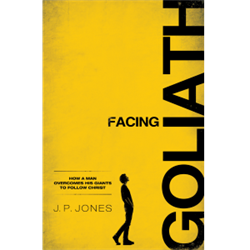
For your gift of $25 or more, we will send you a signed copy of JP’s new book, Facing Goliath. Please join us every Sunday at 9:00 or 11:00 AM at Crossline Church in Laguna Hills. The address is 23331 Moulton Parkway, Laguna Hills, California 92653. Or check us out on the web at CrosslineChurch.com. We’re going to get to the address and phone number again in a moment, but before we do that, Pastor JP, do you have any insight from today’s message?
JP Jones: Thanks Greg. You know, the gospel of Jesus Christ is a gospel of grace. Grace is the only way any of us could come into a relationship with God. The barrier of sin is so great that nothing we do on our own can bridge that chasm. Sin separates us from God, sin destroys, sin leads to eternal spiritual death. And the only antidote to sin is the grace of God. Romans chapter 5 says, "whereas sin reigned in death, even so grace might reign through righteousness to eternal life through Jesus Christ our Lord." We are saved by God’s grace. Ephesians chapter 2 says, "For by grace you have been saved through faith, and that not of yourselves, it’s the gift of God, not as a result of works, lest anyone should boast."
In Titus chapter 3, the Apostle Paul writes to his protege, Titus, and says, "but the kindness of God appeared and he saved us, not according to deeds which we have done in our own righteousness, but according to his own grace." Grace is God’s riches at Christ’s expense. Grace cost Jesus Christ his life. Grace led Jesus Christ to die a sacrificial death on our behalf. Grace led Jesus to atone fully for our sins. It is by grace alone that we are saved. God’s grace extended to us in the sacrifice and substitutionary death of Jesus Christ. That’s why Paul writes to the Corinthians in 1 Corinthians chapter 15 and says, "For I delivered unto you what was of first importance."
The Bible has a lot of important truths, 66 books. What is of first importance? Paul says that Christ died for our sins according to the scriptures, and that he was buried, and that he was raised again on the third day according to the scriptures. You see, that’s the gospel. That’s the good news of Christ’s forgiveness and salvation and hope. And it’s only by grace. It’s not by works. In fact, the Bible tells us in the book of Isaiah that our best stuff, our righteousness of our own, are just filthy rags before God because God is absolutely holy and we’re sinful. And even our best efforts fall short of the holy nature and standard of God.
On our own, we are doomed. On our own, we are separated from God and bound to death. But the grace of God reaches into the most dark situation. The grace of God can turn around the most sinful life. The grace of God can change anything and can change everything. And so the Apostle Paul in the book of Galatians says that the gospel is a gospel of grace, but it’s a narrow truth. Grace is a narrow message because anything other than absolute pure grace is not grace. Any addition of works, any addition of human effort, any addition of religious surrender or commitment, anything that is added to grace makes grace not grace.
Because the very nature of grace is that what we could not do for ourselves, God has done for us. And so with fierce emotion and conviction, the Apostle Paul defends the gospel of grace. And he says in Galatians chapter 1 that this is a narrow truth, but it’s such a powerful truth. It’s such a glorious truth because it leads to salvation. That’s why he wrote to the Romans in Romans chapter 1 and says, "I’m not ashamed of the gospel. It’s the power of God to salvation to anyone who believes, to the Jew first and also to the Gentile." Right now, as you’re hearing this message, if you don’t know Christ, the gospel, the gospel of grace is the power of salvation to you.
If you would believe in Jesus Christ, if you would accept him as the sacrifice for your sin, you would be saved. All of your sins would be forgiven. You’d receive the gift of eternal life. This is such an awesome message. It has to be proclaimed and it has to be defended. It’s the narrow truth of grace. If you know Christ, then what you experience as a believer is the grace of God that covers all your sin. The grace of God that covers your sin past, present, and future. This is a narrow truth, but it’s an awesome truth. It’s the narrow truth of grace. And as I speak these words, I am just reminded that I can say these things and speak these things because grace has changed my life. I once was lost, but now am found. I was blind, but now I see. And it’s only because of the grace of God. Let’s rejoice together in God’s grace.
Jesus, thank you so much that you saved us. What we couldn’t do on our own, you did for us. Jesus, thank you that you are the way, the truth, and the life, and no one comes to the Father but by you. Thank you for your grace. Thank you that your grace saved a wretch like me. And thank you that your grace can save anyone who calls upon you. And we praise you for that in Jesus’ name because of grace. Amen.
Guest (Male): We want to help you in your relationship with Christ. Please get in touch with us at Truth That Changes Lives, 23331 Moulton Parkway, Laguna Hills, California 92653. Or call us at 949-916-0250. On the internet, you’ll find us at CrosslineChurch.com. We hope to see you at one of our services every Sunday at our new campus in Laguna Hills. For more information and directions, please go to CrosslineChurch.com. Please join us next time on Truth That Changes Lives.
Featured Offer
Past Episodes

Featured Offer
About Truth That Changes Lives
About JP Jones
JP Jones is the founding Senior Pastor of Crossline Church in Laguna Hills, CA. Beginning with 16 people, Crossline has grown to a congregation of over 2,000 in 10 years. This growth has come largely through people receiving Christ and joining the church. JP is a dynamic and articulate Bible teacher with a passion to see people come to Christ and grow into being multiplying disciples for Jesus. JP began his ministry career with Campus Crusade for Christ and continues to have a heart for the Great Commission. Traveling on mission trips all over the world, JP preaches the gospel and trains pastors to be reproducing spiritual leaders.
For the past 25 years, JP has been an Adjunct Professor of Theology and Biblical Studies at Biola University and Talbot School of Theology. A published author, JP has written Facing Goliath by Baker Books and the discipleship curriculums, Transformed and Livin’ Large by Life Together. JP is a popular speaker at Men’s Retreats and Couples Conferences. JP is married to his wife Donna and they have 3 children. JP loves family vacation, the beach, Ultimate Fighting and a good cup of coffee.
Contact Truth That Changes Lives with JP Jones
info@crosslinechurch.com
http://pastorjpjones.com/
23331 Moulton Parkway
Laguna Hills CA 92653
(949) 916-0250