

Philippians 2:12-18, Part 1


We've got to take personal ownership for our own spiritual lives!
JP Jones: We've got to take personal ownership for our own spiritual lives.
Guest (Male): Thank you for joining us on Truth That Changes Lives. Pastor JP Jones is the senior pastor of Crossline Community Church in Laguna Hills, California, and a professor in biblical studies at Biola University.
Today on Truth That Changes Lives, Pastor JP will be giving us a message from a series entitled "Joy." Let's listen in as JP gives us part one of Philippians 2:12-18.
JP Jones: In the words of Billy Graham, I want to exhort you to make a decision, and to make no decision is to make a decision. I want to exhort you to make a decision today about your own personal spiritual life.
I can't make you grow spiritually. Men, your wives cannot make you grow spiritually. Wives, your husbands cannot make you grow spiritually. Children, your parents cannot make you grow spiritually. Parents, your children cannot make you grow spiritually.
We've got to take personal ownership for our own spiritual lives. In fact, taking personal ownership for our lives is a sign of maturity. It's actually a sign of reaching adulthood. And spiritually speaking, when we take ownership for our own spiritual lives and when we commit ourselves to our own spiritual growth, the byproduct is joy—overflowing, abiding, eternal joy.
That's what Paul tells us in the book of Philippians in Philippians 2, verses 12 through 18. Let me read that passage: "Therefore, my dear friends, as you have always obeyed, not only in my presence but now much more in my absence, continue to work out your salvation with fear and trembling. For it is God who works in you to will and to act according to his good purpose.
Do everything without complaining or arguing so that you may become blameless and pure children of God without fault in a crooked and depraved generation in which you shine like stars in the universe as you hold out the word of life. In order that I may boast on the day of Christ that I did not run or labor for nothing. But even if I am being poured out like a drink offering on the sacrifice and service coming from your faith, I am glad and rejoice with all of you. So you too should be glad and rejoice with me."
Here's the key principle: we experience joy when we take ownership of our spiritual growth and we discipline ourselves to live out our salvation. That's what this passage is all about. Paul is speaking in this passage not as an apologetic to make the Gospel clear to persuade those who have not yet come to Christ to come into a relationship with Christ.
Instead, he's speaking to those who are already Christ-followers, and he's challenging them to take ownership of their spiritual discipleship. He's challenging them to live out the salvation that they already have, and he's promising that when they do so, they will have joy, and they can rejoice along with him because they've given their lives even as a sacrifice, as an offering for God.
That's what is before every one of us: the possibility of living with eternal significance, living with real ownership of our spiritual growth, and living with joy because we're doing so. Now, in an audience this size, I'm sure that there's some of us here who have yet to make that decision to become followers of Jesus Christ. We describe that as "crossing the line" around here.
That's why we have the name of our church, Crossline. Everybody's on this spiritual journey, but there is a line drawn in the sand. That step on the journey is actually a step from darkness into light, a step from separation from God into relationship with God. If you've never made that step, that would be the strongest encouragement I could give you today: to open up your heart to Jesus Christ and to say yes to Jesus.
But if you make that step and when you make that step, you are now responsible to continue to make more steps. That's what the Bible says: to continue to work out and to live out and to live in the salvation that has been graciously given to you through faith in Jesus Christ.
Several observations from this passage that speak to us about the joy we can have when we really commit ourselves to spiritual growth. Here's the first one: we need to cultivate a lifestyle of obedience. Paul says, "Therefore, my dear friends, as you have always obeyed, not only in my presence, but now much more in my absence," and he gives the exhortation.
So he gives an acknowledgment of what was already true about them. What was already true was that they were obedient people. What was already true was that they were people who lived in obedience to Jesus Christ. This had become not just something that they did every now and then, but was actually their ongoing commitment, their personal experience, their habitual lifestyle.
In the same way, we need to cultivate a lifestyle of obedience. Obedience needs to be our default experience with Jesus. Rather than the exception, it needs to be the norm. Obedience needs to become our first choice and our habit. Paul wrote to the Thessalonians and said this in 1 Thessalonians 4: "Finally then, brethren, we request and exhort you in the Lord Jesus, that as you received from us instruction as to how you ought to walk and please God, just as you actually do walk, excel still more."
He wrote to the church at Thessalonica and he said, "My exhortation to you is to excel at what you're already doing." And what was it that they were already doing? Being obedient to the commands of Jesus. So wherever you are in your spiritual journey, there is the opportunity to excel even more, but the lifestyle that you are to be living, that I am to be living, that we are to even excel more in is a lifestyle of obedience.
Jesus said this in John 14:21: "He who has my commandments and keeps them, he it is who loves me, and he who loves me shall be loved by my Father, and I will love him, and I will disclose myself to him." See, our obedience to Jesus needs to be prompted by a love relationship with Jesus.
We've been set free from trying to earn our salvation. That's not what this passage is about at all. In fact, none of the Bible is about that. We can't earn our salvation. Nobody can. We can't live up to the perfect standard of God. We don't have what it takes. That's why God sent His Son, Jesus Christ, to live a perfect life in our place, to die on the cross, and to be raised from the dead.
Paul talks about that in Romans chapter 8, Romans 8 verse 3, where he says, "For what the Law could not do, weak as it was through the flesh, God did, sending his own Son in the likeness of sinful flesh, and as an offering for sin, he condemned sin in the flesh." So we couldn't do it on our own. So this is not talking about trying to live out in a way to earn something. No, it's living in what we already have.
And our motivation is one of relationship and one of love and one of intimacy with God. That's why Paul says, "Hey, continue to be obedient not only in my presence, but in my absence." So don't just do it while I'm around; do it as something that's intrinsic to your own value system.
Our motivation to be obedient isn't to earn something before God or to gain something from pleasing people; it's because we are in a relationship with God and we're in an intimate love relationship with God. God is our audience, and we want to grow in our relationship with Him, and we want to grow closer in our relationship with Him.
And we do so not out of insecurity to gain something, but we do so out of security. It ought to be the aspiration of every follower of Jesus Christ to get even closer to Jesus Christ. And so we are to make it our habit, and everybody has habits—some good, some bad, some just benign.
I have a habit of drinking coffee every morning. I have a habit of exercising at the gym. I have a habit of spending time on a daily basis in God's Word. Not every one of those habits is spiritually enriching, nor are those habits necessarily evil in and of themselves. They're just habits. They're part of who I am as a person.
If you know me, you know that I drink coffee every day. You know I like to work out. You know I have quiet times, spend time in God's Word. See, we are all creatures of habit. This passage is encouraging us to develop the habit of obedience so that what flows out of our life is a commitment to follow Jesus.
There may be failures and setbacks along the way, but the overflow of our life is that we are people who habitually obey Jesus. We work out the salvation that's already been given to us. Here's a second observation: we need to be in the ongoing process of working out our salvation.
See, he says that in verse 12: "Continue to work out your salvation with fear and trembling." Not "work for." This is not a passage at all that is talking about somehow if we are obedient enough, we get salvation. No, it's talking about working out what we already have. We have salvation in Jesus Christ.
Ephesians 2:8-9 says, "For by grace you have been saved through faith, and that not of yourselves, it's a gift of God, not as a result of works, lest anyone should boast." But then verse 10 adds, "We are his workmanship, created in Christ Jesus for good works, which God prepared beforehand that we should walk in them."
So the salvation that we have by grace alone through faith alone in Christ alone never stands alone. It is demonstrated in good works. It's experienced and expressed in good works. So Paul says by way of command, "Continue to work out your salvation with fear and trembling." It's a present-tense action. He's talking about ongoing process here.
Not just something you do one time or occasionally, but continually. So it is the call of God on our lives as followers of Jesus to continually work out our salvation. Everybody here, as I said, is on some kind of spiritual journey. And if we were to somehow, in some way, have God's insight to be able to map that out, we could set on a continuum.
There's maybe 500 people here this morning: the person that's the most spiritually perfected at this point in time and the person who's the least spiritually perfected at this point in time, and everybody in between. But it wouldn't matter whether you are the most or the least or somewhere in between; there is a place for you to work out and take the next step, to live it out and to continue to grow.
That's what the command of the passage is all about. "Work out your salvation." It's one Greek term. It's the Greek word *ergadzomai*. *Ergon* is to work, *ergadzomai* is to work out. It means to express or to make visible or to bring to conclusion or to be engaged in a process that leads to the end result of what you began.
Well, there was a beginning to everybody's spiritual life. There was a time, if you are a follower of Jesus, where you crossed the line. And so we are to continue to live it out and work it out until it is ultimately completed in the day of Christ.
In fact, we're encouraged by the words of Philippians 1:6, where it says that He who began a good work in you will complete it until the day of Christ. So there was a good work that was begun in us when we first gave our lives to Christ, and God is going to continue to be working in our lives until it's ultimately completed. But there's this divine mystery between God's part and our part. God does His part, and we're commanded to do our part.
The New Testament in particular, when you look at this whole term of salvation, is understood in describing salvation in three ways: a past tense, a present tense, and a future tense. So you could say, "I have been saved," "I'm being saved," and "I will be saved." And there are terms that are associated with each of those phases—temporal phases—of salvation: justification, sanctification, glorification.
So I have been saved; I'm justified. It's a truth, it's a reality, it's already mine. I put my faith in Jesus Christ and at that very moment, God saved me. But I'm being saved because I'm being transformed; I'm becoming right now in process more and more like Christ. And there's God's part and there's my part in terms of that process, but it's an ongoing process. That's sanctification.
Then there's coming a day when I'm going to be with God forever in eternity and I will be completely saved in the future. That's glorification. This passage is talking about that ongoing process sense, sanctification. What's God's part? What's my part? And the command here is talking about my part. My part is to work out my salvation.
And to work out my salvation with fear and trembling, to realize this is a holy calling that God has on my life. And God's my audience. I'm not trying to please people, not even trying to please myself. I'm in a relationship with God and I am a steward of all that God's given to me, and I am to live out what God has given to me.
And He ties us into a larger context that when I do that, when I take that ownership and then I apply myself to that, I experience joy knowing that I'm living out the calling that God has on my life. You see, we work out what we already have been given: salvation.
One of my heroes when I was a high school kid just getting involved in sports and working out was a guy named Paul Anderson. And if you look in the Guinness Book of World Records, he's still in there as the world's strongest man. He was the world's strongest man at one point in time because he was the Olympic weightlifting champion representing the United States.
But he continues to be the world's strongest man because he has lifted more weight off the ground than any person ever in history. No one's even come close to the backlift that Paul Anderson did. So he was the reigning world's strongest man. Now, Paul Anderson competed athletically, at least in weightlifting, in the '50s.
And so it was at a time when weightlifting was not as known and popular as it is today, and certainly not incorporated into the workout regimen of athletes. In that day and time, the idea of lifting weights and working out was thought to make someone muscle-bound. And so people who played football and baseball and basketball, they didn't lift weights at all because the idea was that you're going to become muscle-bound.
So Paul Anderson went to college on a football scholarship, played fullback. And he was under strict prohibition from his football coaches not to lift weights. He was a big, strong farm kid. In fact, he was much stronger than anybody else on his football team. He ran into a guy who was a weightlifter who kind of challenged him to see how strong he really was.
And so even though he was told not to, he went to this guy's gym. And never having lifted weights before in his life, did a lift called the squat and went down and did a squat with a bar on his back and lifted as much as they could put on the bar in the gym and far more than anybody could do at the time.
And the guy who saw that recognized, "The lift you just did just now is stronger than anybody here in this gym and already as strong as about anybody in the country." In a very short amount of time, his football coach found out about it and rather than getting upset, said, "You're in the wrong sport playing football. You should be lifting weights."
And within three months, Paul Anderson was representing the US Olympic team in the Olympics, competing against the Soviet Union, which was at the time, at the height of the Cold War, there was this heightened competition between the US and the Soviet Union in the Olympics. And in what was at the time just world-shattering news, Paul Anderson set a world record in the Olympic lifts and defeated the Soviets and earned the gold medal and became the world's strongest man.
Here's the deal: Paul Anderson, just by his genetics, had tremendous potential for strength. But he had to work it out. And in working out in three months, what was potentially his became expressed in setting the world record in Olympic lifting, and he became the world's strongest man. He had to work it out, though.
He had to exercise. He had to train. And once he did, all that potential became reality in his life. Every person who crosses the line in Jesus Christ has salvation. If you're a believer because you put your faith in Jesus, right now you have salvation. You may not look like it, you may not act like it, you may not talk like it, you may not think like it.
That's because you've got to work it out. You've got to exercise it out. You've got to live it out. And then what is already yours begins to take root and transform your mind and your words and your heart and your actions. Work out your salvation with fear and trembling. Take ownership of your personal spiritual life. That's what Paul's saying here in Philippians chapter 2. And he relates it to this whole idea of having joy.
Because not only do you become transformed spiritually, you begin to experience joy. Here's a third observation from this passage: we need to acknowledge our dependence on and our active trust in God's work within us. We need to acknowledge our dependence on and our active trust in God's work within us.
I mentioned that this is talking about this divine mystery of God's part and our part because sanctification is us working out what God works in. Us working out what God works in. Has to be both parts. God can work it in, but if we don't work it out, we don't get sanctified.
We can try to work it out, but if we try to work it out without letting God work it in, we don't get sanctified. If we don't work it out and God doesn't work it in, we don't get sanctified. The only way we get sanctified is we work out what God works in.
And the way Paul describes that is, "Therefore, my dear friends, as you have always obeyed, not only in my presence, but now much more in my absence, continue to work out your salvation with fear and trembling. For," key connective word, "for it is God who works in you to will and to act according to his good pleasure." We need to acknowledge our dependence on and our active trust in God's work within us.
So as we are working out, it's not a working out independent of God working in; it's a working out in conjunction with God working in. In fact, it's a working out of what God works in. God is our audience. God's the focus of our relationship.
Our relationship isn't with this church. Our relationship isn't with a denomination. Our relationship isn't with a religion. Our relationship isn't with a doctrine. Our relationship is with Jesus Christ. And so with fear and trembling because of a love relationship with Jesus Christ, we work out what God's working in.
And as I mentioned, Paul has already said that we can have confidence about this because he says in Philippians 1:6, "Being confident of this very thing, that he who began a good work in you will complete it until the day of Christ." God began a good work in us when we first gave our lives to Christ, and He is in the process of completing it.
Is He doing that independent of our working out? No, He's doing it in conjunction and through our working it out. But we work out what God works in. So we are dependent upon Him. We're trusting in Him. We're relying upon Him. We're staying connected to Him. We're living out like what Jesus described in John chapter 15 about the branch and the vine.
Says, "I'm the vine, you're the branches. If you abide in me, you'll bear much fruit." And so Jesus said, "If you abide in me, you'll bear much fruit, and my words abide in you. You can ask for whatever you wish and it'll be done for you. By this is my Father glorified, that you bear much fruit and you prove to be my disciples."
It's this abiding, connected, dependent relationship with Jesus, allowing Him to work within us and to produce in us love, joy, peace, patience, kindness, goodness, faithfulness, gentleness, and self-control. God's internal work begins at salvation. It continues up until eternity. And God's internal work always gets manifested externally. It's an inside-out job.
Paul says, 2 Corinthians 3:17, "Now the Lord is the Spirit, and where the Spirit of the Lord is, there's freedom. And we all, with unveiled faces, behold as in a mirror the glory of the Lord and we're being transformed into that same image, from glory to glory, even by the Lord, the Spirit."
So it's this transformation that God is working in our lives and He's encouraged us here in Philippians chapter 2 to be aware of, to be dependent upon, to be working with. So as God works in, we work out. That's a healthy system. That's a healthy spiritual growth. That's sanctification: God working in and we work out.
Guest (Male): What a great message for all of us today. Pastor JP Jones provides us with great insight. That is why we'd like to make it available to you on CD. Just get in touch and mention today's date. We'll send it your way for just five dollars. Or if you'd like to support this ministry, you can write us at Truth That Changes Lives, 23331 Moulton Parkway, Laguna Hills, California 92653, or give us a call at 949-916-0250. That's 949-916-0250.
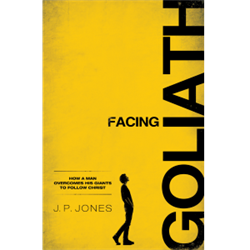
For your gift of twenty-five dollars or more, we will send you a signed copy of JP's new book, *Facing Goliath*. Please join us every Sunday at 9:00 or 11:00 AM at Crossline Church in Laguna Hills. The address is 23331 Moulton Parkway, Laguna Hills, California 92653. Or check us out on the web at crosslinechurch.com. We're going to get to the address and phone number again in a moment, but before we do that, Pastor JP, do you have any insight from today's message?
JP Jones: Thanks, Greg. You know, we're talking about spiritual growth here out of Philippians chapter 2, and what Paul says is that a healthy, growing Christian life is one where God is working in and we're working out. You see, it's only God who can impart spiritual life to us. We're saved by the work of the Holy Spirit giving us a new nature as we put our faith in Jesus Christ.
And it's the Holy Spirit who continues to transform us and to grow us up in the process of what's called sanctification. But we work out what God works in. The Holy Spirit works God's truth and grace into our lives, and we work that out through a life of faith and obedience. We work out what God works in.
It is the only way we can have a healthy, growing relationship with Jesus Christ. It's not us letting go and letting God as if we were totally passive, nor is it us working for our salvation or working only the sanctification process. No, it's the Holy Spirit working, but working through our faithful obedience. We work out what God works in. Would you like to let God know that that's the life you want? Why don't you do it in prayer?
God, I pray that You would work in us and we would work out everything You work in. And I pray for that in Jesus' name. Amen.
Guest (Male): We want to help you in your relationship with Christ. Please get in touch with us at Truth That Changes Lives, 23331 Moulton Parkway, Laguna Hills, California 92653, or call us at 949-916-0250. On the internet, you will find us at crosslinechurch.com.
We hope to see you at one of our services every Sunday at our new campus in Laguna Hills. For more information and directions, please go to crosslinechurch.com. Please join us next time on Truth That Changes Lives.
Featured Offer
Past Episodes

Featured Offer
About Truth That Changes Lives
About JP Jones
JP Jones is the founding Senior Pastor of Crossline Church in Laguna Hills, CA. Beginning with 16 people, Crossline has grown to a congregation of over 2,000 in 10 years. This growth has come largely through people receiving Christ and joining the church. JP is a dynamic and articulate Bible teacher with a passion to see people come to Christ and grow into being multiplying disciples for Jesus. JP began his ministry career with Campus Crusade for Christ and continues to have a heart for the Great Commission. Traveling on mission trips all over the world, JP preaches the gospel and trains pastors to be reproducing spiritual leaders.
For the past 25 years, JP has been an Adjunct Professor of Theology and Biblical Studies at Biola University and Talbot School of Theology. A published author, JP has written Facing Goliath by Baker Books and the discipleship curriculums, Transformed and Livin’ Large by Life Together. JP is a popular speaker at Men’s Retreats and Couples Conferences. JP is married to his wife Donna and they have 3 children. JP loves family vacation, the beach, Ultimate Fighting and a good cup of coffee.
Contact Truth That Changes Lives with JP Jones
info@crosslinechurch.com
http://pastorjpjones.com/
23331 Moulton Parkway
Laguna Hills CA 92653
(949) 916-0250