

Isn't All Truth Relative, Part 2


Sixty-six books, forty authors, fifteen hundred years, three languages, three continents, different life situations, different backgrounds of the authors writing on a whole variety of controversial issues. You know what you would expect to find, a whole conglomeration of opinion and ideas! But instead what you find is a unified truth from Genesis to Revelation! A consistency on every issue that is dealt with. The Bible is unique!
JP Jones: 66 books, 40 authors, 1500 years, three languages, three continents, different life situations, different backgrounds of the authors, writing on a whole variety of controversial issues. You would expect to find a whole conglomeration of opinion and ideas. Instead, what you find is a unified truth from Genesis to Revelation, a consistency on every issue that's dealt with. The Bible is unique.
Greg: Thank you for joining us on Truth That Changes Lives. Pastor JP Jones is the senior pastor of Crossline Community Church in Laguna Hills, California, and a professor in biblical studies at Biola University. Today on Truth That Changes Lives, Pastor JP will be giving us a message from a series entitled "Questions." Let's listen in as JP gives part two of "Isn't All Truth Relative?"
JP Jones: Is the Bible a reliable source of truth? It claims that it is. The Bible claims to be true. Listen to some of the things that the Bible claims about itself. One of them I just alluded to, John chapter 8, where Jesus said this: "Jesus was saying to those Jews who had believed him, 'If you continue in my word, then you are truly disciples of mine, and you will know the truth and the truth will make you free.'" Truth is always connected to life change, to freedom.
The writer of the Psalms in the Old Testament says this, Psalm 19: "The law of the Lord is perfect, reviving the soul. The statutes of the Lord are trustworthy, making wise the simple. The precepts of the Lord are right, giving joy to the heart. The commands of the Lord are radiant, giving light to the eyes." The Psalmist says this about God's truth, God's word, God's law: that it's perfect, that it's trustworthy, that it's right, and that it's radiant.
Because it's perfect, because it's trustworthy, because it's right, because it's radiant, what it says it will do for us as the truth is revive our soul, make us wise, give joy to our hearts, and give light to our eyes. The truth changes our lives. Luke, who wrote the Gospel of Luke's story of Jesus Christ and also the book of Acts, the story of the early church, gives us in his introduction to his Gospel a perspective on the commitment to truth that he had as he gathered the information to write his account of the life, death, and resurrection of Jesus Christ.
He says this in Luke chapter 1: "Inasmuch as many have undertaken to compile an account of the things accomplished among us, just as they were handed down to us by those who from the beginning were eyewitnesses and servants of the word, it seemed fitting for me as well, having investigated everything carefully from the beginning, to write it out for you in consecutive order, most excellent Theophilus, so that you may know the exact truth about the things you've been taught."
Luke is writing to a guy named Theophilus. It may be a real person he was writing to. It's a compound word in the Greek language. Theos, God, phileo, love—lover of God. It could be to anybody who's a lover of God. But what he's telling us is what he went about in preparation for writing the story of Jesus Christ, one of our four Gospels. He confronted all the eyewitnesses and he investigated everything carefully, and he wrote it out in consecutive order so that we might know the exact truth of these things. Truth matters because truth changes lives.
Peter, in first Peter, in his letter that he wrote, says this in first Peter 1:23-25: "For you have been born again, not of perishable seed, but of imperishable, through the living and enduring word of God. All men are like grass, and all the glory is like the flower of the field. The grass withers and the flowers fall, but the word of the Lord stands forever." This is the word that was preached to you. Peter says that this word, this word of truth, is enduring and eternal and abides forever.
This is a quotation from the Hebrew Scriptures in the book of Isaiah, Isaiah chapter 40. He says the grass withers and the flower fades, but the word of our God abides forever. Peter says that it's enduring, it's eternal, and it's abiding, and he says it has literally the power to cause you to be born again. This word plants new life in you who believe. Peter, in his second letter, says this in second Peter 1:16-21: "We did not follow cleverly invented stories when we told you about the power and coming of our Lord Jesus Christ, but we were eyewitnesses of the majesty."
Peter said, "I was an eyewitness. This wasn't just some story I made up." The term "cleverly invented stories" is one Greek word, it's the Greek word mythos, where we get the word myth. He says, "I didn't write to you a bunch of myths." He is using that in a technical sense the way we speak about the Greek myths—Zeus and Hercules and all those stories. They were stories that people made up about the gods to explain the tough stuff of life.
Peter is specifically saying, "I'm not making this stuff up about God or Jesus just to give an explanation about the hard realities that we face. It's not a myth. I was an eyewitness. I saw, heard, and experienced Jesus Christ myself." Verse 17: "For he received honor and glory from God the Father when the voice came to him from the majestic glory saying, 'This is my son whom I love, with whom I'm well pleased.' We ourselves heard this voice that came from the heaven when we were with him on the sacred mountain."
Peter's talking about what we know as the mount of transfiguration experience of Jesus. It is recorded in Matthew chapter 16, where Jesus goes on top of the mountain and Peter is there and so is James and John, and there is this overshadowing of God's power and God the Father actually speaks to his son Jesus Christ. Peter's talking about what I think could arguably be the most profound religious experience that anyone could ever have—actually seeing Jesus Christ in a conversation between the first and second persons of the Trinity, God the Father and God the Son, Jesus, in this actual experience.
Verse 19: "And we have the word of the prophets made more certain, and you do well to pay attention to it." We have the word of the prophets made more certain. He says, "I have the most powerful religious experience anyone could talk about, but this is the word of the prophets made more certain. This is what you ought to pay attention to, as to a light shining in a dark place until the day dawns and the morning star rises in your hearts."
Above all, you must understand that no prophecy of scripture came about by the prophet's own interpretation. This isn't just a bunch of opinions of men. For no prophecy had its origin in the will of man, but men spoke from God as they were carried along by the Holy Spirit. Men spoke from God as they were carried along by the Holy Spirit. We can discuss truth in an academic philosophical sense. But let's just agree that we're going to disagree.
What about practical truth that could make a difference? The Bible claims to be true. It claims to be truth that will change our lives. Does that make it true? No, it doesn't. It's not true just because it claims to be true. But if I'm someone who's looking for truth, if I'm someone who's serious, who's curious, I'd look at the Bible. If I'm someone who's committed, I'd spend time in the Bible. I'd do what it says and I'd share it with others because it claims to be true.
The Bible's uniqueness backs up its claim. This is really an amazing book we have here. There are 66 books that compose what we call the Bible. There is a first half, the Old Testament, and a second half, the New Testament. These 66 books were written over 1500 years. They were written by some 40 authors. It was written in three languages. The Old Testament was written primarily in Hebrew, but a little in Aramaic, and the New Testament was written in Greek.
These are basic facts: 66 books, 1500 years, 40 authors, three languages. It was written on three continents: Africa, Asia, and Europe. 66 books, 1500 years, 40 authors, three languages, three continents. It was written in completely different types of life situations. Sometimes the authors wrote out of times of prosperity and blessing, sometimes the authors wrote out of times of deep poverty. Sometimes the authors wrote in times of war, sometimes they wrote in times of peace.
You have 66 books, 1500 years, 40 authors, three languages, three continents, different life situations, different backgrounds of the authors. Some of the authors were kings, some were shepherds, some of the authors were prophets, some were fishermen, some were physicians, some were rabbis. 66 books, 40 authors, 1500 years, three languages, three continents, different life situations, different backgrounds of the authors. The Bible addresses a whole variety of controversial issues. Everything that you would want to find is in the Bible.
There's violence and there's sex and there's politics and there's great moral teaching and there's unbelievable stories. That's why Hollywood has made so many movies off the Bible. There are issues on right and wrong and truth and family and marriage and business ethics and child rearing. The Bible talks about everything, and it's the kind of stuff that everybody has an opinion on. It's controversial. This is a unique book. Its uniqueness backs up its truth claims.
66 books, 40 authors, 1500 years, three languages, three continents, different life situations, different backgrounds of the authors, writing on a whole variety of controversial issues. You would expect to find a whole conglomeration of opinion and ideas. Instead, what you find is a unified truth from Genesis to Revelation, a consistency on every issue that's dealt with. The Bible is unique. It's unique in its composition, it's unique in its history, it's unique in its authorship, it's unique in its message.
Its uniqueness backs up its claim to be true. The Bible is the first book ever translated from one language to another language. The Hebrew Old Testament was translated from Hebrew to Greek, and it's known as the Septuagint. It happened at about 250 BC. 70 Greek scholars who were also fluent in Hebrew translated because Alexander the Great conquered the then-known world and forced Greek culture on everyone, and everyone had to speak Greek. They took the Hebrew Bible and they translated it into Greek.
70 scholars did it over a 70-day span, and in Greek the word Septuagint refers to 70. It's known as the Septuagint. It was the first book ever translated from one language to another. Books were written on parchments, they were written on clay tablets, they were written on scrolls until Gutenberg invented the movable press and printed the first Bible. The Bible is the first book ever printed. Since the printing of the Bible, it's been printed into more languages than any other book and more copies than any other book.
The Bible is unique in its historicity, its translation, and its circulation. It is a unique book, and its uniqueness backs up its truth claims. Does the uniqueness of the Bible prove that it's true? No, it doesn't. But if I was a person who was curious about truth, I'd read the Bible. If I was a person who was committed, I'd read what the Bible says, I'd apply it to my life, and I'd share it with others because it claims to be the source of truth and its uniqueness backs up its claims to truth.
One last thing. The Bible's impact on people's lives demonstrates that it's true. A couple of years ago I had a young man come to my office and he had a lot of questions. He wanted to talk to me about some of his questions about God and faith and truth. As we began to dialogue and I answered some of his questions and he asked some more, it kept zeroing down on many of my answers coming from the Bible itself. I asked him, "Have you ever read the Bible?" He said, "No, I never have."
I said, "I don't want you to believe this just because I say it's true. Nor do I want you to disbelieve it just because somebody else says it isn't true. I think you ought to read it for yourself. What do you think?" He said, "That makes sense." I said, "You ought to read this for yourself and make up your own mind." Because Jesus said this in John chapter 8: "If you abide in my word, you are truly disciples of mine and you shall know the truth, and the truth shall set you free."
That is recorded for us in John's Gospel. There are four Gospels: Matthew, Mark, Luke, and John. In John's Gospel, at the end of John's Gospel, John the author tells us kind of the rationale that he used in writing this Gospel. He says this in John 20: "Many things Jesus did, and if I were to quote all of them, the books wouldn't even contain them. But these things I have written that you might know and believe that Jesus is the Christ, the Son of God, and that believing you may have life in his name."
John wrote the Gospel of John to present a case for Christ so that a person might believe who Jesus is, and in believing come to have eternal life. If you want to investigate truth and whether or not Christianity is true, I recommend you read the Gospel of John. There are 21 chapters. Why don't you take the next 21 days and read one chapter a day for 21 days? I'll tell you what. I'd be willing to do this. If you'll do that, I'll meet you for the next three weeks.
As you're reading, if you have any questions, just write down what your questions are, and if I can answer them, I'll answer them. Let's meet the next three weeks and you come with the questions that you have from reading the Bible. What do you think? He said, "I'll do it." A week later we met. He'd read the first seven chapters of the Gospel of John. He had a yellow pad, it was just filled with questions. Some of them were hard, tough questions. I wasn't able to answer all of his questions.
But we talked, had a good discussion, and he went back. Met him the next week, there was nothing written down on his yellow pad. I thought he was just going to tell me that he was tired and decided not to do it anymore. I said, "Don't you have any questions this week?" He goes, "Well, I have one." I said, "What's that?" He goes, "How can I know Christ personally?" I said, "I'd be glad to tell you." I talked through with him and just told him about how he could just open up his life and ask Jesus Christ to come into his life as his Lord and Savior.
I said, "Tell me, why are you asking that rather than the questions that you had?" He goes, "I kept reading, and I'm going to keep reading, but as I was reading, every time I'm reading the Bible, it's like a little voice in my head that says, 'This is true, this is true, this is true.' I realized those questions really weren't my question. My question is how can I know God?" I had the privilege that day of praying with him as he asked Jesus Christ to come into his life and became a follower of Christ.
The Bible, because it is true, changes our lives. This morning, there are only two groups of folks here. There are those of us who are curious. My appeal to you is the truth will set you free. Look at the truth. Take the challenge that I shared with that young man a couple of years ago personally. Read it for yourself. Read the Bible for yourself. Read the Gospel of John. Take the next 21 days and read a chapter a day. Ask, "Is this true?" And decide for yourself.
Then there are some of us here who are committed because we've already stepped over the line of faith. We've come to believe in the truth of Jesus Christ. We are followers of Christ. For us, we need to do what Jesus said in John chapter 8: "If you abide in my word, you are truly disciples of mine and you will know the truth and the truth will set you free." We need to abide in this word, we need to read it, we need to apply it to our lives, and we need to share it with others. Because truth changes us. Truth changes our lives.
Greg: What a great message for all of us today. Pastor JP provides us with great insight. That is why we'd like to make it available to you on CD. Just get in touch and mention today's date. We'll send it your way for just five dollars. If you'd like to support this ministry, you can write us at Truth That Changes Lives, 23331 Moulton Parkway, Laguna Hills, California, 92653, or give us a call at 949-916-0250. That's 949-916-0250.
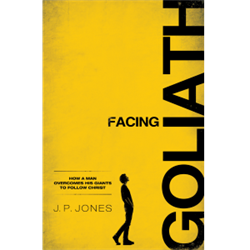
For your gift of 25 dollars or more, we will send you a signed copy of JP's new book, Facing Goliath. Please join us every Sunday at 9:00 or 11:00 AM at Crossline Church in Laguna Hills. The address is 23331 Moulton Parkway, Laguna Hills, California, 92653. Or check us out on the web at crosslinechurch.com. We're going to get to the address and phone number again in a minute, but before we do that, Pastor JP, do you have any insight from today's message?
JP Jones: Thanks, Greg. Today we're talking about truth and the power of truth to change our lives. Jesus said truth is found in two sources. The first source is himself. Truth is found in a person. Jesus said, "I am the way, the truth, and the life, and no one comes to the Father but by me." The second source of truth Jesus said is found in the words of Scripture, in Jesus' words. Jesus said this in John chapter 8: "If you abide in my words, you are truly disciples of mine and you shall know the truth, and the truth shall set you free."
The words of Jesus Christ are true words, and they are words that have life-giving power. It says this in Hebrews chapter 4: "The word of God is living and active and sharper than any two-edged sword. It pierces as far as the division of soul and spirit and joint and marrow. It's able to judge the thoughts and intentions of the heart." Jesus prayed this in his high priestly prayer in John chapter 17: "Father, sanctify them in truth, thy word is truth."
The word of God has the power to change our lives because the word of God is true. In second Timothy 3:16 and 17, it says this: "For all scripture is God-breathed and profitable for teaching, rebuking, correcting, and training in righteousness, that the man of God might be adequate, equipped for every good work." The word of God is inspired, it's God-breathed, and it teaches us, it rebukes us, it corrects us, it trains us in righteousness, it equips us for every good work.
The truth is practical. The truth is relevant. The truth is life-changing if we believe it, if we receive it, and if we apply it to our lives. You see, there is simply not enough light to make a blind man see. If our hearts are not open to the truth of Jesus Christ, if our hearts are not open to the truth of his word, we could be confronted with it, it could be right before us, but we could be unimpacted because we're not receiving it into our lives.
That is why Paul wrote to the Thessalonians in first Thessalonians chapter 2 when he said this: "We thank God that when you received from us the word of God's message, you accepted it not as the word of men, but for what it really is, the word of God, which performs its work in you who believe." Jesus put it simply in a story form, in one of his parables. In Mark chapter 4, Jesus tells the parable of the farmer who goes out and sows the seed.
He says some falls on the road, some falls in rocky soil, some falls in the soil with weeds, and some falls in good soil. Then Jesus gave the interpretation. He said he's the farmer who sows the seed of the word of God. Some seed falls on the hard soil of a person's heart who is closed, who is unbelieving, and Satan takes it away. Some seed falls on the heart, the soil of someone who immediately accepts it with great emotional joy but with no real conviction, and as a result, it doesn't have root, and when trials come, there is no fruit and it falls away.
Jesus said some seed falls on the soil or the heart of the person that the cares of this world and the desires for riches and other things chokes out the seed and so it doesn't really bear fruit. He says some seed is sown in good soil. It is the heart of the person who accepts it, receives it, and applies it. As a result, it produces a crop of 30, 60, 100 fold. The seed of God's word when it's received with a good heart has the potential to produce a crop of 30, 60, or 100 fold in our lives.
God's word can change our life. God's word can build within us hope and joy and faith and courage. God's word can produce within us love, joy, peace, patience, kindness, goodness, faithfulness, gentleness, and self-control when we receive it, when we obey it, when we do what it says. That is why James said this: "But prove yourselves doers of the word and not merely hearers who delude themselves." What are you doing with God's word? What are you doing with the truth?
God's truth can change your life when you receive it and when you apply it and when you do what it says. If that's the desire of your heart, I invite you to pray with me right now. Lord Jesus, I need you. I believe that you died on the cross for my sins. I believe you rose from the dead. I believe you are the truth. Use your truth, the truth of your word, to change my life. I pray for that in Jesus' name. Amen.
Greg: We want to help you in your relationship with Christ. Please get in touch with us at Truth That Changes Lives, 23331 Moulton Parkway, Laguna Hills, California, 92653, or call us at 949-916-0250. On the internet, you will find us at crosslinechurch.com. We hope to see you at one of our services every Sunday at our new campus in Laguna Hills. For more information and directions, please go to crosslinechurch.com. Please join us next time on Truth That Changes Lives.
Featured Offer
Past Episodes

Featured Offer
About Truth That Changes Lives
About JP Jones
JP Jones is the founding Senior Pastor of Crossline Church in Laguna Hills, CA. Beginning with 16 people, Crossline has grown to a congregation of over 2,000 in 10 years. This growth has come largely through people receiving Christ and joining the church. JP is a dynamic and articulate Bible teacher with a passion to see people come to Christ and grow into being multiplying disciples for Jesus. JP began his ministry career with Campus Crusade for Christ and continues to have a heart for the Great Commission. Traveling on mission trips all over the world, JP preaches the gospel and trains pastors to be reproducing spiritual leaders.
For the past 25 years, JP has been an Adjunct Professor of Theology and Biblical Studies at Biola University and Talbot School of Theology. A published author, JP has written Facing Goliath by Baker Books and the discipleship curriculums, Transformed and Livin’ Large by Life Together. JP is a popular speaker at Men’s Retreats and Couples Conferences. JP is married to his wife Donna and they have 3 children. JP loves family vacation, the beach, Ultimate Fighting and a good cup of coffee.
Contact Truth That Changes Lives with JP Jones
info@crosslinechurch.com
http://pastorjpjones.com/
23331 Moulton Parkway
Laguna Hills CA 92653
(949) 916-0250