

The Narrow Path 11/03/2025


Enjoy this program with Steve Gregg from The Narrow Path Radio.
Steve Gregg: Good afternoon and welcome to The Narrow Path radio broadcast. My name is Steve Gregg and we're live for an hour each weekday afternoon taking your calls. If you want to call in with questions about the Bible or the Christian faith that we could discuss together here, or you have a different viewpoint from the host which we could also discuss here, you may freely call. We have some lines open. In fact, right now we have a number of lines open. This is a very good time to get through. The number is 844-484-5737. That's 844-484-5737.
A couple of announcements this week. A couple of important things happening this week. One is rather routine, this Wednesday and the first Wednesday of every month, but still only once a month. We have a Zoom meeting in the evening which anybody around the world is welcome to join us in. It is held at 7:00 PM Pacific Time. We sometimes get calls from as far away as England, so it's quite late at night for people like that, but you just have to do the calculations about what time it is where you are. Wednesday night, 7:00 PM Pacific Time, you're welcome to join us on the Zoom call. You can find the login information at our website, thenarrowpath.com, under the tab that says "Announcements".
The other announcement is not routine at all. It's perhaps a once-in-a-lifetime event. This weekend I will be in Dallas, Texas, and Dr. Michael Brown and I will be debating three times on the weekend: Friday night, Saturday morning, and Saturday afternoon. We'll have three different debates on the same subject. This has to do with Israel. What is God's plan for Israel? Is the modern state of Israel the fulfillment of some prophetic destiny? Is it a sign of the times or whatever? Dr. Brown and I have very different views on these questions and we'll be debating them in Dallas, Texas at Mercy Culture Church there, which is hosting the event.
The information about going there is at our website. We give you a link to the registration page. You don't have to pay anything, it's free, but they want to know who's coming, or at least how many people are coming, and so they've asked that everyone register. This is free, but we have a link to the registration page at our website. Now that's at thenarrowpath.com and the tab there is "Announcements". Both for this Wednesday's Zoom login information and for this Friday and Saturday's debate between Dr. Michael Brown and myself in Dallas, Texas. Again, you have to register, but the link to do that is there at our page, thenarrowpath.com, under "Announcements". Both of those things are under announcements.
All right, I think we can just go to the phones now and talk to Paul from Buena Vista, Colorado. Hi Paul, welcome to The Narrow Path.
Paul: Hi Steve, I was just curious about the seven mountain revelation that I'm hearing about. Are you familiar with that concept?
Steve Gregg: Yeah, I think I know what you're referring to. It's not very recent. I first learned of this back in the 80s or something like that. It's the idea that there are seven spheres of cultural influence or spiritual influence which Christianity must aim at infiltrating and dominating with the Kingdom of God principles. Is this what you're talking about?
Paul: Yeah, I think that must be it. Was Charlie Kirk part of that? That's what I'm hearing.
Steve Gregg: He could have been. I don't know, lots of Christians are. It's definitely something popular among post-millennialists, but you don't have to be post-millennialist to believe in it. It's not a biblical idea. The Bible doesn't teach it. But the first I heard about it was back in probably the early 80s when I heard that Loren Cunningham, the founder of YWAM, was visiting with, I believe it was with David Wilkerson, the founder of Teen Challenge, and they were talking about what they felt God had been speaking to them about.
One of them, I think maybe Loren Cunningham, said that he had come up with this idea that there's these seven spheres that kind of dominate the culture and that Christianity had to seek to penetrate those spheres in order to have dominance in the culture. And he listed them and, as the story was told to me, David Wilkerson said, "God gave me that exact same information." Now both of these men are Pentecostals and obviously believe in getting divine revelation. Some people would not believe in that, but the story of them meeting and having this conversation is where I first heard of it.
Like I said, it was in the early 80s. They may not have been the first, they were just the first I ever heard of to talk about that. I've heard it a lot of times since. The idea is that church just by having church meetings and doing evangelism and bringing people into the church is not fulfilling the Great Commission because the Great Commission is to make disciples of the nations. Now making disciples of the nations can simply mean go make disciples of Gentiles, that is of people who are from all the nations. The word Gentiles and nations is the same in Hebrew and in Greek.
So "make disciples of the nations" can simply mean go reach the Gentiles, but some have understood it to mean we need to reach the nations as national political entities and disciple them, that is teaching them to observe all things Christ commanded. The seven mountains, I don't know if I can remember them off the top of my head, they are like politics, education, entertainment, religion, arts, government, and the media. Some of these may overlap ones I mentioned before.
These are areas which influence people and if we just bring people into the church and preach to them every Sunday, many times we do that, but it doesn't change the culture much. They're saying that Jesus didn't tell us to do that. He told us to go and make disciples of the nations. So they said these are the things we need to aim at. We need to get Christians in politics, we need to get Christians in the media, need to get Christians in education realms and things like that. There are seven of these places.
Now do I agree with it or disagree with it? I think Christians should be everywhere and I think wherever Christians are, they should be Christians. So if Christians feel inclined to take some civil leadership in their communities or in the country, I don't think that's necessarily something the Bible forbids. If Christians are in those realms, of course they should be Christians, like Daniel was in the political system and Joseph in the Old Testament was and they had influence. They had influence over pagan governments. I think when the church is going to be leaven and leaven the lump, it means we affect the world around us.
If a Christian is in government, they should be a Christian in government and they should think like Christians and talk like Christians and what they do should reflect the fact that they have Christian values. Same thing if a Christian is an entertainer. Let's say they're a Hollywood actor or a famous singer or maybe not so famous, but that's the realm God has them in. They should be Christians in that realm. They should be godly. They should speak for Christ when they have a chance. If they are songwriters, they should write music that is reflective of either the gospel itself or at least Christian values.
Likewise, educators should be Christian in their realm. I don't even think it's very controversial, maybe somewhat, but I don't think it's extremely controversial that Christians can be involved in all these realms, these seven mountains so to speak. And the question is, whatever a Christian is doing for a living, should they be a Christian in that role or not? Obviously they should. What does it mean to be a Christian? It means to stand for Christ, to stand for Christ's Kingdom.
So I don't know that it takes any special strategizing, although maybe it does. Maybe Christians have been too mousy and shy and reluctant to speak up in their places of employment and the only place they talk about faith or Christ is in their churches. But this idea would be no, Christians ought to speak for Christ everywhere. We should seek to bring people to Christ. We should seek to bring their values and their behavior under Christ, under his teaching. Jesus said, "If you continue in my words, you're my disciples indeed." So obviously if we're going to make disciples teaching them to observe all things Jesus commanded, then we'll do that wherever we are.
So that's the doctrine as I understand it. I don't know if Charlie Kirk holds it, but I wouldn't be surprised if he did. Most Christians who are somehow involved in government in an active way are somewhat sympathetic toward this seven mountains view. Whether they've actually heard the term "the seven mountains" or not, I don't know, but what it refers to is something that a lot of Christians do agree with and I can't find anything to disagree with about it except if they think they're going to make the Kingdom of God come through politics. That could be a dangerous idea. However, if we believe that we're called to be in the political realm and to behave like Christians there, then I certainly can't think of any reason to object to that.
All right, thank you, brother. Let's talk to Carolyn in Seattle, Washington. Carolyn, welcome, thanks for calling.
Carolyn: Hi.
Steve Gregg: Hi.
Carolyn: Can you talk a little about is America Babylon?
Steve Gregg: Could you get a little closer to your phone?
Carolyn: I'm sorry. Is that better?
Steve Gregg: Yeah, that's a lot better.
Carolyn: I'm sorry, I had the wrong button. About America being Babylon.
Steve Gregg: Well, I don't see America as being the Babylon that's referred to in Revelation, though some people do. When I was a dispensationalist in the 70s, we had the impression that Babylon was the realm of the Antichrist and that this was going to be a ten-nation confederacy in Europe, which is a revived Roman Empire kind of thing. That's a dispensational idea. So I kind of thought of Babylon as a somewhat European anti-Christian entity.
The first time I went to Europe, which was when I was 19, I went over to preach in Europe for about five weeks. Talking to some of the older Christians I met there, it came up what do you guys believe Babylon is in Revelation. They said, "Most people I know think it's New York City," which was kind of funny because we thought it was them and they thought it was us. But anyway, a lot of people think that America could be Babylon or some other modern entity, maybe some future united world, maybe with New York as the center. Most would say with Rome as the center or something.
But that's of course taking the eschatological view of Revelation, the futurist view. I no longer hold a futurist view, so I would obviously see things different from that. I wouldn't necessarily identify anything in Revelation with America or with any modern entity. If you wonder what I would think, I'm a partial preterist and in my approach to that, I see Babylon either as a reference to Rome, ancient Rome, or I think more probably to ancient Jerusalem.
So those are the ways I look at it. But of course in a short call like this, in the format we have here, I can't go into all my reasons. I do, however, in my lectures on Revelation, so nobody need ever ask me what I think about anything in Revelation because I have verse-by-verse lectures free. Anyone can listen to them who wants to at our website thenarrowpath.com and I do go into that in as much detail as I can there. Thank you for your call.
Linda in California, welcome to The Narrow Path, thanks for calling.
Linda: Yes, I wanted to know, I have a question about the Day of the Dead. Is it in the Bible?
Steve Gregg: Are you talking about the Mexican celebration of the Day of the Dead?
Linda: Yes.
Steve Gregg: No, that's not in the Bible.
Linda: Well, is it like worshipping another god? Because this God is a God of the living. That's what I think.
Steve Gregg: Well, I don't know if the Day of the Dead is worshipping any god at all. I think it may be showing reverence to people's ancestors if I'm not mistaken, which is not a Christian thing to do. A lot of cultures other than Western civilization revere their ancestors. African cultures do, many Asian cultures do. If I understand correctly, those who celebrate the Day of the Dead are in some measure revering their ancestors, but I'll have to say I'm not an expert on Mexican culture.
I didn't even know about the Day of the Dead until that movie came out, that Walt Disney or Pixar animated movie some years ago and I didn't even know what the Day of the Dead was before that. I still don't know very much about it. So yeah, that's not in my realm of expertise at all. It's not a biblical topic and I don't know if there's any gods being worshipped there. I don't even know if it's a religious festival or if it's just showing respect for their dead ancestors. I plead complete ignorance about it.
But you know what you could do? There's this thing called Google. If you check that out, they'll probably tell you as much about that as you'd ever want to know. More than I know, to be sure. I appreciate your call, Linda, thanks for joining us.
Dallas in Bath, New York, welcome to The Narrow Path, thanks for calling.
Dallas: Hi Steve, I hope you're doing well.
Steve Gregg: So far so good.
Dallas: Good, good. I wanted your thoughts on something. When it comes to vaccines, is it ethically wrong to use a vaccine that was developed with aborted fetal stem cells?
Steve Gregg: Well, I don't know. I'm certainly against abortion. I would certainly be against doing abortions in order to get materials for a vaccine or in order to do anything else. To kill a baby is murderous. Whoever kills babies will answer to God for that, for shedding innocent blood. It's a great crime and a great sin.
Once a body is dead, whether it was murdered or died of natural causes or whatever, I don't know what the rules would be about using materials from that dead body. For example, I'm not 100% sure I know what God thinks about organ donations, organ transplants, which is a different subject of course, but it's also related to taking materials from a dead body. If I were in favor of organ transplants—I don't know that God's for it or against it, he might be against it—but if he's not against it, I don't know if taking the organs from someone who was a victim of criminal violence and had died would be worse than any others. It's the crime, the murder is the crime and whoever commits the murder is guilty of the crime.
But I don't know much about the vaccine. I didn't get as interested in that as everybody else did. I didn't take the vaccine. I would have resisted it if they tried to force me to. I wasn't afraid of COVID and I'm not afraid of it now. I'm not into vaccines period. I'm not against them. I think some vaccines may do good. I'm just not into them. I don't give them much thought. I don't get them generally speaking.
That being so, I didn't look into it. I did hear people say the vaccine was made from fetal tissue gained possibly by abortions several generations ago or something like that, or lots of years ago. That's simply not a biblical topic. If you find a dead body and you do something good with it, I just don't know that that would be bad in itself. Now if you're killing people in order to do that, like if you're the Chinese government killing prisoners of conscience, political and religious prisoners, to harvest their organs and sell them on the black market, well, that's a horrible thing because you're killing people. You're murdering in order to get the materials.
But if the murders had taken place years ago, it was still evil, but what must be done with the bodies of the dead? I don't know that the answer would come clearly from scripture. So I don't have a firm opinion about that. I personally think everything about the COVID vaccine was suspicious to me and I'd never advise anyone to take it. But as far as the ethics of that particular aspect, there's nothing in the Bible that addresses it directly.
It's like the question of should Christians celebrate Halloween when in fact Satanists do so? It's not really the same question, but it's like if you say if a Christian celebrates Halloween, they're not doing what Satanists do. Satanists worship Satan. Christians don't. And they're doing something that isn't specifically forbidden in the Bible, but it has associations in some people's minds with the occult and therefore some would say Christians shouldn't do it because it's tainted by those associations.
I think people often say the same thing about vaccines. They may be tainted by the fact that somewhere many years ago some baby was murdered and materials from its body were used to make a vaccine. Well, if I was in favor of the vaccine more, I might have more of a tendency to say maybe that's okay. I'm not very favorable to the vaccine, so I'm not in sympathy with it at all. But if it was saving lives truly, it might be that the baby whose life was taken wrongfully in murder—
Featured Offer
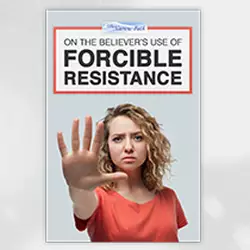
Question from a pastor: In light of Christ’s command to “turn the other cheek” and to “not resist the evil man”, is it inappropriate for believers to contemplate or exercise physical force in defense of our families against criminal aggressors? Over the course of more than three decades, I have weighed the biblical testimony concerning this topic and related questions and cannot claim even now to have the final and definitive answer for every situation. Individual commands of Scripture teach us how these principles are expressed in various life decisions, but in the absence of specific commands we must proceed upon principle, and the commands that do exist should be interpreted in the light of such principles. Download the eBook to read more!
Past Episodes
This ministry does not have any series.
Featured Offer
Question from a pastor: In light of Christ’s command to “turn the other cheek” and to “not resist the evil man”, is it inappropriate for believers to contemplate or exercise physical force in defense of our families against criminal aggressors? Over the course of more than three decades, I have weighed the biblical testimony concerning this topic and related questions and cannot claim even now to have the final and definitive answer for every situation. Individual commands of Scripture teach us how these principles are expressed in various life decisions, but in the absence of specific commands we must proceed upon principle, and the commands that do exist should be interpreted in the light of such principles. Download the eBook to read more!
About The Narrow Path
The Narrow Path is Steve's teaching ministry primarily to Christians. In part, it is a one-hour, call-in radio show. Christians call in with questions about what the Bible says on many topics and how certain passages can or cannot be interpreted. Occasionally, an atheist or agnostic or one of another faith calls in to inquire or raise objections. Steve takes all calls, including objections to what he has presented. It is an open forum with polite, respectful discussions. The object is for the host and the audience to learn together.
The ministry also has a website, a Bible-discussion forum, a Call-of-the-Week video, a YouTube channel, and a Facebook page. These contain Steve's verse-be-verse teachings through the entire Bible, topical lectures and articles, friendly debates with folks of other opinions, and much more. Please explore these hundreds of resources. They are all valuable, but they are all FREE. We have nothing to sell. "Freely you have received, freely give."
Steve is also available to teach and answer questions at church and home meetings. He has taught on every continent. If you would like to have him speak in your area, just organize a group, a place, and propose a date, or several, and e-mail Steve@TheNarrowPath.com.
The Narrow Path exists through the gifts of donors who appreciate these resources. We have no corporate sponsors and run no commercials on the radio or ads on the website. If you are blessed by these resources, we ask that you first pray for us, then tell your family and friends, then consider donating to help us stay "on the air". God faithfully provides through listeners.
About Steve Gregg
When asked a question about a passage, Steve usually lists its several interpretations, gives the reasoning behind each, cross-examines each, and then tells his own conclusions and reasons. He tries to teach how to read and reason about the Bible, not what to think. Education, not indoctrination.
Steve has learned on his own. He did not attend a seminary or Bible college, but he was awarded a Ph.D. for his work by Trinity College of the Bible and Theological Seminary in Evansville, Indiana. He is the author of two books:
(1) All You Want to Know about Hell: Three Christian Views of God's Final Solution to the Problem of Sin
(2) Revelation: Four Views, Revised & Updated
Contact The Narrow Path with Steve Gregg
Steve@TheNarrowPath.com
The Narrow Path
P.O. Box 1730
Temecula, CA 92593
844-484-5737 2-3 PM Pacific Time