

The Narrow Path 06/15/2026


Enjoy this program with Steve Gregg from The Narrow Path Radio.
Steve Gregg: Good afternoon and welcome to the Narrow Path radio broadcast. My name is Steve Gregg and we're live for an hour each weekday afternoon taking your calls. If you have questions about the Bible or the Christian faith that you'd like to ask, I'd be glad to talk to you about those things. You have to call in, though. You can even call in if you disagree with the host and want to explain why. I'd be glad to hear from you. The number to call is 844-484-5737. That's 844-484-5737.
If you'd like to be on the program, it looks like we have one or two lines open right now. This is a good time to call. This week, there's a few places I'm speaking. Between now and Thursday, there's three places. Tonight, I'm in Spokane, Washington from 5:00 to 8:00 PM. It’s a big Q&A time. Anyone can ask questions about the Bible, like they do on the air here. If you'd like to join us, it's at the Liberty Remnant Church in Spokane.
I’d be glad to have you join us there at 5:00. Or if you have to come a little late because you're working, feel free to drop by. It's a long session. It's at 4301 East Day Mount Spokane Road. It's actually in Colbert, Washington. I am invited by people I know, but I've not been to this location. So that's tonight, 5:00 to 8:00 PM, Q&A in Spokane.
Then tomorrow night, Tuesday, I'll be in Kamiah, Idaho, a place that most people have never heard of. But I actually lived not very far from there for a few years and I have friends in that area. So I'm looking forward to being there. It’s a little tiny town, Kamiah, in the Clearwater River Valley in Idaho.
Then I'm going to be in Eagle/Hidden Springs near Boise on Thursday night. It’s a really cool place. The place where we're meeting is an event venue, like for weddings. It’s a beautiful place. That's going to be Thursday night from 6:00 to 9:00 PM. I'm going to be speaking on the Kingdom of God, with a Q&A following. Also in Kamiah tomorrow will be a Q&A. So there’s a lot of Q&As going on, which is something I enjoy doing, as you might imagine.
So that's tonight in Spokane, tomorrow in Kamiah, and then Thursday in the Boise area. Now, if you're in those areas and want to join us, I'd love to see you. The way to find out where we are exactly is to go to our website, thenarrowpath.com. Look under announcements. There’s a tab that says announcements. It has all those meetings, the time and place. I look forward to seeing many of you tonight and hopefully some tomorrow and Thursday night too.
We're going to go to the phones next. The number again is 844-484-5731. We're speaking first to Nigel in Port Townsend, Washington. Hi Nigel, welcome.
Nigel: Hello Steve, good to hear you. I just had a comment about a caller I tried to call last Friday. You had a caller that called in about his daughter that was going to go through a gender transition. I just wanted to pass on some maybe helpful information. There's a girl on YouTube by the name of Chloe Cole. I don't know if you've heard of her.
She's a teen who at 15 went through the process in California, had her breasts removed, but she became a Christian and she went through the detransitioning process. So she shares her story. She even shared it in front of the Senate in California. But I think that girl, that man's daughter, needs to hear some of the stories from people that have been through it.
Steve Gregg: Well, I agree with you. There's been a lot of detransitioners, people who when they were young and confused, they transitioned, and then they outgrow it. Actually, I forget the statistics, something like 95% of people who are transgender when they're young outgrow it before they're 20 years old and they can't imagine why they thought that way.
Imagine how sad they would be if they went through and made some irreversible surgeries or something like that and then later wished they hadn't done it. And of course, anyone who becomes a Christian afterwards will wish they hadn't done it because it's going to complicate your Christian life considerably if you can't go back to your natural state.
So anyway, I have great pity for people who've made a mistake and wish they hadn't done it. Chloe Cole is one of those detransitioners. If you go on YouTube, I'm sure you can find a lot of testimonials from young people who transitioned when they were younger and now wish they had not and they're going through somewhat expensive and maybe even painful detransitioning.
It’s certainly not a very good idea to make any body-altering changes when you're young. Frankly, I'm not in favor of making body-altering changes at any time, but when you're young, you don't have any idea how long you're going to feel that way about it. But the adults who actually encourage it, that is, who encourage them to make the transition, are certainly not friends of these children. So I appreciate your call, Nigel. Thank you for telling us about that. Ron in Indianapolis, Indiana, welcome to the Narrow Path. Thanks for calling.
Ron: Hello Steve, thanks for taking my call. Steve, this is going to be guessing, supposition, whatever, whatever, because I know you say the Bible doesn't mention some things and those things that the Bible doesn't mention, maybe we're not supposed to know. However, I like the way you think, so we're going to talk. Steve, in the new heaven, new earth, are there going to be some people—well first of all, we're going to have new bodies I would imagine and they're going to last forever. In addition to that, aren't there going to be some people who I guess rule over something throughout eternity, as far as the people who are still around, if that makes sense?
Steve Gregg: Yeah, yeah. So is that your question?
Ron: Yes, but the last one is going to be, Steve, I've often wondered, will God let us see the rest of His universe? Maybe that's what eternity will allow for. Do we get to see the rest of the universe? I like seeing and doing things. But I'm going to stop there.
Steve Gregg: All right. Well, for us to see the rest of the universe would take billions of years, but we'll have plenty of time if we have eternal life. We could take the full tour, I imagine. I don't know, the Bible doesn't tell us about that. But honestly, the fact that even in our mortal state in this fallen world, we can see much of the universe from a distance and even travel into space, I would imagine once we're fully immortal and so forth, that probably I wouldn't be surprised.
I can't answer definitely because as you say, the Bible doesn't tell us everything. But my guess is probably we will be able to travel through space and if you've got infinite time, I suppose you could see as much of it as you wanted to. Now, there's not much out there that I know of that I'd care to see or visit, but maybe there's more than we know. And so that's just kind of who knows. I guess that's for us to find out.
As far as your first points, that when we are resurrected from the dead at the coming of Christ, we'll have immortal bodies. That is true. I mean, the Bible says that plainly in 1 Corinthians 15 and is certainly strongly implied in Philippians chapter 3, I think it's verse 20 or 21, and also in 1 John chapter 3, verses 2 and 3.
So there are and probably other places too, I mean, we're going to be like Christ's resurrection body. It'll have continuity with our present body. In other words, God's not just going to make something new from scratch as far as I know. Maybe He will, but the Bible describes it as these bodies will rise. And of course, some would say, but by the time Jesus comes, the majority of people who will have lived have decomposed into practically nothing.
Well, I'm sure God is aware of that and knows how to handle that kind of situation. The main thing is it does say those who are in the graves will come out resurrected. So I assume it'll be the same body transformed into another state of immortality. Paul said this body when it's buried is buried in dishonor, it'll be raised in glory. It's buried a mortal body, it’s raised immortal. It's buried in weakness, it's raised in power.
These are the things Paul says in 1 Corinthians 15. And it would appear then that we will live forever and of course, the Bible indicates we'll live on the new earth where Jesus will also be with us. So yeah, I think you've got that right. But as far as being able to see the rest of the universe, I guess that remains to be seen. But frankly, I can't see any reason why we would necessarily doubt it. I appreciate your call, bro. Let's talk to—let's see—Ron in Indianapolis. Hi, Ron.
Ron: Steve, this is Ron. I think you just answered that question.
Steve Gregg: Okay, well, oh, there was another caller that was on. I thought I hung up on him. Okay, go ahead. That's still you. Go ahead.
Ron: Steve, I understand we probably could see—I think I asked, there're going to be people or somebodies I believe that are going to be ruling over the earth.
Steve Gregg: Yeah, thanks for reminding me of that point. I answered your other two without remembering that one. So it would seem. I mean, we do not know the details, but Jesus told a parable—actually He told two parables that were similar—but in one of them, the one in Luke 19, He said that the stewards to whom the master entrusts his goods, if they steward well, will when he returns, he'll give them rulership over others.
He tells one of them in the parable, rule over five cities. He tells another, rule over ten cities. The Bible definitely says if we endure, we'll reign with Him. Reigning with Christ is essentially what is promised to those who are faithful to Him. Now, if you say, well, who then would we reign over? Well, that we are not told.
We could say well, we'll reign over the animal kingdom like Adam did, but I don't think the animal kingdom is organized into cities. So I don't think that's the answer, though it may well be true that we do reign over the animal kingdom. But I think it's over other humans. Now, those other humans, it's hard to say who they are.
It's very possible that they are other people who are saved because there's no promise that everybody who becomes a Christian will rule. He said if we endure, we'll reign with Him. In the parable, those who were good stewards were entrusted with responsibility to rule over cities and so forth.
The parable also suggests there's some who don't rule, or there's some who aren't very good stewards. Now, I don't want to read anything more into it than is there, but it's possible that, you know, those who are the more faithful will rule over those who have been less faithful with their stewardship. That's only a guess. There may be some other possibilities.
I'm not going to explore them all right now because honestly, it would be a guess. It's an educated guess, but still, it's a guess. Again, that's one of those things I guess we'll just find out. I expect to find those things out later and I can't even understand why knowing them now would be of use to me in my Christian life. I’ve got responsibilities on my plate to keep my attention well enough without me speculating about all that, but I understand the curiosity. We all have curiosity. I appreciate your call, Ron, and thanks for reminding me of that third question. Carrie from Fort Worth, Texas, welcome to the Narrow Path. Thanks for calling.
Carrie: Hey Steve, a couple of questions. Here in Texas, we've got a guy running for Senate who's made some controversial statements. One of them was that God is neither male or female and he—or he is both male and female and everything in between. And I was making—we had a discussion and I was saying, well, the error in his statement was the everything in between. And I got some pushback on that saying no, God was male. So my question is, is God male?
And then I have another question we were studying in 2 Timothy, chapter 2, verse 14, about wrangling with words and it says it's useless and leads to the ruin of hearers, but I like the wrangle about the meaning of words and I find it quite useful. So I was wondering what is meant there.
Steve Gregg: All right. As far as whether God's male or female, both, neither, any of that, we have to remember what male and female are. Those are biological categories. There are living things that are neither male nor female, like amoebas. There're asexual biological organisms and there're sexual biological organisms.
And the ones that are sexual can be categorized as male or female. And the ones that are male have male characteristics. In the case of humans, they've got different chromosomes than females and they have different genitalia than females and that's at least two characteristics in which males and females differ.
God is not physical or biological. He's not part of the biological world, which means He probably doesn't have any chromosomes, I'm pretty sure of that. And I don't think He has any of the other characteristics that distinguish males and females. Therefore, He is asexual—not sexual—but not because He's like an amoeba, but because He's not a biological being at all. Sexuality is related to biology and God is a spirit.
So it would be a mistake to say that God is male and female or male or female. Neither male or female is the right answer because frankly, it takes some kind of biological system to determine maleness and femaleness. Now, on the other hand, male and female in the human race don't only bespeak their biology but also their relationships to each other.
A man and a woman when they're married have corresponding, complementary relationship roles. And therefore, some of these relationship roles, they serve as models of the kind of relationship God wants us to have with Him. And so the most common human social relationship metaphor for God in the Bible is to call Him the Father and to call us His children.
So certainly, though God is not a male because He's not biological, He wants us to relate to Him and think of Him in terms that we think of as a male parent, as opposed to as a female parent or as a machine that isn't male or female. God has put people in families so that they have familiarity with people in different roles, children toward their parents, especially their father.
Now, some things about God, even His parental aspects, are not 100% unlike female ones because Jesus said, "Jerusalem, Jerusalem, how many times I would have gathered your children as a hen gathers her chicks under her wing, but you would not." So Jesus said, "I have desired to do what a hen would do with her chicks," at least something analogous to that.
God says in Isaiah, "Can a mother forget her nursing child or fail to have compassion? She may forget, but I will not." Now, He's not saying He's like a mother. He's actually saying He's better than a mother. A mother might forget her child. There have been women who abandon their children. He says but that—a mother's commitment to her child is one of the highest imaginable human commitments to other human beings and even they fail in that, but God doesn't fail in that.
So I mean, there's a sense in which He uses a metaphor for a woman toward a child to give us some idea of His commitment and love for us. So God's not ashamed to use, if necessary, a female metaphor. In Deuteronomy, He compares Himself to a mother eagle hovering over her eaglets and carrying them on her wings and so forth, which He's saying that's like Him and Israel.
So motherly attitudes and motherly behaviors are not entirely absent from God. I think God made male and female humans and animals so that they could in a sense reflect different aspects of His character and His relationship with us. Now, when God said, "Let us make man in our image," man meaning mankind, He says He made man in His image, male and female He made them.
So there's a sense in which males and females each bear some resemblance to God's nature, God's character, whatever. God is reflected in different ways in the role of a mother and that of a father. But He is never encouraged us to think of Him as our mother. And when He came to live among us, He did not reveal Himself as a female but as a male. Why? Well, because He's the king, He's not the queen.
He's a father, He's not a mother. At least these are the human-type roles that He wants us to relate to Him in. He's a lord, not a mistress of servants. He's the Lord of the servants. The roles that male leaders hold—fathers, kings, lords, so forth—are the ones that correspond to the role of God toward us.
So Jesus said that a wife submits to her husband as the church submits to Christ and the husband must love the wife as Christ loves the church. That is, Christ and God, who is reflected in Christ, is the role model for the male and the church is the role model for the female in her submission to her husband.
So yeah, I mean, it's a category error to say God is both genders or God is pan-genderal or whatever. He's not really a gender at all, if we're talking about male and female. These are actually biological categories. God is not biological. But to say that relationally, the different roles of leaders, for example in relationships—fathers, kings, and those kind of things—the male roles are the ones that God wants us to think of Him in terms of.
He never invites us to think of Him as our mother or as a queen, but He certainly does as a Lord, a King, a Father. So it's not the same thing. That's not saying that God is male. It's saying that the roles of males in the human society correspond more exactly to the role of God in our lives than the female roles do in human society. So that would be not a yes or no answer, but it's basically, I think, we have to take those things into consideration.
Carrie: So the 2 Timothy—
Steve Gregg: Yeah, 2 Timothy talks about wrangling. 2 Timothy 2:14, Paul says remind them of these things, charging them before the Lord not to—your version—not to wrangle about words. The New King James says not to strive about words, to no profit, to the ruin of the hearers. I think you're saying you like to wrangle about words. I think what you really mean is you like to parse words.
You like to tease out the meaning of words to get a better understanding of them and so forth. I think that's probably what you mean. If you want to just cause fights with people over the way they say things, as opposed to the way you say things, that's not a mark of spiritual maturity. That's a mark of wanting to strive. So I don't think that's—I mean, I doubt that you're saying that you like to strive over words. Maybe you are. If you are, then that's not a good thing, Paul said. But if what you're saying is I'm very interested in words, I'm very precise in my—I want to be precise in my understanding of words, I want to discuss words so I can understand them better, that's not what Paul's talking about is striving or wrangling over words.
Carrie: Okay, well that helps.
Steve Gregg: All right, Carrie. Thanks for your call, brother. Okay, Jeff from Springfield, Massachusetts. Actually, I probably shouldn't take Jeff's call until after the break. So Jeff, hang in there. I'm looking at the clock. The break's coming up in one minute. So I’ve got to find some way to use a minute without talking to Jeff. I will say this, many of our lines are open right now. So if you want to be on the air in our second half hour, we have—if you're not familiar—this is a one-hour show.
We take a break at the bottom to let you know what we have to offer, the website and that we're listener-supported, those kinds of things, and then we have another half hour, which is coming up very quickly. If you want to be on the program, this is a good time to call because you will get on our switchboard and very likely you'll be on the air before the show ends. The number is 844-484-5737. I’ll give it to you again, 844-484-5737.
So the Narrow Path has been on the air for 29 years. We have archives of shows going back decades. They are at our website. You can listen to the show live or later at the website. We also have, oh, I'm just estimating, someone gave me the number 1,500 lectures of mine at the website you can listen to for free and they include verse-by-verse lectures through every book of the Bible and topical lectures on virtually every subject of interest that Christians have ever discussed.
Just think of any theological controversy you know about, it's been discussed and I give very thorough teachings on those subjects, which are at the website. Everything's free. Another thing that's at our website is my—the announcements, where I'm speaking tonight in Spokane, Washington, tomorrow and Thursday night in Idaho. If you're interested in those things, that's also at the website.
The website's actually a treasure trove of opportunities for you to hear teaching or listen to radio shows or whatever. The website is thenarrowpath.com. But we are listener-supported. That is, we don't have anything, we don't sell anything, we don't have any sponsors. We stay on the air by paying radio stations for time and we are listener-supported. You can donate if you want from thenarrowpath.com. And I'll be back in 30 seconds. Don't go away.
Welcome back to the Narrow Path radio broadcast. My name is Steve Gregg and we're live for another half hour taking your calls. You can get on the air with us if you call this number, 844-484-5737. If you have questions about the Bible or the Christian faith, that's what we discuss here, the number 844-484-5737.
Now the announcement that took place just a moment ago mentioned our app. I would just—I wouldn't say anything about it except there's something that may not be clear in that announcement, something that actually has changed. We used to have our apps in the place you normally go for apps, that is, at the App Store for iPhone or at Google Play for Android.
In fact, we might even still have apps there for all I know. A better app, an improved app, more functional app was made some time ago now, but you can't find it at the App Store or Google Play. You find it—we have a website thenarrowpath.app. Now I mentioned we have our website thenarrowpath.com, but there's another website you go, you know, on your browser, on Safari or whatever you use.
Go to thenarrowpath.app. So you're going to a website. And you'll have instructions there on how to download the icon for that app onto your device, your phone or whatever. Now once it's there, it operates just like any other app. And you've got all the lectures from the website, you've got all the radio shows from the website, you've got links to other resources that are available.
I really think anyone who enjoys this program or has heard our lectures and wants them at their fingertips, if you go to on your browser on your phone or on your iPad or whatever, go to thenarrowpath.app and follow the instructions there to download it on your phone. You'll have access to thousands of things that are free and nothing is for sale. So I just wanted to clarify that. We're going to talk next to Jeff from Springfield, Massachusetts. Jeff, welcome to the Narrow Path. Thanks for calling.
Jeff: Hi Steve, thank you for taking my call. I've got two brief questions. The first one, I don't know if I've ever heard you speak on this, is the contention between the Orthodox and the Catholic on the Filioque clause, the procession of the Holy Spirit, whether and from the Son. And I don't know what your thought is on it, but I mean, how does it really make a difference in a believer's life? I mean, is it just a theological wrangling over something that's not really relevant?
Steve Gregg: Yeah, talk about wrangling over words. I think it maybe falls into that category. Now, it's very precious to the Eastern Orthodox because it's one of the things that defines them in distinction from the Roman Catholic. The Filioque means the phrase "and from the Son." And in the Creeds, I hope I have this right, the Roman Catholics in their Creeds say that the Holy Spirit proceeds from the Father and the Son.
Okay, and then the Eastern Orthodox leave out "and the Son." So yeah, they say—the Eastern Orthodox say that the Holy Spirit proceeds from the Father. The Catholic Church says the Holy Spirit proceeds from the Father and the Son. So the dispute is over the phrase "and the Son," which I guess the Catholics include and the Eastern Orthodox do not. And you're saying, "What does it matter?" Very good question. That's a very good question.
I mean, Jesus said, "If you earthly fathers know how to give good gifts to your children when they ask, how much more will the Father give the Holy Spirit to those who ask him?" So I mean, all that I care about is I want the Holy Spirit to proceed from heaven to me, you know. And if it's from God, that's fine. If it's from God and Jesus, I really don't care because it's not a practical question that I can understand or care about.
It's like Jesus said in John 14, "I go away. I'm going to ask the Father and He'll send you another Comforter, the Holy Spirit." So he's saying He is going to ask the Father to send the Holy Spirit and clearly he's saying the Father will send the Holy Spirit. But we could say since Jesus asked the Father, we could say and, you know, we get the Holy Spirit from the Father at the request of Jesus. So in a sense, the Holy Spirit comes to us from the Father and from Jesus.
I could see a way of talking about things that would support one or the other position, but I can't see any benefit in choosing one or the other. I will say this, the Roman Catholic and the Eastern Orthodox and frankly, most Protestant churches place a lot of emphasis on getting the words right. And I don't think Jesus taught His disciples to place emphasis on whether people say the right phrases.
The Eastern Church and the Western Church parted partly over that issue, partly over the icons versus images controversy and other things. But really, I don't think icons or images are biblical. So I wouldn't be on either side of that. I'd be against both of those ideas. Whether the Holy Spirit proceeds only from the Father or from the Father and the Son, that sounds like an academic point that doesn't have anything to do with receiving the Holy Spirit or with walking in the Spirit or being spiritual or being saved.
I mean, I just don't see any thing in it. Now, I'm sure since we do have Catholic and Eastern Orthodox listeners, and it may be probably the Eastern Orthodox would be the most animated about this because they broke away from the West over that issue. But I mean, maybe they would say, "Oh, it makes all the difference in the world."
Well, if it makes all the difference in the world to you, then go the way that works for you. But I can't imagine anyone telling me how it would make a difference in my life. My understanding of the Christian life is you obey Christ, you follow Christ, you do so in the power of the Holy Spirit, which is given to us when we're born again. You walk in the Spirit, you don't fulfill the lusts of the flesh.
This is a gritty thing. We're in the world here, we're walking around in a real physical world and doing physical acts and mental acts which are supposed to be subordinated to Christ and the Holy Spirit helps us. Okay, so whether the Spirit was given by God the Father or by God the Father and God the Son together, I don't really, honestly, I don't care.
Now if they say, "Well, it's important to know because one's true and one's false." Well, there are lots of issues where one view is true and the other's false. But having the wrong view on it isn't made a divisive point in the Bible. In fact, if the Bible was absolutely clear on this matter and fully supported one or the other, there wouldn't be a division over it.
So it's not something that the Bible—I mean, it's certainly all-important that we know that God gives us His Holy Spirit. But whether it's only the Father or the Father and the Son together seems to me to be an incredibly impractical question. So earlier, Carrie from Texas was asking about wrangling about words. That might be the very epitome of churches dividing over words rather than real issues in the Christian life. So I realize that will probably offend someone, probably Eastern Orthodox more than Catholic, or maybe both. It wouldn't be the first time I've offended people, not that I try to. But my answer to you is I can't see how it matters.
Jeff: All right, well thank you. I couldn't really see how it mattered either. And I have one more question. Did you know John Michael Talbot? I know he's from your era.
Steve Gregg: Right, I never met him. I never met him, but I like his music.
Jeff: I was going to ask if you like his music and stuff.
Steve Gregg: Well, I wasn't a huge fan, but only because I like rock and roll and he wasn't playing rock and roll by then, by the time he became a monk. He had some very beautiful, soft songs, very worshipful. In fact, in our home church, we sing some of his songs in worship. So he's a very worshipful man. As far as listening to his music all day, I might enjoy some music that has a little higher energy once in a while. But that's okay. I'm not complaining.
Jeff: All right, Steve, well I thank you very much. You have a nice day.
Steve Gregg: All right, thanks for your call, Jeff. And that was Jeff spelled with a G. This is Jeff spelled with a J from Los Angeles. Hi, Jeff, welcome to the Narrow Path.
Jeff: Hi, Steve, thank you for your ministry. I've been so blessed by that. May God bless you.
Steve Gregg: Thank you.
Jeff: My question is about—you just touched on it a little bit, you brought up Catholicism. I'm trying to get some clarification. Do you consider Catholicism mainline Christianity and if not, what do you consider it? I've heard different characterizations—that it's mainline, that it's a cult, different things. Could you just expand upon that a little bit, clarify that for me, and also some main differences?
Steve Gregg: Okay. Well, the term mainline with reference to denominations I've usually heard applied to ancient Protestant denominations like the Lutheran and the Presbyterian and Methodist that have been around for hundreds of years. They're sometimes called the mainline churches. I don't really know the technical definition of mainline.
Perhaps because Orthodoxy and Catholicism are both ancient also, maybe they're called mainline. What you're probably asking is, "Are they mainstream? Are they correct church? Are they part of the true church or are they—you asked—are they cults or something like that?" Here's what I think. And this is what I understand the Scriptures to teach.
The church is a global community and family of people who've been born of God and are His children and who are submitted to Jesus Christ as their head, so they're His body. They have His spirit, just like your body has your spirit in it, the body of Christ has the Spirit of Christ. Paul said anyone who does not have the Spirit of Christ is none of His.
So the true church has every member has the Spirit of Christ. Every member is subject to Christ as the head, or I mean, that's a metaphor of a body and a head, but that means He's the Lord. He's the King. They're following Him. They're obeying Him. So all over the world, there are gazillions of people who have embraced Christ as Lord, have been born again, they have the Holy Spirit and wherever they are, they are members of the body of Christ which is the true church.
Now those who are part of the church do not all fellowship in the same organizations. The Roman Catholic Church is a religious organization which—well they kind of think they're the whole true church, but that's—I'm not going to—I can't go there because it's not realistic. The Eastern Orthodox may think that they're the whole true church and that's no more realistic.
And Protestants, there are actually some denominations—they're kind of unusual denominations—but there are some Protestant ones that think they're the whole church. So any one organization that says, "We're the whole church," that's kind of a cultic attitude, I have to say. The whole church is everybody who's a follower of Christ in genuineness and loves Him and has His spirit and is obedient to Him. That's the true church.
And it's all over the world and its individual members are found in virtually every denomination there is. And that doesn't mean every denomination is equally good or right. But it does mean that all Christians are fallible and none of us are omniscient, which means we all make mistakes. And different Christians make their mistakes different ways.
And I believe that some of the non-biblical traditions in some of these churches are mistakes that Christians are making. But I can't condemn them because I've made my mistakes too and maybe I'm still making some I don't know about. God's not going to bust you on a technicality because even though you were seeking to please Him with all your heart, you made a mistake.
He knows His own and His own, I think, can be found in many churches, even some that we would say, "Boy, they've got some really bad traditions." Well, I'll let God be the judge of the individuals. But you see, I believe the true church transcends any one denominational group. I believe some true followers of Jesus are in the Catholic Church and some are in the Eastern Orthodox Church, but neither of those are the true church per se.
All Christians aren't in them. There are Christians in other groups too. So none of the organized or institutional churches are the church. None of the denominations or movements are the church. The church is bigger than them. But that doesn't mean there aren't true members of the true church in each of them.
Now if it sounds like I'm saying it really doesn't matter what you believe as long you're trying to follow Jesus, that's not what I think. I actually think we should all be striving to come to a full knowledge of the truth, realizing that the point we are at, each of us, we don't know everything. And when we do learn things, we may have to change our mind about them.
And every Christian should be a learner. Every Christian should be seeking the whole truth even if they're not positive that everything they believe is. I think we need to follow the truth as we understand it until we understand it better. So I don't condemn people who are Roman Catholics who love Jesus.
I would say if somebody says, "I'm saved because I'm a Roman Catholic and I've never really followed Jesus, but I'm in the Catholic Church and I take the Eucharist and, you know, I was baptized," I would be critical of that because of course they're basing their hope not on Christ but on an organization and the rituals of that organization. I think the more we can come out of that state of mind, the better. On the other hand, God knows who loves Him. So those would be my thoughts on your question. I hope that clarifies some things, at least clarifies what I think about them. Doug in St. Paul, Minnesota, welcome.
Doug: Hi Steve. I'm so glad to get through to your show today. Can you hear me fine?
Steve Gregg: Yes, sir. Go ahead.
Doug: Okay. With the movie *Disclosure Day*, which is about the UFO cover-up, I've heard a lot of pastors talk about the evil spirits abducting people as opposed to extraterrestrials. And so I wonder if you can help clarify my thinking on this. My belief is that demons or evil spirits cannot create their own bodies. All they can do is maybe take over a human body.
Steve Gregg: As far as I know, you're correct about that. As far as I know, you're correct, but we don't know everything. Yeah.
Doug: And so if it was discovered that there were non-humanoid bodies, are the pastors correct in saying that those would be evil spirits themselves or demons themselves?
Steve Gregg: Well, I don't know if the pastors are correct because I'm not sure exactly what it is they're saying and the Bible doesn't say anything on the subject of extraterrestrials. So pastors and individuals, Christian and non-Christian, may form opinions. They're not forming them from the Bible because the Bible doesn't say whether there are or are not extraterrestrials.
Now we do know the Bible says that Satan is the father of lies. So if we have encounters with some non-human intelligences and they're telling us lies, we know that they are either the devil's agents as demons or living intelligent beings who have been deceived by the devil or are being used by the devil to deceive. Because frankly, there are human beings who tell lies too and they are agents of Satan.
So if there's living intelligent beings on other planets, it's entirely possible that they have also succumbed to deception from the enemy too. So I don't know. I have not yet heard what they have to say. I probably will see the movie because Steven Spielberg, I guess, knows how to market a movie. He said that this is going to make a lot of Christians challenge their faith.
Well, nothing I could ever find out about extraterrestrials would make me challenge my faith because my faith is not a faith that relates to extraterrestrials. That's peripheral to my faith. My faith is in Jesus Christ whom I know personally and whom I can demonstrate objectively to be who I believe Him to be. So I've got no problem with my faith.
It's like if I was a Christian who thought dinosaurs were extinct and then suddenly living dinosaurs were found. I think, "Wow, great, cool." It doesn't even intersect with my faith. My faith is not about dinosaurs. Same thing if I thought well there's no extraterrestrials and it turns out oh there are. Well that's interesting, cool. But that doesn't affect my faith.
So I'm not sure why Steven Spielberg thinks the movie will hurt Christians' faith unless the Christians he has in mind don't know Jesus, in which case their faith is already hurt. They need to get to know Him. But I will say if people have weak faith, I don't know, maybe they should avoid seeing the movie. I don't intend to avoid it and I'm sure we'll have much to discuss once we've all seen it.
Anyway, yeah, do I believe extraterrestrials could be demons? Absolutely I believe they could be. Do I believe they could be from outer space, little organisms, intelligent organisms? Of course. But there's nothing that tells me that they wouldn't also be deceived and spread deception. People do, why wouldn't other intelligent creatures be capable of doing the same thing? That’d be my approach to that question. I appreciate your call. Fred in Alameda, California, welcome to the Narrow Path. Thanks for calling.
Fred: Yes, what would you say if—because some Christians believe that God chose some apart from others—but what if like a Charles Manson or an Adolf Hitler were to say, you know, if they face the Great White Throne Judgment, if they do, "God, I know you're sending me to hell, but I just want to say you're unfair because you never wanted me in the first place"?
Steve Gregg: Well, if those who say that some people are chosen, you know, without reference to their own choices to be saved or lost, yeah then that does—I mean if they were right, that would seem to make God unfair. Fortunately, the Bible doesn't teach that. The Bible says God says those who honor Me I will honor. Those who despise Me I will lightly esteem.
The Bible says God gives grace to the humble and He resists the proud. In other words, when God shows grace or honors people, it's not because of nothing, you know. He's decided whom He's going to do that—He said, "Blessed are the merciful, they shall obtain mercy." So it's very clear that showing mercy, showing grace, honoring certain individuals, God says, "Well I tell you, it's not on no basis at all. The merciful are the ones I'll show mercy to. The humble are the ones I'll give grace to. Those who honor Me are the ones I'm going to honor."
So you know if somebody says no, God gives His salvation to people who don't have any interest in God, He just kind of unilaterally, boom, changes their mind and makes them believers. Well, the Bible doesn't say that. I'm not going to follow a theology I can't find in the Bible, especially if it contradicts what I do find in the Bible.
So yeah, nobody's going to be able, Hitler or anyone else, or your next-door neighbor either for that matter if they're not saved, no one's going to be able to stand before God and say, "Well it wasn't fair because You chose me to go to hell." The Bible doesn't say God has chosen anyone to go to hell. What He has chosen is to save all who submit to Him, all who repent and believe in Christ, those who are humble enough to seek His grace.
I mean, those are the ones that He says He’s going to save. So I mean if some non-Christian stands before God and says, "You didn't choose me," I mean God will simply, I imagine, just say, "Well, the feeling's mutual. You didn't choose Me and that's why you're not in My kingdom."
So I realize that there are Christians who say otherwise and you started out by "some people say that God chose some and not others." I think those people who say that need to read their Bible more carefully and rethink their position. But honestly, I realize that some Bible scholars take that position because there's a theological view out there that somebody a long time ago named Augustine came up with and some people still follow him even though the Bible doesn't support his views on this. Hey, I appreciate your call. I'm out of time. You're listening to the Narrow Path. My name is Steve Gregg. We have a website, lots of resources, everything free at the website. You can donate there if you want. It's thenarrowpath.com. Thanks for joining us. Let's talk again tomorrow.
Featured Offer
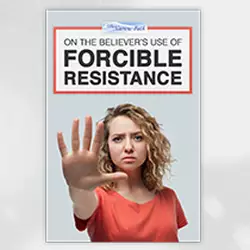
Question from a pastor: In light of Christ’s command to “turn the other cheek” and to “not resist the evil man”, is it inappropriate for believers to contemplate or exercise physical force in defense of our families against criminal aggressors? Over the course of more than three decades, I have weighed the biblical testimony concerning this topic and related questions and cannot claim even now to have the final and definitive answer for every situation. Individual commands of Scripture teach us how these principles are expressed in various life decisions, but in the absence of specific commands we must proceed upon principle, and the commands that do exist should be interpreted in the light of such principles. Download the eBook to read more!

Featured Offer
Question from a pastor: In light of Christ’s command to “turn the other cheek” and to “not resist the evil man”, is it inappropriate for believers to contemplate or exercise physical force in defense of our families against criminal aggressors? Over the course of more than three decades, I have weighed the biblical testimony concerning this topic and related questions and cannot claim even now to have the final and definitive answer for every situation. Individual commands of Scripture teach us how these principles are expressed in various life decisions, but in the absence of specific commands we must proceed upon principle, and the commands that do exist should be interpreted in the light of such principles. Download the eBook to read more!
About The Narrow Path
The Narrow Path is Steve's teaching ministry primarily to Christians. In part, it is a one-hour, call-in radio show. Christians call in with questions about what the Bible says on many topics and how certain passages can or cannot be interpreted. Occasionally, an atheist or agnostic or one of another faith calls in to inquire or raise objections. Steve takes all calls, including objections to what he has presented. It is an open forum with polite, respectful discussions. The object is for the host and the audience to learn together.
The ministry also has a website, a Bible-discussion forum, a Call-of-the-Week video, a YouTube channel, and a Facebook page. These contain Steve's verse-be-verse teachings through the entire Bible, topical lectures and articles, friendly debates with folks of other opinions, and much more. Please explore these hundreds of resources. They are all valuable, but they are all FREE. We have nothing to sell. "Freely you have received, freely give."
Steve is also available to teach and answer questions at church and home meetings. He has taught on every continent. If you would like to have him speak in your area, just organize a group, a place, and propose a date, or several, and e-mail Steve@TheNarrowPath.com.
The Narrow Path exists through the gifts of donors who appreciate these resources. We have no corporate sponsors and run no commercials on the radio or ads on the website. If you are blessed by these resources, we ask that you first pray for us, then tell your family and friends, then consider donating to help us stay "on the air". God faithfully provides through listeners.
About Steve Gregg
When asked a question about a passage, Steve usually lists its several interpretations, gives the reasoning behind each, cross-examines each, and then tells his own conclusions and reasons. He tries to teach how to read and reason about the Bible, not what to think. Education, not indoctrination.
Steve has learned on his own. He did not attend a seminary or Bible college, but he was awarded a Ph.D. for his work by Trinity College of the Bible and Theological Seminary in Evansville, Indiana. He is the author of two books:
(1) All You Want to Know about Hell: Three Christian Views of God's Final Solution to the Problem of Sin
(2) Revelation: Four Views, Revised & Updated
Contact The Narrow Path with Steve Gregg
Steve@TheNarrowPath.com
The Narrow Path
P.O. Box 1730
Temecula, CA 92593
844-484-5737 2-3 PM Pacific Time